
 English
 Español
 中文
中文 हिन्दी
 Français
On this page
Overview
Connecticut is the southernmost state of New England, bordered by Massachusetts to the north, Rhode Island to the east, New York to the west, and Long Island Sound to the south. With roughly 3.62 million residents in just 5,543 square miles, it is the third-smallest state by area, the 29th most populous, and the fourth-most densely populated.
The name “Connecticut” comes from the Algonquian word Quinnehtukqut, meaning “beside the long tidal river” — a reference to the Connecticut River, which bisects the state from north to south. Connecticut was one of the original thirteen colonies and ratified the U.S. Constitution on January 9, 1788, becoming the fifth state.
Connecticut’s economy is one of the most productive in the country per capita. It is anchored by finance and insurance (Hartford has long been known as the “Insurance Capital of the World”), advanced manufacturing — particularly submarines, jet engines, and helicopters — and a major life-sciences and biotech sector concentrated near Yale University in New Haven.
Geography & Climate
Connecticut is divided by the Connecticut River, which flows from north to south through the central lowlands. To the west of the river rise the rolling Western Highlands, an extension of the Berkshire and Taconic ranges that contain the state’s highest point, Bear Mountain (2,316 feet). The Eastern Highlands occupy the eastern third of the state, with lower hills, forests, and stone walls marking former farmland.
The southern coast along Long Island Sound is heavily populated and indented by harbors and tidal marshes; Connecticut’s shoreline is one of the most densely developed in the country. The state’s landscape was shaped by glaciers, leaving rocky soils, kettle ponds, and erratic boulders.
Despite its small size, Connecticut is unusually wooded: more than 60 percent of the state is forested. Major rivers include the Connecticut, Housatonic, Thames, and Quinnipiac. The state has a humid continental climate with four distinct seasons, including snowy winters and warm summers tempered by sea breezes along the coast.
History
For thousands of years before European contact, Connecticut was home to Algonquian-speaking peoples — most prominently the Pequot, Mohegan, Mattabesett, and Quinnipiac. Adriaen Block, a Dutch explorer, sailed up the Connecticut River in 1614, but it was English Puritans from the Massachusetts Bay Colony who established the first permanent European settlements at Windsor, Wethersfield, and Hartford in the mid-1630s.
In 1639, those three towns adopted the Fundamental Orders of Connecticut, often described as the first written constitution in Western history to create a government — earning Connecticut its nickname “The Constitution State.” The colony received a royal charter in 1662 with unusually generous self-governance provisions.
Connecticut played a significant role in the American Revolution, supplying so many provisions to the Continental Army that George Washington called it the “Provisions State.” Connecticut ratified the U.S. Constitution on January 9, 1788, becoming the fifth state.
In the 19th century, Connecticut became a cradle of American manufacturing. Eli Whitney pioneered interchangeable parts at his New Haven musket factory; Samuel Colt revolutionized firearms manufacturing in Hartford. The state also produced clocks, sewing machines, tools, brass goods, and rubber products that defined the American industrial age.
Economy
Connecticut’s economy is highly diversified, with leading roles in finance and insurance, advanced manufacturing, biopharmaceuticals, and higher education. Its per-capita personal income consistently ranks among the highest in the United States.
- Finance and insurance: Hartford has long been called the “Insurance Capital of the World,” headquartering The Hartford, Travelers, Aetna, and many others. Fairfield County is home to hedge funds and private-equity firms tied to Greater New York City.
- Defense and advanced manufacturing: Electric Boat in Groton builds the U.S. Navy’s nuclear submarines. Pratt & Whitney (East Hartford) builds jet engines for commercial and military aircraft, and Sikorsky (Stratford) builds the Army’s Black Hawk helicopters.
- Biotech and life sciences: The Yale–New Haven biotech corridor includes Alexion Pharmaceuticals, Bristol Myers Squibb (research), and a dense network of biotech start-ups. The Jackson Laboratory operates a major genomics campus at Farmington.
- Higher education: Yale University in New Haven is one of the world’s leading research universities. The University of Connecticut, Wesleyan, Trinity, and Connecticut College are also major employers and cultural anchors.
- Tourism and gaming: Mystic Seaport, the Litchfield Hills, Long Island Sound shoreline, and two of the largest casinos in the Western Hemisphere — Foxwoods and Mohegan Sun — drive an extensive hospitality industry.
Government
Connecticut operates under its 1965 constitution, the latest of several state constitutions. The General Assembly is bicameral, with a 36-member Senate and a 151-member House of Representatives. Legislators serve two-year terms; the Governor and other constitutional officers serve four-year terms.
Connecticut is one of a small number of states with no county-level government — all governing power is divided between the state and 169 cities and towns. Each town typically operates under a board of selectmen and a town meeting form of government, although larger cities have mayors and councils.
Connecticut has five seats in the U.S. House of Representatives and two U.S. Senators. The Connecticut Supreme Court has seven justices appointed by the Governor and confirmed by the General Assembly. The state capital is Hartford, while New Haven is the largest population center after the merger-era growth of Bridgeport.
Culture
Connecticut culture combines deep Yankee heritage with affluent commuter suburbs and a rich academic tradition. The colonial towns of New England — Litchfield, Wethersfield, Old Lyme — are among the most carefully preserved in the country. Wood-frame churches with white steeples, town greens, and stone walls define the rural landscape.
New Haven is a major cultural center, anchored by Yale University and famous as the home of American pizza. The “apizza” of Frank Pepe’s and Sally’s on Wooster Street is considered by many critics to be the best in the country. New Haven has also produced Hollywood-bound theater (Yale Repertory, Long Wharf) and a major jazz tradition.
The Connecticut shoreline supports a strong maritime culture, with Mystic Seaport — the country’s leading maritime museum — preserving 19th-century shipbuilding, whaling, and fishing heritage. The Litchfield Hills draw weekend visitors from New York City to second homes and antique shops.
Notable Cities
- Bridgeport — Largest city in Connecticut, on Long Island Sound. A 19th-century manufacturing center and home of P.T. Barnum, today undergoing redevelopment with a growing arts and waterfront scene.
- Hartford — State capital and historic “Insurance Capital of the World.” Home of the Mark Twain House, the Wadsworth Atheneum (the oldest public art museum in the United States), and the State Capitol.
- New Haven — Home of Yale University and a major medical and biotechnology hub. Often called the birthplace of American pizza (“apizza”), with a thriving arts and dining scene.
- Stamford — Major corporate hub in Fairfield County, headquarters to many large firms and a high-rise skyline that rivals downtown Hartford. A fast-growing edge city for the New York metropolitan area.
- Mystic — Coastal village famous for Mystic Seaport, the leading maritime museum in the United States, and Mystic Aquarium. A premier summer tourism destination on the Connecticut shoreline.
State Symbols
Connecticut’s official state symbols, designated by the General Assembly, reflect the state’s colonial heritage, maritime history, and natural landscape.
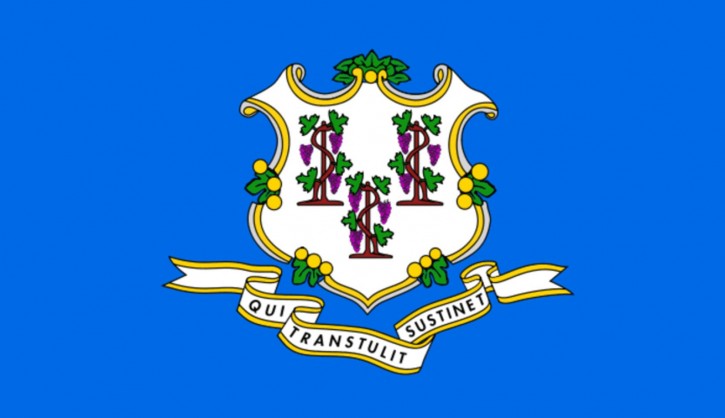
State Flag
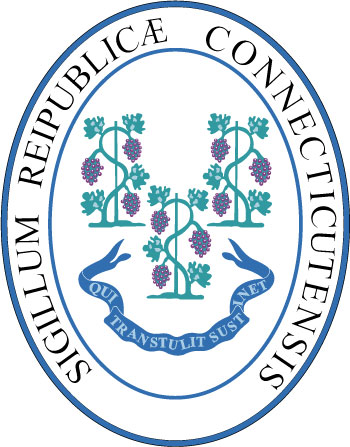
Great Seal
Nickname
The Constitution State
Motto
Qui Transtulit Sustinet (“He who transplanted still sustains”)
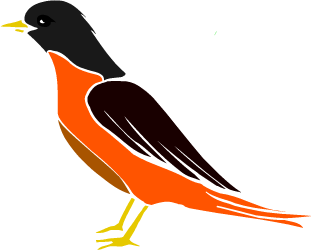
Bird
American Robin

Flower
Mountain Laurel
Tree
White Oak (the Charter Oak)
Animal
Sperm Whale
Insect
European Mantis
Fish
American Shad
Shellfish
Eastern Oyster
Mineral
Garnet
Fossil
Eubrontes giganteus (dinosaur track)
Song
“Yankee Doodle”