
 English
 Español
 中文
中文 हिन्दी
 Français
On this page
Overview
Delaware is a Mid-Atlantic state on the eastern seaboard of the United States, bordered by Pennsylvania to the north, New Jersey across the Delaware River and Bay to the east, Maryland to the south and west, and the Atlantic Ocean to the southeast. With roughly 1.03 million residents in just 1,949 square miles, it is the second-smallest state by area and the sixth-smallest by population, but the seventh-most densely populated.
Delaware earned its nickname “The First State” by ratifying the U.S. Constitution on December 7, 1787 — the first of the thirteen original colonies to do so. The state takes its name from Thomas West, 3rd Baron De La Warr, the first colonial governor of Virginia, after whom the Delaware River was named.
Despite its small size, Delaware exerts an outsized influence on American commerce. More than two-thirds of all Fortune 500 companies are legally incorporated in Delaware because of its specialized Court of Chancery and favorable corporate law. The state economy is also anchored by banking, chemical manufacturing (DuPont’s historic home), pharmaceuticals, and a major beach-tourism corridor.
Geography & Climate
Delaware is divided into three counties — New Castle, Kent, and Sussex — corresponding roughly to the three regions of the state. The northern tip lies within the Piedmont, a hilly, hardwood-forested region where the state’s only elevations of any consequence are found; Delaware’s high point, Ebright Azimuth at 448 feet, is the lowest high point of any state.
The remainder of Delaware lies entirely on the Atlantic Coastal Plain, a flat lowland that tilts gently toward the Atlantic. The Delaware River and Delaware Bay form the eastern boundary; the Atlantic shoreline includes Cape Henlopen, Rehoboth Beach, Bethany Beach, and the Indian River Inlet. The famous twelve-mile-radius “arc” forming the northern boundary with Pennsylvania is unique among U.S. state borders.
The state’s climate is humid subtropical in the south and humid continental in the north. The Coastal Plain contains fertile soils, pine forests, the freshwater wetlands of the Great Cypress Swamp, and tidal marshes that support a major migratory bird flyway along the Delaware Bay shore.
History
Before European contact, the Lenape (Delaware) people inhabited the region. Henry Hudson explored the Delaware Bay in 1609 under the Dutch flag, and the first European settlement was established by the Dutch at Zwaanendael (modern Lewes) in 1631. Swedish colonists founded New Sweden along the Delaware River in 1638, building Fort Christina at present-day Wilmington — the first permanent European settlement in the region.
The Dutch reclaimed the colony in 1655, the English took it in 1664, and it was eventually granted to William Penn in 1682 as the “Three Lower Counties on the Delaware.” Delaware separated administratively from Pennsylvania in 1704 and operated as a distinct colony with its own legislature, although the two shared a governor until 1776.
Delaware was the first state to ratify the U.S. Constitution on December 7, 1787 — five days before Pennsylvania — earning the official nickname “The First State.” The state remained loyal to the Union during the Civil War despite being a slave state.
The 19th and 20th centuries were defined by industrialization along the Brandywine and Christina Rivers, anchored by the DuPont Company — founded in 1802 as a gunpowder mill and grown into a global chemical and materials giant. In the late 20th century, Delaware became a major credit-card and banking center after passing the 1981 Financial Center Development Act.
Economy
Delaware’s economy is unusually concentrated in financial services, corporate law, chemicals and pharmaceuticals, and agriculture — particularly poultry. Per-capita income is among the highest in the country.
- Corporate law and finance: More than two-thirds of Fortune 500 companies and about 1.8 million businesses are legally domiciled in Delaware. The state’s specialized Court of Chancery is the most influential business court in the United States. Delaware is also a major credit-card and banking center, with operations of JPMorgan Chase, Bank of America, M&T Bank, and Citi.
- Chemicals and pharmaceuticals: DuPont was founded in 1802 in Wilmington and remains a major presence, alongside its spinoffs Chemours and Corteva. AstraZeneca operates a major U.S. site in Fairfax, and Incyte is based in Alapocas.
- Agriculture: Despite its small size, Delaware is a leading per-acre agricultural producer. Sussex County is the largest broiler-chicken-producing county in the United States, anchored by Mountaire and Perdue. Soybeans, corn, and dairy round out the agricultural sector.
- Manufacturing: The historic auto-assembly heritage at Newark and New Castle has given way to advanced materials, plastics, and food processing. Schweiger and Sussex County’s poultry-processing plants employ thousands.
- Tourism: The Delaware Beaches — Rehoboth, Bethany, Dewey, Lewes, and Fenwick Island — draw millions of summer visitors. Tax-free shopping, Cape Henlopen State Park, and the historic du Pont estates (Winterthur, Nemours, Longwood Gardens in nearby Pennsylvania) round out the state’s tourism offer.
Government
Delaware operates under its fourth and current constitution, adopted in 1897. The General Assembly is bicameral, with a 21-member Senate and a 41-member House of Representatives. Senators serve four-year terms and representatives two-year terms.
The Governor of Delaware serves a four-year term and may serve a maximum of two terms (consecutive or not). Other statewide elected officials include the Lieutenant Governor, Attorney General, Treasurer, Auditor, and Insurance Commissioner. Delaware is unusual in that it has never adopted a citizen-initiative process for ballot measures.
Delaware has a single at-large seat in the U.S. House of Representatives and two U.S. Senators. The state’s courts — particularly the Court of Chancery, which handles corporate-law disputes without juries — have nationwide reach. The state capital is Dover; the largest city is Wilmington.
Culture
Delaware culture sits at the intersection of the Mid-Atlantic and the South. Wilmington’s art scene, anchored by the Delaware Art Museum and the Grand Opera House, reflects the state’s urban Northeast character; the southern counties retain strong farming, hunting, and beach-town traditions.
The Delaware Beaches have been a leading East Coast summer destination since the late 19th century. Rehoboth Beach in particular is known as “the Nation’s Summer Capital” for its long-standing popularity among Washington, D.C. residents — including presidents, members of Congress, and federal workers.
Wilmington is a notable cultural and political center. The du Pont family endowed several remarkable estates open to the public, including Winterthur (Henry Francis du Pont’s American decorative-arts museum) and Nemours. Delaware was the home of the 46th President of the United States, Joe Biden, who lived in Greenville and commuted by Amtrak to the Senate for decades.
Notable Cities
- Wilmington — Largest city, on the Christina River near its confluence with the Delaware. A national financial center and historic chemical-industry hub. Home to the Delaware Art Museum, the Grand Opera House, and Frawley Stadium.
- Dover — State capital, in central Kent County. Home of Dover Air Force Base, the Dover International Speedway, and Delaware State University. The Old State House and Legislative Hall anchor the historic district.
- Newark — Home of the University of Delaware, the state’s flagship public university. A historic Revolutionary War town and the site of the only Revolutionary battle fought in Delaware (Cooch’s Bridge, 1777).
- Rehoboth Beach — Premier Delaware beach resort on the Atlantic, long known as “the Nation’s Summer Capital.” A walkable boardwalk town with award-winning restaurants and tax-free outlet shopping.
- Lewes — Historic coastal town at the mouth of Delaware Bay, founded by the Dutch in 1631. Site of the Cape May–Lewes Ferry and Cape Henlopen State Park.
State Symbols
Delaware’s official state symbols, designated by the General Assembly, reflect the state’s revolutionary heritage, agricultural strength, and coastal landscape.
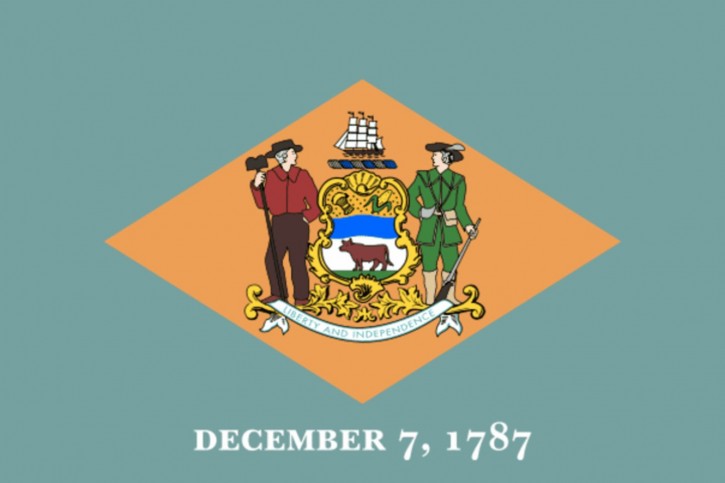
State Flag
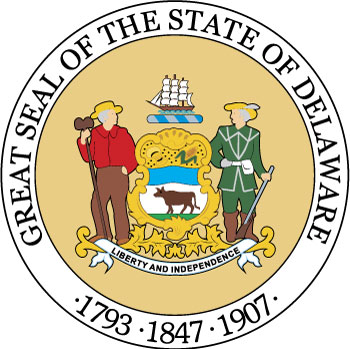
Great Seal
Nickname
The First State
Motto
Liberty and Independence
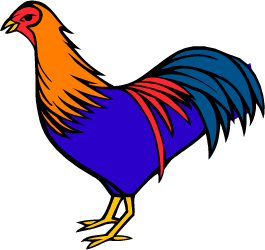
Bird
Blue Hen Chicken
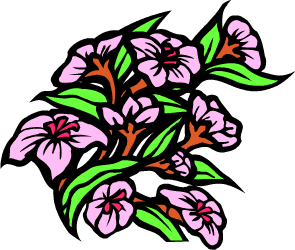
Flower
Peach Blossom
Tree
American Holly
Fish
Weakfish (Sea Trout)
Insect
Ladybug
Butterfly
Tiger Swallowtail
Marine Animal
Horseshoe Crab
Mineral
Sillimanite
Beverage
Milk
Song
“Our Delaware”