
 English
 Español
 中文
中文 हिन्दी
 Français
On this page
Overview
Georgia is a state in the southeastern United States, bordered by Tennessee and North Carolina to the north, South Carolina and the Atlantic Ocean to the east, Florida to the south, and Alabama to the west. With roughly 11.0 million residents across 59,425 square miles, it is the eighth-most populous state and the 24th largest by area.
Georgia was one of the original thirteen British colonies, founded in 1733 by James Oglethorpe as a refuge for English debtors and an Anglican buffer against Spanish Florida. The state ratified the U.S. Constitution on January 2, 1788, becoming the fourth state, and is named for King George II of Great Britain.
Today Georgia is one of the most economically dynamic states in the South. Atlanta is the state capital, the busiest air gateway in the world, and the corporate home of Coca-Cola, Home Depot, Delta Air Lines, UPS, CNN, and many others. Georgia also leads U.S. peanut, pecan, and broiler-chicken production, and serves as one of the country’s most active film and television production centers.
Geography & Climate
Georgia spans five geographic regions. The Blue Ridge Mountains in the far north contain Brasstown Bald, the state’s highest point at 4,784 feet. South of the Blue Ridge, the Ridge and Valley and Appalachian Plateau regions extend into the state’s northwest corner. The Piedmont, a rolling region of red clay soils and hardwood forests, covers central Georgia and contains the Atlanta metropolitan area.
South of the Piedmont, the Fall Line marks the boundary with the Coastal Plain, a flat lowland that occupies the southern three-fifths of the state. The Coastal Plain includes the vast Okefenokee Swamp on the Florida border and the agriculturally productive South Georgia plain. Along the Atlantic coast, the Sea Islands — barrier islands such as Cumberland, St. Simons, Jekyll, and Tybee — feature live oaks, salt marshes, and historic resort communities.
Major rivers include the Chattahoochee, Savannah, Flint, Oconee, and Altamaha. Georgia’s climate is humid subtropical, with hot, humid summers and mild winters in most of the state, transitioning to a slightly cooler humid continental climate in the northern mountains. The state lies on the western edge of the Atlantic hurricane belt and is occasionally affected by tropical storms.
History
Before European contact, Georgia was inhabited primarily by the Cherokee in the north and the Creek (Muscogee) in the south. Spanish missions reached the coast in the 1500s, but the British founded the colony of Georgia in 1733 when James Oglethorpe landed at present-day Savannah. Georgia was the youngest and southernmost of the thirteen colonies.
Georgia ratified the U.S. Constitution on January 2, 1788, becoming the fourth state. The 1828–1838 Indian removals — including the infamous Trail of Tears suffered by the Cherokee — opened up north Georgia to white settlement and gold mining. The state seceded from the Union in 1861 and was devastated by the Civil War, particularly William T. Sherman’s 1864 March to the Sea.
The Reconstruction era and the long Jim Crow period that followed made Georgia central to twentieth-century African-American history. Atlanta, the birthplace of Martin Luther King Jr., became a national center of the civil-rights movement, with the Southern Christian Leadership Conference, Ebenezer Baptist Church, and the Atlanta Student Movement at its core.
Post-war Atlanta’s rise into a banking, broadcasting, and aviation capital — capped by hosting the 1996 Summer Olympics — transformed the state. Georgia also became a global hub for film and television production after passage of generous state tax credits in 2008, hosting major Marvel, AMC, and Netflix productions.
Economy
Georgia hosts one of the largest and most diversified economies in the southeastern United States, with anchor sectors in logistics, agriculture, manufacturing, finance, film and television, and information technology.
- Logistics and aviation: Hartsfield–Jackson Atlanta International Airport is the world’s busiest passenger airport. The Port of Savannah is the second-largest container port on the U.S. East Coast. UPS, Delta Air Lines, and major rail carriers anchor the state’s logistics dominance.
- Agriculture: Georgia is the nation’s top producer of peanuts, pecans, and broiler chickens, and a major producer of peaches, blueberries, cotton, onions (Vidalia), and watermelon. Poultry alone is a $20+ billion industry.
- Manufacturing: Kia Motors’ U.S. assembly plant operates in West Point, Hyundai is building a major EV plant near Savannah, and SK Battery America operates in Commerce. Georgia hosts major Lockheed Martin and Gulfstream Aerospace facilities, and produces 75 percent of the chenille and 80 percent of the carpet manufactured in the United States (around Dalton).
- Film and television: Georgia became the third-largest film and television production hub in the world after passing the Entertainment Industry Investment Act in 2008. Marvel Studios, AMC, Tyler Perry Studios, Pinewood, and Trilith Studios all operate major facilities in the Atlanta area.
- Finance and corporate headquarters: Atlanta is home to the headquarters of Coca-Cola, Home Depot, UPS, Delta Air Lines, Aflac (Columbus), Truist Financial, NCR, and CNN. The city is one of the largest banking centers in the U.S. South.
Government
Georgia operates under its 1983 constitution, the tenth in its history. The Georgia General Assembly is bicameral, with a 56-member Senate and a 180-member House of Representatives. Legislators serve two-year terms with no term limits.
The Governor of Georgia serves a four-year term and may serve a maximum of two consecutive terms. The state also elects a Lieutenant Governor, Attorney General, Secretary of State, and a Commissioner of Agriculture, among other constitutional officers.
Georgia has 14 seats in the U.S. House of Representatives plus two U.S. Senators. The Supreme Court of Georgia has nine justices serving six-year terms. The state capital is Atlanta.
Culture
Georgia culture is shaped by deep African-American heritage, Southern hospitality, Appalachian traditions in the north, and a fast-growing population of internal and international migrants. Atlanta is the cultural and economic center of the Black South, often described as a “Black Mecca” for its leading historically Black universities and the cradle of the civil-rights movement.
Music is central to Georgia’s identity. The state has produced Ray Charles, James Brown, Otis Redding, Little Richard, REM, the B-52s, OutKast, Usher, Gladys Knight, and many more. Macon and Athens are deeply musical cities; the Allman Brothers and the rebirth of college rock both started here.
Georgia foodways combine deep Southern traditions — barbecue, fried chicken, biscuits, peach desserts — with Lowcountry coastal cuisine in Savannah and the Sea Islands and a fast-evolving global food scene in Atlanta. The state also hosts the Masters Tournament in Augusta — the most famous event in golf.
Notable Cities
- Atlanta — State capital, largest city, and the most important commercial center of the U.S. South. Home of Hartsfield–Jackson International Airport, the Atlanta Braves, the Coca-Cola headquarters, the Martin Luther King Jr. National Historical Park, and a metropolitan area of roughly 6.3 million.
- Augusta — Second-largest city, on the Savannah River. Home of the Augusta National Golf Club and the Masters Tournament, as well as Fort Eisenhower (formerly Fort Gordon) and a substantial U.S. Army Cyber Command presence.
- Savannah — Historic port city, founded in 1733 as the first European settlement in Georgia. Famous for its preserved colonial squares, antebellum architecture, Savannah College of Art and Design, and the second-largest container port on the East Coast.
- Columbus — Third-largest city, on the Chattahoochee River bordering Alabama. Home of Fort Moore (formerly Fort Benning) — one of the largest U.S. Army installations — and the headquarters of Aflac and Synovus Financial.
- Athens — College town and home of the University of Georgia, the flagship public university founded in 1785. A legendary music city — birthplace of REM, the B-52s, Widespread Panic, and Drive-By Truckers.
State Symbols
Georgia’s official state symbols, designated by the General Assembly, celebrate the agricultural heritage, coastal landscape, and unique natural history of the Peach State.
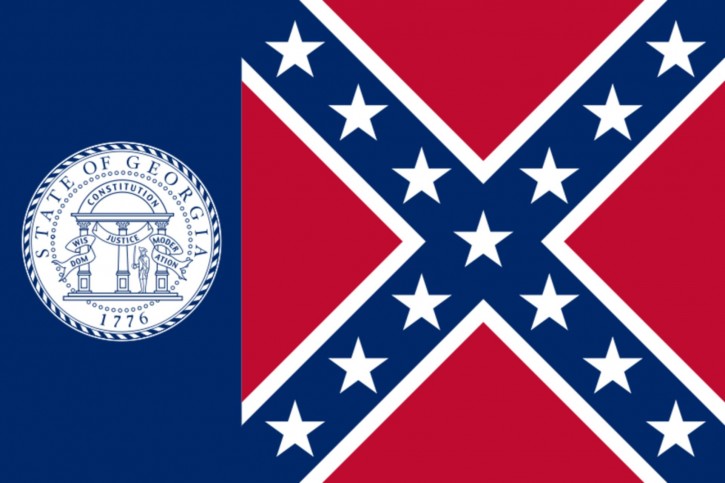
State Flag
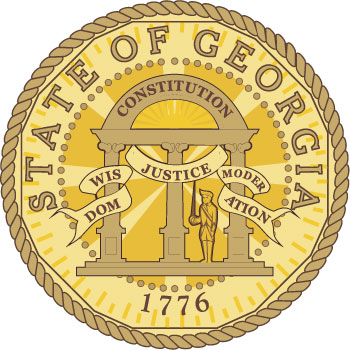
Great Seal
Nickname
The Peach State
Motto
Wisdom, Justice, Moderation
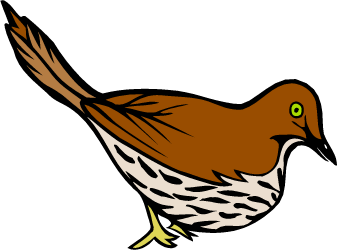
Bird
Brown Thrasher

Flower
Cherokee Rose
Tree
Live Oak
Mammal
White-tailed Deer
Marine Mammal
North Atlantic Right Whale
Fish
Largemouth Bass
Reptile
Gopher Tortoise
Butterfly
Tiger Swallowtail
Insect
Honeybee
Song
“Georgia on My Mind”