
 English
 Español
 中文
中文 हिन्दी
 Français
On this page
Overview
Idaho is a state in the Pacific Northwest region of the United States, bordered by Montana and Wyoming to the east, Utah and Nevada to the south, Oregon and Washington to the west, and the Canadian province of British Columbia to the north. With roughly 2.0 million residents across 83,569 square miles, it is the 38th-most populous state and the 14th largest by area, and one of the fastest-growing states in the nation.
Idaho is a deeply mountainous state, containing more designated wilderness than any state outside Alaska. The Rocky Mountains cover most of the state, while the Snake River Plain — an arc of fertile volcanic soil across the south — is the agricultural and population heartland. Boise, the state capital and largest city, anchors the rapidly growing Treasure Valley metropolitan area in the southwest.
Admitted as the 43rd state on July 3, 1890, Idaho is celebrated as the "Gem State" for the unusual diversity of gemstones found within its borders, including the rare star garnet that occurs in commercial quantities almost nowhere else on Earth. Idaho is best known nationally for its potatoes — long the dominant U.S. producing state — and for a rapidly diversifying economy in technology, advanced manufacturing, and outdoor recreation.
Geography & Climate
Idaho is divided into three broad regions. The Idaho Panhandle in the north is a narrow strip dominated by lakes, dense forests, and the northern Rockies. Central Idaho contains the rugged Sawtooth, Salmon River, and Clearwater Mountains, along with the Frank Church–River of No Return Wilderness — at over 2.3 million acres, the largest contiguous wilderness in the lower 48 states. Southern Idaho is dominated by the Snake River Plain, a vast arc of volcanic-origin lowland that is the agricultural heart of the state.
Borah Peak, in the Lost River Range, is Idaho’s highest point at 12,662 feet. Hells Canyon, on the Oregon border along the Snake River, is the deepest river gorge in North America at 7,993 feet. Major rivers include the Snake, Salmon, Clearwater, Boise, and Payette. Shoshone Falls on the Snake, taller than Niagara, is often called the "Niagara of the West."
The climate ranges from a relatively wet, mild marine-influenced regime in the Panhandle to a high-desert continental climate across most of the south, with cold winters and hot, dry summers. Snowpack in the mountains feeds the rivers that irrigate the Snake River Plain and generate hydropower, which provides the majority of the state’s electricity. Idaho contains substantial portions of Yellowstone National Park as well as Craters of the Moon National Monument and Nez Perce National Historical Park.
History
Idaho has been continuously inhabited for at least 14,500 years, and is one of the oldest archaeologically documented regions in the Americas. At the time of European contact, the territory was home to the Nez Perce, Coeur d’Alene, Shoshone, Bannock, Kootenai, Northern Paiute, and other peoples. The Lewis and Clark Expedition reached present-day Idaho in 1805, becoming the first U.S. citizens to cross the Bitterroot Mountains.
The 1860s gold strikes — beginning at Pierce in 1860 and exploding through the Boise Basin and the Coeur d’Alene Mountains — drew tens of thousands of miners and created the framework for Idaho Territory, which was established on March 4, 1863. The Nez Perce War of 1877, including Chief Joseph’s celebrated retreat through Idaho and Montana, marked one of the final and most poignant resistance campaigns of the Plains and Plateau Indian Wars.
Latter-day Saint settlers from Utah established the first permanent non-Indigenous community in present-day Idaho at Franklin in 1860 and continued to populate the eastern Snake River Plain for decades. Idaho gained statehood as the 43rd state on July 3, 1890. The early twentieth century brought massive federal irrigation projects, including Arrowrock Dam — the world’s highest dam when completed in 1915 — that opened the Snake River Plain to large-scale potato and sugar-beet agriculture.
World War II and the postwar nuclear age transformed Idaho. The Idaho National Laboratory on the eastern Snake River Plain hosted the first electricity generated by nuclear power in 1951 and remains a leading U.S. nuclear-energy research center. Since 2000, the Treasure Valley around Boise has emerged as a major destination for technology firms and refugees from California housing costs, making Idaho one of the fastest-growing states in the country.
Economy
Idaho hosts one of the most rapidly growing economies in the United States, with anchor sectors in agriculture, semiconductor and technology manufacturing, forestry and mining, and an increasingly important tourism and outdoor-recreation industry.
- Agriculture and food processing: Idaho is the nation’s leading producer of potatoes, supplying roughly one-third of U.S. output. The state is also a top-five producer of barley, dairy, sugar beets, hops, peppermint oil, and trout. Major food-processing firms include J.R. Simplot (founded in Idaho and a longtime supplier to McDonald’s), Lamb Weston, and Chobani, whose Twin Falls plant is the world’s largest yogurt facility.
- Technology and semiconductors: Boise-based Micron Technology is one of the world’s largest memory-chip manufacturers and the only U.S.-headquartered producer of DRAM. Hewlett-Packard operates one of its largest printing-research and manufacturing complexes in Boise. The Treasure Valley has become a regional technology hub.
- Forestry and mining: Idaho ranks among the top U.S. lumber producers, and the Silver Valley around Coeur d’Alene historically produced more silver than any other district in the world. Idaho is also a leading producer of phosphate (used in fertilizer) and the only U.S. source of commercial star garnets.
- Tourism and outdoor recreation: Sun Valley, the United States’ first destination ski resort, opened in 1936 and remains an international destination. Outdoor recreation — including rafting, fly fishing, hunting, hiking, and skiing — drives a multi-billion-dollar industry across the state. Yellowstone’s western and southern reaches lie within Idaho.
- Energy: Hydropower from the Snake River and its tributaries supplies the majority of Idaho’s electricity, giving the state some of the lowest power rates in the country. The Idaho National Laboratory is a leading U.S. center for advanced nuclear-reactor research.
Government
Idaho operates under its original 1890 constitution, the only U.S. state constitution still in its founding form. The Idaho Legislature is bicameral, with a 35-member Senate and a 70-member House of Representatives. Legislators serve two-year terms with no term limits.
The Governor of Idaho serves a four-year term without statutory limit, though tradition strongly favors a maximum of two terms. The state also elects a Lieutenant Governor, Attorney General, Secretary of State, Controller, Treasurer, and Superintendent of Public Instruction. Idaho has one of the strongest direct-democracy systems in the country, with initiative, referendum, and recall available.
Idaho has two seats in the U.S. House of Representatives plus two U.S. Senators. The Idaho Supreme Court has five justices elected on nonpartisan ballots for six-year terms. The state capital is Boise.
Culture
Idaho culture is shaped by the rugged Western and mining heritage of the central mountains, the strong Latter-day Saint communities of the eastern Snake River Plain, and a deep tradition of outdoor recreation that defines daily life across the state. The Nez Perce, Shoshone-Bannock, Coeur d’Alene, Kootenai, and Shoshone-Paiute tribes maintain sovereign reservations and remain active stewards of cultural heritage, fisheries, and lands.
Boise is home to the largest Basque community in the United States, descended from Pyrenean sheepherders who immigrated in the late nineteenth and early twentieth centuries. The Basque Block in downtown Boise, the Basque Museum, and the Jaialdi cultural festival are unique in North America. The state also has a sizeable refugee community settled around Boise, particularly from former Yugoslavia, Iraq, and several African countries.
Sun Valley, the Sawtooth Mountains, and the Salmon and Snake river corridors have long drawn artists, writers, and conservationists. Ernest Hemingway is buried in Ketchum. The Coeur d’Alene region in the Panhandle and the Boise foothills have grown into year-round outdoor-recreation destinations, and the Idaho Shakespeare Festival in Boise is among the leading regional theater festivals in the country.
Notable Cities
- Boise — State capital, largest city, and economic center, with a population of roughly 240,000 in the city and over 800,000 in the Treasure Valley metropolitan area. Home to Boise State University, the Idaho State Capitol, the Basque Block, and headquarters of Micron Technology and Albertsons.
- Meridian — Second-largest city, immediately west of Boise in the Treasure Valley. The fastest-growing major city in Idaho, with a population of roughly 135,000 and a strong concentration of technology, healthcare, and retail employment.
- Nampa — Third-largest city, also in the Treasure Valley. Home to Northwest Nazarene University, the Ford Idaho Center, and major food-processing and agricultural-services industries.
- Idaho Falls — Largest city in eastern Idaho, on the Snake River. Headquarters of the Idaho National Laboratory, the largest employer in eastern Idaho, and a regional service center for the surrounding agricultural and nuclear-research economy.
- Coeur d’Alene — Largest city in the Idaho Panhandle, on the shore of Lake Coeur d’Alene. A major resort destination and the regional commercial center of northern Idaho, with year-round tourism centered on the lake and surrounding national forests.
State Symbols
Idaho’s official state symbols, designated by the Idaho Legislature, celebrate the rugged mountain landscape, mining heritage, agricultural wealth, and natural history of the Gem State.
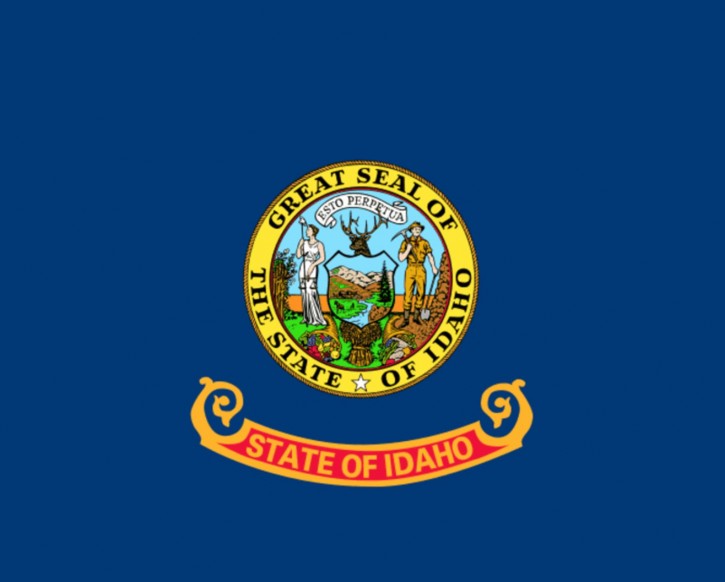
State Flag
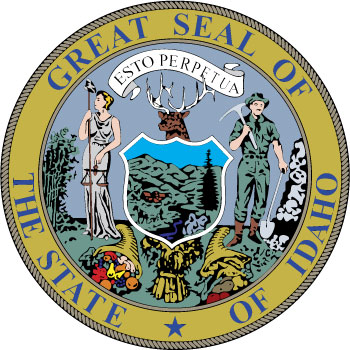
Great Seal
Nickname
The Gem State
Motto
Esto Perpetua ("Let it be perpetual")
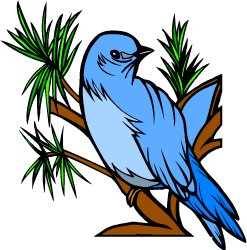
Bird
Mountain Bluebird

Flower
Syringa (Mock Orange)
Tree
Western White Pine
Horse
Appaloosa
Fish
Cutthroat Trout
Raptor
Peregrine Falcon
Gem
Star Garnet
Fruit
Huckleberry
Vegetable
Potato
Song
"Here We Have Idaho"