
 English
 Español
 中文
中文 हिन्दी
 Français
On this page
Overview
Illinois is a state in the Midwestern United States, bordered by Wisconsin to the north, Lake Michigan to the northeast, Indiana to the east, Kentucky across the Ohio River to the south, Missouri across the Mississippi River to the west, and Iowa across the upper Mississippi to the northwest. With roughly 12.5 million residents across 57,914 square miles, it is the sixth-most populous state and the 25th largest by area.
Illinois entered the Union as the 21st state on December 3, 1818. The state takes its name from the Illinois River and the Illiniwek (Illinois) Confederation, an Algonquian-speaking alliance of Indigenous peoples. Springfield, in the central prairie, is the state capital. Chicago, on Lake Michigan in the northeast, is the largest city, the third-largest in the United States, and the cultural and economic heart of the Midwest.
Illinois is often described as a microcosm of the United States. Heavily urban metropolitan Chicago anchors the north; productive corn-and-soybean farmland fills the central prairies; and culturally Southern small towns lie in "Little Egypt" at the state’s southern tip. The state has produced four U.S. presidents — Abraham Lincoln, Ulysses S. Grant, Ronald Reagan, and Barack Obama — and remains a cornerstone of American agriculture, finance, transportation, and manufacturing.
Geography & Climate
Illinois is almost entirely a low, gently rolling glacial plain. Most of the state was scraped flat by Pleistocene ice sheets, which deposited thick, fertile soils that make Illinois one of the most agriculturally productive regions on Earth. The state’s lowest point lies at the confluence of the Mississippi and Ohio rivers near Cairo at 279 feet; its highest, Charles Mound in the unglaciated Driftless Area of the far northwest, reaches only 1,235 feet.
Illinois has more interior river miles than any other state — over 870 miles of navigable waterway. The Mississippi forms the western boundary, the Wabash and Ohio form much of the east and south, and the Illinois River, draining from Lake Michigan through Chicago, cuts diagonally across the state to join the Mississippi above St. Louis. The Chicago River was famously reversed in 1900 to send the city’s sewage away from Lake Michigan.
The climate is humid continental in the north and humid subtropical in the south, with cold, snowy winters along Lake Michigan and longer, hotter summers downstate. Illinois sits in the heart of Tornado Alley’s eastern flank and experiences frequent severe weather. The far southwest, in the Shawnee Hills, contains the unglaciated Shawnee National Forest and unusual sandstone canyons, bluffs, and old-growth hardwood stands.
History
For roughly a thousand years before European arrival, Illinois was home to one of the largest pre-Columbian civilizations north of Mexico. The Mississippian culture built Cahokia, near present-day Collinsville, into a city of perhaps 20,000 people centered on enormous earthen mounds including the 100-foot Monks Mound — still the largest earthwork in North America. French explorers, including Jacques Marquette and Louis Jolliet, reached the area in 1673; France controlled the Illinois Country until the British took it in 1763 after the French and Indian War.
After the American Revolution, Illinois became part of the Northwest Territory, then Indiana Territory, and finally Illinois Territory in 1809. Illinois was admitted as the 21st state on December 3, 1818. Massive Yankee, German, and Irish migration in the 1830s–1850s built Chicago from a frontier outpost on the Chicago Portage into the great rail and grain hub of the continent.
Springfield-based attorney and politician Abraham Lincoln served in the Illinois General Assembly, the U.S. House, and as the 16th President of the United States, leading the country through the Civil War. He is buried at Oak Ridge Cemetery in Springfield. The Great Chicago Fire of October 8–10, 1871, destroyed much of the city and spurred a generation of architectural innovation — the birth of the modern skyscraper.
The 20th century saw the Great Migration of African Americans from the Deep South to Chicago, the rise of the Illinois steel and meatpacking industries, the South Side jazz and blues scenes, and the establishment of Illinois as one of the country’s industrial heartlands. The University of Chicago played a central role in the Manhattan Project, with the first sustained nuclear chain reaction taking place under the football grandstands at Stagg Field in 1942. Barack Obama, the 44th President, launched his political career as a community organizer and Illinois state senator on Chicago’s South Side.
Economy
Illinois hosts one of the largest and most diversified state economies in the United States, with major sectors in finance, agriculture, manufacturing, transportation, and information technology, and gross state product among the top five in the country.
- Finance and corporate headquarters: Chicago is the largest financial center in the United States outside New York. The Chicago Mercantile Exchange Group is the world’s largest derivatives marketplace. Major Fortune 500 headquarters in Illinois include Boeing (until 2022), Caterpillar, Walgreens Boots Alliance, State Farm, Allstate, Archer Daniels Midland, Deere & Company, Abbott Laboratories, AbbVie, McDonald’s, and Mondelez International.
- Agriculture: Illinois is the nation’s top producer of soybeans and consistently ranks number one or two in corn. The state is also among the leaders in hog production, with roughly 75 percent of its land area in farms. ADM (Decatur), John Deere (Moline), Caterpillar (Peoria) anchor an agricultural-supply economy that ties Illinois to global food markets.
- Manufacturing: Illinois remains one of the largest U.S. manufacturing states. Caterpillar manufactures heavy construction equipment, Deere makes agricultural machinery, and the state is a center for medical-device manufacturing (Abbott, Baxter), steel, food processing, and aerospace components.
- Transportation and logistics: Chicago O’Hare International Airport is one of the world’s busiest by aircraft movements. Chicago is the only city in which six of the seven U.S. Class I railroads converge, and the Chicago region handles roughly a quarter of all U.S. rail freight. The Illinois Waterway connects the Great Lakes to the Mississippi River system at Chicago.
- Energy and research: Illinois has the largest nuclear-power generating fleet of any U.S. state. Fermilab in Batavia is one of the nation’s leading particle-physics laboratories, and Argonne National Laboratory in Lemont leads U.S. research in energy science, materials, and advanced computing.
Government
Illinois operates under its 1970 constitution. The Illinois General Assembly is bicameral, with a 59-member Senate and a 118-member House of Representatives. Senators serve a mix of two- and four-year terms (one ten-year cycle is 2-4-4 to align with redistricting); representatives serve two-year terms. There are no legislative term limits.
The Governor of Illinois serves a four-year term with no statutory limit, although recent governors have rarely served beyond two terms. The state also elects a Lieutenant Governor, Attorney General, Secretary of State, Comptroller, and Treasurer. The Illinois state government has been the most powerful U.S. state in terms of fiscal scale outside of California, New York, and Texas, and Chicago’s mayor leads one of the most consequential municipal governments in the country.
Illinois has 17 seats in the U.S. House of Representatives plus two U.S. Senators. The Illinois Supreme Court has seven justices elected from districts for ten-year terms. The state capital is Springfield, where Abraham Lincoln practiced law and is buried.
Culture
Illinois culture is dominated by Chicago, one of the most consequential cultural cities in the United States. Chicago is the birthplace of urban electric blues — Muddy Waters, Howlin’ Wolf, Buddy Guy — and a major center of jazz, gospel, house music, and hip-hop. The city is also the home of Second City, the comedy training ground that produced Bill Murray, Tina Fey, Stephen Colbert, and many others, and the Steppenwolf Theatre Company and Goodman Theatre, two of the most acclaimed regional theaters in the country.
Chicago architecture, born from the rebuilding after the 1871 fire, is among the most studied in the world. Daniel Burnham, Louis Sullivan, Frank Lloyd Wright, Ludwig Mies van der Rohe, and Jeanne Gang have all shaped the city. The Chicago River, the Loop, the Art Institute of Chicago, the Field Museum, the lakefront, and the Magnificent Mile are among the most-visited urban attractions in the country.
Illinois cuisine is anchored by Chicago-style deep-dish pizza, Italian beef, the Chicago-style hot dog (no ketchup), and a deep barbecue and soul-food tradition particularly on the South Side. Downstate, central and southern Illinois share a Midwestern and lower-Midwestern food culture with strong German, Polish, Mexican, and African-American influences. The University of Illinois at Urbana-Champaign, Northwestern University, and the University of Chicago are among the leading research universities in the world.
Notable Cities
- Chicago — Largest city in Illinois and third-largest in the United States, with a city population of roughly 2.7 million and a metropolitan area of nearly 9.5 million. The economic, cultural, and transportation center of the Midwest, home to O’Hare International Airport, the Sears Tower (Willis Tower), the Chicago Mercantile Exchange, the University of Chicago, and Northwestern University.
- Aurora — Second-largest city, on the Fox River about 40 miles west of Chicago, with a population of roughly 180,000. A historically industrial city that has become a diversified outer-suburban center, and home to Hollywood Casino and a portion of Fermilab.
- Naperville — A suburban city of about 150,000 west of Chicago, repeatedly ranked among the wealthiest and best-educated U.S. cities of its size. Home of Edward Hospital, North Central College, and major Bell Laboratories and BP North America operations.
- Joliet — A city of roughly 150,000 southwest of Chicago, historically anchored by limestone quarrying and steel. Today a major logistics hub at the southern end of the Illinois Waterway and home to Joliet Junior College, the first public community college in the United States.
- Springfield — State capital, in central Illinois, with a population of roughly 110,000. Home of the Lincoln Home National Historic Site, the Lincoln Tomb, the Abraham Lincoln Presidential Library and Museum, and the Old State Capitol where Lincoln delivered his "House Divided" speech in 1858.
State Symbols
Illinois’s official state symbols, designated by the Illinois General Assembly, reflect the prairie landscape, Lincoln heritage, and natural history of the Prairie State.
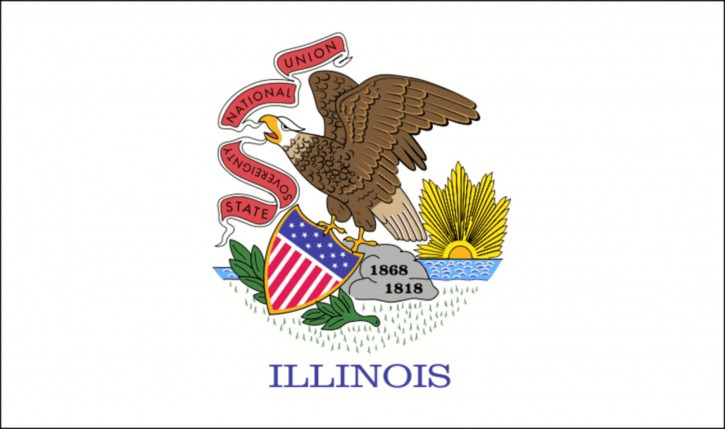
State Flag
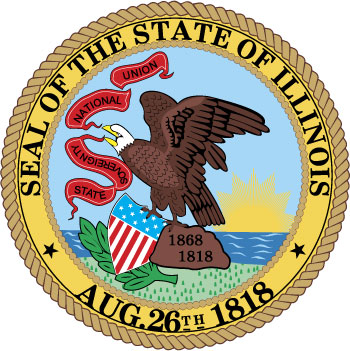
Great Seal
Nickname
The Prairie State / Land of Lincoln
Motto
State Sovereignty, National Union
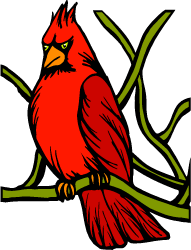
Bird
Northern Cardinal

Flower
Violet
Tree
White Oak
Mammal
White-tailed Deer
Fish
Bluegill
Reptile
Painted Turtle
Insect
Monarch Butterfly
Amphibian
Eastern Tiger Salamander
Fossil
Tully Monster
Song
"Illinois"