
 English
 Español
 中文
中文 हिन्दी
 Français
On this page
Overview
Iowa is a state in the Upper Midwestern United States, bordered by Minnesota to the north, Wisconsin and Illinois across the Mississippi River to the east, Missouri to the south, and Nebraska and South Dakota across the Missouri and Big Sioux rivers to the west. With roughly 3.2 million residents across 56,273 square miles, it is the 31st-most populous state and the 26th largest by area.
Iowa entered the Union as the 29th state on December 28, 1846. The state takes its name from the Iowa (Ioway) people, an Indigenous nation related to the Ho-Chunk. Des Moines, in the central part of the state, is the capital and the largest city. Residents are known as Iowans; the "Hawkeye" nickname honors the Sauk leader Black Hawk and was popularized by territorial promoters in the 1830s.
Iowa is one of the most agriculturally productive states in the world. It is consistently the U.S. leader in corn, hog, and egg production, and a top producer of soybeans, biofuels, and wind energy. The state is also widely known for the Iowa Caucuses, which have held first-in-the-nation status in the U.S. presidential nominating process for both parties since 1972 (most recently for the Republicans), and for an outsized cultural footprint in literature, agriculture policy, and education.
Geography & Climate
Iowa is composed almost entirely of rolling glacial plains, with thick, fertile soils developed under tallgrass prairie. It is one of the only U.S. states whose west, east, and parts of its north and south boundaries are all defined by rivers — the Missouri and Big Sioux on the west, the Mississippi on the east, and tributaries on portions of the other sides. Iowa thus has more total river frontage than nearly any other state in the country.
Hawkeye Point in the northwest is the state’s highest point at 1,671 feet; the southeast corner near the Mississippi is the lowest at 480 feet. The Driftless Area in northeastern Iowa, never reached by the last continental glaciers, is hilly, forested, and dotted with limestone bluffs and trout streams — a striking contrast to the rest of the state. The Loess Hills along the Missouri River are one of only two formations of their kind in the world (the other is in China).
The climate is humid continental, with cold, snowy winters and hot, humid summers. Iowa lies on the northern edge of Tornado Alley and experiences frequent severe thunderstorms. The state is intensively cultivated; roughly 86 percent of Iowa’s land area is used for agricultural production, the highest share of any U.S. state.
History
Iowa was home to the Ioway, Sauk, Meskwaki (Fox), Sioux, Ho-Chunk, and other Indigenous nations before European arrival. French explorers Jacques Marquette and Louis Jolliet, descending the Mississippi from Wisconsin, first sighted present-day Iowa in 1673. The region passed from France to Spain in 1763, back to France in 1800, and to the United States via the Louisiana Purchase in 1803.
The Black Hawk Purchase of 1832, following the Black Hawk War in Illinois, opened a strip along the Mississippi to American settlement. The Iowa Territory was established in 1838, and Iowa was admitted as the 29th state on December 28, 1846. The capital moved from Iowa City to Des Moines in 1857.
Iowa was strongly antislavery, voted to ratify the Thirteenth Amendment in 1865, and was an early state to grant African Americans the right to vote and to integrate its public schools. Iowa was also the first state west of the Mississippi to host a public university (the University of Iowa, 1847). The state’s small towns and cities were built almost entirely on agriculture, and the Farm Crisis of the 1980s — when collapsing land values and high interest rates bankrupted thousands of farms — fundamentally reshaped rural Iowa.
Since the 1990s, Iowa has emerged as a global leader in wind-energy generation. By the early 2020s, wind supplied more than 60 percent of the state’s electricity — the highest share of any U.S. state. The Iowa Caucuses, formalized in 1972, have given the state outsized influence in U.S. presidential politics for half a century.
Economy
Iowa hosts one of the most agriculturally driven economies of any U.S. state, complemented by major sectors in insurance and financial services, biofuels and renewable energy, advanced manufacturing, and food processing.
- Agriculture: Iowa is consistently the nation’s top producer of corn, hogs, and eggs, and a top-three producer of soybeans, ethanol, biodiesel, and cattle on feed. Agriculture and related industries directly account for a large share of state employment and shape the rural economy of most of the state.
- Biofuels: Iowa is the largest U.S. producer of both ethanol and biodiesel. Roughly 30 percent of the U.S. corn-ethanol supply originates in Iowa, and biofuels demand has tightly linked Iowa’s farm economy to national energy policy.
- Wind energy: Iowa is one of the leading U.S. wind-energy states, generating more than 60 percent of its in-state electricity from wind — the highest share in the country. MidAmerican Energy and Alliant Energy operate major wind portfolios across the state.
- Insurance and finance: Des Moines is the third-largest insurance center in the United States, after New York and Hartford. Principal Financial Group, EMC Insurance, Nationwide, Wells Fargo Home Mortgage, and many other firms anchor a deep financial-services cluster.
- Manufacturing and food processing: John Deere is headquartered in Moline (across the Mississippi in Illinois) but has its largest production complex in Waterloo, Iowa. Other major manufacturers include Pella Windows (Pella), Vermeer Corporation (Pella), Winnebago (Forest City), and HNI Corporation (Muscatine). Tyson Foods, JBS, and Smithfield run massive pork-processing plants across the state.
Government
Iowa operates under its 1857 constitution. The Iowa General Assembly is bicameral, with a 50-member Senate (four-year terms) and a 100-member House of Representatives (two-year terms). There are no legislative term limits.
The Governor of Iowa serves a four-year term with no statutory limit, although tradition favors two terms. The state also elects a Lieutenant Governor (jointly with the Governor), Attorney General, Secretary of State, Auditor, Treasurer, and Secretary of Agriculture — the only directly elected agriculture office of its kind in the country, a reflection of the centrality of farming.
Iowa has four seats in the U.S. House of Representatives plus two U.S. Senators. The Iowa Supreme Court has seven justices appointed by the governor through merit selection and retained by uncontested election. The state capital is Des Moines.
Culture
Iowa culture is shaped by an exceptionally strong agricultural identity, a deep tradition of public education, and a quietly outsized influence on American letters and politics. The Iowa State Fair in Des Moines, held each August, is one of the most-attended state fairs in the country and a culturally indispensable Iowa institution, featured in films, novels, and political rituals alike. The Iowa Caucuses every four years draw national and international attention to small-town Iowa.
The University of Iowa in Iowa City is internationally renowned for the Iowa Writers’ Workshop, the oldest and most prestigious creative-writing graduate program in the United States. Iowa City is a UNESCO City of Literature, and the workshop has trained generations of major American writers including Flannery O’Connor, John Cheever, Kurt Vonnegut, Marilynne Robinson, Tracy K. Smith, and many others.
Iowa’s small towns and rural communities are anchored by a deep tradition of German, Scandinavian, Czech, Dutch, and African-American heritage. The Amana Colonies in eastern Iowa, founded by German Pietists in the 1850s, are among the most successful long-lived intentional communities in U.S. history. The "Field of Dreams" site in Dyersville and the National Czech & Slovak Museum in Cedar Rapids draw visitors year-round. Iowa wrestling, particularly at the University of Iowa, is among the most decorated programs in U.S. collegiate sports history.
Notable Cities
- Des Moines — State capital, largest city, and economic center, with a city population of roughly 215,000 and a metropolitan area of about 750,000. Anchor of the third-largest U.S. insurance center, home of Principal Financial Group, the Iowa State Fairgrounds, the Greater Des Moines Botanical Garden, and Iowa State University’s College of Veterinary Medicine.
- Cedar Rapids — Second-largest city, in east-central Iowa on the Cedar River, with a population of roughly 135,000. A major food-processing, biotechnology, and aerospace center, home to Quaker Oats, General Mills, Cargill, ADM, and Collins Aerospace, and to the National Czech & Slovak Museum and Library.
- Davenport — Largest of the Quad Cities, on the Mississippi River, with a population of roughly 100,000. Headquarters of the Rock Island Arsenal across the river, host city of the Bix Beiderbecke Memorial Jazz Festival, and home of St. Ambrose University.
- Sioux City — Largest city in western Iowa, at the confluence of the Missouri and Big Sioux rivers, with a population of roughly 85,000. A regional service and meatpacking center where Iowa, Nebraska, and South Dakota meet, and historic departure point of the Lewis and Clark Expedition’s only fatality, Sgt. Charles Floyd.
- Iowa City — A city of roughly 75,000 in east-central Iowa. Home of the University of Iowa, the original state capital from 1846 to 1857, a UNESCO City of Literature, and the cultural center of eastern Iowa.
State Symbols
Iowa’s official state symbols, designated by the Iowa General Assembly, celebrate the rich agricultural heritage, native prairie ecology, and natural history of the Hawkeye State.
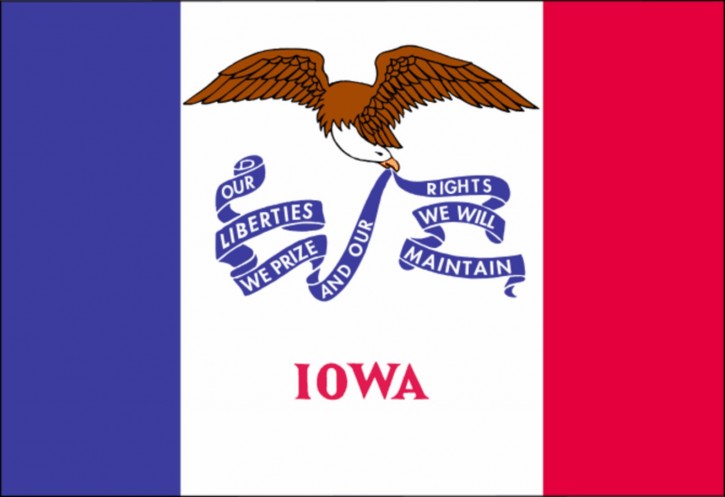
State Flag
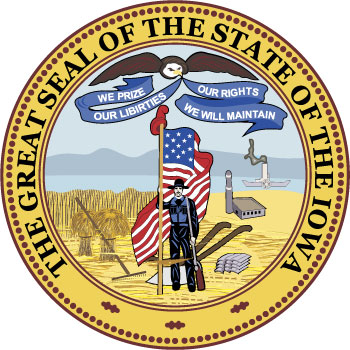
Great Seal
Nickname
The Hawkeye State
Motto
Our liberties we prize and our rights we will maintain
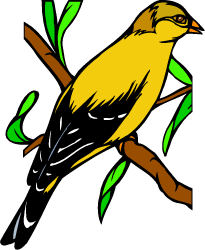
Bird
Eastern Goldfinch (American Goldfinch)

Flower
Wild Prairie Rose
Tree
Bur Oak
Rock
Geode
Fish
Channel Catfish
Insect
None officially designated
Grain
Corn
Soils
Tama Series (state soil)
Snack
Iowa Sweet Corn (informal)
Song
"The Song of Iowa"