
 English
 Español
 中文
中文 हिन्दी
 Français
On this page
Overview
Kentucky, officially the Commonwealth of Kentucky, is a state in the east-south-central United States, bordered by Illinois, Indiana, and Ohio across the Ohio River to the north, West Virginia and Virginia to the east, Tennessee to the south, and Missouri across the Mississippi River to the west. With roughly 4.5 million residents across 40,408 square miles, it is the 26th-most populous state and the 37th largest by area.
Kentucky entered the Union as the 15th state on June 1, 1792 — the first state west of the Appalachian Mountains and the first carved out of an existing state (Virginia). Frankfort, on the Kentucky River, is the state capital, although Louisville on the Ohio River is by far the largest city. Lexington, at the heart of the Bluegrass region, is the second largest and the state’s educational and equine center.
Kentucky is one of only four U.S. states that style themselves a "commonwealth," reflecting the state’s eighteenth-century founding tradition. The Bluegrass State is internationally famous as the birthplace of bourbon whiskey, the home of the Kentucky Derby and the Thoroughbred horse industry, and the cultural cradle of bluegrass music. Kentucky is also a top U.S. producer of coal, automobiles, and aluminum, and home to UPS Worldport — the world’s largest automated package-handling facility.
Geography & Climate
Kentucky is divided into five major geographic regions. The Cumberland Plateau (Eastern Kentucky Coal Field) in the east is rugged, heavily forested, and dominated by steep ridges and narrow valleys; Black Mountain in Harlan County, the state’s highest point at 4,145 feet, lies here. To the west, the Knobs region forms a horseshoe-shaped ring of isolated conical hills. The famous Bluegrass region in north-central Kentucky is a gently rolling, limestone-floored land of horse farms and tobacco fields.
The Pennyroyal Plateau covers much of south-central and southwestern Kentucky, a karst landscape underlain by limestone caves — including Mammoth Cave, the longest known cave system in the world, with more than 426 mapped miles. The Jackson Purchase in the far west is the youngest and flattest region, lying west of the Tennessee River. The Ohio River forms the entire 664-mile northern boundary, and the Mississippi River forms a short western boundary.
The climate is humid subtropical, with hot, humid summers and cool to cold winters. Tornadoes are common in the western and central parts of the state. Mammoth Cave National Park and Cumberland Gap National Historical Park preserve some of Kentucky’s most iconic landscapes. Daniel Boone National Forest covers much of eastern Kentucky.
History
Before European arrival, Kentucky was inhabited and used as a hunting ground by the Shawnee, Cherokee, Yuchi, Chickasaw, and other Indigenous peoples. The name "Kentucky" derives from an Iroquoian or Algonquian word of contested meaning. Long-hunter Daniel Boone, working for the Transylvania Company, blazed the Wilderness Road through the Cumberland Gap in 1775, opening Kentucky to large-scale Anglo-American settlement at the height of the American Revolution.
Kentucky was originally Kentucky County of Virginia, and after years of separatist agitation it became the 15th state of the Union on June 1, 1792 — the first state admitted west of the Appalachian Mountains and the first formed from an existing state. Frankfort was selected as the capital because of its central, neutral location between Louisville and Lexington.
Although Kentucky declared neutrality at the start of the Civil War, both armies eventually moved through the state and Kentucky contributed troops to both sides — though substantially more to the Union. President Abraham Lincoln and Confederate President Jefferson Davis were both born in Kentucky within a year and a hundred miles of each other. After the war, the state developed a distinctive bourbon, tobacco, and Thoroughbred-horse economy in the Bluegrass region, and a coal economy in the Appalachian east.
The twentieth century brought industrial diversification to the urban Ohio River corridor — Ford in Louisville, GE Appliance Park, Reynolds Aluminum, and later Toyota Manufacturing Kentucky in Georgetown (Toyota’s largest production facility outside Japan). The Appalachian coal economy in eastern Kentucky boomed in the early twentieth century and went through deep decline beginning in the late twentieth century, shaping ongoing economic and political tensions in the region.
Economy
Kentucky hosts a diversified economy with anchor sectors in advanced manufacturing (especially automotive), distilled spirits, agriculture and horse breeding, logistics, energy, and aluminum production.
- Bourbon and distilled spirits: Kentucky produces roughly 95 percent of the world’s bourbon whiskey. Major distilleries include Jim Beam, Maker’s Mark, Wild Turkey, Buffalo Trace, Heaven Hill, Four Roses, Woodford Reserve, and Bulleit. The Kentucky Bourbon Trail draws more than a million visitors a year. Distilled spirits is a major export industry for the state.
- Automobiles and manufacturing: Toyota Motor Manufacturing Kentucky in Georgetown is Toyota’s largest production plant outside Japan, building the Camry. Ford operates two large assembly plants in Louisville (the Kentucky Truck Plant and the Louisville Assembly Plant). GM, Stellantis, and a deep tier-1 supply base round out one of the largest U.S. automotive clusters.
- Horses: Kentucky is the world capital of Thoroughbred horse breeding and racing. Lexington is the global center of the industry; the Kentucky Horse Park, Keeneland racetrack, and dozens of leading breeding farms operate in the surrounding Bluegrass counties. The Kentucky Derby at Churchill Downs in Louisville, run since 1875, is the longest continuously held major sporting event in the United States.
- Logistics: UPS Worldport at Louisville Muhammad Ali International Airport is the world’s largest automated package-handling facility, processing more than 2 million packages per night at peak. Louisville is also a major Amazon air-cargo hub and home to one of FedEx’s growing regional operations.
- Coal and energy: Kentucky has long been one of the top U.S. coal-producing states, with deposits in both the Eastern Kentucky Coal Field (Appalachia) and the Western Kentucky Coal Field. Coal output peaked in the 2000s and has fallen sharply with the rise of natural gas and renewables, putting heavy economic pressure on the Appalachian east.
Government
Kentucky operates under its 1891 constitution, the fourth in its history. The Kentucky General Assembly is bicameral, with a 38-member Senate (four-year terms) and a 100-member House of Representatives (two-year terms). There are no legislative term limits.
The Governor of Kentucky serves a four-year term and is limited to two consecutive terms. The state also separately elects a Lieutenant Governor (who runs jointly with the Governor since 1992), Attorney General, Secretary of State, Auditor, Treasurer, and Commissioner of Agriculture. Kentucky is one of only four U.S. states styled as a "commonwealth" — alongside Massachusetts, Pennsylvania, and Virginia — a designation rooted in eighteenth-century constitutional tradition.
Kentucky has six seats in the U.S. House of Representatives plus two U.S. Senators. The Supreme Court of Kentucky has seven justices elected from districts to eight-year terms. The state capital is Frankfort.
Culture
Kentucky culture is deeply shaped by the bourbon, horse, and Bluegrass traditions of the central limestone region, and by the Appalachian heritage of the coal-bearing east. The Kentucky Derby on the first Saturday in May — the "Run for the Roses" — is one of the most famous sporting and social events in the United States and dominates Louisville’s cultural calendar each spring. The Kentucky State Fair, the Bourbon Trail, and Keeneland’s spring and fall race meets are similarly central public rituals.
Kentucky is the birthplace of bluegrass music, named for native son Bill Monroe and his Blue Grass Boys, who brought the genre to national audiences in the 1940s. The state also produced Loretta Lynn, the Judds, Dwight Yoakam, and Chris Stapleton in country music; gospel and African-American shape-note traditions in the western counties; and the Appalachian old-time and ballad traditions of the Cumberland Plateau. The annual ROMP festival in Owensboro celebrates bluegrass each summer.
Kentucky cuisine includes the Hot Brown (a knife-and-fork open-faced turkey sandwich invented at the Brown Hotel in Louisville), burgoo (a rich stew), country ham, Derby pie, and fried chicken made worldwide-famous by Colonel Harland Sanders of Corbin. Kentucky basketball — particularly the University of Kentucky Wildcats, one of the two most successful programs in NCAA history — is a unifying statewide passion that crosses urban, rural, and partisan lines.
Notable Cities
- Louisville — Largest city and economic center, on the Ohio River, with a city population of roughly 625,000 and a metropolitan area of about 1.4 million. Home of Churchill Downs and the Kentucky Derby, UPS Worldport, two Ford assembly plants, the Muhammad Ali Center, the Louisville Slugger Museum, and the headquarters of Humana, Brown-Forman, Yum! Brands (parent of KFC, Taco Bell, and Pizza Hut), and Papa John’s.
- Lexington — Second-largest city and the heart of the Bluegrass region, with a population of roughly 325,000. Home to the University of Kentucky, the Kentucky Horse Park, Keeneland racetrack, and dozens of leading Thoroughbred breeding farms.
- Bowling Green — A city of roughly 75,000 in south-central Kentucky. Home of Western Kentucky University, the National Corvette Museum, and the General Motors Corvette assembly plant — the only place in the world the Chevrolet Corvette is produced.
- Owensboro — A city of roughly 60,000 on the Ohio River in western Kentucky. Self-styled "Barbecue Capital of the World" (famed for mutton barbecue), host city of the International Bluegrass Music Museum (now the Bluegrass Music Hall of Fame & Museum) and the annual ROMP bluegrass festival.
- Frankfort — State capital, on the Kentucky River, with a population of roughly 28,000 — among the smallest U.S. state capitals. Home of the Kentucky State Capitol, the Kentucky History Center, Buffalo Trace Distillery, and the grave of Daniel Boone.
State Symbols
Kentucky’s official state symbols, designated by the Kentucky General Assembly, celebrate the equine, distilling, agricultural, and natural heritage of the Bluegrass State.
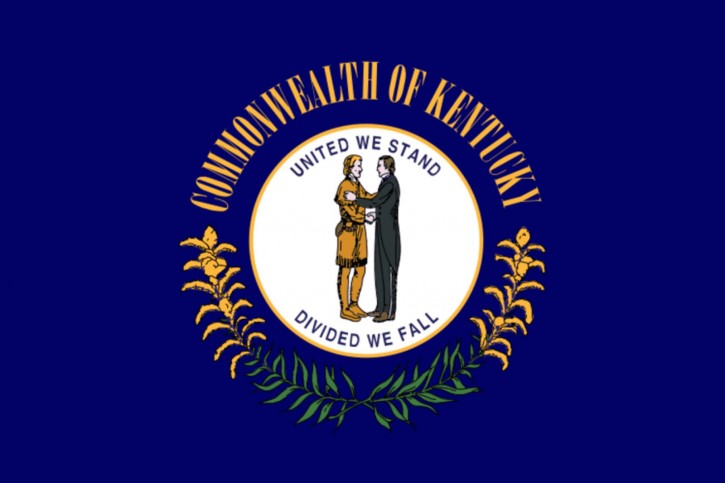
State Flag
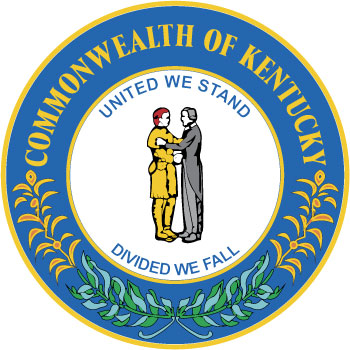
Great Seal
Nickname
The Bluegrass State
Motto
United we stand, divided we fall
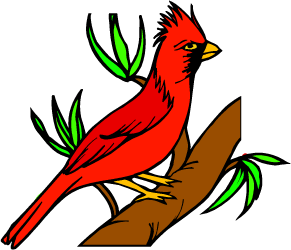
Bird
Northern Cardinal
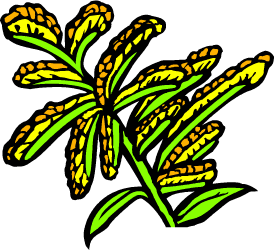
Flower
Goldenrod
Tree
Tulip Poplar (Yellow Poplar)
Horse
Thoroughbred
Wild Animal
Gray Squirrel
Fish
Kentucky Spotted Bass
Butterfly
Viceroy
Insect
Honeybee
Beverage
Milk
Song
"My Old Kentucky Home"