
 English
 Español
 中文
中文 हिन्दी
 Français
On this page
Overview
Maine is the easternmost and northernmost state in the contiguous United States, occupying the far northeast corner of the country. It is bordered by New Hampshire to the west, the Canadian provinces of Quebec to the northwest and New Brunswick to the northeast, and the Gulf of Maine of the Atlantic Ocean to the south and east. With roughly 1.38 million residents across 35,385 square miles, it is the 42nd-most populous state but the 39th largest by area — the largest of the six New England states by far.
Maine entered the Union as the 23rd state on March 15, 1820, separating from Massachusetts as part of the Missouri Compromise — Maine joined as a free state to balance Missouri’s admission as a slave state. Augusta on the Kennebec River is the state capital, and Portland on Casco Bay is the largest city and economic center. The state takes its name most likely from the historical French province of Maine, although several theories exist.
Maine is the most heavily forested state in the United States, with about 89 percent of its land area in forest. Its more than 3,500 miles of tidal shoreline (including all of the state’s 4,600+ islands) exceed those of California. Maine is internationally known for its lobster fishery (more than 80 percent of the U.S. lobster catch), its wild blueberries (Maine is the world’s largest producer), Acadia National Park, the rugged Atlantic coastline punctuated by historic lighthouses, and a cultural identity that pairs working-class self-reliance with the largest summer tourism industry in New England.
Geography & Climate
Maine sits at the northeastern edge of the Appalachian Mountains. The interior is dominated by lakes, rivers, and pine and spruce-fir forests; the highest point, Mount Katahdin in Baxter State Park, rises to 5,269 feet and is the northern terminus of the Appalachian Trail. Moosehead Lake is the largest lake in the state and the largest in New England outside Lake Champlain. The Penobscot, Kennebec, Androscoggin, Saco, and Allagash rivers drain most of the state, and the Allagash Wilderness Waterway is one of the country’s most acclaimed canoe and wilderness corridors.
The coast is rocky, deeply indented, and dotted with thousands of small islands. Acadia National Park on Mount Desert Island, near Bar Harbor, was the first U.S. national park east of the Mississippi and is one of the most-visited national parks in the country. Casco Bay near Portland is studded with the so-called "Calendar Islands" (so named because there were said to be one for every day of the year, though the true count is about 222).
The climate is humid continental, with long, snowy winters and short, cool summers — generally cooler and wetter than the rest of New England. Northern Aroostook County experiences harsher conditions than coastal Maine and is best known for its rolling potato fields. The state’s far north reaches above latitude 47°N, the highest in the contiguous United States after Minnesota and Washington.
History
Maine has been inhabited continuously for at least 12,000 years. At European contact, it was home to the Wabanaki Confederacy of Algonquian peoples, including the Penobscot, Passamaquoddy, Maliseet, and Mi’kmaq nations — four of which remain federally recognized today and operate sovereign reservations across the state. The French navigator Giovanni da Verrazzano explored the coast for France in 1524; Samuel de Champlain followed in 1604–1605, founding short-lived French settlements at Saint Croix Island and Saint Sauveur.
For most of the seventeenth and eighteenth centuries, the present state of Maine was contested between France (which controlled present-day Acadia and Nova Scotia just to the east) and English colonies (especially Massachusetts Bay). British settlement gradually pushed up the coast and inland. Maine remained part of Massachusetts after the American Revolution, but agitation for statehood gradually built up, motivated in part by Massachusetts’s refusal to defend the District during the War of 1812.
Maine was admitted as the 23rd state on March 15, 1820, as part of the Missouri Compromise: Maine entered as a free state, Missouri entered as a slave state, and the precarious balance in the U.S. Senate was preserved for another generation. The new state was named in part to keep its identity distinct from the mainland of Massachusetts.
The nineteenth and early twentieth centuries built Maine on lumbering, shipbuilding (Bath, Searsport, and many smaller yards), granite quarrying, and Down East fisheries. Acadia National Park was established in 1916, the first U.S. national park east of the Mississippi. Bath Iron Works, founded in 1884 on the Kennebec River, remains today one of the U.S. Navy’s two principal shipyards for Arleigh Burke–class guided-missile destroyers. The state has consistently led the nation in lobster landings since the late twentieth century.
Economy
Maine hosts a small but distinctive economy anchored by tourism, fishing (especially lobster), shipbuilding, forest products, agriculture (especially potatoes and wild blueberries), and a growing biotechnology and outdoor-equipment sector.
- Tourism: Tourism is Maine’s largest private-sector industry. Acadia National Park, the rocky coast, the inland lakes, ski resorts (Sunday River, Sugarloaf), and the state’s lobster shacks and lighthouses draw tens of millions of visitor-nights a year. Bar Harbor, Portland, Kennebunkport, Boothbay Harbor, and Camden are leading destinations.
- Lobster and seafood: Maine consistently lands more than 80 percent of the U.S. lobster catch, valued well over $1 billion at the dock in good years. Soft-shell clams, scallops, oysters, and groundfish (haddock, pollock, cod) round out a major coastal fishing economy, although climate-driven warming of the Gulf of Maine has put pressure on northern cod and other fisheries.
- Shipbuilding and defense: Bath Iron Works, on the Kennebec River, is one of the U.S. Navy’s two principal shipyards for Arleigh Burke–class destroyers (DDG-51 class), with roughly 7,000 employees. The Portsmouth Naval Shipyard on the Maine–New Hampshire border (Kittery, Maine) is the U.S. Navy’s oldest active shipyard.
- Forestry, agriculture, and food: Maine is the largest U.S. producer of wild (lowbush) blueberries and a major producer of seed and table potatoes in northern Aroostook County. Forest products — paper, pulp, and lumber — were historically the dominant industry and remain important despite consolidation. Maine maple syrup and Allen’s Coffee Brandy are distinctive local products.
- Outdoor equipment and biotech: L.L.Bean, founded in Freeport in 1912, remains a globally recognized outdoor-apparel and equipment retailer. Idexx Laboratories in Westbrook is a global leader in veterinary diagnostics. The Jackson Laboratory in Bar Harbor is one of the world’s leading mouse-genetics and biomedical-research institutions.
Government
Maine operates under its 1820 constitution. The Maine Legislature is bicameral, with a 35-member Senate and a 151-member House of Representatives, both serving two-year terms with a term limit of four consecutive terms. The Maine Legislature is one of only a handful of U.S. state legislatures considered "citizen" or part-time legislatures.
The Governor of Maine serves a four-year term and is limited to two consecutive terms. Unusually, the Lieutenant Governor position does not exist in Maine — the Senate President is first in line of succession. The state also separately elects the Attorney General, Secretary of State, Treasurer, and State Auditor — all four through the Legislature, not directly by the voters. Maine was the first U.S. state to adopt ranked-choice voting for federal primary and general elections (2018).
Maine has two seats in the U.S. House of Representatives plus two U.S. Senators. The Maine Supreme Judicial Court has seven justices appointed by the governor with legislative confirmation, serving seven-year terms. The state capital is Augusta.
Culture
Maine culture is shaped by a strong tradition of rural self-reliance, working-class maritime and woods labor, and an outsized summer tourism economy that has long brought "people from away" to the same towns generation after generation. The state’s distinctive accent — non-rhotic, with hard "ah" vowels — is one of the most recognizable regional dialects in the United States, although it has weakened in recent decades. Bestselling novelist Stephen King, who lives in Bangor, has done as much as anyone to make Maine a literary landscape known globally.
Wabanaki cultural traditions — basketmaking from black ash and sweetgrass, language revitalization, and salmon and alewife restoration on the Penobscot River — are central to a long Indigenous presence that long predates and continues alongside the colonial state. The Penobscot Nation’s Indian Island reservation near Old Town, and the Passamaquoddy reservations at Pleasant Point and Indian Township in Washington County, are sovereign nations conducting their own affairs.
Maine food culture centers on lobster (especially the lobster roll), steamed clams, haddock chowder, blueberry pie, Whoopie Pies (the official state treat), and Allen’s Coffee Brandy. Henry Wadsworth Longfellow, Edna St. Vincent Millay, Sarah Orne Jewett, and E.B. White lived and wrote in Maine; the painters Winslow Homer, Andrew Wyeth, Marsden Hartley, and Rockwell Kent worked extensively along the coast. The Common Ground Country Fair in Unity each September is one of the largest sustainable-agriculture fairs in the country.
Notable Cities
- Portland — Largest city and economic center, on Casco Bay, with a city population of roughly 68,000 and a metropolitan area of about 545,000. Home of the Old Port and Working Waterfront, the Portland Head Light, the Portland Museum of Art, the University of Southern Maine, and a nationally celebrated food scene. The Portland International Jetport is the busiest in the state.
- Lewiston — Second-largest city, on the Androscoggin River, with a population of roughly 36,000. A historic textile-mill city with a deep Franco-American heritage and, since 2000, the destination of large refugee resettlement (especially Somali, Bantu, and Congolese communities). Home of Bates College and the Lewiston/Auburn Maine Mariners hockey team.
- Bangor — Third-largest city, on the Penobscot River, with a population of roughly 32,000. Long the lumber capital of Maine and the gateway to the North Woods. Home of the Bangor International Airport, Cole Land Transportation Museum, and the longtime residence of author Stephen King.
- South Portland — A city of roughly 27,000 immediately south of Portland across the Fore River. Home to the Portland Headlight (Cape Elizabeth border), the Maine Mall, and a major heating-oil and gasoline import terminal — South Portland is the largest oil-handling port east of New York.
- Augusta — State capital, on the Kennebec River, with a population of roughly 18,500. Home of the Maine State Capitol, the Maine State Museum, the Maine State Library, the Blaine House (governor’s residence), and the central state-government complex.
State Symbols
Maine’s official state symbols, designated by the Maine Legislature, celebrate the forests, rocky coastline, wildlife, and working maritime and woods heritage of the Pine Tree State.
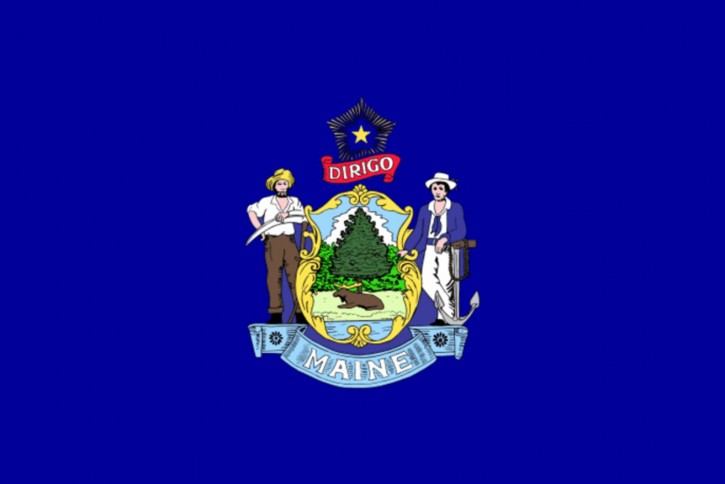
State Flag
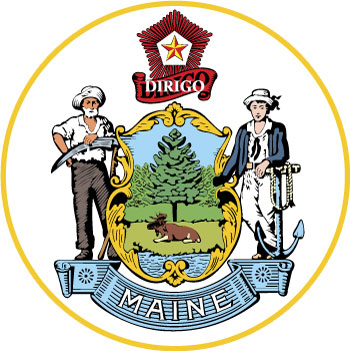
Great Seal
Nickname
The Pine Tree State (also Vacationland)
Motto
Dirigo ("I lead" / "I direct")
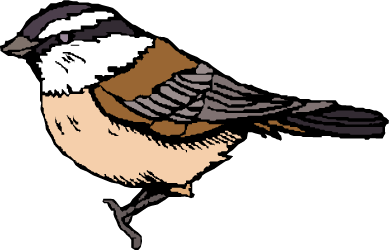
Bird
Black-capped Chickadee
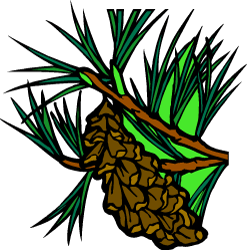
Flower
White Pine Cone and Tassel
Tree
Eastern White Pine
Animal
Moose
Fish
Landlocked Salmon
Crustacean
American Lobster
Insect
Honeybee
Berry
Wild Blueberry
Treat
Whoopie Pie
Song
"State of Maine Song"