
 English
 Español
 中文
中文 हिन्दी
 Français
On this page
Overview
Maryland is a Mid-Atlantic state on the United States’ eastern seaboard, bordered by Pennsylvania to the north along the Mason–Dixon Line, Delaware and the Atlantic Ocean to the east, Virginia and the District of Columbia across the Potomac River to the south, and West Virginia to the west. With roughly 6.18 million residents across 12,406 square miles, it is the 19th-most populous state but the 42nd largest by area — one of the most densely populated states in the country.
Maryland entered the Union as the 7th state on April 28, 1788, when it ratified the U.S. Constitution. The state is named for Queen Henrietta Maria, wife of the English King Charles I, who granted the colonial charter to George Calvert (1st Lord Baltimore) in 1632. Annapolis on the western shore of the Chesapeake Bay is the state capital and the home of the United States Naval Academy. Baltimore on the Patapsco River, with a metropolitan area of about 2.8 million, is the largest city.
Maryland is often called "America in Miniature" because of its extraordinary geographic and economic diversity in a small area: Appalachian highlands, rolling Piedmont, Coastal Plain, sandy ocean beaches, and the enormous Chesapeake Bay estuary all fit within its borders. The state hosts the headquarters of the National Institutes of Health, NASA Goddard Space Flight Center, the National Security Agency, the Social Security Administration, the FDA, the NIST, and dozens of other federal agencies, anchoring one of the most federally connected economies in the country.
Geography & Climate
Maryland is shaped by the Chesapeake Bay, the largest estuary in the United States and the third-largest in the world, which nearly bisects the state and creates more than 3,000 miles of tidal shoreline (more than any state on the East Coast except Florida). The bay separates the Eastern Shore (the Maryland portion of the Delmarva Peninsula) from the more urbanized Western Shore. Five major physiographic regions cross the state: the Atlantic Coastal Plain, the Piedmont, the Blue Ridge, the Ridge and Valley, and the Appalachian Plateau.
The Allegheny Mountains in westernmost Maryland include Hoye-Crest atop Backbone Mountain, the state’s highest point at 3,360 feet. Backbone Mountain and surrounding ranges are part of the Allegheny Plateau and contain Garrett County, Maryland’s only county west of the Eastern Continental Divide. The narrowest part of the state, near Hancock, is less than two miles across between Pennsylvania and West Virginia. Maryland’s lowest land surface is at sea level along the Atlantic and Chesapeake shores; the deepest point in Maryland — the bottom of "Bloody Point Hole" in the Chesapeake Bay — lies 174 feet below sea level.
The climate is humid subtropical in the south and east and humid continental in the higher elevations of the west, with hot, humid summers and mild to cold winters. Assateague Island National Seashore preserves a barrier island known for its wild horses; Antietam National Battlefield, the Catoctin Mountains (location of Camp David), and the C&O Canal National Historical Park are among Maryland’s most-visited protected lands.
History
Before European arrival, Maryland was home to the Piscataway, Susquehannock, Nanticoke, Choptank, and other Indigenous peoples. King Charles I granted George Calvert, 1st Lord Baltimore, a charter for the Province of Maryland in 1632. Calvert died before the charter was sealed; his son Cecil Calvert, 2nd Lord Baltimore, became the founding proprietor, and Cecil’s brother Leonard Calvert led the first English settlers to St. Mary’s City in 1634. Maryland was founded in part as a Catholic refuge — the 1649 Maryland Toleration Act was an early step toward religious freedom in the Anglo-American colonies — though political control fluctuated between Catholics and Protestants for decades.
The disputed border with Pennsylvania was resolved by the 1763–1767 survey of Charles Mason and Jeremiah Dixon — the Mason–Dixon Line — which later became the cultural boundary between the free North and the slave South. Maryland was the seventh state to ratify the U.S. Constitution, on April 28, 1788, and ceded land in 1790 along with Virginia to create the new District of Columbia. From November 1783 to August 1784, Annapolis served as the capital of the United States; the Treaty of Paris ending the American Revolution was ratified there.
During the War of 1812, the British attacked Baltimore in September 1814; the bombardment of Fort McHenry inspired Francis Scott Key, a Maryland lawyer, to write the poem that became "The Star-Spangled Banner," the U.S. national anthem. Maryland was a deeply divided border state during the Civil War. The Battle of Antietam near Sharpsburg on September 17, 1862, was the bloodiest single day in American history with more than 22,000 casualties, and Union victory there prompted President Lincoln to issue the Emancipation Proclamation.
In the twentieth century, the dramatic expansion of the U.S. federal government transformed Maryland. The construction of NIH (Bethesda), Fort Meade (NSA), NASA Goddard (Greenbelt), the Patuxent River Naval Air Station, and dozens of other federal facilities turned the Washington-Baltimore corridor into one of the densest concentrations of federally driven knowledge economy in the country. Baltimore, meanwhile, transitioned from an industrial port and steel town (Bethlehem Steel’s Sparrows Point) to a city anchored by Johns Hopkins University and Hospital — the country’s largest recipient of National Institutes of Health funding.
Economy
Maryland hosts one of the wealthiest and most federally connected economies in the United States, anchored by federal employment and contracting, biomedical research and pharmaceuticals, defense and intelligence, advanced manufacturing, port logistics, and a substantial financial-services sector.
- Federal employment and research: Maryland is home to NIH (Bethesda), NASA Goddard (Greenbelt), the NSA and U.S. Cyber Command (Fort Meade), the FDA (White Oak), the U.S. Naval Academy (Annapolis), the NIST (Gaithersburg), the SSA (Woodlawn), and many more — collectively employing hundreds of thousands of Marylanders and supporting a massive federal-contracting cluster.
- Biomedical and life sciences: Johns Hopkins University and Hospital, the nation’s largest recipient of NIH research funding, anchors a deep Baltimore-area biomedical cluster. Major pharmaceutical and biotech firms — including AstraZeneca subsidiary MedImmune (Gaithersburg), Emergent BioSolutions, Novavax, Lonza, Catalent, and many more — operate in the Interstate 270 "biotech corridor" north of Washington.
- Defense and intelligence: Lockheed Martin headquarters in Bethesda anchors one of the largest U.S. defense-contracting clusters. Northrop Grumman, Leidos, General Dynamics, MITRE, Booz Allen Hamilton, and CACI all maintain major Maryland operations. The Patuxent River Naval Air Station and Indian Head are major Navy R&D facilities, and the National Cryptologic Museum and intelligence-community work cluster around Fort Meade.
- Ports, agriculture, and seafood: The Port of Baltimore is one of the largest U.S. ports for autos, roll-on/roll-off cargo, and forest products. Maryland’s Eastern Shore is a leading U.S. poultry producer, anchored by Perdue Farms (Salisbury). The Chesapeake Bay supports a historic blue-crab fishery (Maryland is the top U.S. producer) along with oysters, soft-shell clams, and rockfish (striped bass).
- Finance, tourism, and media: T. Rowe Price (Baltimore), Legg Mason, Marriott International (Bethesda), Discovery (Silver Spring), and Under Armour (Baltimore) are headquartered in Maryland. Tourism centers on the Inner Harbor, the Chesapeake Bay, Ocean City, Antietam, and the U.S. Naval Academy. The Preakness Stakes in Baltimore, run since 1873, is the second jewel of horse racing’s Triple Crown.
Government
Maryland operates under its 1867 constitution, the fourth in its history. The Maryland General Assembly is bicameral, with a 47-member Senate and a 141-member House of Delegates, both elected to four-year terms. There are no legislative term limits.
The Governor of Maryland serves a four-year term and is limited to two consecutive terms. The state also elects a Lieutenant Governor (jointly with the Governor), Attorney General, and Comptroller. The Maryland General Assembly retains unusual constitutional power: it can reduce but not increase the governor’s budget, an arrangement designed to enforce fiscal discipline. Maryland’s 24 jurisdictions consist of 23 counties plus Baltimore City, which functions as an independent city — the only such jurisdiction in the U.S. East apart from Virginia.
Maryland has eight seats in the U.S. House of Representatives plus two U.S. Senators. The Supreme Court of Maryland (the state’s highest court, until 2022 known as the "Court of Appeals") has seven justices appointed by the governor and retained by voters every ten years. The state capital is Annapolis.
Culture
Maryland culture is regionally diverse to an unusual degree for a state of its size. Baltimore — "Charm City" — has a distinctive working-class identity expressed in the music of Tony Bennett, Frank Sinatra, the films of John Waters and Barry Levinson, the writing of Edgar Allan Poe and Anne Tyler, the David Simon television series "The Wire," the Hon culture, and the dialect ("hon," "Baltimore" pronounced "Bawlmer"). Annapolis blends Naval Academy and yachting culture; the Eastern Shore is rural watermen’s country; western Maryland is Appalachian; and the Washington suburbs are among the country’s wealthiest, most multilingual, and most highly educated jurisdictions.
The Chesapeake Bay anchors a distinctive food culture centered on Maryland blue crab — particularly steamed and seasoned with Old Bay, served at hammered-tin-covered tables and eaten with mallets. Crab cakes, soft-shell crabs, Smith Island Cake (the official state dessert), oysters on the half shell, Berger cookies, pit beef, and Natty Boh (National Bohemian) beer are all enduring Baltimore-Maryland icons. The annual J. Millard Tawes Crab and Clam Bake on the Eastern Shore is a defining cultural ritual.
Maryland is a powerhouse in lacrosse — particularly at Johns Hopkins, the University of Maryland, and a thick layer of high schools. The Maryland Terrapins and the Baltimore Ravens (NFL) and Orioles (MLB) are central cultural institutions. The Preakness Stakes at Pimlico Race Course in Baltimore, run since 1873 (the second jewel of horse racing’s Triple Crown), is the state’s single largest annual sporting event.
Notable Cities
- Baltimore — Largest city, an independent city on the Patapsco River, with a city population of roughly 575,000 and a metropolitan area of about 2.8 million. Home of the Inner Harbor, Fort McHenry, Johns Hopkins University and Hospital, the Baltimore Ravens, the Baltimore Orioles, the National Aquarium, the Walters Art Museum, the Edgar Allan Poe House, and the Maryland Institute College of Art.
- Frederick — A city of roughly 80,000 in north-central Maryland, the second-most populous incorporated city in the state. A growing biotech and federal-research hub anchored by Fort Detrick (one of the U.S. Army’s leading biomedical-research installations) and the National Cancer Institute’s Frederick National Laboratory.
- Rockville — A city of roughly 68,000 in Montgomery County, north of Washington, D.C. County seat of Maryland’s most populous county and home to a substantial federal and biomedical-research employment base, including major operations of the FDA, the NIH, the NRC, and dozens of biotech firms.
- Gaithersburg — A city of roughly 70,000 in Montgomery County, immediately north of Rockville. Home of the National Institute of Standards and Technology (NIST), the AstraZeneca/MedImmune campus, the Asian Indian American Cultural Center, and a deeply multicultural population.
- Annapolis — State capital, on the western shore of the Chesapeake Bay, with a population of roughly 40,000. Home of the United States Naval Academy, the Maryland State House (the oldest U.S. state capitol in continuous legislative use, where the Treaty of Paris was ratified in 1784), and a national sailing and yachting center.
State Symbols
Maryland’s official state symbols, designated by the Maryland General Assembly, celebrate the Chesapeake Bay heritage, the equestrian and agricultural traditions, and the state’s seventeenth-century Calvert-family origins.
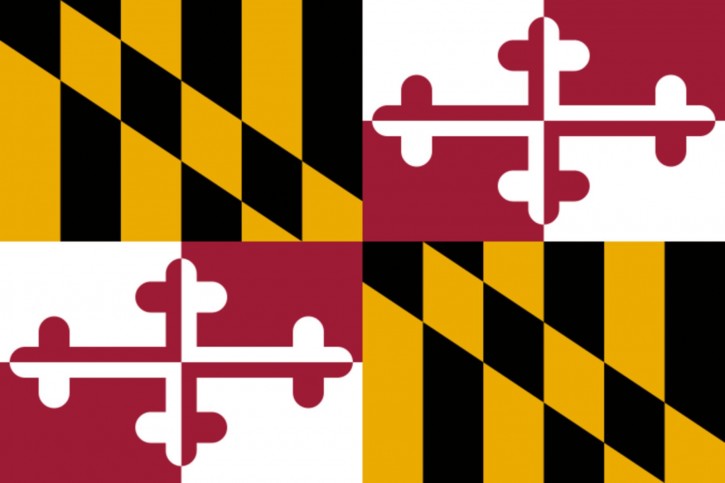
State Flag
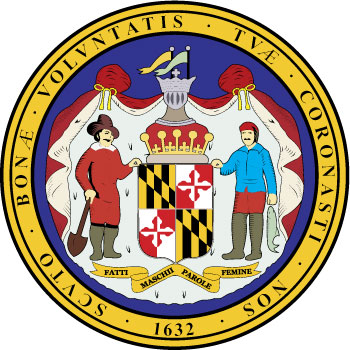
Great Seal
Nickname
The Old Line State / The Free State
Motto
Fatti maschii, parole femine ("Manly deeds, womanly words")
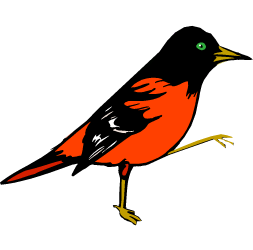
Bird
Baltimore Oriole
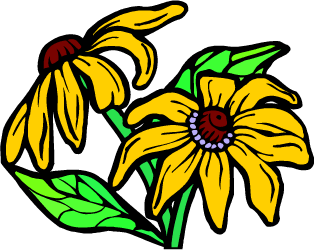
Flower
Black-eyed Susan
Tree
White Oak
Crustacean
Maryland Blue Crab
Fish
Striped Bass (Rockfish)
Dog
Chesapeake Bay Retriever
Cat
Calico Cat
Sport
Jousting (state sport); Lacrosse (state team sport)
Dessert
Smith Island Cake
Boat
Skipjack