
 English
 Español
 中文
中文 हिन्दी
 Français
On this page
Overview
Massachusetts, officially the Commonwealth of Massachusetts, is a state in New England, bordered by Vermont and New Hampshire to the north, the Atlantic Ocean to the east, Rhode Island and Connecticut to the south, and New York to the west. With roughly 7.0 million residents across 10,565 square miles, it is the 16th-most populous state but the 44th largest by area — one of the most densely populated states in the country and the most populous in New England.
Massachusetts ratified the U.S. Constitution as the sixth state on February 6, 1788. The Commonwealth of Massachusetts is one of only four U.S. states styled as a "commonwealth," alongside Pennsylvania, Virginia, and Kentucky. Boston is the state capital, the largest city, and the historical, cultural, and economic anchor of all of New England. The state takes its name from the Massachusett people, an Indigenous Algonquian-speaking nation whose name means roughly "at the great hill."
Massachusetts has been central to American history since long before the United States existed — as the site of the 1620 landing of the Pilgrims at Plymouth, the 1775 outbreak of the American Revolution at Lexington and Concord, and the long abolitionist movement of the nineteenth century. Today it hosts the highest concentration of universities of any U.S. state — including Harvard and MIT — and is the most highly educated state in the country by share of adults with college degrees. It is also among the highest per-capita-income states.
Geography & Climate
Massachusetts is divided into several distinct regions. Eastern Massachusetts is dominated by the Boston metropolitan area, the largest in New England, with a rocky Atlantic coast indented by Boston Harbor and a network of small harbors and bays. Southeast of Boston, Cape Cod arcs out into the Atlantic in a curving 60-mile hook, and the islands of Martha’s Vineyard and Nantucket lie further south. Central Massachusetts is rolling and forested, with the Connecticut River Valley running north-south through the middle of the state.
Western Massachusetts is dominated by the Berkshire Hills and the Hoosac Range — outliers of the Appalachian system. Mount Greylock in the Berkshires, at 3,489 feet, is the highest point in Massachusetts. The Connecticut River, New England’s longest, traverses the Pioneer Valley between Springfield and the Vermont line. The state has about 1,500 miles of tidal shoreline once Cape Cod, the islands, and the harbors are counted.
The climate is humid continental with humid-subtropical influence near the coast, with cold winters, warm summers, and substantial year-round rainfall. The Cape and Islands are notably milder, with later autumn freezes and earlier spring thaws than the inland Berkshires. Cape Cod National Seashore, the Berkshires, Mount Greylock, and the coastal beaches and islands are among the state’s most-visited landscapes.
History
For thousands of years before European arrival, Massachusetts was home to the Wampanoag, Massachusett, Nipmuc, Pocomtuc, Pequot, and Nauset peoples. English Separatist Pilgrims aboard the Mayflower founded the Plymouth Colony in 1620 — celebrated each November in the U.S. Thanksgiving holiday. A much larger English Puritan migration in 1630 founded the Massachusetts Bay Colony at Boston, Salem, and surrounding towns; under Governor John Winthrop, the colony aspired to be "a city upon a hill" — a phrase that has echoed through American political rhetoric ever since.
Massachusetts established the first public school in the English colonies (Boston Latin, 1635) and the first college (Harvard, 1636). The Salem witch trials of 1692 left 25 dead in one of the most studied episodes of early American history. The Massachusetts colonies were merged into the Province of Massachusetts Bay in 1691.
Tensions with the British Crown over taxation, trade, and political representation made Massachusetts the cradle of the American Revolution: the 1770 Boston Massacre, the 1773 Boston Tea Party, and the April 19, 1775, battles of Lexington and Concord — "the shot heard round the world" — touched off the war for independence. The June 17, 1775, Battle of Bunker Hill (actually fought on Breed’s Hill) followed. Massachusetts ratified the U.S. Constitution as the sixth state on February 6, 1788. It was also the first state to abolish slavery — the Massachusetts Supreme Judicial Court found slavery incompatible with the 1780 state constitution in 1781–1783.
In the nineteenth century, Massachusetts mill towns — Lowell, Lawrence, Fall River, and New Bedford — became the cradle of the American Industrial Revolution. The state was a leading center of abolitionism, transcendentalism, and women’s rights agitation. Four U.S. presidents — John Adams, John Quincy Adams, John F. Kennedy, and George H.W. Bush — were born in Massachusetts. In the late twentieth and twenty-first centuries, the Boston-Cambridge corridor became one of the world’s most concentrated centers of biotechnology, computer science, and venture capital.
Economy
Massachusetts hosts one of the wealthiest, most innovation-driven economies in the United States, anchored by higher education, healthcare, biotechnology, financial services, and a deep cluster of technology and defense firms.
- Higher education and research: Massachusetts has more colleges and universities per capita than any U.S. state. Harvard, MIT, Tufts, Boston College, Boston University, Northeastern, Williams, Amherst, Wellesley, Smith, Mt. Holyoke, and the University of Massachusetts system are major economic engines. Higher-education-driven research and consulting contracts pull billions of dollars a year into the state.
- Healthcare and biotechnology: Mass General Brigham (Massachusetts General and Brigham and Women’s), Boston Children’s, Dana-Farber, and Beth Israel Lahey anchor one of the largest U.S. healthcare clusters. Kendall Square in Cambridge is one of the densest biotechnology clusters in the world, with Moderna, Vertex, Biogen, Pfizer’s Boston R&D, Novartis, Takeda, Sanofi Genzyme, and hundreds of smaller firms and CROs.
- Technology and venture capital: The Route 128 corridor was the original U.S. high-technology cluster of the 1960s–1980s, and Boston-Cambridge remains a global venture-capital and software hub. Major players headquartered or operating in the state include HubSpot, Akamai, Wayfair, TripAdvisor, Toast, DraftKings, and leading VCs including General Catalyst, Battery Ventures, Bessemer, and Greylock.
- Financial services: Boston is one of the most important U.S. asset-management centers, home to Fidelity, State Street, Putnam, MFS, Wellington, and Loomis Sayles. Insurance giant Liberty Mutual is headquartered in Back Bay. Boston was the cradle of the modern mutual fund — the first U.S. mutual fund (Massachusetts Investors Trust) was founded there in 1924.
- Defense and aerospace: Raytheon Technologies (now RTX) maintains a major presence at its Tewksbury, Andover, Marlborough, and Cambridge sites. MIT Lincoln Laboratory in Lexington is a federally funded R&D center for the U.S. Air Force and a leader in radar, AI, and space-domain awareness research. General Electric’s aviation business has substantial Massachusetts operations.
Government
Massachusetts operates under its 1780 constitution — the oldest functioning written constitution of any government in the world. The Massachusetts General Court is bicameral, with a 40-member Senate and a 160-member House of Representatives, both elected to two-year terms. The Massachusetts House is the second-largest U.S. state lower chamber after the New Hampshire House. There are no legislative term limits.
The Governor of Massachusetts serves a four-year term with no constitutional limit on the number of terms. The state also elects a Lieutenant Governor (jointly with the Governor), Attorney General, Secretary of the Commonwealth, Treasurer, and Auditor. Massachusetts is one of only four U.S. states styled as a "commonwealth," alongside Pennsylvania, Virginia, and Kentucky.
Massachusetts has nine seats in the U.S. House of Representatives plus two U.S. Senators. The Massachusetts Supreme Judicial Court — the oldest continuously functioning appellate court in the Western Hemisphere, in operation since 1692 — has seven justices appointed by the governor with the consent of the Governor’s Council and serving to age 70. The state capital is Boston.
Culture
Massachusetts culture is deeply shaped by its Yankee Puritan and academic intellectual heritage, by waves of nineteenth and twentieth century Irish, Italian, French Canadian, Portuguese, and Eastern European immigration, by a vibrant African American and Caribbean community in Boston, Cambridge, and Springfield, and by major Vietnamese, Brazilian, Haitian, and Cape Verdean communities. The famous Boston accent — non-rhotic, with characteristic vowel mergers ("pahk the cah in Hahvahd Yahd") — has weakened in recent decades but remains an immediately recognizable identifier.
Massachusetts has produced an outsized share of major American writers, scientists, and political figures, from Ralph Waldo Emerson, Henry David Thoreau, Nathaniel Hawthorne, and Louisa May Alcott in the nineteenth-century Concord-Boston literary world, to E.E. Cummings, Sylvia Plath, John Updike, Robert Frost (longtime resident), and Robert Lowell in the twentieth century, to Norman Mailer, Henry Roth, and Dennis Lehane. Harvard alone has produced 47 Nobel laureates as faculty or affiliates.
New England sports culture is centered in Massachusetts: the Boston Red Sox (MLB, founded 1901, playing at Fenway Park since 1912 — the oldest MLB ballpark still in use), the New England Patriots (NFL, six-time Super Bowl champions in the Brady-Belichick era), the Boston Celtics (NBA, 17-time champions), and the Boston Bruins (NHL). The Boston Marathon, run on Patriots’ Day each April since 1897, is the oldest annual marathon in the world. Massachusetts cuisine — clam chowder, lobster rolls, fried clams, baked beans, Boston cream pie, and the official state cookie, the chocolate chip cookie — is distinctive throughout New England.
Notable Cities
- Boston — State capital, largest city, and historical, cultural, and economic anchor of New England, with a city population of roughly 670,000 and a metropolitan area of about 4.9 million. Home of Fenway Park, the Freedom Trail, the Boston Common (the oldest U.S. public park, 1634), the Museum of Fine Arts, Faneuil Hall, the Bunker Hill Monument, the Boston Symphony, and dozens of universities and hospitals.
- Worcester — Second-largest city in New England, in central Massachusetts, with a city population of roughly 207,000 and a metropolitan area of about 870,000. Home to Worcester Polytechnic Institute, Clark University, the College of the Holy Cross, the UMass Chan Medical School, and the Worcester Art Museum.
- Springfield — Largest city in western Massachusetts, on the Connecticut River, with a population of roughly 155,000 and a metropolitan area of about 700,000 that extends across the Connecticut state line. Birthplace of basketball (invented by James Naismith at Springfield College in 1891) and home of the Basketball Hall of Fame, the Springfield Armory National Historic Site, and Smith & Wesson’s historic headquarters.
- Cambridge — A city of roughly 118,000 immediately across the Charles River from Boston. Home of Harvard University, the Massachusetts Institute of Technology, the Kendall Square biotech and technology cluster, and the headquarters of Akamai, HubSpot, Biogen, Moderna, and many other firms. Among the most highly educated cities in the United States.
- Lowell — A city of roughly 115,000 in the Merrimack Valley north of Boston. The birthplace of the U.S. Industrial Revolution, where in the 1820s Boston Manufacturing Company industrialists harnessed the Merrimack to power the world’s first integrated cotton mills. Home of the University of Massachusetts Lowell and Lowell National Historical Park.
State Symbols
Massachusetts’s official state symbols, designated by the Massachusetts General Court, celebrate the Atlantic coastline, Indigenous and colonial heritage, and natural history of the Bay State.
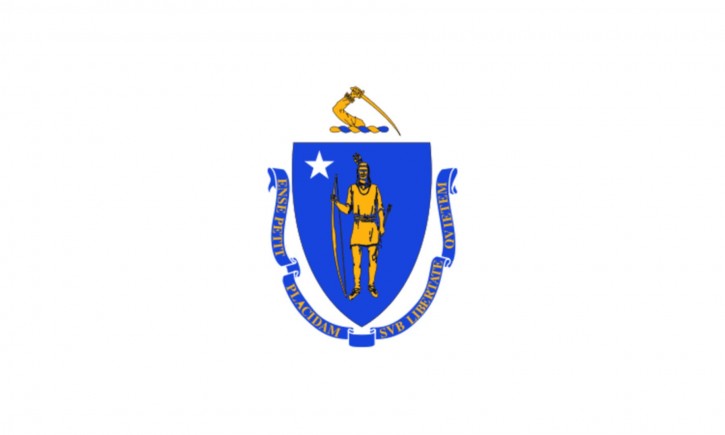
State Flag
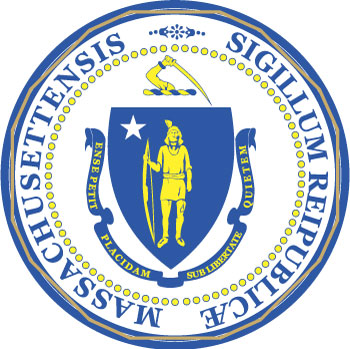
Great Seal
Nickname
The Bay State
Motto
Ense petit placidam sub libertate quietem ("By the sword we seek peace, but peace only under liberty")
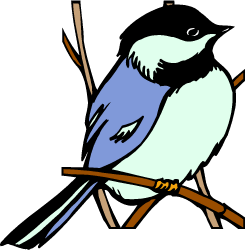
Bird
Black-capped Chickadee
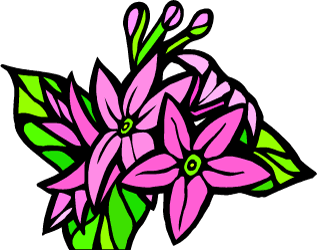
Flower
Mayflower (Trailing Arbutus)
Tree
American Elm
Mammal
Right Whale (marine); Tabby Cat (domestic)
Game Bird
Wild Turkey
Dog
Boston Terrier
Insect
Ladybug
Cookie
Chocolate Chip Cookie
Drink
Cranberry Juice
Song
"All Hail to Massachusetts"