
 English
 Español
 中文
中文 हिन्दी
 Français
On this page
Overview
Minnesota is a state in the Upper Midwest of the United States, bordered by the Canadian provinces of Manitoba and Ontario to the north, Lake Superior and Wisconsin to the east, Iowa to the south, and South Dakota and North Dakota to the west. With roughly 5.74 million residents across 86,936 square miles, it is the 22nd-most populous state and the 12th largest by area — the second-largest state east of the Rocky Mountains after Texas.
Minnesota entered the Union as the 32nd state on May 11, 1858. The state takes its name from the Dakota phrase "Mni Sóta," meaning roughly "land where the waters reflect the clouds." Saint Paul on the east bank of the Mississippi River is the state capital; Minneapolis on the west bank is the largest city. The two cities are collectively known as the "Twin Cities" and anchor a metropolitan area of about 3.7 million.
Minnesota is famous as the "Land of 10,000 Lakes" — the actual count is more than 11,800 lakes of ten acres or larger. It is the headwaters of the Mississippi River, the northernmost reach of any U.S. state east of the Rockies (the Northwest Angle peninsula extending into Lake of the Woods), and one of the most Scandinavian-heritage-rich regions in the country. Minnesota hosts more Fortune 500 headquarters per capita than nearly any other U.S. state, including 3M, UnitedHealth Group, Target, Best Buy, General Mills, U.S. Bancorp, and the privately held giant Cargill.
Geography & Climate
Minnesota spans the transition between the Eastern Forest and the Great Plains. The Boundary Waters Canoe Area Wilderness and Voyageurs National Park in northern Minnesota lie within the boreal forest of the Canadian Shield — a million-plus acres of interconnected lakes and rivers paddleable for weeks at a time. South of the boreal forest, the central transitional zone is a mosaic of conifer-and-hardwood forest and lakes, including the famed "lake country" north of the Twin Cities. The southern third of the state is rich agricultural prairie and farmland, much of it now in corn-and-soybean production.
Eagle Mountain in Cook County, on the Lake Superior north shore, is Minnesota’s highest point at 2,301 feet — within a few miles of Lake Superior, the state’s lowest point at 602 feet. The Mississippi River begins at Lake Itasca in Itasca State Park, less than 18 feet wide there, and runs more than 2,300 miles to the Gulf of Mexico. The Red River of the North flows north along Minnesota’s western border toward Lake Winnipeg and Hudson Bay — the only U.S. river system that drains to the Arctic.
The climate is humid continental, with long, very cold winters and short, warm summers. International Falls and other northern Minnesota communities regularly experience temperatures of -40°F or lower in midwinter, while summer days can reach the 90s°F. Minnesota’s northern reaches lie at higher latitudes than southern Canada (the Northwest Angle is the northernmost place in the contiguous United States). The state’s nearly 100,000 miles of rivers and streams and 11,800+ lakes define both the recreational economy and the cultural identity.
History
For thousands of years before European contact, the region was home to the Dakota (Sioux), Anishinaabe (Ojibwe), and Ho-Chunk peoples. French voyageurs and Jesuit missionaries reached the region in the seventeenth century; Father Louis Hennepin observed and named the Falls of Saint Anthony in 1680. France ceded its claim east of the Mississippi to Britain in 1763 and the territory west of the Mississippi to Spain — and then back to France, and on to the United States via the Louisiana Purchase of 1803. The area east of the Mississippi passed to the United States after the American Revolution.
Fort Snelling, at the confluence of the Mississippi and Minnesota rivers, was established in 1819 to anchor U.S. military and treaty authority. Minnesota Territory was organized in 1849, and Minnesota was admitted as the 32nd state on May 11, 1858. The U.S.–Dakota War of 1862, the most serious armed conflict between Indigenous nations and the United States in the upper Midwest, ended with the largest mass execution in U.S. history — 38 Dakota men hanged at Mankato on December 26, 1862, on orders from President Lincoln.
The late nineteenth century brought massive Scandinavian (Norwegian, Swedish, Finnish, Danish), German, and Bohemian immigration to Minnesota’s farms, mines, and lumber camps. The discovery of the immense Mesabi Iron Range in 1890 made Minnesota the largest iron-ore producer in the United States — a status it has held ever since. Minneapolis became the world’s largest milling center in the 1880s, anchored by Pillsbury and Washburn (later General Mills) using power from the Falls of St. Anthony.
The Mayo brothers founded what became the Mayo Clinic in Rochester in 1889. The twentieth century saw Minnesota build one of the most diversified state economies in the country, the rise of the DFL (Democratic-Farmer-Labor) party fusion in 1944, the establishment of a culture of strong civic engagement (Minnesota consistently leads the nation in voter turnout), and the late-twentieth- and twenty-first-century arrival of large Hmong, Somali, Liberian, Karen, Mexican, and Indian immigrant communities that have transformed the Twin Cities and the larger state.
Economy
Minnesota hosts one of the most diversified state economies in the United States, with a remarkably broad mix of Fortune 500 headquarters spanning retail, healthcare, agriculture, industrial conglomerates, financial services, and medical devices.
- Fortune 500 headquarters: Minnesota hosts an unusually high number of Fortune 500 headquarters relative to its population — including UnitedHealth Group (Minnetonka, the fifth-largest U.S. company), Target (Minneapolis), Best Buy, 3M (Maplewood), General Mills, U.S. Bancorp, Ecolab, Hormel Foods, Land O’Lakes, Polaris, Xcel Energy, and others. Cargill (Wayzata) is the largest privately held U.S. company. The Twin Cities are the third-largest U.S. headquarters concentration after New York and Chicago.
- Healthcare and medical devices: The Mayo Clinic, founded in Rochester in 1889, is one of the most internationally renowned medical centers in the world. Medtronic (founded in Minneapolis, headquartered in Galway, Ireland for tax purposes but operationally based in Minnesota) is the world’s largest medical-device company. Boston Scientific, St. Jude Medical, and many smaller medtech firms cluster in the Twin Cities along "Medical Alley."
- Agriculture and food: Minnesota is the nation’s leading producer of sugar beets, turkeys, sweet corn for processing, and oats, and a top-five producer of corn, soybeans, hogs, milk, and edible dry beans. Cargill, General Mills, Hormel, Land O’Lakes, and Schwan’s anchor a massive food-processing economy. Wild rice — manoomin in Ojibwe — is the official state grain and is harvested both wild and in cultivated paddies.
- Mining and forestry: The Iron Range of northeastern Minnesota — the Mesabi, Vermilion, Cuyuna, and Gunflint ranges — produces roughly 80 percent of U.S. iron ore. Forestry and paper milling remain significant in the north, although consolidation has reduced their footprint. Polymet and Twin Metals copper-nickel projects have been the subject of intense ongoing debate.
- Retail and consumer brands: The Mall of America in Bloomington, the largest shopping mall in the United States, draws roughly 40 million visitors a year. Target, Best Buy, and Land O’Lakes are global consumer brands headquartered in Minnesota. The state’s tourism industry — anchored by the Boundary Waters, Lake Superior North Shore, the Mall of America, and the Twin Cities — adds another major economic pillar.
Government
Minnesota operates under its 1857 constitution. The Minnesota Legislature is bicameral, with a 67-member Senate (mostly four-year terms, staggered around redistricting) and a 134-member House of Representatives (two-year terms). There are no legislative term limits.
The Governor of Minnesota serves a four-year term with no constitutional limit on the number of terms. The state also elects a Lieutenant Governor (jointly with the Governor), Attorney General, Secretary of State, and State Auditor. Minnesota uniquely has the Democratic-Farmer-Labor Party (DFL) as the major center-left party — the result of a 1944 merger between the Democratic and Farmer-Labor parties — rather than the Democratic Party found in every other U.S. state.
Minnesota has eight seats in the U.S. House of Representatives plus two U.S. Senators. The Minnesota Supreme Court has seven justices elected to staggered six-year terms. The state capital is Saint Paul.
Culture
Minnesota culture is shaped by Scandinavian (especially Norwegian, Swedish, and Finnish) and German immigrant heritage, by a strong Lutheran and Catholic religious presence, by deep Ojibwe and Dakota cultural roots, and by major recent African (Somali, Liberian, Ethiopian, Oromo), Southeast Asian (Hmong, Karen, Vietnamese), Mexican, and South Asian communities. "Minnesota Nice," "hotdish," lutefisk, and lefse are clichés but real markers of a culture that prizes politeness, communalism, and surviving long winters. The state has the country’s highest voter turnout in most general elections.
Minnesota has produced an outsized share of major American cultural figures: musicians Bob Dylan (born in Duluth and raised in Hibbing), Prince (Minneapolis), Judy Garland (Grand Rapids), and the band the Replacements; writers F. Scott Fitzgerald (Saint Paul), Sinclair Lewis (Sauk Centre — first American Nobel laureate in literature), Tim O’Brien, and Louise Erdrich; cartoonist Charles Schulz (St. Paul — creator of Peanuts); broadcaster Garrison Keillor and his "A Prairie Home Companion"; and many leading writers, scientists, and politicians.
"Lake culture" is a defining feature of Minnesota life. "Going up to the cabin" each summer is a near-universal ritual, the State Fair in Saint Paul each Labor Day is one of the largest in the country (drawing 1.8 to 2 million attendees in twelve days), and ice fishing, ice hockey, cross-country skiing, and snowmobiling structure most winters. Minneapolis and Saint Paul’s arts and theater scene — the Guthrie Theater, the Walker Art Center, the Minnesota Orchestra, and dozens of smaller venues — is one of the most active per-capita in the country. The Minnesota Vikings, Twins, Wild, Timberwolves, and Lynx anchor a deep professional-sports identity.
Notable Cities
- Minneapolis — Largest city, on the west bank of the Mississippi River, with a city population of roughly 430,000 and a Twin Cities metropolitan area of about 3.7 million. Home of the Falls of Saint Anthony, the Walker Art Center, the Minneapolis Institute of Art, the Guthrie Theater, the headquarters of Target, U.S. Bancorp, Xcel Energy, and Ameriprise, and a music scene that produced Prince, the Replacements, and Hüsker Dü.
- Saint Paul — State capital and twin city to Minneapolis, on the east bank of the Mississippi, with a population of roughly 305,000. Home of the Minnesota State Capitol, the Cathedral of Saint Paul, the Como Park Zoo & Conservatory, the Science Museum of Minnesota, the Saint Paul Saints, the headquarters of Ecolab and Securian Financial, and the largest urban Hmong population in the United States.
- Rochester — Third-largest city, in southeastern Minnesota, with a population of roughly 121,000. Home of the Mayo Clinic — one of the world’s leading medical institutions, with roughly 1.4 million unique patients per year — and a deeply medical-tourism-driven economy.
- Duluth — A city of roughly 87,000 on the western tip of Lake Superior, at the head of the Great Lakes shipping channel. The Twin Ports of Duluth-Superior collectively form one of the largest U.S. bulk-shipping ports, exporting iron-ore taconite, grain, and coal. Home of the University of Minnesota Duluth, the Aerial Lift Bridge, and Glensheen Mansion.
- Bloomington — A city of roughly 90,000 immediately south of Minneapolis. Home of the Mall of America, the largest shopping mall in the United States, the Minneapolis-Saint Paul International Airport, the headquarters of Ceridian and Toro, and several major insurance company campuses.
State Symbols
Minnesota’s official state symbols, designated by the Minnesota Legislature, celebrate the boreal forests, the more than 11,800 lakes, the Indigenous and immigrant heritage, and the natural history of the North Star State.
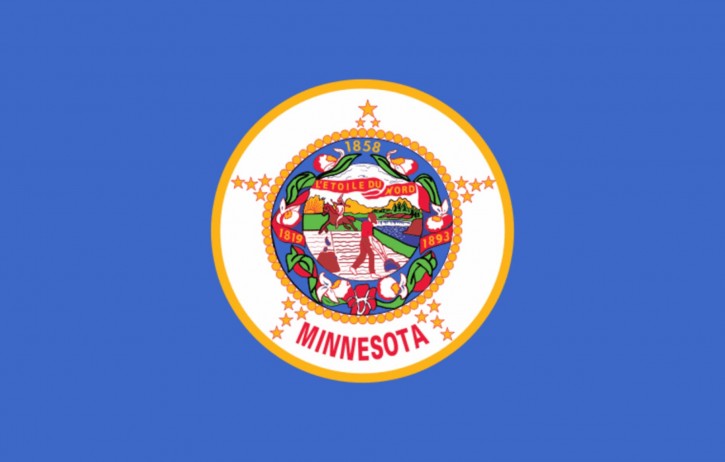
State Flag
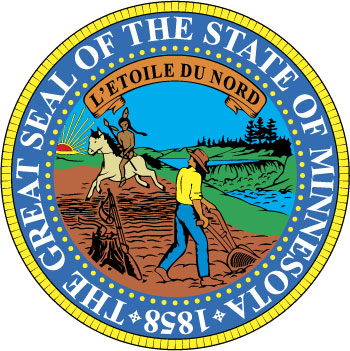
Great Seal
Nickname
The Land of 10,000 Lakes / The North Star State
Motto
L’Étoile du Nord ("The Star of the North")

Bird
Common Loon

Flower
Showy Lady’s Slipper
Tree
Red (Norway) Pine
Fish
Walleye
Grain
Wild Rice (Manoomin)
Mushroom
Morel
Gemstone
Lake Superior Agate
Butterfly
Monarch
Muffin
Blueberry Muffin
Song
"Hail! Minnesota"