
 English
 Español
 中文
中文 हिन्दी
 Français
On this page
Overview
Mississippi is a state in the Deep South region of the United States, bordered by Tennessee to the north, Alabama to the east, the Gulf of Mexico and Louisiana to the south, and Arkansas and Louisiana across the Mississippi River to the west. With roughly 2.94 million residents across 48,432 square miles, it is the 35th-most populous state and the 32nd largest by area.
Mississippi entered the Union as the 20th state on December 10, 1817. The state takes its name from the Mississippi River, whose name derives from the Ojibwe "Misi-ziibi," meaning "great river." Jackson, in the geographic center of the state, is the state capital and the largest city. The state is divided culturally and geographically into the Delta, the Hills, the Piney Woods, and the Gulf Coast — each with distinct economies and identities.
Mississippi is the birthplace of America’s blues music — Robert Johnson, B.B. King, Muddy Waters, Howlin’ Wolf, and John Lee Hooker were all born in the Mississippi Delta — as well as the home of Elvis Presley (born in Tupelo) and rock and roll. The state has produced an outsized share of major American writers, including William Faulkner, Eudora Welty, Tennessee Williams, Richard Wright, Margaret Walker, and John Grisham. Mississippi was at the center of the most violent and consequential phases of the U.S. Civil Rights Movement.
Geography & Climate
Mississippi is a state of low-lying coastal plain and gently rolling hills. The Mississippi Alluvial Plain — the Yazoo–Mississippi Delta, or simply "the Delta" — covers the northwestern part of the state with exceptionally fertile black-clay soils built up over thousands of years by the Mississippi River’s flood deposits. The Delta is one of the most agriculturally productive regions in the United States and the cradle of Mississippi’s plantation economy and blues music.
East of the Delta, the North Central Hills and the Pontotoc Ridge rise to forested uplands. Woodall Mountain in Tishomingo County in the far northeast, at 807 feet, is the state’s highest point — one of the lowest "highest points" of any state. The Piney Woods covers much of southern Mississippi with longleaf and slash pine forests. Mississippi’s 44 miles of Gulf of Mexico coastline run from Pearlington east to the Alabama border and include barrier islands now protected as Gulf Islands National Seashore.
The climate is humid subtropical, with hot, humid summers, mild winters, and abundant year-round rainfall. Mississippi sits in the Atlantic hurricane belt and is regularly struck by major storms — Hurricane Camille (1969), Katrina (2005), and others have devastated coastal communities. The Pearl, Big Black, Yazoo, Tombigbee, and Pascagoula rivers drain different parts of the state. Magnolias and live oaks grow throughout, and Bay St. Louis on the coast is famous for its centuries-old oak canopy.
History
For thousands of years before European contact, the area was home to the Choctaw, Chickasaw, Natchez, Houma, Biloxi, and Tunica peoples, with the elaborate Mississippian civilization centered in the Lower Mississippi Valley. The Spanish explorer Hernando de Soto crossed Mississippi in 1540, the first European to do so. French explorer René-Robert Cavelier, Sieur de La Salle, claimed the entire Mississippi Valley for France in 1682; Pierre Le Moyne d’Iberville established Fort Maurepas at present-day Ocean Springs in 1699 — the oldest permanent European settlement on the U.S. Gulf Coast.
France ceded Mississippi to Britain in 1763 after the French and Indian War. Britain held the area until the American Revolution, after which it became part of the United States. The Mississippi Territory was organized in 1798. Following decades of treaty-pressure and forced removal, the Choctaw under the 1830 Treaty of Dancing Rabbit Creek and the Chickasaw under the 1832 Treaty of Pontotoc Creek ceded their remaining homelands and were forced west along the Trail of Tears.
Mississippi was admitted as the 20th state on December 10, 1817. The antebellum Mississippi economy was built on cotton plantations and the labor of enslaved African Americans, who made up the majority of the state’s population by 1840. Mississippi seceded on January 9, 1861, the second state to do so. The Siege of Vicksburg in May–July 1863 was one of the most decisive Union victories of the Civil War; combined with Gettysburg, it turned the war.
Reconstruction briefly empowered African American Mississippians; Hiram Rhodes Revels of Mississippi became the first African American U.S. Senator in 1870. The state then plunged into the longest, harshest Jim Crow era of any U.S. state. The 1955 murder of fourteen-year-old Emmett Till near Money, the 1962 federal-troop integration of the University of Mississippi, the 1963 assassination of NAACP field secretary Medgar Evers, and the 1964 murders of three Freedom Summer voter-registration workers near Philadelphia, Mississippi, were among the central events of the U.S. Civil Rights Movement. The 1965 Voting Rights Act fundamentally rebuilt Mississippi politics. The state today has more elected African American officials than any other.
Economy
Mississippi hosts an economy traditionally rooted in agriculture, forestry, and the Gulf shipbuilding industry, with significant gaming, automotive manufacturing, and federal-aerospace sectors.
- Agriculture: Mississippi is the nation’s leading producer of farm-raised catfish, supplying the bulk of U.S. domestic catfish. The state is also a top producer of cotton, soybeans, rice, sweet potatoes, and poultry, with the Delta as the agricultural heartland. Agriculture and the food/forestry chain account for roughly 17 percent of state employment.
- Forestry and forest products: Roughly 65 percent of Mississippi’s land area is forested, mostly with pine. The state is one of the largest U.S. producers of lumber, plywood, pulpwood, and paper. Major paper mills operate at Vicksburg, Monticello, Greenville, and elsewhere.
- Shipbuilding and defense: Huntington Ingalls Industries — Ingalls Shipbuilding at Pascagoula — is the largest private employer in Mississippi and the principal U.S. Navy shipyard for amphibious assault ships, San Antonio–class transport docks, and National Security Cutters for the U.S. Coast Guard. NASA Stennis Space Center in Hancock County is the country’s largest rocket-engine testing facility.
- Automotive and manufacturing: Nissan operates a major vehicle assembly plant in Canton (Madison County), and Toyota assembles the Corolla at its Blue Springs plant (Union County). Tier-1 suppliers cluster around both plants. Mississippi also hosts substantial poultry processing (Sanderson Farms, before its Wayne-Sanderson merger; Tyson), and aerospace operations of GE Aviation in Ellisville and Aurora Flight Sciences in Columbus.
- Gaming and tourism: Mississippi was one of the first U.S. states to legalize riverboat and dockside casinos (1990), creating significant gaming economies on the Gulf Coast (Biloxi, Gulfport, Bay St. Louis) and in Tunica County in the Delta. The state’s music tourism — Memphis-adjacent Tunica, the Mississippi Blues Trail across the Delta, Elvis’s birthplace in Tupelo, and Natchez antebellum architecture — anchor a steady tourism economy.
Government
Mississippi operates under its 1890 constitution. The Mississippi Legislature is bicameral, with a 52-member Senate and a 122-member House of Representatives, both elected to four-year terms. There are no legislative term limits.
The Governor of Mississippi serves a four-year term and is limited to two consecutive terms. The state also separately elects a Lieutenant Governor, Attorney General, Secretary of State, Treasurer, Auditor, Insurance Commissioner, Commissioner of Agriculture and Commerce, and three Transportation and Public Service Commissioners. Mississippi has one of the most extensive sets of independently elected statewide executive officials of any U.S. state.
Mississippi has four seats in the U.S. House of Representatives plus two U.S. Senators. The Supreme Court of Mississippi has nine justices elected from three districts to staggered eight-year terms. The state capital is Jackson.
Culture
Mississippi culture is shaped above all by the African American Delta blues tradition and by the rural Southern culture of the Hills, the Piney Woods, and the Gulf Coast. The Mississippi Blues Trail, the Delta Blues Museum in Clarksdale, the B.B. King Museum and Delta Interpretive Center in Indianola, the Elvis Presley Birthplace in Tupelo, and the Grammy Museum Mississippi in Cleveland anchor the state’s deep music heritage. The Mississippi Delta is widely recognized as the cradle of America’s blues, gospel, and rock and roll traditions.
Mississippi has produced an extraordinarily large share of major American writers per capita: William Faulkner (Oxford and his fictional Yoknapatawpha County), Eudora Welty (Jackson), Tennessee Williams (Columbus), Richard Wright (Roxie), Margaret Walker, Willie Morris, Walker Percy, Shelby Foote, Ellen Gilchrist, John Grisham, and Jesmyn Ward. The Center for the Study of Southern Culture at the University of Mississippi documents and supports the state’s literary, musical, and folk-arts traditions.
Mississippi cuisine — fried catfish, hush puppies, tamales (a distinctive Delta Mississippi tradition), gumbo on the Coast, barbecue, pecan pie, sweet potato pie, and Mississippi mud pie — is among the most influential regional cuisines in the U.S. The state is overwhelmingly Christian and within the Bible Belt, with Southern Baptist and African Methodist Episcopal churches both deeply rooted. The Mississippi State Fair in Jackson and the Neshoba County Fair near Philadelphia — the state’s "giant house party" with its open-air political speeches — are central public rituals.
Notable Cities
- Jackson — State capital and largest city, on the Pearl River, with a city population of roughly 145,000 and a metropolitan area of about 590,000. Home of the Mississippi Civil Rights Museum and the Mississippi History Museum (a joint complex), the Mississippi State Capitol, Jackson State University, Tougaloo College, the Eudora Welty House, and Mississippi’s major medical center, the University of Mississippi Medical Center.
- Gulfport — Second-largest city, on the Mississippi Gulf Coast, with a population of roughly 72,000. Home of the Port of Gulfport (one of the largest U.S. banana-import ports), Keesler Air Force Base nearby in Biloxi, and a substantial casino-gaming economy along the coast.
- Southaven — Third-largest city, in DeSoto County in the northwest corner of the state, immediately south of Memphis, with a population of roughly 56,000. Functionally part of the Memphis metropolitan area and the fastest-growing community in Mississippi.
- Hattiesburg — A city of roughly 47,000 in southern Mississippi, the "Hub City" of the Piney Woods. Home of the University of Southern Mississippi and William Carey University, and a major rail, highway, and military-training center (Camp Shelby Joint Forces Training Center is the largest state-owned and -operated training facility in the United States).
- Biloxi — A city of roughly 50,000 on the Mississippi Gulf Coast, the site of Fort Maurepas (1699) — the oldest permanent European settlement on the U.S. Gulf Coast. Home of Keesler Air Force Base, the Biloxi Lighthouse, the Beauvoir estate (last home of Jefferson Davis), and a major Gulf Coast gaming and tourism economy.
State Symbols
Mississippi’s official state symbols, designated by the Mississippi Legislature, celebrate the magnolia forests, Gulf waters, agricultural heritage, and Mississippi Delta cultural roots of the Magnolia State.
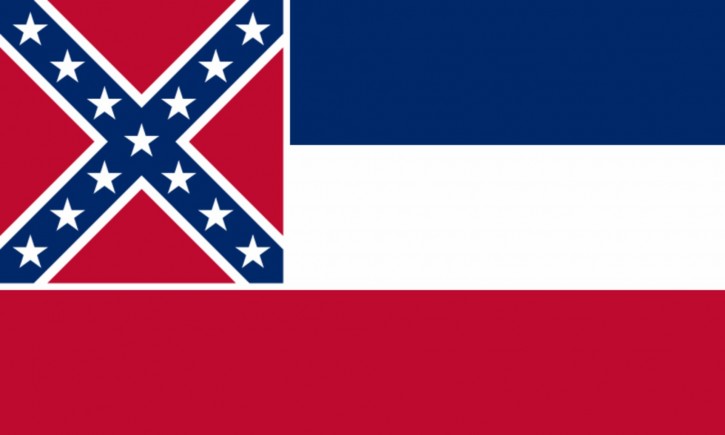
State Flag
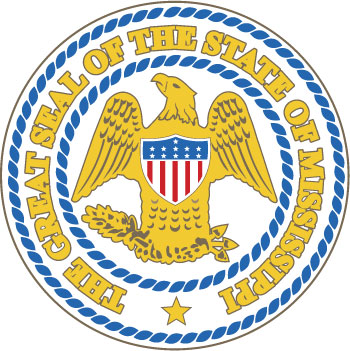
Great Seal
Nickname
The Magnolia State
Motto
Virtute et armis ("By valor and arms")

Bird
Northern Mockingbird

Flower
Magnolia
Tree
Southern Magnolia
Mammal
White-tailed Deer (land); Bottlenose Dolphin (marine)
Reptile
American Alligator
Fish
Largemouth Bass
Butterfly
Spicebush Swallowtail
Insect
Western Honeybee
Beverage
Milk
Song
"Go, Mississippi"