
 English
 Español
 中文
中文 हिन्दी
 Français
On this page
Overview
Missouri is a state in the Midwestern United States, bordered by Iowa to the north; Illinois, Kentucky, and Tennessee across the Mississippi River to the east; Arkansas to the south; and Oklahoma, Kansas, and Nebraska to the west. With roughly 6.18 million residents across 69,707 square miles, it is the 19th-most populous state and the 21st largest by area. Missouri shares a border with eight other states — a tie with Tennessee for the most of any U.S. state.
Missouri entered the Union as the 24th state on August 10, 1821, under the Missouri Compromise of 1820 — a federal balancing act that admitted Missouri as a slave state alongside Maine as a free state. The state takes its name from the Missouria (Niúachi) people, an Indigenous nation whose name means roughly "town of the large canoes." Jefferson City, on the Missouri River in the central part of the state, is the state capital. Kansas City in the west and St. Louis in the east are by far the largest cities, anchoring metropolitan areas of about 2.4 million and 2.8 million respectively.
Missouri is the geographic and demographic heart of the United States. The confluence of the Missouri and Mississippi rivers north of St. Louis is one of the most important inland water junctions in North America. Missouri was the "Gateway to the West" for Lewis and Clark, the Oregon Trail, the Santa Fe Trail, and the Pony Express. The state has produced President Harry S. Truman, writers Mark Twain and T.S. Eliot, the Disney empire of native son Walt Disney, the Kansas City jazz of Charlie Parker, the St. Louis blues of Chuck Berry, and the ragtime of Scott Joplin.
Geography & Climate
Missouri’s geography is shaped by the Missouri and Mississippi rivers. The northern half of the state is gently rolling glacial plain — fertile agricultural land that is part of the corn-and-soybean Corn Belt. South of the Missouri River, the Ozark Plateau rises into the rugged, forested Ozark Mountains, which cover roughly the southern third of the state and continue into Arkansas. Taum Sauk Mountain in the St. Francois Mountains, at 1,772 feet, is Missouri’s highest point.
The Bootheel of southeastern Missouri — the rectangular notch that hangs below the rest of the state — is part of the Mississippi Alluvial Plain and was historically swampy before twentieth-century drainage made it some of Missouri’s most productive cotton and rice land. The Lake of the Ozarks in central Missouri, formed by Bagnell Dam on the Osage River in 1931, has more shoreline than the entire California coast. The Mark Twain National Forest preserves much of the state’s remaining Ozark wilderness.
The climate is humid continental in the north and humid subtropical in the south, with hot, humid summers and cold winters that grow milder toward the Bootheel. Missouri sits in the heart of Tornado Alley’s eastern flank and experiences frequent severe weather. The state’s climate is also distinctive among Midwestern states for its New Madrid Seismic Zone in the southeast — the source of three of the largest North American earthquakes in recorded history in 1811–1812, and a continuing seismic hazard.
History
For thousands of years before European arrival, Missouri was home to Mississippian-culture mound-building societies (notably at Cahokia just east in present-day Illinois), and at European contact to the Osage, Missouria (Niúachi), Otoe, and Quapaw peoples. French explorers reached the Missouri country in the late seventeenth century. Pierre Laclède founded St. Louis in 1764 as a French fur-trading post, and Sainte Genevieve, established in the 1730s, is the oldest permanent European settlement west of the Mississippi.
Missouri passed from France to Spain in 1763, back to France in 1800, and to the United States via the Louisiana Purchase of 1803. The Lewis and Clark Expedition launched from St. Charles in May 1804. Missouri Territory was organized in 1812. The Missouri Compromise of 1820 — the first major federal legislative attempt to keep the balance between free and slave states — admitted Missouri as a slave state on August 10, 1821 alongside Maine as a free state. The compromise also prohibited slavery in the remaining Louisiana Purchase land north of 36°30′ latitude.
Throughout the nineteenth century, Missouri served as the gateway to the American West. The Oregon Trail and Santa Fe Trail both began at Independence; the Pony Express launched from St. Joseph in 1860. Members of the Latter-day Saint movement settled at Independence and other Missouri sites in the 1830s, with Joseph Smith proclaiming Independence the future site of Zion before mounting persecution drove the church to Illinois and ultimately to Utah.
Missouri remained in the Union during the Civil War but was bitterly divided, with both Union and Confederate state governments operating simultaneously and bushwhacker raids devastating the countryside. The post-war period brought industrialization in St. Louis and Kansas City, the rise of Anheuser-Busch as the world’s largest brewer, the 1904 St. Louis World’s Fair and Summer Olympics, the founding of the Walt Disney Company by Marceline native Walt Disney, the political career of Independence native Harry S. Truman (33rd U.S. President, 1945–1953), and the long peaks of Kansas City jazz and St. Louis blues.
Economy
Missouri hosts a diversified economy anchored by aerospace and defense, agriculture and food processing, financial services, biosciences and animal health, and substantial tourism around Branson, Lake of the Ozarks, and the two major metros.
- Aerospace and defense: Boeing’s Defense, Space and Security division — heir to McDonnell Douglas — is headquartered in the St. Louis area and is one of Missouri’s largest employers, producing the F-15, F/A-18, T-7, and major Navy and Air Force programs. Defense contracting and aerospace research span the state, including major work at Whiteman Air Force Base (B-2 stealth bombers) and Fort Leonard Wood.
- Agriculture: Missouri is a top-five U.S. producer of soybeans, beef cattle, hogs, hay, rice (in the Bootheel), turkey, and cotton. Bayer Crop Science (formerly Monsanto), headquartered in St. Louis, is one of the world’s largest agricultural-input companies. ConAgra, Tyson, Smithfield, JBS, and Hostess (Twinkies) all operate major Missouri food-processing facilities.
- Financial services and biosciences: St. Louis is home to Edward Jones, Stifel Financial, Centene (a Fortune 500 health-insurance giant), Emerson Electric, Reinsurance Group of America, Express Scripts, and the Federal Reserve Bank of St. Louis. Kansas City is the headquarters of Hallmark Cards, H&R Block, Russell Stover, Garmin (Olathe, KS is adjacent), and the Federal Reserve Bank of Kansas City. The Kansas City Animal Health Corridor straddles the Missouri–Kansas border.
- Manufacturing and brewing: Anheuser-Busch InBev’s St. Louis brewery — the original 1852 plant — is the world’s flagship of one of the largest brewing companies on Earth. Ford, GM, and Stellantis all operate major Missouri assembly plants. The St. Louis area hosts substantial chemicals manufacturing (Solutia, Dow), aluminum smelting (historically), and a long history as a U.S. shoe and apparel manufacturing center.
- Tourism: Branson in the Ozarks is one of the most-visited small towns in the United States, drawing roughly 8 million visitors a year for country and variety shows, Silver Dollar City, and Table Rock Lake. The Lake of the Ozarks is one of the largest U.S. inland recreational lakes. St. Louis (Gateway Arch, Anheuser-Busch tours, Forest Park), Kansas City (BBQ, jazz, fountains), and Mark Twain’s Hannibal anchor a substantial heritage-tourism economy.
Government
Missouri operates under its 1945 constitution, the fourth in its history. The Missouri General Assembly is bicameral, with a 34-member Senate (four-year terms, two-term limit) and a 163-member House of Representatives (two-year terms, four-term limit). Missouri was one of the first U.S. states to impose strict legislative term limits, in 1992.
The Governor of Missouri serves a four-year term and is limited to two terms. The state also separately elects a Lieutenant Governor, Attorney General, Secretary of State, Treasurer, and State Auditor. Jefferson City was selected as the capital in 1821 because of its central location on the Missouri River, and remains one of the smaller U.S. state capitals.
Missouri has eight seats in the U.S. House of Representatives plus two U.S. Senators. The Supreme Court of Missouri has seven justices appointed by the governor through merit selection (the "Missouri Plan," which has been adopted in part by many other states) and retained by voters every twelve years. The state capital is Jefferson City.
Culture
Missouri culture is split between two strikingly different major cities. Kansas City — straddling the Missouri-Kansas border but with the larger and older portion in Missouri — is famous for its barbecue (slow-smoked, finished with thick tomato-and-molasses sauce, served with burnt ends), its jazz heritage (the 18th & Vine district where Charlie Parker came of age), its more than 200 fountains (more than any city outside Rome), its Negro Leagues Baseball Museum, the Country Club Plaza, and its NFL Chiefs and MLB Royals. St. Louis is famous for the Gateway Arch (the tallest U.S. monument at 630 feet), Forest Park (larger than Central Park), Anheuser-Busch, the Cardinals, the Italian Hill neighborhood (toasted ravioli, gooey butter cake, t-ravs), and the long blues, soul, and ragtime traditions of Chuck Berry, Tina Turner, Miles Davis, and Scott Joplin (Sedalia and St. Louis).
Outside the two metros, Missouri culture is overwhelmingly small-town, rural, and Southern-influenced. The Ozark Mountains preserve a deep Anglo-Scots-Irish folk-music tradition; Branson’s country-and-variety theater industry is built on it. Hannibal on the Mississippi was Mark Twain’s boyhood home and the setting for The Adventures of Tom Sawyer and Adventures of Huckleberry Finn. Marceline is Walt Disney’s boyhood town and the inspiration for Main Street, U.S.A. at the Disney parks. Independence is the birthplace of President Harry S. Truman and a longtime headquarters of the Community of Christ (formerly Reorganized LDS Church).
Missouri has produced an extraordinary share of American cultural figures: Mark Twain (Hannibal), T.S. Eliot (St. Louis), Maya Angelou (St. Louis), Langston Hughes (Joplin), Walt Disney (Marceline), Scott Joplin (Sedalia), Charlie Parker (Kansas City, KS but raised on both sides), Chuck Berry (St. Louis), Tina Turner (Nutbush, TN but career launched in St. Louis), Miles Davis (Alton, IL but career in St. Louis), Yogi Berra (St. Louis), Sheryl Crow (Kennett), Brad Pitt (Springfield), and Brad Paisley have all helped define Missouri’s outsize cultural footprint.
Notable Cities
- Kansas City — Largest city in Missouri, on the Missouri River at the border with Kansas, with a city population of roughly 510,000 and a bi-state metropolitan area of about 2.4 million. Famous for Kansas City–style barbecue, the historic 18th & Vine Jazz District, the Country Club Plaza shopping district, the Negro Leagues Baseball Museum, the National World War I Museum, Arrowhead Stadium (NFL Chiefs), Kauffman Stadium (MLB Royals), and the headquarters of Hallmark Cards, H&R Block, and Russell Stover.
- St. Louis — Independent city on the Mississippi River, with a city population of roughly 280,000 and a metropolitan area of about 2.8 million. Anchor of "the Gateway to the West," home of the Gateway Arch, Forest Park (larger than Central Park), the St. Louis Cardinals (one of the most successful franchises in MLB history), Anheuser-Busch, the historic Italian neighborhood The Hill, Washington University, and Saint Louis University.
- Springfield — Third-largest city, in southwestern Missouri at the edge of the Ozarks, with a population of roughly 170,000. Known as the "Queen City of the Ozarks," home of Missouri State University, Drury University, Evangel University, and Bass Pro Shops’ original Outdoor World mega-store. Birthplace of Route 66 (founded April 30, 1926, at the Colonial Hotel).
- Columbia — A city of roughly 130,000 in central Missouri, midway between St. Louis and Kansas City. The flagship-university town anchored by the University of Missouri (the oldest public university west of the Mississippi, founded 1839), as well as Stephens College and Columbia College. A regional health-care and insurance center.
- Independence — A city of roughly 121,000 immediately east of Kansas City. The historic starting point of the Oregon, California, and Santa Fe trails; the boyhood and adult home of President Harry S. Truman (the Truman Library and Museum is here); and a longtime headquarters of the Community of Christ (formerly the Reorganized LDS Church).
State Symbols
Missouri’s official state symbols, designated by the Missouri General Assembly, celebrate the agricultural heritage, Ozark forests, river-and-prairie landscape, and Western-gateway identity of the Show-Me State.
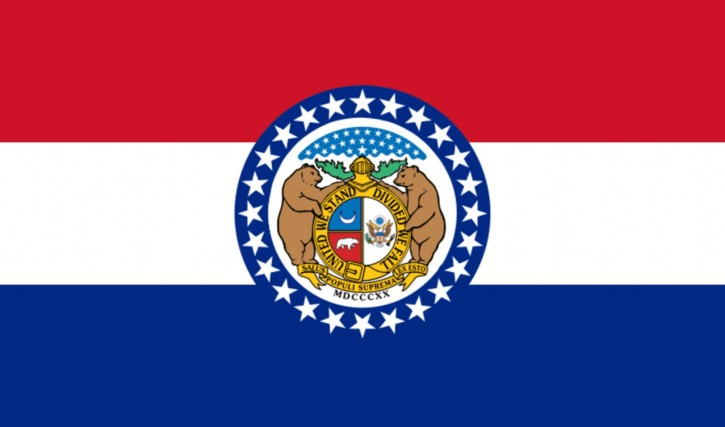
State Flag
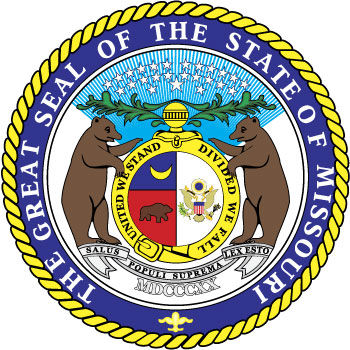
Great Seal
Nickname
The Show-Me State
Motto
Salus populi suprema lex esto ("The welfare of the people shall be the supreme law")

Bird
Eastern Bluebird

Flower
White Hawthorn Blossom
Tree
Flowering Dogwood
Animal
Missouri Mule
Reptile
Three-toed Box Turtle
Fish
Channel Catfish
Insect
Honeybee
Aquatic Animal
Paddlefish
Horse
Missouri Fox Trotter
Song
"Missouri Waltz"