
 English
 Español
 中文
中文 हिन्दी
 Français
On this page
Overview
Nebraska is a state in the Midwestern United States, bordered by South Dakota to the north, Iowa and Missouri across the Missouri River to the east, Kansas to the south, Colorado to the southwest, and Wyoming to the west. With roughly 1.99 million residents across 77,348 square miles, it is the 37th-most populous state and the 16th largest by area.
Nebraska entered the Union as the 37th state on March 1, 1867 — the first state admitted after the Civil War. The state takes its name from the Otoe word "Ñí Brásge" (or the related Omaha "Ní Btháska"), meaning "flat water," referring to the Platte River. Lincoln, named for Abraham Lincoln, is the state capital. Omaha on the Missouri River, the largest city, anchors a metropolitan area of about 985,000 that crosses into Iowa.
Nebraska is uniquely organized as the only U.S. state with a unicameral, officially nonpartisan legislature — a system established by amendment in 1934 at the urging of progressive senator George W. Norris. The state is one of the most agriculturally productive in the country, anchoring the U.S. cattle-feeding industry and ranking among the top producers of corn and soybeans. Omaha is the headquarters of Berkshire Hathaway (Warren Buffett), Mutual of Omaha, Union Pacific Railroad, and Kiewit Corporation.
Geography & Climate
Nebraska lies entirely within the Great Plains and rises gradually from roughly 840 feet in the Missouri River valley at the southeast corner to Panorama Point in the far southwest at 5,424 feet (Nebraska’s highest point, at the meeting of the Colorado and Wyoming borders). The state spans three major physiographic regions: the Dissected Till Plains in the east, the rolling Loess Hills and Loess Plains in the south-central, and the High Plains in the west.
The Sandhills region in north-central and northwest Nebraska is one of the largest sand-dune formations in the Western Hemisphere, covering roughly a quarter of the state. The dunes are mostly stabilized by mixed-grass prairie and create a uniquely beautiful, lightly populated cattle-grazing landscape. The Sandhills overlie the rich Ogallala Aquifer, on which most of Nebraska’s irrigated agriculture depends.
The Platte River — formed by the confluence of the North Platte and South Platte rivers — flows east across the state to join the Missouri at Plattsmouth. The Niobrara River across northern Nebraska is one of the country’s premier canoeing rivers. The climate is humid continental in the east and semi-arid in the west, with hot summers, cold winters, and frequent severe weather; Nebraska sits at the heart of the western flank of Tornado Alley.
History
For thousands of years before European arrival, Nebraska was home to the Otoe, Missouria, Omaha, Ponca, Pawnee, and (in western Nebraska) Lakota, Cheyenne, and Arapaho peoples. The Lewis and Clark Expedition passed through Nebraska in 1804 along the Missouri River and held its first formal council with Indigenous nations near present-day Council Bluffs. The region became part of the United States with the Louisiana Purchase of 1803.
Through the mid-nineteenth century, Nebraska was the great corridor of westward migration: the Oregon Trail, the California Trail, the Mormon Trail, and the Pony Express all followed the Platte River across what is now central Nebraska. The Kansas-Nebraska Act of 1854 created the Nebraska Territory and reopened the question of slavery in the western territories. The 1862 Homestead Act drove the first major wave of agricultural settlement; Daniel Freeman filed the first claim under the act in Beatrice, Nebraska, on January 1, 1863. Nebraska was admitted as the 37th state on March 1, 1867.
In 1879, the trial of Ponca chief Standing Bear — held in Omaha — produced a landmark federal ruling that Native Americans were "persons under the law" and could not be imprisoned without legal process. The decision was a turning point in U.S. civil-rights law. The late nineteenth and early twentieth centuries brought massive German, Czech (Bohemian), Irish, Polish, Russian-German, and Scandinavian immigration to Nebraska’s farms and railroad towns.
Nebraska politician William Jennings Bryan, "the Great Commoner," delivered his 1896 "Cross of Gold" speech to the Democratic National Convention, helping launch progressive populism and three Democratic presidential nominations. In 1934, voters approved an amendment proposed by Senator George W. Norris to convert the Nebraska Legislature into a single-chamber, nonpartisan body — the only such state legislature in the country. The 1950s established Offutt Air Force Base in Bellevue as the headquarters of Strategic Air Command (now U.S. Strategic Command), and the rise of Berkshire Hathaway under Warren Buffett anchored Omaha as a global financial center.
Economy
Nebraska hosts a small but unusually concentrated economy anchored by cattle-feeding and agriculture, insurance and financial services, transportation and logistics, and food processing.
- Cattle and agriculture: Nebraska is the nation’s largest cattle-feeding state and the largest commercial red-meat producer. It is also a top-three producer of corn (Nebraska, Iowa, and Illinois alternate), and a major producer of soybeans, sorghum, hay, wheat, sugar beets, and popcorn. Nebraska contains the largest U.S. center-pivot irrigation area, drawing on the Ogallala Aquifer.
- Insurance and finance: Berkshire Hathaway, headquartered in Omaha and chaired since 1965 by Warren Buffett, is one of the largest holding companies in the world by market capitalization. Mutual of Omaha is one of the largest U.S. insurance and financial-services firms. The Federal Reserve Bank of Kansas City has a major Omaha branch.
- Transportation and logistics: Union Pacific Corporation — the largest U.S. railroad — is headquartered in Omaha, where it was chartered by President Lincoln in 1862 to build the eastern half of the first transcontinental railroad. Werner Enterprises, one of the largest U.S. truckload carriers, is headquartered in Omaha. Crete Carrier, Crowley Corporation, and others anchor a deep state trucking sector.
- Food processing and manufacturing: Nebraska’s cattle-feeding economy supports massive meatpacking operations from Tyson, JBS, Cargill, and Smithfield. ConAgra Foods was founded in Omaha (and headquartered there until 2016). Kiewit Corporation, headquartered in Omaha, is one of the largest U.S. construction and engineering firms. The state hosts major operations of HDR, the Gallup organization (founded in Lincoln and headquartered in Omaha), and Valmont Industries (irrigation equipment, towers).
- Defense and aerospace: Offutt Air Force Base in Bellevue is the headquarters of U.S. Strategic Command (USSTRATCOM), which oversees U.S. nuclear forces, global strike, missile defense, and space operations — making the Omaha metro one of the most important defense-command nodes in the United States. The 55th Wing at Offutt operates the unique RC-135 reconnaissance fleet.
Government
Nebraska operates under its 1875 constitution. Uniquely among U.S. states, the Nebraska Legislature is unicameral — a single chamber of 49 senators serving four-year terms — and officially nonpartisan, meaning candidates do not appear on ballots with party affiliation and there are no formal party caucuses. The arrangement, established by 1934 constitutional amendment at the urging of Senator George W. Norris, makes Nebraska one of the most institutionally distinctive U.S. states.
The Governor of Nebraska serves a four-year term and is limited to two consecutive terms. The state also elects a Lieutenant Governor (jointly with the Governor), Attorney General, Secretary of State, Treasurer, and Auditor of Public Accounts. Nebraska and Maine are the only U.S. states to award electoral-college votes by congressional district rather than statewide winner-take-all.
Nebraska has three seats in the U.S. House of Representatives plus two U.S. Senators. The Nebraska Supreme Court has seven justices appointed by the governor through merit selection and retained by uncontested election. The state capital is Lincoln, whose 400-foot Nebraska State Capitol — completed in 1932 and topped by "The Sower" — is one of the most architecturally distinguished U.S. state capitols.
Culture
Nebraska culture is dominated nationally by University of Nebraska–Lincoln Cornhuskers football. The Cornhuskers have won five national championships, and Memorial Stadium on game days becomes the third-largest "city" in Nebraska, with attendance exceeding 90,000. The Huskers sold out every home game from 1962 through 2023 — at 375 consecutive sellouts the longest streak in college football history. "Husker Red" is the dominant cultural color of the state and "Go Big Red" the unofficial state slogan.
Beyond football, Nebraska culture is rooted in the agricultural heartland identity, the German, Czech (Bohemian), Polish, Russian-German, Swedish, and Irish heritage of the Plains, and a strong African American and Mexican American presence in Omaha. The state has produced an extraordinary share of major American cultural figures: writers Willa Cather (Red Cloud, "O Pioneers!" "My Ántonia"), Mari Sandoz (Sandhills, "Old Jules"), John G. Neihardt, and Wright Morris; actors Marlon Brando, Henry Fonda, Fred Astaire (all born in Omaha), Nick Nolte, James Coburn, Hilary Swank, and Yul Brynner (Sept-Îles, born in Russia but raised partly in Omaha); broadcaster Johnny Carson (Norfolk); and football coach Tom Osborne.
The Reuben sandwich — corned beef, sauerkraut, Swiss cheese, and Russian dressing on grilled rye — was invented at the Blackstone Hotel in Omaha around 1925. Runzas (German-Russian meat-and-cabbage hand pies brought by Volga German settlers) are a state specialty. The College World Series has been held at Omaha since 1950 — first at Rosenblatt Stadium and since 2011 at Charles Schwab Field. The Henry Doorly Zoo & Aquarium in Omaha is among the most-visited zoos in the country.
Notable Cities
- Omaha — Largest city in Nebraska, on the Missouri River, with a city population of roughly 487,000 and a bi-state metropolitan area of about 985,000. Home of Berkshire Hathaway (Warren Buffett), Mutual of Omaha, Union Pacific Railroad, Kiewit Corporation, the College World Series, the Henry Doorly Zoo, and a vibrant Old Market district. Offutt Air Force Base in Bellevue, the headquarters of U.S. Strategic Command, is part of the Omaha metro.
- Lincoln — State capital and second-largest city, on Salt Creek, with a population of roughly 295,000 and a metropolitan area of about 350,000. Home of the University of Nebraska–Lincoln (and Memorial Stadium), the Nebraska State Capitol with its 400-foot tower and "The Sower," the headquarters of the Gallup organization, Nelnet, and Sandhills Global, and the Sheldon Museum of Art.
- Bellevue — A city of roughly 64,000 immediately south of Omaha, the oldest continuously settled community in Nebraska (founded in 1822). Home of Offutt Air Force Base — the headquarters of U.S. Strategic Command — and Bellevue University.
- Grand Island — A city of roughly 52,000 in central Nebraska, on the Platte River. The largest city in central Nebraska and a regional service center, hosting the annual Nebraska State Fair and the Stuhr Museum of the Prairie Pioneer.
- Kearney — A city of roughly 34,000 in south-central Nebraska, on the Platte River. Home of the University of Nebraska at Kearney and the Great Platte River Road Archway Monument — a museum that spans Interstate 80 and tells the story of westward migration along the Platte.
State Symbols
Nebraska’s official state symbols, designated by the Nebraska Legislature, celebrate the Great Plains landscape, agricultural heritage, and Indigenous identity of the Cornhusker State.
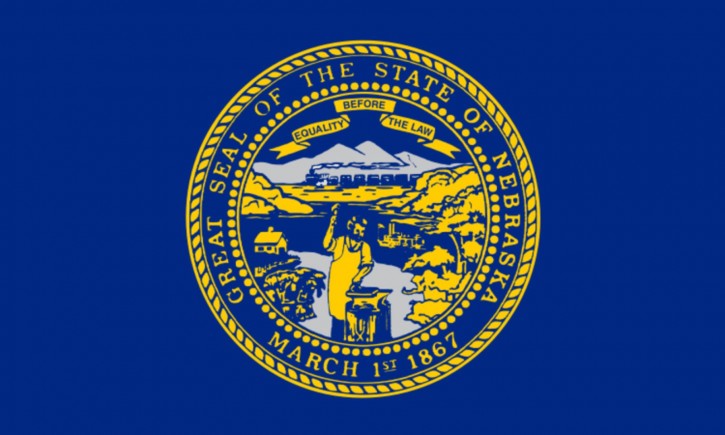
State Flag
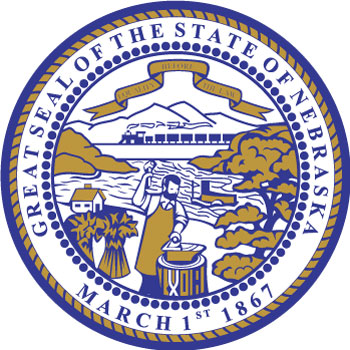
Great Seal
Nickname
The Cornhusker State
Motto
Equality Before the Law

Bird
Western Meadowlark
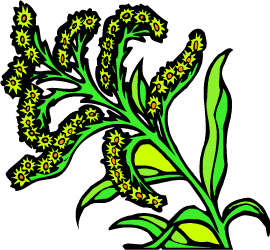
Flower
Goldenrod
Tree
Eastern Cottonwood
Mammal
White-tailed Deer
Fish
Channel Catfish
Insect
Honeybee
Gem
Blue Agate (Prairie Agate)
Rock
Prairie Agate
Soft Drink
Kool-Aid (invented in Hastings, NE)
Song
"Beautiful Nebraska"