
 English
 Español
 中文
中文 हिन्दी
 Français
On this page
Overview
New Hampshire is a state in the New England region of the northeastern United States, bordered by Quebec to the north, Maine and the Atlantic Ocean to the east, Massachusetts to the south, and Vermont across the Connecticut River to the west. With roughly 1.4 million residents across 9,349 square miles, it is the 41st-most populous state and the 46th largest by area — the fifth-smallest state by area.
New Hampshire ratified the U.S. Constitution as the ninth state on June 21, 1788, providing the critical ninth ratification that placed the Constitution into force. The state takes its name from the English county of Hampshire. Concord on the Merrimack River is the state capital; Manchester, also on the Merrimack, is the largest city and economic center. New Hampshire’s 18-mile Atlantic coastline is the second-shortest of any U.S. state with coastline (after Illinois on Lake Michigan).
New Hampshire is famous for the motto "Live Free or Die," for the White Mountains and Mount Washington, for the iconic (now collapsed) Old Man of the Mountain rock formation, and for the First-in-the-Nation Presidential Primary held every four years by state law. The state has the lowest combined tax burden of any U.S. state — there is no general sales tax and no broad personal income tax — financed instead by relatively high property taxes and various business and excise taxes.
Geography & Climate
New Hampshire is shaped by the White Mountains, which dominate the northern half of the state. The Presidential Range — Mount Washington (6,288 feet), Mount Adams, Mount Jefferson, Mount Madison, Mount Monroe, and others — is the highest range in the northeastern United States. Mount Washington is famous for some of the world’s worst recorded weather; for sixty-two years (1934–1996) its observatory held the world record for the highest surface wind speed ever recorded, at 231 mph during the April 1934 storm.
South of the Whites, the Lakes Region centers on Lake Winnipesaukee — New Hampshire’s largest lake and one of the largest in New England — surrounded by Squam Lake, Lake Winnisquam, and dozens of smaller bodies of water. The Merrimack Valley along the central spine carries the state’s largest river south through Concord, Manchester, and Nashua to Massachusetts. The Connecticut River forms the entire western boundary with Vermont, and Lake Sunapee anchors the western Dartmouth–Sunapee region. The Monadnock and Seacoast regions occupy the southwest and the small southeast Atlantic coast.
New Hampshire is one of the most heavily forested U.S. states by percentage — roughly 84 percent of its land area — alongside Maine. The climate is humid continental with significant variation: the seacoast is moderated by the Atlantic, while the White Mountains experience cold, snowy winters with consistent ski conditions. Crawford Notch, Franconia Notch, and Pinkham Notch are dramatic mountain passes that anchor the state’s tourism economy. The annual Mount Washington Auto Road and the Cog Railway — the first mountain-climbing cog railway in the world (1869) — both ascend the great mountain.
History
Before European contact, New Hampshire was home to the Pennacook, Abenaki, and Western Abenaki peoples. English explorer Martin Pring sailed up the Piscataqua River in 1603. The first permanent English settlement in present-day New Hampshire was established at Odiorne’s Point in present-day Rye in 1623. New Hampshire was originally part of Massachusetts Bay Colony, then separated as the Province of New Hampshire in 1679 — the first English province in America to be governed separately under a royal charter.
New Hampshire was the first American colony to formally declare independence from Britain on January 5, 1776 — six months before the Declaration of Independence — and the first to adopt its own state constitution (also January 5, 1776). New Hampshire’s ratification of the U.S. Constitution on June 21, 1788, was the decisive ninth vote that established the Constitution as the law of the land.
The state motto "Live Free or Die" comes from a toast offered by Revolutionary War hero General John Stark on July 31, 1809, in a letter he wrote at age 81 declining to attend a reunion commemorating the 1777 Battle of Bennington: "Live free or die; death is not the worst of evils." The motto was officially adopted in 1945.
The nineteenth century built New Hampshire on textiles, leather, and shoes — the Amoskeag Manufacturing Company in Manchester operated what was, for decades, the largest cotton-textile mill in the world. The mill economy collapsed in the 1930s, and New Hampshire reinvented itself in the late twentieth century as a low-tax suburb of Boston and a New England technology center, particularly along the Interstate 93 corridor. The First-in-the-Nation Presidential Primary, formalized in 1920 and protected by state law, has made New Hampshire a critical four-year stop in U.S. presidential politics.
Economy
New Hampshire hosts a small but distinctive economy anchored by advanced manufacturing and defense, tourism, healthcare and biotech, financial and insurance services, and a strong cross-border consumer economy driven by the absence of sales and income tax.
- Advanced manufacturing and defense: BAE Systems is New Hampshire’s largest private employer, with major sites in Nashua, Merrimack, and Hudson that build electronic-warfare and reconnaissance systems for the U.S. military. Other major manufacturers include Albany International (composite components for jet engines), Hitchiner Manufacturing, Hypertherm (plasma cutting), and Velcro USA, all of which anchor a deep precision-manufacturing cluster.
- Tourism: Tourism is one of New Hampshire’s largest industries. The White Mountains, the Lakes Region, the Seacoast (Hampton Beach, Portsmouth), and the New Hampshire Motor Speedway (the largest sports venue in New England, hosting NASCAR Cup Series races) draw millions of visitors each year. Major ski resorts include Loon Mountain, Cannon Mountain, Bretton Woods, Waterville Valley, and Mount Sunapee.
- Healthcare and biotech: Dartmouth Health (formerly Dartmouth-Hitchcock) in Lebanon, anchored by the Geisel School of Medicine, is one of New Hampshire’s largest employers and a major academic medical center. Dean Kamen’s DEKA Research in Manchester (inventor of the Segway, advanced prosthetic arms, and the iBOT wheelchair) anchors a small but high-impact biomedical-engineering cluster.
- Cross-border consumer economy: New Hampshire has no general sales tax and no broad personal income tax — a long-standing political commitment. The state-run liquor commission operates large discount liquor stores at all major Massachusetts border crossings, drawing massive cross-border shopping from neighboring states. Major regional shopping centers — the Pheasant Lane Mall in Nashua, the Mall of New Hampshire in Manchester, and others — draw substantial out-of-state spending.
- Financial services and technology: Bank of America (formerly Merrill Lynch) and Fidelity Investments operate major back-office and wealth-management campuses in Hudson and Merrimack respectively. Liberty Mutual and Anthem maintain major operations. Software companies including Dyn (acquired by Oracle) and Bottomline Technologies have built a steady regional tech economy in the Manchester–Portsmouth corridor.
Government
New Hampshire operates under its 1784 constitution, the second-oldest functioning state constitution in the United States after Massachusetts. The New Hampshire General Court is bicameral, with a 24-member Senate and a 400-member House of Representatives — the largest U.S. state legislature and the fourth-largest English-speaking legislative body in the world (after the U.K. Parliament, the U.S. Congress, and the Indian Parliament). Both chambers serve two-year terms, with no term limits. Most legislators are paid only $100 per year, making New Hampshire one of the most citizen-driven state legislatures.
The Governor of New Hampshire serves a two-year term — one of only two U.S. state governors (with Vermont) elected to such short terms — with no term limit. The state separately elects no other constitutional officers at the polls; the Executive Council, a five-member elected body, advises and consents on appointments and major contracts. The state capital is Concord.
New Hampshire has two seats in the U.S. House of Representatives plus two U.S. Senators. The Supreme Court of New Hampshire has five justices appointed by the governor with Executive Council approval, serving to age 70. New Hampshire has held the First-in-the-Nation Presidential Primary every four years since 1920, protected by a state law that requires it to take place at least seven days before any "similar election" in any other state — making it a critical proving ground in U.S. presidential politics.
Culture
New Hampshire culture is shaped by Yankee independence, a deep tradition of town-meeting direct democracy in smaller communities, a long French Canadian heritage (especially in Manchester and Nashua, where 20–25 percent of residents report French Canadian ancestry), and the cultural pull of nearby Boston. The state motto "Live Free or Die" has both literal and ironic uses, and the state has long attracted libertarian "Free Stater" migration. The collapse of the Old Man of the Mountain — the granite profile in Franconia Notch State Park that adorned the state quarter and license plate — in May 2003 was an event of statewide mourning that says much about New Hampshire’s identity.
Robert Frost lived for decades in Franconia and Derry and wrote much of his greatest poetry — "The Road Not Taken," "Stopping by Woods on a Snowy Evening," "Mending Wall" — about the New Hampshire landscape. Dartmouth College in Hanover, founded in 1769 — one of the nine colonial colleges and a member of the Ivy League — anchors a distinctive intellectual and cultural community in the Upper Valley. The Currier Museum of Art in Manchester, the Strawbery Banke historic district in Portsmouth, and the Mount Washington Resort at Bretton Woods (where the 1944 Bretton Woods Agreement was signed) are leading cultural landmarks.
New Hampshire cuisine combines New England staples — clam chowder, lobster rolls, baked beans, and apple pie — with a strong French Canadian influence (tourtière pork pie, poutine, sugar pie). Maple syrup is a major spring product. The New Hampshire Highland Games at Loon Mountain each September is one of the largest Scottish-heritage festivals in the United States. Skiing, hiking the White Mountains, fly fishing the Saco and Pemigewasset rivers, and lakefront summers on Lake Winnipesaukee define the state’s outdoor culture.
Notable Cities
- Manchester — Largest city in New Hampshire, on the Merrimack River, with a population of roughly 116,000. Historically the home of the Amoskeag Manufacturing Company — once the world’s largest cotton-textile mill — and today the economic anchor of southern New Hampshire. Home of Saint Anselm College, Southern New Hampshire University, the Currier Museum of Art, and Manchester-Boston Regional Airport.
- Nashua — Second-largest city, on the Merrimack River near the Massachusetts border, with a population of roughly 92,000. Repeatedly ranked among "Best Places to Live" in the United States by Money magazine. Home of major BAE Systems operations and a growing technology and life-sciences employment base.
- Concord — State capital, on the Merrimack River, with a population of roughly 44,000. Home of the New Hampshire State House (the oldest U.S. state capitol in which the legislature still meets in its original chambers, completed in 1819), the New Hampshire Historical Society, and the Christa McAuliffe Planetarium named for the Concord-based Challenger astronaut.
- Derry — A town of roughly 34,000 in southeastern New Hampshire, where Robert Frost lived and farmed from 1900 to 1911 and where he wrote some of his most-anthologized poems. Birthplace of Apollo 14 astronaut Alan Shepard, the first American in space.
- Dover — A city of roughly 33,000 on the Cocheco River, founded in 1623 as one of the first permanent European settlements in New Hampshire. Home of the University of New Hampshire School of Law, the Children’s Museum of New Hampshire, and a growing technology economy as part of the Seacoast Region.
State Symbols
New Hampshire’s official state symbols, designated by the New Hampshire General Court, celebrate the granite-rich landscape, the White Mountains, and the natural history of the Granite State.
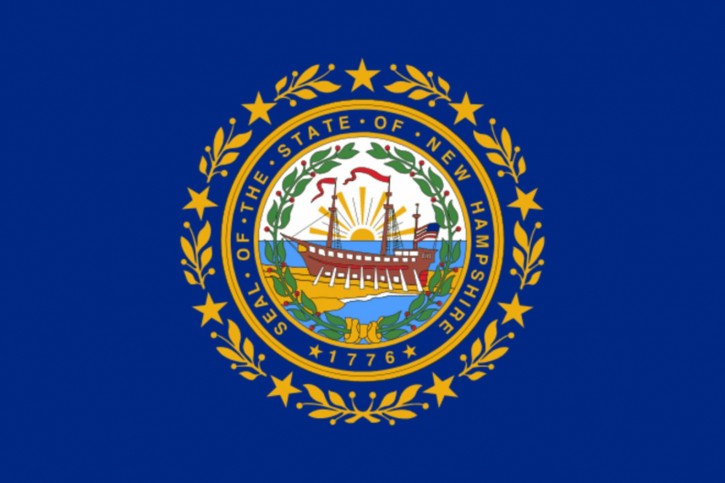
State Flag
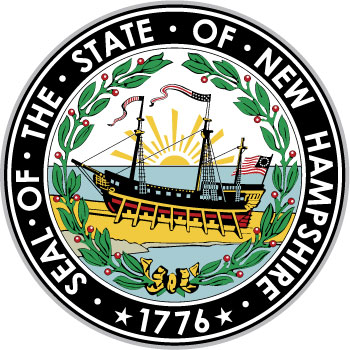
Great Seal
Nickname
The Granite State
Motto
Live Free or Die

Bird
Purple Finch

Flower
Purple Lilac
Tree
White Birch (Paper Birch)
Animal
White-tailed Deer
Fish
Brook Trout (freshwater); Striped Bass (saltwater)
Amphibian
Red-spotted Newt
Insect
Convergent Ladybug
Butterfly
Karner Blue
Mineral
Beryl
Song
"Old New Hampshire"