
 English
 Español
 中文
中文 हिन्दी
 Français
On this page
Overview
Nevada is a state in the Mountain West region of the United States, bordered by Oregon to the northwest, Idaho to the northeast, Utah to the east, Arizona to the southeast, and California to the south, west, and northwest. With roughly 3.19 million residents across 110,572 square miles, it is the 32nd-most populous state and the 7th-largest by area. Nevada is the driest U.S. state, with average annual precipitation under 10 inches statewide.
Nevada entered the Union as the 36th state on October 31, 1864 — admitted during the Civil War in significant part to ensure additional electoral-college votes for Abraham Lincoln’s re-election and added support for the Thirteenth Amendment. The state’s nickname "Battle Born" refers to this Civil War-era admission. The state takes its name from the Spanish word "nevada," meaning "snow-covered," referring to the Sierra Nevada along the western border.
Carson City in the west is Nevada’s state capital. Las Vegas, in the far southern Mojave Desert, is by far the largest city and anchors a metropolitan area of about 2.3 million — home to over 70 percent of all Nevadans. Reno-Sparks in the northwest is the second-largest metropolitan area, near the Lake Tahoe Sierra and the Tahoe-Reno Industrial Center. Nevada is internationally known for the Las Vegas Strip, Lake Tahoe, the Hoover Dam, and as the only U.S. state with legal countywide-licensed brothels.
Geography & Climate
Nevada is the most mountainous U.S. state by total terrain — it contains more than 300 named mountain ranges. Almost all of Nevada lies within the Great Basin, a vast endorheic region (rivers do not reach the sea) between the Sierra Nevada to the west and the Wasatch Range to the east. The southern tip of Nevada, around Las Vegas, lies within the Mojave Desert. Boundary Peak in the White Mountains along the California border, at 13,147 feet, is Nevada’s highest point.
Lake Tahoe — the largest alpine lake in North America and the second-deepest U.S. lake at 1,645 feet — straddles the California-Nevada border and is the state’s most famous natural feature. The Colorado River forms much of Nevada’s southeastern boundary; Hoover Dam (1936) impounds the Colorado to form Lake Mead, the largest U.S. reservoir by volume. Pyramid Lake (Washoe Tribe) and Walker Lake (Walker River Paiute Tribe) are remnants of the prehistoric Lake Lahontan.
The climate ranges from cold-desert continental in the north (Great Basin) to hot desert in the south (Mojave). Las Vegas regularly experiences summer highs above 110°F and is the sunniest large U.S. city. The federal government owns roughly 80 percent of Nevada’s land — by far the highest share of any U.S. state — including Nellis Air Force Range, the Nevada Test Site (Nevada National Security Site), Great Basin National Park, and vast tracts of Bureau of Land Management and U.S. Forest Service land.
History
For thousands of years before European contact, Nevada was home to the Northern Paiute, Southern Paiute, Western Shoshone, Washoe, and Mojave peoples. The first European to enter Nevada was Spanish Franciscan missionary Francisco Garcés in 1776. The Old Spanish Trail across southern Nevada (1829), the Humboldt Trail in the north, and the California Trail through Nevada to the Sierra crossings carried tens of thousands of nineteenth-century emigrants. The U.S. acquired Nevada from Mexico via the 1848 Treaty of Guadalupe Hidalgo ending the Mexican-American War.
The 1859 discovery of the Comstock Lode at Virginia City — one of the richest silver deposits ever found — triggered the boom that built early Nevada. Nevada Territory was carved out of Utah Territory in 1861, and Nevada was rushed to statehood on October 31, 1864, in time to bolster Lincoln’s 1864 reelection. The original draft of the state constitution was transmitted to Washington by telegraph at a cost of $4,303.27 — at the time the longest and most expensive telegram in history.
Comstock silver production peaked and declined sharply in the 1870s–1880s, sending Nevada through a long economic depression. The 1900–1907 Tonopah and Goldfield gold and silver booms drove a second wave of mining. In 1931, the Nevada Legislature legalized gambling and made divorce easy, hoping to attract Depression-era tourists. Construction of Boulder (later Hoover) Dam, 1931–1936, brought thousands of workers and electricity to the Las Vegas Valley.
World War II brought Nellis Army Air Field (1941) and major munitions and magnesium plants. The Nevada Test Site (now Nevada National Security Site), established in 1951, conducted more than 900 atmospheric and underground nuclear weapons tests through 1992. Post-war Las Vegas grew explosively, with mobster-built mid-century casinos giving way over decades to publicly traded megaresorts and a globally dominant tourism, gaming, and convention industry. Reno-Sparks emerged as a major distribution and technology center in the 2010s, anchored by the Tesla Gigafactory 1 and Apple, Google, and Switch data centers in the Tahoe-Reno Industrial Center.
Economy
Nevada hosts one of the most distinctive U.S. state economies — anchored by gaming and tourism, mining, logistics and data centers, military and defense, and a fast-growing renewable-energy sector.
- Gaming and tourism: Tourism is by far Nevada’s largest industry. Las Vegas and Clark County host the world’s largest concentration of hotel rooms (more than 150,000), drawing roughly 40 million visitors a year for casinos, shows, conventions (CES, MAGIC, World of Concrete), and increasingly major sports — the NFL Raiders, NHL Golden Knights, WNBA Aces, and (from 2025) the MLB Athletics, plus annual Formula 1 races and the 2024 Super Bowl. Reno-Sparks and Lake Tahoe also support major casino-resort economies.
- Mining: Nevada is the largest U.S. producer of gold and one of the largest in the world — Nevada Gold Mines (a joint venture of Barrick Gold and Newmont) operates much of the Carlin Trend in northeastern Nevada. Silver, copper, and lithium production are also major; the Thacker Pass lithium mine in Humboldt County is one of the largest U.S. lithium deposits and central to the U.S. domestic battery-supply effort.
- Logistics, data centers, and manufacturing: The Tahoe-Reno Industrial Center east of Reno is the largest industrial park in North America by buildable area. It is home to Tesla’s Gigafactory 1 (battery and motor production), as well as Apple, Google, Microsoft, Switch, and many other large data-center and logistics tenants. Nevada’s no-state-income-tax policy and central western U.S. location have made it a major distribution hub for California-bound goods.
- Military and defense: Nellis Air Force Base outside Las Vegas hosts the U.S. Air Force Warfare Center, the Thunderbirds aerial demonstration squadron, and the Red Flag exercises. Creech Air Force Base is the U.S. Air Force’s center for armed-drone (MQ-9 Reaper) operations. Naval Air Station Fallon east of Reno hosts the Naval Aviation Warfighting Development Center, home of the famous TOPGUN training school.
- Renewable energy and agriculture: Nevada is one of the leading U.S. states in solar energy generation per capita, with vast utility-scale solar arrays in the Mojave Desert. Geothermal output ranks second only to California. Agriculture remains modest by U.S. standards but includes major beef cattle ranching in the Great Basin, alfalfa hay, dairy, and the famous Mason Valley onions and Lovelock cantaloupes.
Government
Nevada operates under its 1864 constitution. The Nevada Legislature is bicameral, with a 21-member Senate (four-year terms, two-term limit) and a 42-member Assembly (two-year terms, six-term limit) — the smallest lower-house in the United States. The Legislature meets only in odd-numbered years (with biennial 120-day sessions), one of just four U.S. state legislatures that meet biennially.
The Governor of Nevada serves a four-year term and is limited to two terms. The state also elects a Lieutenant Governor (jointly with the Governor), Attorney General, Secretary of State, Treasurer, and Controller. Nevada is unique in U.S. law for permitting county-licensed brothels (in counties with under 700,000 population) and for legalizing recreational marijuana, gaming, and (early in the twentieth century) easy divorce — collectively shaping its long reputation as a libertarian-leaning state.
Nevada has four seats in the U.S. House of Representatives plus two U.S. Senators. The Supreme Court of Nevada has seven justices elected to staggered six-year terms; in 2014 voters created an intermediate Court of Appeals. The state capital is Carson City, which was reorganized as an independent city in 1969 and serves no surrounding county — one of just two U.S. state capitals (with St. Louis–style independence) without a county government.
Culture
Nevada culture is dominated nationally by Las Vegas — the global capital of casino gambling, big-room entertainment, conventions, and increasingly major-league sports. The Las Vegas Strip is unincorporated Clark County, technically outside the city of Las Vegas, but is the cultural face of the state to the world. The Strip’s evolution from mob-built mid-century casinos through 1990s family resorts to the contemporary luxury-and-spectacle megaresorts is one of the most-studied trajectories in American urban history. Las Vegas is also the headquarters of UFC mixed martial arts and a major center of professional boxing.
Northern Nevada culture is markedly different from Las Vegas. The Reno-Carson-Lake Tahoe region carries the Comstock-era mining heritage, the influence of nearby Mormon Utah, an outsized Basque community descended from Pyrenean sheepherders (anchored by the National Basque Festival in Elko each July), and the wild "do-it-yourself" cultural pilgrimage of Burning Man held each Labor Day week in the Black Rock Desert north of Reno (about 80,000 attendees in normal years).
Nevada is one of the most ethnically diverse U.S. states, with substantial Hispanic/Latino (about 29 percent of state population), African American, Asian American (including the largest Filipino American community per capita on the U.S. mainland), and Pacific Islander populations. The state’s 27 federally recognized tribes — Western Shoshone, Northern and Southern Paiute, and Washoe — maintain sovereign reservations and colonies. Nevada cuisine combines casino-buffet excess, Basque set-table feasts (Elko, Winnemucca, Gardnerville), shrimp cocktails (a long Las Vegas tradition), prime rib, and an exploding food-and-cocktail scene on and off the Las Vegas Strip.
Notable Cities
- Las Vegas — Largest city in Nevada, in the southern Mojave Desert, with a city population of roughly 660,000 and a Las Vegas Valley metropolitan area of about 2.3 million. Global capital of casino gambling, big-room entertainment, and major-event tourism, anchored by the Las Vegas Strip (which is technically in unincorporated Clark County south of the city limits). Home of the Las Vegas Raiders (NFL), Vegas Golden Knights (NHL), and Las Vegas Aces (WNBA).
- Henderson — Second-largest city, in the southeast Las Vegas Valley, with a population of roughly 327,000. A planned suburban city repeatedly ranked among the most livable in the United States, home to the Raiders’ practice facility, the Las Vegas Ballpark (AAA baseball), and major operations of Levi Strauss and Ford’s autonomous-vehicle division.
- Reno — Third-largest city, in northwestern Nevada near the Sierra Nevada and Lake Tahoe, with a city population of roughly 275,000 and a Reno-Sparks metropolitan area of about 500,000. Long known as the smaller-scale "Biggest Little City in the World" gaming destination, but now also a major logistics, data-center, and manufacturing hub anchored by Tesla Gigafactory 1 in the adjacent Tahoe-Reno Industrial Center.
- North Las Vegas — A city of roughly 280,000 in the Las Vegas Valley, immediately north of Las Vegas. A fast-growing and increasingly diverse community, with the developing Apex Industrial Park, the Aliante Casino, and major Amazon and Sephora distribution centers.
- Carson City — State capital, on the eastern slope of the Sierra Nevada, with a population of roughly 58,000. Independent city covering the entire former Carson City County. Home of the Nevada State Capitol, the Nevada State Museum, and the Kit Carson Trail of historic homes. Named in 1858 for explorer and frontiersman Christopher "Kit" Carson.
State Symbols
Nevada’s official state symbols, designated by the Nevada Legislature, celebrate the Great Basin desert, the Sierra Nevada and Mojave landscapes, and the silver-mining heritage of the Silver State.
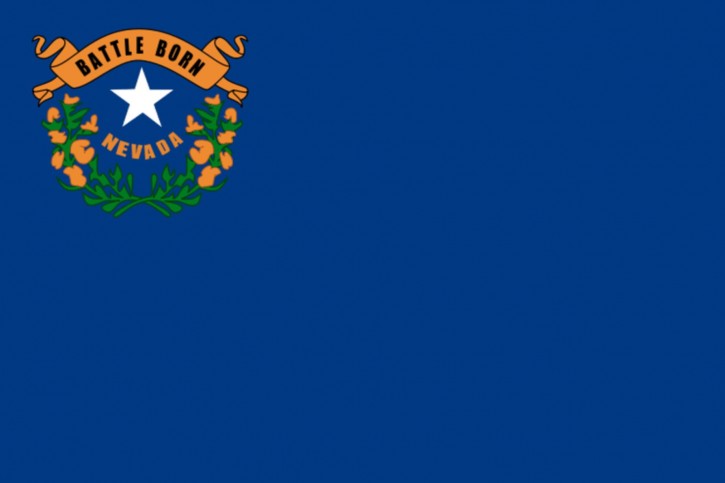
State Flag
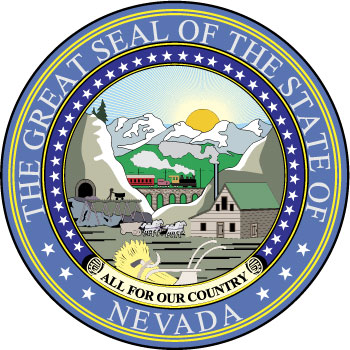
Great Seal
Nickname
The Silver State / The Battle Born State
Motto
All for Our Country

Bird
Mountain Bluebird
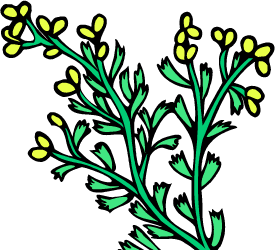
Flower
Sagebrush
Tree
Single-leaf Piñon and Bristlecone Pine
Mammal
Desert Bighorn Sheep
Reptile
Desert Tortoise
Fish
Lahontan Cutthroat Trout
Fossil
Ichthyosaur (Shonisaurus popularis)
Metal
Silver
Gemstone
Black Fire Opal (precious); Nevada Turquoise (semi-precious)
Song
"Home Means Nevada"