
 English
 Español
 中文
中文 हिन्दी
 Français
On this page
Overview
Montana is a state in the Mountain West region of the United States, bordered by the Canadian provinces of British Columbia, Alberta, and Saskatchewan to the north, North Dakota and South Dakota to the east, Wyoming to the south, and Idaho to the west and southwest. With roughly 1.13 million residents across 147,040 square miles, it is the 44th-most populous state but the fourth-largest by area, with one of the lowest population densities in the country.
Montana entered the Union as the 41st state on November 8, 1889. The state takes its name from the Spanish word "montaña," meaning "mountain," even though only the western third of the state is actually mountainous; the eastern two-thirds are part of the Great Plains. Helena, in the west-central part of the state, is the capital. Billings, on the Yellowstone River in south-central Montana, is the largest city.
Montana is internationally known as "Big Sky Country" — a phrase popularized by a 1947 novel by A.B. Guthrie Jr. and adopted as the official state tourism brand. The state contains Glacier National Park, a portion of Yellowstone National Park (Yellowstone is mostly in Wyoming but the north entrance and a strip of land are in Montana), and seven Native American reservations representing twelve tribes. Montana is one of the most rugged and least densely populated U.S. states and is a national leader in barley, wheat, and beef-cattle production.
Geography & Climate
Montana is divided into two strongly contrasting regions. The western third of the state is dominated by the Rocky Mountains — including the Bitterroot, Mission, Swan, Beartooth, and Crazy ranges — and contains the Continental Divide, which runs north to south through the state. Granite Peak in the Beartooth Mountains, at 12,799 feet, is Montana’s highest point. Glacier National Park, on the U.S.–Canadian border in the northwest, anchors the U.S. side of the Waterton-Glacier International Peace Park and is one of the country’s most stunning landscapes.
The eastern two-thirds of the state lie within the Great Plains: rolling prairie, badlands, and broad river valleys cut by the Missouri, Yellowstone, Powder, and Tongue rivers. The "Hi-Line" along the Canadian border is wheat country. The Bakken Shale formation in northeastern Montana and adjacent North Dakota has been a major oil and gas producer since the 2000s. The Missouri River begins at the confluence of the Jefferson, Madison, and Gallatin rivers near Three Forks; it then runs across the entire state to the North Dakota border.
The climate ranges from cold continental in the high mountain country to semi-arid steppe across the eastern plains. Montana experiences some of the most dramatic chinook winds in the country, with winter temperatures that can swing 30 to 50 degrees Fahrenheit in a single day. The Hi-Line and Glacier–Bob Marshall wilderness corridor are subject to extreme winter cold, while summer heat in the eastern plains can exceed 100°F. The state contains substantial portions of three major wilderness complexes — the Bob Marshall, the Selway-Bitterroot, and the Absaroka-Beartooth — among the largest in the lower 48 states.
History
Montana has been inhabited for at least 12,000 years. At European contact, the region was home to the Crow (Apsáalooke), Blackfeet (Niitsítapi), Salish, Pend d’Oreille, Kootenai, Northern Cheyenne, Assiniboine, Sioux, Gros Ventre (A’aninin), and Chippewa Cree peoples. The Lewis and Clark Expedition crossed Montana in 1805–1806 — their only major contact with the region prior to U.S. settlement — and met largely cooperative Salish and Nez Perce peoples at the western passes.
Most of Montana east of the Continental Divide came to the U.S. with the Louisiana Purchase in 1803; the western portion came with the Oregon Country boundary treaty of 1846. The 1862 gold strike at Bannack, followed by Last Chance Gulch (Helena) in 1864 and Confederate Gulch in 1865, drove the first wave of U.S. settlement. Montana Territory was organized in 1864. The 1876 Battle of the Little Bighorn (called "Greasy Grass" by the victors) on Crow Reservation land — in which Lakota and Cheyenne warriors led by Sitting Bull and Crazy Horse annihilated Lt. Col. George Armstrong Custer and the 7th Cavalry — was the most famous Indigenous victory of the American Indian Wars.
Montana was admitted as the 41st state on November 8, 1889. The Anaconda Copper Mining Company at Butte — "the Richest Hill on Earth" — emerged as one of the largest mining concerns in the world by the early twentieth century, dominating Montana politics and producing roughly one-third of all U.S. copper at its peak. The cattle and sheep ranching that filled the eastern plains was punctuated by the devastating winter of 1886–1887, which killed huge percentages of the open-range herds.
In the twentieth century, Montana developed irrigation agriculture along the Missouri and Yellowstone, hydroelectric power on the Missouri, and substantial federal infrastructure — Fort Peck Dam (1933–1940), one of the largest hydroelectric earthen dams in the world, employed thousands during the Great Depression. The closure of the Anaconda smelter in 1980 ended Montana’s copper-mining heyday. Since the 1990s, the state has gained substantial population from California and other coastal states, particularly around Bozeman, Missoula, and the Flathead Valley.
Economy
Montana hosts a small but diversified economy anchored by agriculture and ranching, tourism, energy and mining, forestry, and a fast-growing technology and outdoor-recreation sector centered on Bozeman and Missoula.
- Agriculture and ranching: Montana is one of the largest U.S. producers of wheat (especially hard red spring wheat and durum), barley (Montana leads the country, supplying most U.S. brewing barley), beef cattle, sugar beets, hay, and pulses (lentils, dry peas, and chickpeas). The state has more than 23,000 farms and ranches and one of the largest cattle-to-people ratios in the country.
- Tourism and outdoor recreation: Tourism is one of Montana’s largest industries, drawing roughly 12 million visitors a year. Glacier National Park, a portion of Yellowstone National Park, the Beartooth Highway, Flathead Lake (the largest natural freshwater lake west of the Mississippi), the Bob Marshall Wilderness, and a deep ski-resort sector (Big Sky, Whitefish, Bridger Bowl) anchor the visitor economy. Fly fishing, hunting, and snowmobiling are central recreational pursuits.
- Energy and mining: Montana ranks among the top U.S. states in coal reserves (the Powder River Basin extends into eastern Montana). The Stillwater Complex in south-central Montana is the only U.S. source of platinum and palladium. Oil and gas production from the Bakken Shale, the Cedar Creek Anticline, and other plays remains substantial. Talc mining (the Treasure State Mine near Dillon and Yellowstone Mine near Cameron) makes Montana the U.S. leader in talc.
- Forestry and wood products: Roughly a quarter of Montana is forested, primarily with western larch, ponderosa pine, lodgepole pine, and Douglas-fir. Lumber mills in western Montana — Pyramid Mountain Lumber, RY Timber, and others — remain important employers despite long-term consolidation. The Forest Service is a major Montana landowner: roughly 30 percent of the state is federally owned.
- Technology and growth corridors: Bozeman, anchored by Montana State University, has become a fast-growing technology and outdoor-equipment cluster (Simms Fishing, Schnee’s, Onx Maps, RightNow Technologies — later acquired by Oracle — and a deep layer of optics and aerospace startups). Missoula, anchored by the University of Montana, hosts software, biotech, and a creative-economy cluster. The Flathead Valley around Kalispell has grown rapidly with retirees and remote workers.
Government
Montana operates under its 1972 constitution, the second in its history (the first dated to statehood in 1889). The Montana Legislature is bicameral, with a 50-member Senate (four-year terms, two-term limit) and a 100-member House of Representatives (two-year terms, four-term limit). The Legislature meets in regular session for 90 days every other year (an "odd-year" cycle) — one of only four U.S. state legislatures that meet biennially.
The Governor of Montana serves a four-year term and is limited to eight years in any 16-year period. The state also elects a Lieutenant Governor (jointly with the Governor), Attorney General, Secretary of State, State Auditor (who also serves as Insurance Commissioner), and Superintendent of Public Instruction. Montana is one of only a few states whose constitution explicitly guarantees a "clean and healthful environment."
Montana has two seats in the U.S. House of Representatives (it gained a second seat in 2023 after the 2020 census, restoring representation it had lost in 1993) plus two U.S. Senators. The Montana Supreme Court has seven justices elected to eight-year terms. The state capital is Helena, which was selected by popular vote in 1894 in a celebrated campaign funded by the rival copper barons of Butte.
Culture
Montana culture is built on ranching, mining, and an Indigenous presence that remains central to public life in a way few other U.S. states match. The state has seven federally recognized Indian reservations representing twelve tribes — the Blackfeet, Crow, Fort Belknap (Assiniboine and Gros Ventre), Fort Peck (Sioux and Assiniboine), Northern Cheyenne, Rocky Boy’s (Chippewa-Cree), and Flathead (Salish, Pend d’Oreille, and Kootenai) Reservations. The Crow Fair each August at Crow Agency is one of the largest annual gatherings of Native peoples in North America.
Montana has produced an outsized literary tradition for its small population: A.B. Guthrie Jr. ("The Big Sky," "The Way West"), Wallace Stegner (born in Iowa but raised in Great Falls), Norman Maclean (born in Iowa but a longtime Montana resident; "A River Runs Through It"), James Welch (Blackfeet–Gros Ventre author of "Fools Crow" and "Winter in the Blood"), Ivan Doig, William Kittredge, Rick Bass, Thomas McGuane, James Lee Burke, and Pulitzer-winning poet Richard Hugo. The University of Montana’s Master of Fine Arts program in Missoula has been a leading center of Western American writing for half a century.
Cowboy and Western art is anchored by Charlie Russell (1864–1926), one of the most influential Western painters in U.S. history, whose home and studio in Great Falls is now the C.M. Russell Museum. Fly fishing on Montana’s blue-ribbon trout rivers — the Madison, Beaverhead, Bighole, Blackfoot, Bitterroot, Bighorn, and Yellowstone — is internationally famous. The Montana State University Bobcats and University of Montana Grizzlies football teams meet each fall in "the Brawl of the Wild," one of the most-attended games in the U.S. for any state of Montana’s size.
Notable Cities
- Billings — Largest city in Montana, on the Yellowstone River in south-central Montana, with a city population of roughly 120,000 and a metropolitan area of about 185,000. A major medical, retail, and energy-services hub for the surrounding ranch country and the Bakken oil patch, and the headquarters of First Interstate Bank.
- Missoula — Second-largest city, at the confluence of the Clark Fork, Bitterroot, and Blackfoot rivers in western Montana, with a population of roughly 75,000. Home of the University of Montana, the U.S. Forest Service Northern Region headquarters, Smokejumpers Visitor Center, and a deep literary and outdoor-culture identity.
- Great Falls — Third-largest city, on the Missouri River north of Helena, with a population of roughly 60,000. Home of Malmstrom Air Force Base (one of three U.S. Air Force bases hosting Minuteman III ICBMs), the C.M. Russell Museum, and a longtime hydroelectric and agricultural-services economy.
- Bozeman — A city of roughly 58,000 in southwestern Montana in the Gallatin Valley. Home of Montana State University, one of the fastest-growing technology and outdoor-recreation clusters in the Mountain West, the Museum of the Rockies (with one of the world’s leading dinosaur collections), and the gateway to Big Sky Resort and Yellowstone’s north entrance.
- Helena — State capital, in the foothills of the northern Rockies, with a population of roughly 33,000. Founded during the 1864 gold rush at Last Chance Gulch (the city’s downtown still follows the original gulch). Home of the Montana State Capitol, the Cathedral of St. Helena, and Carroll College.
State Symbols
Montana’s official state symbols, designated by the Montana Legislature, celebrate the Rocky Mountains, Great Plains prairie, gold-and-silver mining heritage, and Indigenous identity of Big Sky Country.
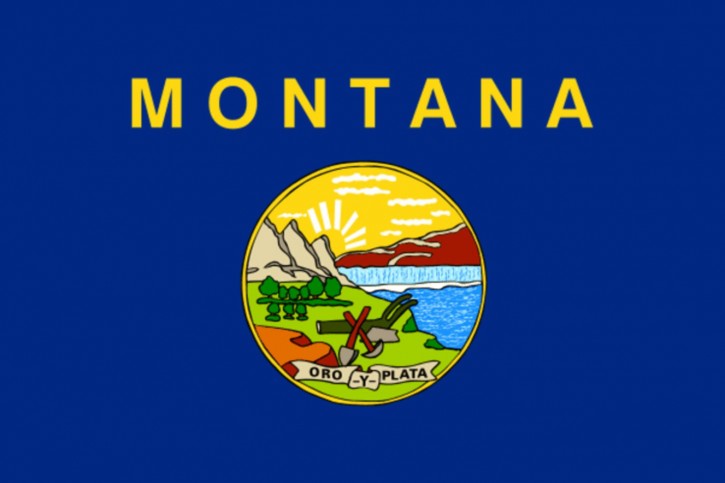
State Flag
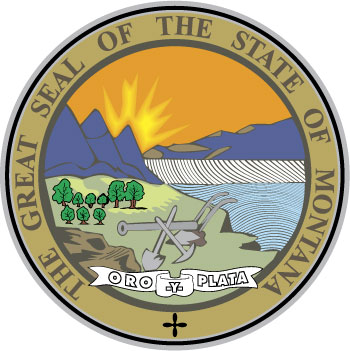
Great Seal
Nickname
Big Sky Country / The Treasure State
Motto
Oro y Plata ("Gold and Silver")

Bird
Western Meadowlark

Flower
Bitterroot
Tree
Ponderosa Pine
Mammal
Grizzly Bear
Fish
Blackspotted Cutthroat Trout
Fossil
Duck-billed Dinosaur (Maiasaura peeblesorum)
Gem
Sapphire and Montana Agate
Grass
Bluebunch Wheatgrass
Animal Symbol
Bobcat
Song
"Montana"