
 English
 Español
 中文
中文 हिन्दी
 Français
On this page
Overview
New Jersey is a state in the Mid-Atlantic and Northeastern regions of the United States, bordered by New York and the Hudson River to the north and northeast, the Atlantic Ocean to the east, Delaware Bay and Delaware to the southwest, and Pennsylvania across the Delaware River to the west. With roughly 9.29 million residents across 8,723 square miles, it is the 11th-most populous state but the 47th-largest by area — making it by far the most densely populated U.S. state.
New Jersey ratified the U.S. Constitution as the third state on December 18, 1787. The state takes its name from the English Channel Island of Jersey, granted by King Charles II to Sir George Carteret in 1664. Trenton on the Delaware River is the state capital; Newark on Newark Bay is the largest city and a major economic anchor. New Jersey sits between the New York City and Philadelphia metropolitan areas, and a large majority of the state’s population lives within commuting distance of one or the other.
New Jersey is the "Garden State" — a nickname popularized in the nineteenth century in reference to the state’s productive truck-farming economy supplying nearby New York and Philadelphia. It is also one of the most ethnically and religiously diverse states in the country, the wealthiest U.S. state by median household income, the home of the world’s largest concentration of pharmaceutical-company headquarters, and the cradle of the American Revolution — more than 100 battles and skirmishes of the Revolution were fought in New Jersey, the most of any state.
Geography & Climate
New Jersey is divided into four major geographic regions. The Atlantic Coastal Plain covers about three-fifths of the state — all of South Jersey and much of central Jersey — and includes the Pine Barrens (the largest contiguous wilderness on the U.S. eastern seaboard between Boston and Richmond, at roughly 1.1 million acres) and the Jersey Shore’s 130 miles of Atlantic beach. North of the Coastal Plain, the Piedmont region runs across the densely urbanized northeast of the state, including most of Newark, Jersey City, and the New York commuter belt.
Beyond the Piedmont, the New England Uplands (Highlands) and the Appalachian Ridge and Valley region rise into the northwest of the state. High Point in the Kittatinny Mountains, at 1,803 feet, is New Jersey’s highest point. The Hudson River, the Delaware River and Bay, the Raritan River, the Passaic River, and the Hackensack River drain the state. The Delaware Water Gap National Recreation Area, the Great Swamp National Wildlife Refuge, and the Pine Barrens (legally protected as the Pinelands National Reserve) preserve the largest natural areas.
The climate is humid subtropical along the Jersey Shore and most of South Jersey, and humid continental in the highlands of the north. The Jersey Shore is moderated by the Atlantic, while the northwest experiences cold, snowy winters. The state lies on the Atlantic hurricane corridor and has been struck by major storms — Hurricane Sandy in October 2012 was one of the most destructive natural disasters in U.S. history, devastating coastal communities from Cape May to Sandy Hook.
History
Before European arrival, New Jersey was home to the Lenape (Delaware) people, an Algonquian-speaking nation whose name for themselves means "the original people." The Dutch established a trading post on Manhattan in 1614 and claimed the area as part of New Netherland; New Sweden controlled the Delaware Valley from 1638 to 1655. England seized New Netherland in 1664 and renamed the territory New Jersey after the Channel Island of Jersey.
New Jersey was originally two proprietary colonies — East Jersey and West Jersey — which were merged into the royal Province of New Jersey in 1702 and given a separate royal governor in 1738. New Jersey ratified the U.S. Constitution as the third state on December 18, 1787, and was the first state to ratify the Bill of Rights on November 20, 1789.
During the American Revolution, New Jersey hosted more than 100 battles, skirmishes, and significant troop movements — more than any other state — and is known as the "Crossroads of the American Revolution." George Washington crossed the Delaware on Christmas Night 1776 to launch the surprise victories at Trenton (December 26, 1776) and Princeton (January 3, 1777) — turning points after a bleak autumn. The 1778 Battle of Monmouth (Freehold) was one of the largest land battles of the war. Princeton briefly served as the U.S. capital in 1783; Trenton served as the temporary capital in 1784.
The nineteenth and twentieth centuries built New Jersey into one of the most industrialized states in the country. Paterson, founded in 1791 by Alexander Hamilton as the first planned industrial city in the United States, anchored silk, locomotive, and firearms manufacturing. Thomas Edison’s laboratories at Menlo Park (1876) and West Orange (1887) produced the phonograph, the practical incandescent light bulb, motion pictures, and many other inventions. Bell Labs at Murray Hill produced the transistor (1947), the laser, and other foundational twentieth-century technologies. The first college football game was played at Rutgers in New Brunswick on November 6, 1869.
Economy
New Jersey hosts one of the largest and most diversified state economies in the United States, anchored by pharmaceuticals and life sciences, financial and professional services, shipping and logistics, technology, and a substantial tourism and gaming economy.
- Pharmaceuticals and life sciences: New Jersey is the world capital of pharmaceutical headquarters. Johnson & Johnson (New Brunswick), Merck (Rahway), Bristol Myers Squibb (Princeton), Bayer U.S. (Whippany), Pfizer (Peapack-Gladstone), Novartis (East Hanover), Sanofi U.S. (Bridgewater), Roche/Genentech (Little Falls), and many others maintain major operations and headquarters in the state. New Jersey hosts more than half of the top 20 global pharmaceutical companies.
- Financial and professional services: Prudential Financial (Newark), Chubb (Warren), Merck-affiliated reinsurance, and large back-office operations of JP Morgan, Goldman Sachs, Bank of America, and Bridgewater Associates anchor a financial-services economy that extends across the Hudson from Wall Street. ADP (Roseland) is one of the largest U.S. payroll and HR-services firms. The Port of New York and New Jersey is the largest port on the U.S. East Coast.
- Technology and telecommunications: Verizon Communications, Nokia Bell Labs (Murray Hill — heir to AT&T Bell Labs), Honeywell (Charlotte HQ but historic New Jersey base in Morris Plains), and the Picatinny Arsenal anchor a long technology heritage. Princeton University and the Institute for Advanced Study (Albert Einstein’s long-time home) anchor an exceptional academic-research base. The Educational Testing Service (ETS) — administrator of the SAT, TOEFL, and GRE — is based in Princeton.
- Agriculture and food production: New Jersey is the "Garden State" — small but exceptionally productive truck farms across South Jersey supply New York City and Philadelphia with cranberries (the state is the third-largest U.S. producer), blueberries (highbush blueberries were developed in Whitesbog, NJ, in 1916), peaches, tomatoes, sweet corn, asparagus, and bell peppers. Major food-processing firms with New Jersey ties include Campbell Soup (Camden) and Goya Foods (Jersey City).
- Tourism and gaming: The Jersey Shore — 130 miles of beaches from Sandy Hook to Cape May — draws tens of millions of summer visitors. Atlantic City hosts nine casinos and one of the U.S. East Coast’s most extensive gaming, entertainment, and convention economies, second only to Las Vegas among U.S. gambling destinations. Six Flags Great Adventure in Jackson is one of the country’s largest theme parks, and the MetLife Stadium in East Rutherford hosts the NFL’s New York Giants and New York Jets.
Government
New Jersey operates under its 1947 constitution, the third in its history. The New Jersey Legislature is bicameral, with a 40-member Senate (mostly four-year terms, with one two-year term per decade aligned to redistricting) and an 80-member General Assembly (two-year terms). There are no legislative term limits.
The Governor of New Jersey serves a four-year term and is limited to two consecutive terms. The state also elects a Lieutenant Governor (jointly with the Governor since 2009 — New Jersey was one of the last U.S. states without a lieutenant-gouvernor position). New Jersey is one of only two U.S. states (with Virginia) whose gubernatorial elections occur in odd-numbered years, giving New Jersey unusual visibility in off-year national politics.
New Jersey has 12 seats in the U.S. House of Representatives plus two U.S. Senators. The Supreme Court of New Jersey has seven justices appointed by the governor with consent of the Senate, serving an initial seven-year term and (if reappointed) tenure until age 70. The state capital is Trenton.
Culture
New Jersey culture is shaped by its proximity to both New York City and Philadelphia, its extraordinary ethnic and religious diversity, and its position as one of the most densely populated places in the United States. North Jersey culturally orbits New York; South Jersey orbits Philadelphia; and Central Jersey (whose very existence is a long-running statewide debate) bridges the two. The state has the highest proportion of Italian Americans, the third-highest proportion of Jews, and one of the largest Indian American, Filipino American, Cuban American, and Egyptian American populations of any U.S. state.
New Jersey has produced an extraordinary share of major American cultural figures. In music, Frank Sinatra (Hoboken), Bruce Springsteen (Freehold/Asbury Park), Jon Bon Jovi (Sayreville), Whitney Houston (Newark), Lauryn Hill (South Orange), Queen Latifah (Newark), Bon Iver, the Jonas Brothers (Wyckoff), and many others all hail from New Jersey. In film and television, Meryl Streep (Summit), Jack Nicholson (Neptune City), John Travolta (Englewood), Joe Pesci (Newark), Danny DeVito (Asbury Park), the Sopranos cast (set in North Jersey), and many more. The state is famously the setting of "The Sopranos" — one of the most acclaimed TV series in U.S. history.
New Jersey food culture is one of the most distinctive regional cuisines in the United States. The state has more diners per capita than anywhere else on Earth. Pork roll / Taylor ham (a divisive North vs. Central/South Jersey naming controversy), Italian-American pizza (especially the New Haven–adjacent and Trenton tomato-pie traditions), Italian hoagies/subs, Sicilian and Neapolitan immigrant foods, and bagels are central to everyday eating. The Jersey Shore boardwalk traditions — saltwater taffy (invented in Atlantic City), fried clams, pizza, custard, and funnel cake — define summer in much of the metro region.
Notable Cities
- Newark — Largest city in New Jersey, on the Passaic River and Newark Bay, with a city population of roughly 305,000 and a substantial role in the New York City metropolitan area of over 19 million. Home of Newark Liberty International Airport (one of the three major NYC-area airports), Port Newark (the largest container port on the U.S. East Coast), Prudential Financial, the Prudential Center (NHL Devils), Rutgers University–Newark, and the New Jersey Performing Arts Center.
- Jersey City — Second-largest city, on the west bank of the Hudson River directly across from lower Manhattan, with a population of roughly 290,000. A fast-growing waterfront city anchored by major financial-services back offices and a sprawling residential growth corridor. Home of Liberty State Park, the Statue of Liberty (administratively part of New Jersey), and Ellis Island (the Jersey portion).
- Paterson — Third-largest city, on the Passaic River, with a population of roughly 159,000. Founded in 1791 by Alexander Hamilton as America’s first planned industrial city, anchored by the Great Falls of the Passaic (Paterson Great Falls National Historical Park). Today one of the most ethnically diverse U.S. cities, with one of the largest Arab American populations in the country (especially Palestinian) along South Main Street.
- Elizabeth — Fourth-largest city, immediately south of Newark on Newark Bay, with a population of roughly 137,000. Home of the Port Elizabeth–Newark container terminal (the busiest container port on the U.S. East Coast), the IKEA Elizabeth (the largest U.S. IKEA), and the Jersey Gardens outlet mall, one of the largest outlet malls in the country.
- Trenton — State capital, on the Delaware River across from Pennsylvania, with a population of roughly 90,000. Site of the Battle of Trenton (December 26, 1776) — one of the turning points of the American Revolution. Briefly served as the U.S. capital in 1784. Home of the New Jersey State House (the second-oldest state capitol in continuous use in the country), the New Jersey State Museum, and the city motto on its bridges: "Trenton Makes — The World Takes."
State Symbols
New Jersey’s official state symbols, designated by the New Jersey Legislature, celebrate the agricultural heritage of the Garden State, the natural history of the Pine Barrens and Jersey Shore, and the colonial and revolutionary identity of the state.
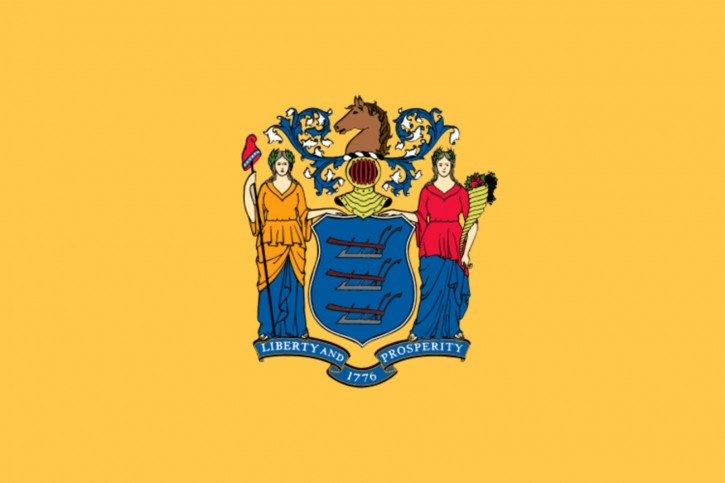
State Flag
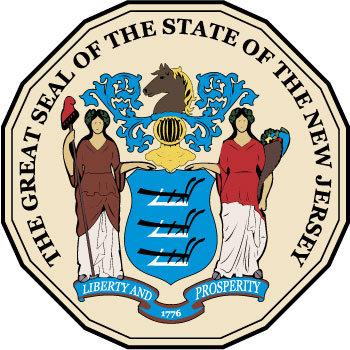
Great Seal
Nickname
The Garden State
Motto
Liberty and Prosperity

Bird
Eastern Goldfinch (American Goldfinch)

Flower
Common Meadow Violet
Tree
Northern Red Oak
Animal
Horse
Fish
Brook Trout
Insect
Honeybee
Dinosaur
Hadrosaurus foulkii (first nearly complete dinosaur skeleton found, Haddonfield 1858)
Shell
Knobbed Whelk
Fruit
Highbush Blueberry
Vegetable
Jersey Tomato (informal)