
 English
 Español
 中文
中文 हिन्दी
 Français
On this page
Overview
New York is a state in the Mid-Atlantic and Northeastern regions of the United States, bordered by Lake Ontario and the Canadian provinces of Ontario and Quebec to the north, Vermont, Massachusetts, and Connecticut to the east, the Atlantic Ocean and New Jersey to the south, and Pennsylvania and Lake Erie to the southwest and west. With roughly 19.45 million residents across 54,555 square miles, it is the fourth-most populous U.S. state and the 27th largest by area.
New York ratified the U.S. Constitution as the eleventh state on July 26, 1788. The state takes its name from the English Duke of York (later King James II), to whom Charles II granted the territory after seizing it from the Dutch in 1664. Albany on the Hudson River is the state capital. New York City — the largest city in the United States with roughly 8.3 million residents and a metropolitan area of about 19.7 million — is by far the state’s and the country’s most significant economic and cultural anchor.
New York is the "Empire State" — a nickname popularized in the early nineteenth century in reference to the state’s commercial and cultural dominance after the 1825 opening of the Erie Canal. New York City is the global financial capital (Wall Street, the New York Stock Exchange, the Federal Reserve Bank of New York), the leading center of U.S. media, publishing, and broadcasting, the heart of the American art and theater worlds, and the most-visited U.S. city (more than 60 million annual visitors in recent years). The state hosts roughly half of the population of New England and the Mid-Atlantic combined.
Geography & Climate
New York is the most geographically diverse Eastern U.S. state. The Adirondack Mountains in the northeast — Mount Marcy at 5,344 feet is the state’s highest point — form one of the largest publicly protected wilderness regions in the United States: the 6.1-million-acre Adirondack Park is larger than Yellowstone, Yosemite, Grand Canyon, Glacier, and Great Smoky Mountains combined. South of the Adirondacks, the Catskill Mountains rise above the Hudson Valley; further south, the Hudson River runs 315 miles from Lake Tear of the Clouds high in the Adirondacks to New York Harbor.
Western New York drains into Lake Erie and Lake Ontario, and the Niagara River carries the world-famous Niagara Falls across the Canadian border. The Finger Lakes — eleven long, narrow glacial lakes including Cayuga, Seneca, and Skaneateles — define central New York and anchor New York’s major wine region. Long Island stretches 118 miles east from Manhattan into the Atlantic, featuring extensive ocean beaches at Jones Beach and the Hamptons. New York City is built on a series of islands at the mouth of the Hudson: Manhattan, Staten Island, and the western part of Long Island (Brooklyn and Queens), plus the mainland Bronx.
The climate ranges from humid subtropical in New York City and Long Island to humid continental in upstate New York. Snowfall is extraordinarily heavy along the Lake Ontario and Lake Erie shores (the "lake-effect snow belt"); Tug Hill east of Lake Ontario regularly receives more than 250 inches of snow per year. The Atlantic moderates Long Island and the city; the high Adirondacks experience some of the coldest winter temperatures of any place in the eastern United States.
History
Before European contact, New York was home to the Haudenosaunee (Iroquois) Confederacy — the Mohawk, Oneida, Onondaga, Cayuga, and Seneca nations, joined by the Tuscarora in 1722 — across upstate New York, and to the Algonquian-speaking Lenape (Delaware), Wappinger, Mahican, and other peoples in the Hudson Valley, Long Island, and Manhattan. The Haudenosaunee Confederacy is one of the oldest continuously functioning democracies in the world, and is widely credited with influencing aspects of the U.S. Constitution.
Henry Hudson, sailing for the Dutch East India Company in 1609, explored the river that bears his name. The Dutch West India Company founded the colony of New Netherland in 1614 and purchased Manhattan from the Lenape in 1626 to establish New Amsterdam. England seized the colony in 1664 and renamed it for the Duke of York, the future King James II. New York City briefly served as the U.S. capital from 1785 to 1790; George Washington was inaugurated as the first U.S. president on the balcony of Federal Hall in Manhattan on April 30, 1789.
The October 1777 American victory at the Battles of Saratoga is widely considered the turning point of the American Revolution; it persuaded France to enter the war as a U.S. ally. New York ratified the U.S. Constitution as the eleventh state on July 26, 1788. The 1825 completion of the Erie Canal — connecting the Hudson River at Albany to Lake Erie at Buffalo — opened the Great Lakes interior to Atlantic commerce, made New York City the largest U.S. port, and gave New York the "Empire State" identity.
New York City emerged as the great American immigrant gateway: Ellis Island processed roughly 12 million arrivals between 1892 and 1954, and the Statue of Liberty (gifted by France in 1886) became the national symbol of immigration. The state powered through the Industrial Revolution with Buffalo (steel and grain), Rochester (Eastman Kodak, Xerox, Bausch & Lomb), Syracuse, Albany–Schenectady–Troy (General Electric), and the textile mills of the Mohawk Valley. The September 11, 2001, terrorist attacks on the World Trade Center killed 2,753 people in New York City — the deadliest attack on American soil since Pearl Harbor — and reshaped both the city and U.S. domestic and foreign policy for a generation.
Economy
New York hosts one of the largest and most diversified state economies in the world — anchored by global finance, media and publishing, biomedical research, technology, healthcare, manufacturing, agriculture, and tourism. New York City alone is the largest metropolitan economy in the United States and one of the two or three largest in the world.
- Finance and banking: New York City is the global financial capital. The New York Stock Exchange (founded 1792) is the world’s largest stock exchange by market capitalization, and NASDAQ (also headquartered in New York) is the second. JP Morgan Chase, Goldman Sachs, Morgan Stanley, Citigroup, BlackRock (the world’s largest asset manager), MetLife, and the Federal Reserve Bank of New York all anchor the world’s densest banking and asset-management cluster.
- Media, publishing, and advertising: New York City is the historic and current center of U.S. media. The four U.S. broadcast network headquarters (ABC, CBS, NBC, Fox), the major newspapers (The New York Times, The Wall Street Journal, the New York Post, the Daily News), the "Big Five" book publishers (Penguin Random House, HarperCollins, Simon & Schuster, Hachette, Macmillan), Condé Nast, Hearst, and Bloomberg LP all operate from Manhattan. Madison Avenue is synonymous with the global advertising industry.
- Technology and biosciences: Silicon Alley — the New York City tech cluster from Flatiron to Chelsea — hosts headquarters or major offices of Google, Meta, Apple, Amazon, Bloomberg, and a dense layer of fintech, ad-tech, and media-tech firms. Cornell Tech on Roosevelt Island, Memorial Sloan Kettering, NYU Langone, Weill Cornell, Mount Sinai, and the Rockefeller University anchor one of the world’s largest biomedical-research clusters. Upstate, IBM (Armonk), Corning Incorporated (Corning), Wegmans (Rochester), and Plug Power (Latham) sustain a substantial advanced-manufacturing economy.
- Tourism: New York City is the most-visited U.S. city, drawing more than 60 million tourists in peak years. Times Square, Central Park, the Statue of Liberty, the Empire State Building, the Metropolitan Museum of Art, Broadway theaters, and the city’s restaurants and shopping are the foundation of a massive tourism economy. Upstate, Niagara Falls, the Adirondacks, the Catskills, the Finger Lakes wine country, Cooperstown (the Baseball Hall of Fame), Saratoga Springs, and the Hamptons add substantial regional tourism economies.
- Agriculture and food: Despite its image, New York is a leading U.S. agricultural state. It is the second-largest U.S. producer of apples, maple syrup, and cabbage; a top-three producer of grapes (especially Concord and wine grapes from the Finger Lakes), milk, and cottage cheese; and home to a yogurt industry centered on Chobani in South Edmeston that has made New York the country’s leading Greek-yogurt producer. The Finger Lakes wine region, the Long Island wine country, and the Hudson Valley are leading U.S. cool-climate viticulture regions.
Government
New York operates under its 1894 constitution, the fourth in its history. The New York State Legislature is bicameral, with a 63-member Senate and a 150-member Assembly, both elected to two-year terms. There are no legislative term limits. The state has long carried a reputation for one of the most influential and litigation-prone state governments in the country, with substantial regulatory authority over banking, insurance, and securities through the Department of Financial Services.
The Governor of New York serves a four-year term with no constitutional term limit. The state also separately elects a Lieutenant Governor (jointly with the Governor since 1953), Attorney General, and Comptroller. The Court of Appeals (the state’s highest court — uniquely named, as the lower trial-court level is called the Supreme Court) has seven judges appointed by the governor with consent of the Senate, serving fourteen-year terms.
New York has 26 seats in the U.S. House of Representatives (the third-largest state delegation, after California and Texas) plus two U.S. Senators. New York City’s mayor leads the largest municipal government in the United States, with a budget exceeding $100 billion — larger than the budgets of most U.S. states. The state capital is Albany, one of the oldest continuously chartered cities in the country (chartered 1686).
Culture
New York culture is dominated globally by New York City. The five boroughs — Manhattan, Brooklyn, Queens, the Bronx, and Staten Island — together house roughly 8.3 million people and the largest single-city concentration of African Americans, Jewish Americans, Italian Americans, Irish Americans, Chinese Americans, Puerto Rican Americans, Dominican Americans, and West Indian Americans in the country. The city is the cultural capital of American art, theater, classical music, opera, jazz, hip-hop (born in the Bronx in the 1970s), publishing, and fashion — Broadway, Lincoln Center, the Metropolitan Museum of Art, the Met Opera, the New York Philharmonic, MoMA, the Guggenheim, the Apollo Theater in Harlem, Carnegie Hall, the Whitney, and many more.
Upstate New York culture is markedly different from downstate. Buffalo is famed for chicken wings (invented at the Anchor Bar in 1964) and a distinctive blue-collar Polish, Italian, and German heritage; Rochester for its Eastman/Kodak photography history and the unique "garbage plate"; Syracuse for the Salt Springs/Erie Canal heritage and Syracuse University; the Adirondacks for backwoods Adirondack rustic style and the 1932 and 1980 Lake Placid Winter Olympics. The state has nine federally recognized Indigenous nations including six of the seven Haudenosaunee Confederacy nations.
New York has produced an unparalleled share of major American cultural figures. Writers from Henry James, Edith Wharton, Herman Melville, and Walt Whitman to F. Scott Fitzgerald, James Baldwin, Toni Morrison, J.D. Salinger, Truman Capote, Tom Wolfe, Joan Didion (long-time resident), and Don DeLillo. Musicians from Duke Ellington (Harlem) to George Gershwin, Bob Dylan (Greenwich Village), Lou Reed, Patti Smith, the Beastie Boys, Jay-Z, Notorious B.I.G., Nas, Mariah Carey, Billy Joel, and Lady Gaga. Filmmakers including Martin Scorsese, Woody Allen, Spike Lee, Sidney Lumet, and the Coen brothers. New York food culture — bagels, deli, pizza, halal-cart chicken-and-rice, dim sum, Dominican mofongo, Buffalo wings, the Rochester garbage plate, Long Island pizza, and the Brooklyn restaurant explosion — is one of the world’s most influential cuisines.
Notable Cities
- New York City — Largest city in the United States, on a series of islands and the mainland at the mouth of the Hudson River, with a city population of roughly 8.3 million and a metropolitan area of about 19.7 million. The global capital of finance (Wall Street), media (Manhattan publishing and broadcasting), theater (Broadway), and art (the Met, MoMA, the Guggenheim, the Whitney), and host of the United Nations headquarters. Comprises five boroughs: Manhattan, Brooklyn, Queens, the Bronx, and Staten Island.
- Buffalo — Second-largest city, on Lake Erie at the eastern terminus of the Great Lakes shipping channel, with a city population of roughly 277,000 and a metropolitan area of about 1.16 million. Birthplace of the Buffalo chicken wing (1964 at the Anchor Bar), home of the Buffalo Bills (NFL) and Buffalo Sabres (NHL), and a center of the Frank Lloyd Wright Darwin D. Martin House and substantial Polish, Italian, and German heritage.
- Yonkers — Third-largest city, immediately north of New York City along the lower Hudson, with a population of roughly 211,000. A dense, transit-served suburb that anchors the southern Westchester County economy. Home of the historic Yonkers Raceway and the Sherwood House and Philipse Manor Hall historic sites.
- Rochester — Fourth-largest city, on the Genesee River and Lake Ontario in western New York, with a city population of roughly 211,000 and a metropolitan area of about 1.05 million. Long an industrial hub (Eastman Kodak, Xerox, Bausch & Lomb), now anchored by the University of Rochester (and its Eastman School of Music), Strong National Museum of Play, and the Rochester Institute of Technology nearby.
- Syracuse — Fifth-largest city, in central New York, with a city population of roughly 145,000 and a metropolitan area of about 660,000. A historic salt-and-Erie-Canal city, home of Syracuse University, the Carrier Dome (the largest domed stadium on a U.S. college campus), and the New York State Fair (the second-oldest U.S. state fair).
State Symbols
New York’s official state symbols, designated by the New York State Legislature, celebrate the Adirondacks and Catskills wilderness, the Hudson Valley, and the diverse natural and cultural heritage of the Empire State.
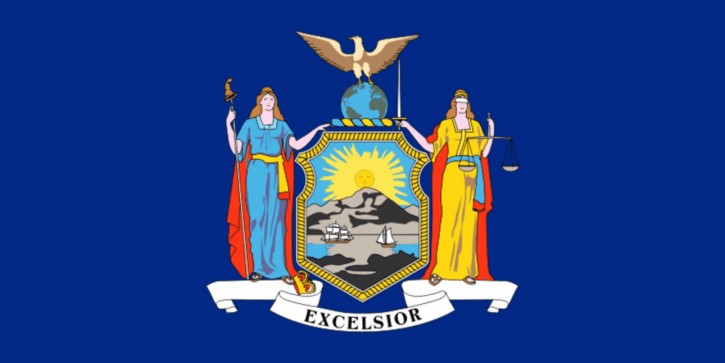
State Flag
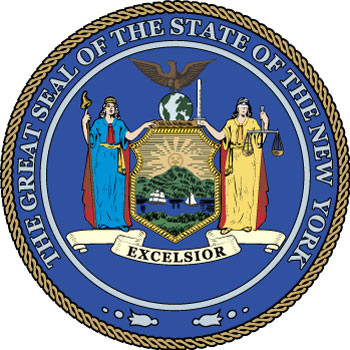
Great Seal
Nickname
The Empire State
Motto
Excelsior ("Ever Upward")

Bird
Eastern Bluebird
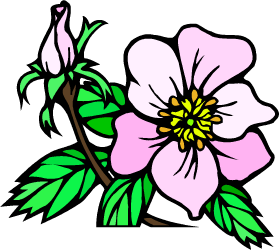
Flower
Rose
Tree
Sugar Maple
Mammal
Beaver
Fish
Brook Trout (freshwater); Striped Bass (saltwater)
Insect
Nine-spotted Ladybug
Gem
Garnet
Beverage
Milk
Fruit
Apple
Song
"I Love New York"