
 English
 Español
 中文
中文 हिन्दी
 Français
On this page
Overview
North Dakota is a state in the Upper Midwest and Great Plains region of the United States, bordered by the Canadian provinces of Saskatchewan and Manitoba to the north, Minnesota across the Red River of the North to the east, South Dakota to the south, and Montana to the west. With roughly 785,000 residents across 70,698 square miles, it is the 47th-most populous state and the 19th largest by area — one of the least densely populated U.S. states.
North Dakota entered the Union as the 39th state on November 2, 1889 — the same day as South Dakota. President Benjamin Harrison shuffled the signed admission documents before signing them so that no one could ever say whether North Dakota or South Dakota became a state first; alphabetical order traditionally lists North Dakota as 39th. The state takes its name from the Dakota Sioux people; "Dakota" means "allies" or "friends" in the Lakota and Dakota Sioux languages. Bismarck on the Missouri River is the state capital. Fargo, on the Red River of the North across from Moorhead, Minnesota, is the largest city.
North Dakota is famous as the "Peace Garden State" — a reference to the International Peace Garden along the U.S.–Canadian border. The state is one of the most agriculturally productive places on Earth, the leading U.S. producer of spring wheat, durum wheat, sunflowers, honey, and many other crops, and since 2008 a major U.S. oil producer thanks to the Bakken Shale formation in the western part of the state.
Geography & Climate
North Dakota lies entirely within the Great Plains. The Red River Valley in the east is one of the flattest large areas on Earth — a former glacial lake bed left by Lake Agassiz some 10,000 years ago. The Drift Prairie covers most of central North Dakota with rolling glacial moraines and thousands of small "potholes" — wetland depressions that are critical waterfowl breeding grounds. The Missouri Plateau (or Missouri Coteau) rises in the west, culminating in the rugged Badlands along the Little Missouri River, protected as Theodore Roosevelt National Park.
White Butte in Slope County in the southwest, at 3,506 feet, is North Dakota’s highest point. The Red River of the North (which flows north to Lake Winnipeg and Hudson Bay) forms the entire eastern border. The Missouri River cuts diagonally across the state from the northwest to the south, dammed at Garrison Dam to form Lake Sakakawea — the third-largest U.S. reservoir by volume, named for the Lemhi Shoshone woman who guided Lewis and Clark from Mandan villages in present-day North Dakota.
The climate is humid continental in the east and semi-arid in the west, with long, very cold winters (subzero temperatures common from December through February) and short, warm summers. International Falls and Minot occasionally record the coldest temperatures in the lower 48 states. The state lies along the migration corridor between the great waterfowl breeding grounds of the Canadian prairies and the wintering grounds of the U.S. South, making it one of the most important waterfowl regions in North America.
History
For thousands of years before European arrival, North Dakota was home to the Mandan, Hidatsa, and Arikara peoples — the Three Affiliated Tribes — who built sophisticated agricultural villages along the Missouri River, as well as the Lakota, Yanktonai, and Dakota Sioux, the Ojibwe (Chippewa), and the Métis. The Lewis and Clark Expedition wintered at the Mandan villages (Fort Mandan, near present-day Washburn) in 1804–1805 — by far the longest stop on their journey — and there they met and recruited Sacagawea, the Lemhi Shoshone woman who would prove indispensable to the expedition. North Dakota acquired its territory from the United States via the Louisiana Purchase of 1803 (most of the state) and the Convention of 1818 (along the 49th parallel).
The U.S. organized the Dakota Territory in 1861. The arrival of the Northern Pacific and Great Northern Railroads in the 1870s and 1880s and the great "Bonanza Farms" of the Red River Valley triggered massive immigration of Norwegian, German-Russian, Swedish, and other settlers. The 1876 Battle of the Little Bighorn in Montana — the most famous Indigenous victory in U.S. history — was followed by U.S. Army campaigns from Fort Abraham Lincoln (south of Bismarck), where the 7th Cavalry under George Armstrong Custer had been based.
North Dakota was admitted as the 39th state on November 2, 1889 — the same day as South Dakota. President Benjamin Harrison shuffled the signed admission documents so that no one would know which state actually became the 39th and which the 40th. The early twentieth century saw the rise of the Nonpartisan League, a radical farmer-led movement founded by A.C. Townley in 1915, which in 1919 created the Bank of North Dakota and the North Dakota Mill and Elevator at Grand Forks — both still operational today, and the only state-owned bank and state-owned grain mill in the United States.
Theodore Roosevelt arrived in the Dakota Badlands in 1883 to hunt buffalo, fell in love with the region, and operated cattle ranches there through the late 1880s. He later credited the experience with shaping the conservation views that drove him to create the U.S. Forest Service and to greatly expand the national park, monument, and refuge systems as the 26th U.S. president. The Cold War made North Dakota one of the most heavily militarized states per capita: Minot AFB and Grand Forks AFB hosted the largest ICBM-launch complexes in the country, and at the peak, North Dakota’s nuclear arsenal would have made it the third-largest nuclear power in the world.
Economy
North Dakota hosts a small but rapidly grown economy anchored by agriculture, oil and gas production, coal and lignite mining, wind power, and a substantial U.S. Air Force footprint. From 2010 through 2014, North Dakota had the fastest-growing GDP per capita of any U.S. state, driven by the Bakken Shale oil boom.
- Agriculture: North Dakota is the nation’s leading producer of spring wheat, durum wheat, sunflowers (both oil and confectionery), flaxseed, canola, dry edible beans, dry edible peas, lentils, honey, and barley. It is consistently among the top U.S. producers of corn, soybeans, sugar beets, oats, dry hay, beef cattle, and all-class wheat. More than 90 percent of North Dakota’s land area is in farms or ranches — the highest share of any U.S. state.
- Oil and gas: The Bakken Shale formation in western North Dakota (the Williston Basin) made North Dakota the third-largest U.S. oil-producing state from the late 2000s onward, after Texas and (later) New Mexico. Williston, Watford City, and Dickinson are the centers of the Bakken oil patch. Continental Resources, Whiting Petroleum, Hess Corporation, and ExxonMobil are among the major producers.
- Coal, lignite, and wind power: North Dakota has the largest lignite coal reserves in the United States — concentrated in the west-central counties — that fuel several major power plants including the Coal Creek Station and the Antelope Valley Station. The state is also a leading U.S. wind-power state: wind generates roughly 35 percent of in-state electricity, with major wind farms scattered across the Drift Prairie and the Missouri Plateau.
- State enterprises: North Dakota is the only U.S. state with a state-owned commercial bank — the Bank of North Dakota in Bismarck, founded by the Nonpartisan League in 1919 — and the only state with a state-owned flour mill and grain elevator (the North Dakota Mill and Elevator in Grand Forks). The Bank of North Dakota acts as a "banker’s bank" supporting local lending and economic development, and is the country’s only government-owned commercial bank of any size.
- Defense and aerospace: Minot Air Force Base hosts the 5th Bomb Wing (B-52H Stratofortress bombers) and the 91st Missile Wing (Minuteman III ICBMs). Grand Forks Air Force Base — formerly an ICBM base — has been transformed into a major MQ-1/MQ-9 unmanned aerial vehicle and Global Hawk operations center, anchoring a growing UAS (unmanned aircraft systems) industry across North Dakota with major operations of Northrop Grumman, General Atomics, and the University of North Dakota’s Center for UAS Research.
Government
North Dakota operates under its 1889 constitution, written and ratified at the time of statehood. The North Dakota Legislative Assembly is bicameral, with a 47-member Senate and a 94-member House of Representatives, both serving four-year staggered terms. The Legislative Assembly meets in regular session only every other year (odd-numbered years) for 80 days — one of just four U.S. state legislatures that meet biennially.
The Governor of North Dakota serves a four-year term with no term limit. The state also separately elects a Lieutenant Governor (jointly with the Governor since 1972), Attorney General, Secretary of State, Treasurer, Auditor, Insurance Commissioner, Agriculture Commissioner, Tax Commissioner, three Public Service Commissioners, and the Superintendent of Public Instruction — one of the most expansive sets of independently elected state executive officials in the country.
North Dakota has one seat in the U.S. House of Representatives plus two U.S. Senators. The North Dakota Supreme Court has five justices elected statewide on nonpartisan ballots to ten-year terms. The state capital is Bismarck, named in 1873 for the German chancellor Otto von Bismarck as part of a successful Northern Pacific Railroad effort to attract German investment.
Culture
North Dakota culture is overwhelmingly Scandinavian and German-from-Russia in heritage — roughly 30 percent of North Dakotans claim Norwegian ancestry, the highest proportion of any U.S. state, and the state has very large German-Russian, German, Swedish, Ukrainian, and Métis communities. Lutheran and German Catholic churches define small-town religious life. The Norsk Høstfest in Minot each fall is the largest Scandinavian heritage festival in North America, with more than 60,000 attendees from across the United States and Norway.
North Dakota’s five federally recognized Indigenous nations — the Three Affiliated Tribes (Mandan, Hidatsa, and Arikara) on the Fort Berthold Reservation; the Standing Rock Sioux on the Standing Rock Reservation; the Spirit Lake Sioux on the Spirit Lake Reservation; the Turtle Mountain Band of Chippewa on the Turtle Mountain Reservation; and the Sisseton-Wahpeton Sioux on a small portion of the Lake Traverse Reservation — maintain sovereign governments and central cultural traditions. The 2016–2017 Standing Rock protests at the Dakota Access Pipeline crossing drew worldwide attention.
North Dakota State University Bison football has dominated the NCAA Division I FCS (formerly I-AA) for more than a decade, winning nine national championships between 2011 and 2021 — the most successful run by any program in college football of any division during that span. The University of North Dakota Fighting Hawks have similarly dominated NCAA Division I men’s ice hockey, with eight national championships. Theodore Roosevelt National Park, the Lewis and Clark National Historic Trail, the International Peace Garden (jointly with Manitoba), and the rebuilt Knife River Indian Villages National Historic Site anchor the state’s heritage tourism. The state has produced a small but significant share of major American cultural figures including bandleader Lawrence Welk (born in the German-Russian community of Strasburg in 1903), basketball legend Phil Jackson (raised in Williston), film director Joel Coen (born in Minneapolis but with deep Fargo connections — the Coen brothers’ "Fargo" is set in Brainerd, Minnesota, despite the title), and many others.
Notable Cities
- Fargo — Largest city in North Dakota, on the west bank of the Red River of the North directly across from Moorhead, Minnesota, with a city population of roughly 130,000 and a metropolitan area of about 250,000 spanning the state line. Home of North Dakota State University, the Fargo Theatre, the Plains Art Museum, and a fast-growing technology and back-office economy. Globally recognized through the 1996 Coen brothers’ film "Fargo" (which is largely set elsewhere).
- Bismarck — State capital and second-largest city, on the east bank of the Missouri River in south-central North Dakota, with a city population of roughly 75,000. Home of the 19-story North Dakota State Capitol — one of the few "skyscraper" state capitols in the country — the North Dakota Heritage Center, Fort Abraham Lincoln State Park (the historic 7th Cavalry post under Custer), and the Capitol grounds Indian Memorial.
- Grand Forks — Third-largest city, on the Red River of the North in northeastern North Dakota, with a city population of roughly 60,000. Home of the University of North Dakota (the state’s flagship university), the Ralph Engelstad Arena (one of the largest college ice-hockey arenas in the world), the North Dakota Mill and Elevator (the only state-owned grain mill in the United States), and Grand Forks Air Force Base just to the west.
- Minot — Fourth-largest city, in north-central North Dakota, with a city population of roughly 49,000. Home of Minot Air Force Base (B-52 bombers and Minuteman III ICBMs), Minot State University, and the annual Norsk Høstfest each September — the largest Scandinavian heritage festival in North America.
- West Fargo — Fifth-largest city, immediately west of Fargo, with a population of roughly 41,000. The fastest-growing city in North Dakota and home of Bonanzaville USA, a major living-history pioneer village that preserves the heritage of the Red River Valley "Bonanza Farms" of the late nineteenth century.
State Symbols
North Dakota’s official state symbols, designated by the North Dakota Legislative Assembly, celebrate the Great Plains prairie, the agricultural heritage, the Indigenous nations, and the natural history of the Peace Garden State.
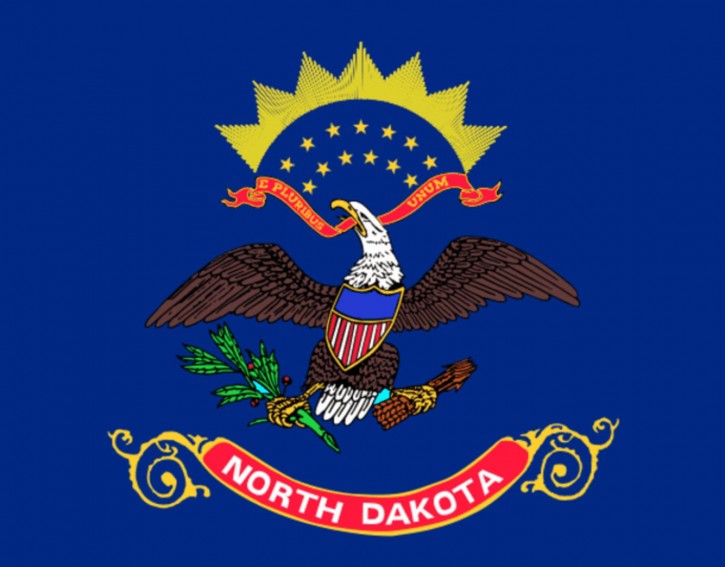
State Flag
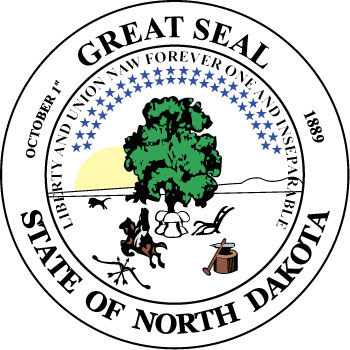
Great Seal
Nickname
The Peace Garden State / The Roughrider State
Motto
Liberty and Union, Now and Forever, One and Inseparable

Bird
Western Meadowlark
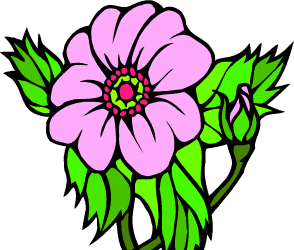
Flower
Wild Prairie Rose
Tree
American Elm
Mammal
Nokota Horse
Fish
Northern Pike
Insect
Convergent Lady Beetle
Fossil
Teredo-bored Petrified Wood
Beverage
Milk
Grass
Western Wheatgrass
Song
"North Dakota Hymn"