
 English
 Español
 中文
中文 हिन्दी
 Français
On this page
Overview
Oklahoma is a state in the South Central United States, bordered by Kansas to the north, Missouri and Arkansas to the east, Texas across the Red River to the south, New Mexico to the west, and Colorado at the tip of the Panhandle. With roughly 4.05 million residents across 69,899 square miles, it is the 28th-most populous state and the 20th largest by area.
Oklahoma entered the Union as the 46th state on November 16, 1907 — the merger of Oklahoma Territory and Indian Territory into a single state. The name "Oklahoma" comes from the Choctaw words "okla" ("people") and "humma" ("red") — together, "red people." Oklahoma City, in the geographic center of the state, is the state capital and the largest city. Tulsa on the Arkansas River is the second-largest city and was for decades known as the "Oil Capital of the World."
Oklahoma is unique among U.S. states for its concentration of Indigenous nations: the Cherokee, Chickasaw, Choctaw, Muscogee (Creek), Seminole, Osage, Comanche, Kiowa, Wichita, and many other peoples — 39 federally recognized tribes in all — maintain sovereign governments across the state. The 2020 U.S. Supreme Court decision in McGirt v. Oklahoma confirmed that much of eastern Oklahoma, including the city of Tulsa, lies within the boundaries of historic Indian reservations that were never formally disestablished. Oklahoma is also a top U.S. producer of oil, natural gas, beef cattle, and wheat, and the home of Tinker Air Force Base — the largest aircraft-maintenance and logistics facility in the U.S. Department of Defense.
Geography & Climate
Oklahoma is divided into four major physiographic regions. The Ozark Plateau and the Boston Mountains cover the northeastern corner around Tahlequah and Grand Lake, with forested hills and clear-running streams. The Ouachita Mountains run east-to-west across the southeastern part of the state — the only major east-west mountain range between the Appalachians and the Rockies — and contain the Ouachita National Forest. The central and east-central parts of the state, the Sandstone Hills and Prairie Plains, contain Tulsa and Oklahoma City and much of the population.
Western Oklahoma is rolling Great Plains, with the iconic red-soil "Red Bed" plains of the southwest and the high plains of the Panhandle. Black Mesa at the tip of the Panhandle, at 4,973 feet, is Oklahoma’s highest point — also the only piece of true Rocky Mountain mesa-and-plateau country east of New Mexico. The Red River forms the entire 539-mile southern boundary with Texas. The Arkansas River runs diagonally across the state and is, via the McClellan-Kerr Arkansas River Navigation System, the only inland waterway in the Great Plains connecting to the Mississippi River system — making Tulsa-Catoosa one of the most inland deep-draft ports in the United States.
The climate ranges from humid subtropical in the southeast (where the Ouachitas and the Red River valley share weather patterns with Arkansas and east Texas) to semi-arid in the Panhandle. Oklahoma sits at the heart of "Tornado Alley" and averages more tornadoes per square mile than any other U.S. state. The May 3, 1999 Bridge Creek–Moore tornado near Oklahoma City recorded the highest wind speed ever measured at the surface of the Earth: 321 mph.
History
Before European contact, the area was home to the Caddo, Wichita, Osage, Quapaw, Apache, Comanche, Kiowa, and other Indigenous peoples. The Spanish conquistador Francisco Vázquez de Coronado crossed the region in 1541. France claimed the area as part of Louisiana, and the United States acquired it via the 1803 Louisiana Purchase. The Oklahoma Panhandle was a no-man’s-land between U.S. and Spanish (later Mexican) territory until it was added to U.S. control by the 1850 Compromise.
Beginning in the 1830s, the U.S. government forcibly relocated southeastern Indigenous nations — the Cherokee, Choctaw, Chickasaw, Muscogee (Creek), and Seminole, collectively known as the "Five Civilized Tribes" — to "Indian Territory" west of the Mississippi River, in much of what is now Oklahoma. The Cherokee removal of 1838–1839, the most infamous of these forced marches, is known as the Trail of Tears; roughly a quarter of the Cherokee Nation died in transit. The displaced nations established new constitutional governments and capital towns (Tahlequah for the Cherokee, Tuskahoma for the Choctaw, and others) and operated as semi-sovereign nations.
On April 22, 1889, at exactly 12:00 noon, the U.S. opened the "Unassigned Lands" of central Oklahoma to non-Indigenous settlement. Approximately 50,000 hopefuls lined up at the territorial border to race for free homesteads in what became known as the Land Run of 1889. Settlers who illegally entered the area before noon to stake the best claims became known as "Sooners" — the nickname has stuck to the state ever since. Oklahoma Territory was organized in 1890. Continuing pressure from settlers led the U.S. to forcibly dissolve the tribal governments of the Five Civilized Tribes and merge Oklahoma Territory and Indian Territory into a single state on November 16, 1907.
The 1901 discovery of the Glenn Pool field south of Tulsa launched Oklahoma’s long oil boom; by the 1910s, Oklahoma was the leading U.S. oil-producing state, and Tulsa became known as the "Oil Capital of the World." Greenwood — the prosperous African American neighborhood of north Tulsa known as "Black Wall Street" — was destroyed in the May 31–June 1, 1921 Tulsa Race Massacre, in which a white mob killed hundreds of Black residents and burned the district to the ground. The Dust Bowl of the 1930s devastated western Oklahoma, displacing hundreds of thousands of "Okies" who migrated west to California (memorialized in John Steinbeck’s "The Grapes of Wrath"). The 1995 bombing of the Alfred P. Murrah Federal Building in Oklahoma City — until 9/11, the deadliest terrorist attack on U.S. soil — killed 168 people and reshaped American discussion of domestic terrorism. The 2020 U.S. Supreme Court decision in McGirt v. Oklahoma held that the Muscogee (Creek) Nation reservation had never been formally disestablished, restoring federal Indian-country status across a wide swath of eastern Oklahoma.
Economy
Oklahoma hosts an economy historically anchored by oil and gas, agriculture (especially beef cattle and wheat), and U.S. military presence, with increasingly significant aerospace, biosciences, and Indigenous-tribal gaming and economic-development sectors.
- Oil and gas: Oklahoma has been one of the top U.S. oil and natural-gas producing states since the early twentieth century. The Anadarko Basin and the SCOOP and STACK plays in central Oklahoma are among the most active U.S. shale plays. Devon Energy (Oklahoma City), Continental Resources (Oklahoma City), Chesapeake Energy (Oklahoma City, before its 2020 bankruptcy and reemergence), ONEOK (Tulsa), and Williams Companies (Tulsa) anchor a deep oil-and-gas corporate base.
- Agriculture: Oklahoma is one of the top five U.S. producers of beef cattle, wheat, and pecans, and a major producer of cotton, hogs, dairy, and poultry. The Oklahoma Panhandle is one of the largest U.S. centers of large-scale beef-cattle feedlot operations. Oklahoma State University at Stillwater anchors one of the leading U.S. agricultural research and extension programs.
- Military and aerospace: Tinker Air Force Base in Midwest City — east of Oklahoma City — is the largest aircraft-maintenance facility in the U.S. Department of Defense and one of the largest employers in Oklahoma, providing depot maintenance for the B-1, B-52, E-3, KC-46, KC-135, and other aircraft. Fort Sill near Lawton is the U.S. Army’s home of the Field Artillery and Air Defense Artillery branches and the U.S. Army Air Defense Artillery School. Vance AFB (Enid) and Altus AFB add to one of the largest concentrations of military per capita in the country.
- Native American gaming and economic development: Oklahoma hosts 39 federally recognized tribes and one of the largest concentrations of tribal gaming in the United States — second only to California by some measures. The Chickasaw Nation, the Cherokee Nation, the Muscogee (Creek) Nation, and the Choctaw Nation operate major casinos, hotels, golf courses, and other enterprises, including the WinStar World Casino (the largest casino in the United States by gaming-floor area) owned by the Chickasaw Nation near the Texas border.
- Biosciences and energy services: The Oklahoma City Innovation District, anchored by the OU Health Sciences Center and the Oklahoma Medical Research Foundation, has become a fast-growing biomedical-research cluster. ONEOK, Williams Companies, and Magellan Midstream Partners (now part of ONEOK) make Tulsa a leading U.S. midstream-pipeline corporate hub. Williams’ heritage in pipeline construction and operation is foundational to U.S. natural-gas distribution.
Government
Oklahoma operates under its 1907 constitution. The Oklahoma Legislature is bicameral, with a 48-member Senate (four-year terms) and a 101-member House of Representatives (two-year terms). The state has one of the strictest legislative term-limit laws in the country, with a combined 12-year cap that a legislator may serve in any combination of chambers over a lifetime.
The Governor of Oklahoma serves a four-year term and is limited to two consecutive terms. The state separately elects a Lieutenant Governor (separately from the Governor), Attorney General, Secretary of State (appointed since a 2010 constitutional amendment), Treasurer, Auditor, Insurance Commissioner, Labor Commissioner, Superintendent of Public Instruction, and three Corporation Commissioners — one of the most expansive sets of independently elected state executive officials in the country.
Oklahoma has five seats in the U.S. House of Representatives plus two U.S. Senators. The Supreme Court of Oklahoma has nine justices appointed by the governor through merit selection and retained by uncontested election; Oklahoma is one of two U.S. states (with Texas) to have separate Supreme and Criminal Appeals courts. The state capital is Oklahoma City, which replaced Guthrie as the capital in a 1910 statewide vote.
Culture
Oklahoma culture is unlike any other U.S. state in its blending of cowboy and Indigenous heritage. The state has 39 federally recognized tribal nations — including the Cherokee Nation, the Chickasaw Nation, the Choctaw Nation, the Muscogee (Creek) Nation, the Seminole Nation, the Osage Nation, the Comanche Nation, the Kiowa, and many others — each with its own constitutional government, cultural calendar, and language-revitalization programs. The 1907 statehood was originally proposed as a separate Indian-led state of "Sequoyah." Tulsa’s Gilcrease Museum and Norman’s Sam Noble Museum of Natural History hold some of the world’s leading collections of Indigenous art and material culture.
The 1943 Rodgers and Hammerstein musical "Oklahoma!" — based on Lynn Riggs’s play "Green Grow the Lilacs" — opened a new era of American musical theater and gave Oklahoma a worldwide cultural identity. The title song "Oklahoma!" is the official state song. Oklahoma is the birthplace of Will Rogers (Oologah — the Cherokee cowboy, syndicated columnist, and humorist), Woody Guthrie (Okemah — who wrote "This Land Is Your Land"), Mickey Mantle (Spavinaw), the Flaming Lips (Oklahoma City), Garth Brooks (Tulsa), Reba McEntire (Chockie), Carrie Underwood (Checotah), Vince Gill, and many others.
Oklahoma food culture combines Texas-influenced barbecue, chicken-fried steak (the official state meal), Tex-Mex, Native American fry bread (the Oklahoma Indian Taco), Oklahoma-style onion-fried burgers (originated in El Reno during the Depression), and the Sonic Drive-In — the now-national chain founded in Shawnee in 1953. College football is a defining cultural passion: the University of Oklahoma Sooners and the Oklahoma State University Cowboys have produced an enormous share of NFL talent, and the annual "Bedlam" game between them is one of the most intense in the country. The U.S. Rodeo Hall of Fame is at the National Cowboy & Western Heritage Museum in Oklahoma City.
Notable Cities
- Oklahoma City — State capital and largest city, in the geographic center of the state along the Canadian and North Canadian rivers, with a city population of roughly 695,000 and a metropolitan area of about 1.45 million. Home of the Oklahoma City National Memorial (commemorating the 1995 federal-building bombing), the Bricktown entertainment district, the Oklahoma City Thunder (NBA), the National Cowboy & Western Heritage Museum, the Sam Noble Museum nearby in Norman, and the headquarters of Devon Energy and Chesapeake Energy.
- Tulsa — Second-largest city, on the Arkansas River in northeastern Oklahoma, with a city population of roughly 412,000 and a metropolitan area of about 1.01 million. Long known as the "Oil Capital of the World," now home of the Tulsa Race Massacre Memorial (commemorating the destruction of the historic Greenwood "Black Wall Street" district in 1921), the Philbrook Museum of Art, the Gilcrease Museum, the BOK Center, the University of Tulsa, and the headquarters of ONEOK and Williams Companies.
- Norman — Third-largest city, immediately south of Oklahoma City, with a population of roughly 130,000. Home of the University of Oklahoma (the state’s flagship university), the OU College of Medicine campus, the Sam Noble Oklahoma Museum of Natural History, the Fred Jones Jr. Museum of Art, and the National Weather Center (the U.S. National Severe Storms Laboratory and the National Weather Service Storm Prediction Center are both based here).
- Broken Arrow — Fourth-largest city, immediately southeast of Tulsa, with a population of roughly 116,000. A fast-growing residential and commercial Tulsa suburb, home of the Bass Pro Shops headquarters distribution center, FlightSafety International’s Simulation operations, and the Broken Arrow Museum.
- Lawton — Fifth-largest city, in southwestern Oklahoma near the Wichita Mountains, with a population of roughly 91,000. The principal civilian community supporting Fort Sill — the U.S. Army’s home of the Field Artillery and Air Defense Artillery branches — and home of Cameron University. The Wichita Mountains Wildlife Refuge just to the north protects one of the largest U.S. bison herds.
State Symbols
Oklahoma’s official state symbols, designated by the Oklahoma Legislature, celebrate the layered Indigenous heritage, the cowboy and ranching identity, the agricultural economy, and the unique landscape of the Sooner State.
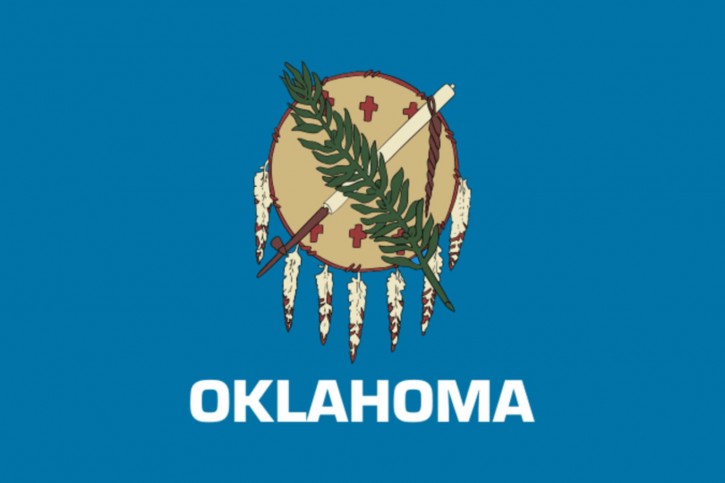
State Flag
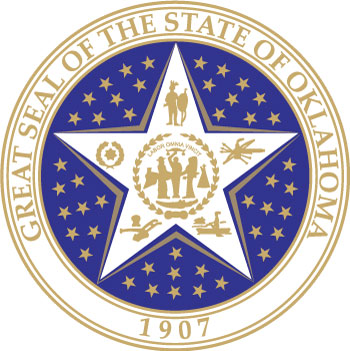
Great Seal
Nickname
The Sooner State
Motto
Labor omnia vincit ("Labor conquers all things")

Bird
Scissor-tailed Flycatcher

Flower
Oklahoma Rose
Tree
Eastern Redbud
Mammal
American Bison (Buffalo)
Reptile
Common Collared Lizard (Mountain Boomer)
Fish
White Bass (Sand Bass)
Wildflower
Indian Blanket
Soil
Port Silt Loam
Meal
Chicken-Fried Steak with cream gravy, plus 12 other components
Song
"Oklahoma!" (from the 1943 Rodgers and Hammerstein musical)