
 English
 Español
 中文
中文 हिन्दी
 Français
On this page
Overview
Pennsylvania, officially the Commonwealth of Pennsylvania, is a state in the Mid-Atlantic and Northeastern regions of the United States, bordered by New York to the north, New Jersey across the Delaware River to the east, Maryland and West Virginia to the south, Ohio to the west, and Lake Erie at the northwest corner. With roughly 12.96 million residents across 46,054 square miles, it is the fifth-most populous state and the 33rd largest by area.
Pennsylvania ratified the U.S. Constitution as the second state on December 12, 1787 — five days after Delaware. The state takes its name from "Penn’s Woods," after William Penn’s father, Admiral Sir William Penn, to whom King Charles II had owed a large debt; the king granted the colony to the younger William Penn in 1681 to settle the debt. Harrisburg on the Susquehanna River is the state capital. Philadelphia in the southeast is the largest city, the sixth-largest in the United States, and one of the most historically important cities in the Western Hemisphere.
Pennsylvania is the "Keystone State" — a nickname both geographical (it lay at the keystone of the original thirteen colonies) and historical (Pennsylvania was the central state in the founding of the United States: the Declaration of Independence was signed in Philadelphia on July 4, 1776, and the U.S. Constitution was drafted there in the summer of 1787). The state is one of only four U.S. states styled as a "commonwealth," alongside Massachusetts, Virginia, and Kentucky. Philadelphia and Pittsburgh anchor two distinct cultural and economic worlds — eastern Pennsylvania looking to New York and the Atlantic, western Pennsylvania to the Ohio Valley and the Midwest.
Geography & Climate
Pennsylvania spans nine physiographic regions across the central and northern Appalachians. The Atlantic Coastal Plain occupies a small wedge in the far southeast around Philadelphia. North and west of the Coastal Plain, the Piedmont includes the Lancaster County farmland — some of the most productive non-irrigated farmland in the world. The Ridge and Valley province (the "folded Appalachians") runs in long parallel ridges from the southwest to the northeast and contains the state capital, Harrisburg.
West of the Ridge and Valley, the Appalachian Plateau covers the largest part of Pennsylvania. Mount Davis in Somerset County, on the Allegheny Plateau, is the state’s highest point at 3,213 feet. The Pocono Mountains in the northeast are a long-time resort area. Pennsylvania’s 51 miles of Lake Erie shoreline in the northwest at Erie are the only Great Lakes coast in the state. The Susquehanna River drains most of central Pennsylvania to the Chesapeake Bay, the Delaware River drains the east to the Atlantic, and the Allegheny and Monongahela rivers meet at Pittsburgh to form the Ohio River — the second-most important river system in the eastern United States.
The climate is humid continental in most of the state, with humid subtropical influence in Philadelphia and the southeast. Pittsburgh and the western Appalachians receive substantial winter snow — the western Allegheny Mountains are part of a notable lake-effect snow belt off Lake Erie. The Pennsylvania Wilds in the north-central part of the state — a 2-million-acre region centered on Cherry Springs State Park — contains some of the darkest night skies in the eastern United States.
History
For thousands of years before European contact, Pennsylvania was home to the Lenape (Delaware), Susquehannock, Erie, Shawnee, and Iroquois (especially the Seneca in the northwest) peoples. Swedish settlers established New Sweden along the lower Delaware River beginning in 1638, the first European settlement in present-day Pennsylvania. The Dutch took New Sweden in 1655, and the English took the Dutch in 1664.
In 1681, King Charles II granted the Province of Pennsylvania to William Penn, son of Admiral Sir William Penn, to settle a debt owed to his father. The younger Penn — a Quaker — designed the colony as a "Holy Experiment" in religious toleration and constitutional government, opening it to Quakers, German Pietists, Welsh Baptists, Scotch-Irish Presbyterians, Catholics, Jews, and many other groups otherwise persecuted in Europe. Philadelphia, planned by Penn and surveyed in 1682, became one of the largest and most cosmopolitan cities in the English-speaking world by the 1750s.
Pennsylvania became the central state of the American Revolution. The First and Second Continental Congresses met in Philadelphia. The Declaration of Independence was adopted in the Pennsylvania State House (now Independence Hall) on July 4, 1776. The U.S. Constitution was drafted and signed in the same building during the Philadelphia Convention of 1787, and Pennsylvania became the second state to ratify it on December 12, 1787. Philadelphia served as the temporary U.S. capital from 1790 to 1800 — most of George Washington’s presidency and all of John Adams’s.
The nineteenth and twentieth centuries built Pennsylvania into the industrial heartland of the United States. Anthracite coal in the northeast, bituminous coal in the southwest, oil (the world’s first commercial oil well was drilled at Titusville in 1859), iron and steel (Pittsburgh’s "Steel City" was the largest steel-producing region on Earth by 1900 under Andrew Carnegie), and the great railroads — the Pennsylvania Railroad was for decades the largest corporation in the world. The Battle of Gettysburg, July 1–3, 1863, was the deadliest battle of the U.S. Civil War and is widely considered the conflict’s turning point; President Lincoln delivered the Gettysburg Address there on November 19, 1863. Pittsburgh’s steel industry collapsed dramatically in the 1980s, and the city has since reinvented itself as a leading U.S. center for healthcare, robotics, and computer science research at Carnegie Mellon University.
Economy
Pennsylvania hosts one of the largest and most diversified state economies in the United States, anchored by healthcare and life sciences, financial services, education, advanced manufacturing, agriculture and food, energy (especially Marcellus Shale natural gas), and substantial logistics and federal-government employment.
- Healthcare and life sciences: UPMC (University of Pittsburgh Medical Center) is Pennsylvania’s largest non-government employer and one of the largest U.S. integrated health-care systems. The University of Pennsylvania Health System, Children’s Hospital of Philadelphia, Penn State Health, Geisinger Health, and Independence Blue Cross anchor a deep healthcare cluster. Major pharmaceutical operations include GlaxoSmithKline (Philadelphia operations), Merck (West Point), Wyeth (now Pfizer, Collegeville), AstraZeneca, and the new gene-therapy and cell-therapy industries emerging from Penn-affiliated startups.
- Financial services and media: Comcast (Philadelphia) — one of the largest cable, broadband, and media companies in the world — is headquartered in the Comcast Center, the tallest building in Philadelphia. Vanguard Group (Malvern) is one of the world’s largest asset managers, second only to BlackRock. PNC Financial Services (Pittsburgh), Lincoln Financial, Aramark, and Capital BlueCross add to a substantial financial-services cluster. Berkshire Hathaway’s See’s Candies and other operations have major Pennsylvania facilities.
- Manufacturing and energy: Pennsylvania remains a major U.S. manufacturing state. U.S. Steel, originally founded by Andrew Carnegie in 1901, is still headquartered in Pittsburgh (now in a UPMC-anchored building). Boeing’s Defense Helicopters division (Boeing Vertical Lift, Ridley Township) builds the V-22 Osprey, the CH-47 Chinook, and the MH-139A Grey Wolf. The Marcellus Shale formation makes Pennsylvania the second-largest U.S. natural-gas producer (after Texas), with major operations of EQT Corporation (Pittsburgh), Range Resources, CNX Resources, and Chesapeake Energy.
- Agriculture and food: Pennsylvania is the leading U.S. producer of mushrooms (Chester County around Kennett Square produces about 70 percent of all U.S. mushrooms), and a top-five producer of dairy, eggs, Christmas trees, hardwood lumber, and pumpkins. Hershey’s (Hershey), Heinz (originally Pittsburgh, now part of Kraft Heinz), Utz Quality Foods (Hanover), Wise Foods, Snyder’s of Hanover, and Yuengling (the oldest U.S. brewery, founded in Pottsville in 1829) are anchors of one of the most distinctive U.S. food-manufacturing clusters.
- Technology, education, and tourism: Carnegie Mellon University in Pittsburgh is one of the leading U.S. universities for computer science, robotics, and artificial intelligence research. The University of Pennsylvania, an Ivy League research university, anchors a deep biomedical and tech cluster in West Philadelphia. Penn State University is one of the largest U.S. public universities. Tourism is anchored by Philadelphia’s Independence Hall and Liberty Bell, the Gettysburg battlefield, the Pocono Mountains, Hersheypark, the Pennsylvania Dutch Country in Lancaster County (the largest Old Order Amish settlement in the United States), and the Pittsburgh sports and museum scene.
Government
Pennsylvania operates under its 1968 constitution, the fifth in its history (the original 1776 Pennsylvania Constitution was one of the most democratic in the world at the time of adoption). The Pennsylvania General Assembly is bicameral, with a 50-member Senate (four-year terms) and a 203-member House of Representatives (two-year terms). The Pennsylvania House is the third-largest U.S. state lower chamber after New Hampshire’s and Massachusetts’s. There are no legislative term limits.
The Governor of Pennsylvania serves a four-year term and is limited to two consecutive terms. The state also elects a Lieutenant Governor (jointly with the Governor since 1971), Attorney General, Auditor General, and Treasurer. Pennsylvania is one of only four U.S. states styled as a "commonwealth," alongside Massachusetts, Virginia, and Kentucky — a Quaker-era constitutional tradition emphasizing the public good ("common wealth") over royal sovereignty.
Pennsylvania has 17 seats in the U.S. House of Representatives plus two U.S. Senators. The Supreme Court of Pennsylvania has seven justices elected statewide on partisan ballots for ten-year terms and is the oldest appellate court in the United States, in continuous operation since 1684 (predating the U.S. Constitution by more than a century). The state capital is Harrisburg, named for the colonial trader John Harris Jr., who ran the ferry across the Susquehanna where the city now stands.
Culture
Pennsylvania culture is shaped above all by the contrast between Philadelphia in the east and Pittsburgh in the west — culturally, linguistically, and economically distinct cities separated by 305 miles of Appalachian mountain. Philadelphia is one of the most historic U.S. cities — Independence Hall, the Liberty Bell, Benjamin Franklin’s grave, the Reading Terminal Market, the Philadelphia Museum of Art (the "Rocky steps"), the Italian Market, and the famous Philly cheesesteak (Pat’s King of Steaks vs. Geno’s Steaks is a long-running rivalry). Philadelphia sports — Eagles, Phillies, 76ers, Flyers — are some of the most intensely supported in the country. South Philly Italian heritage, the African American culture of the Philadelphia jazz tradition, the deep Irish-American heritage, and emerging Vietnamese, Cambodian, and West African communities all shape modern Philadelphia.
Pittsburgh culture is built on its steel-mill working-class history, its Polish, Italian, German, Irish, and Slavic immigrant heritage, the three rivers, and the distinctive "Pittsburghese" dialect (yinz, n’at, jagoff, pop instead of soda). Pierogies, kielbasa, Primanti Brothers sandwiches (with fries and coleslaw inside the sandwich), and the Heinz ketchup heritage define Pittsburgh food. The Steelers, Penguins, and Pirates anchor city sports; the Andy Warhol Museum, the Carnegie Museums, the Heinz History Center, and the Mattress Factory anchor the arts.
Pennsylvania Dutch Country — the central and south-central counties around Lancaster — is home to the largest Old Order Amish community in the United States, with more than 40,000 Amish residents in Lancaster County alone. Pennsylvania Dutch German-derived dialect, hex signs on barns, shoofly pie, scrapple, soft pretzels, chicken-and-waffles, and whoopie pies all originate here. The Pennsylvania Dutch are not Dutch but Pennsylvania German (Deitsch). Hershey, Pennsylvania — "Chocolate Town USA" — was founded as a company town for Milton Hershey’s chocolate factory in 1903. Penn State football (Beaver Stadium has the second-largest seating capacity in the country, behind only Michigan Stadium) and the Pennsylvania Dutch and Quaker religious traditions are central statewide cultural anchors.
Notable Cities
- Philadelphia — Largest city in Pennsylvania and sixth-largest in the United States, on the Delaware River, with a city population of roughly 1.55 million and a metropolitan area of about 6.25 million spanning Pennsylvania, New Jersey, and Delaware. Home of Independence Hall (where the Declaration of Independence and the U.S. Constitution were signed), the Liberty Bell, the Philadelphia Museum of Art, the University of Pennsylvania, Temple University, Drexel University, the Eagles (NFL), Phillies (MLB), 76ers (NBA), Flyers (NHL), and Comcast headquarters.
- Pittsburgh — Second-largest city, at the confluence of the Allegheny and Monongahela rivers forming the Ohio, with a city population of roughly 304,000 and a metropolitan area of about 2.35 million. Former "Steel City" reinvented as one of the leading U.S. centers for healthcare (UPMC), robotics, and AI research (Carnegie Mellon University, University of Pittsburgh). Home of the Steelers (NFL — six-time Super Bowl champions), Penguins (NHL), Pirates (MLB), the Andy Warhol Museum, the Carnegie Museums, PNC Park, and PNC Financial Services Group.
- Allentown — Third-largest city, in the Lehigh Valley of eastern Pennsylvania, with a city population of roughly 125,000 and a Lehigh Valley metropolitan area of about 860,000. A former steel-and-cement center (Bethlehem Steel was nearby) that has reinvented itself as a healthcare and logistics economy, anchored by the Lehigh Valley Health Network, the PPL Center arena, and major distribution centers serving the New York and Philadelphia metro areas.
- Erie — Fourth-largest city, on Pennsylvania’s 51-mile Lake Erie shoreline in the northwest corner of the state, with a city population of roughly 95,000 and a metropolitan area of about 270,000. The principal Pennsylvania Great Lakes port. Home of Presque Isle State Park (the most-visited Pennsylvania state park), the Erie Maritime Museum and Brig Niagara (Commodore Oliver Hazard Perry’s flagship at the 1813 Battle of Lake Erie), Mercyhurst University, and Gannon University.
- Reading — Fifth-largest city, in Berks County in southeastern Pennsylvania, with a city population of roughly 95,000. The historic center of the Pennsylvania Dutch region, home of the Reading Phillies (a longstanding minor-league baseball team), the Goggleworks Center for the Arts, and substantial Latino-heritage cultural institutions reflecting the city’s significant Puerto Rican and Mexican American population.
State Symbols
Pennsylvania’s official state symbols, designated by the Pennsylvania General Assembly, celebrate the Appalachian forests, the agricultural heritage of Lancaster County and the Pennsylvania Dutch region, the Quaker founding tradition, and the industrial history of the Keystone State.
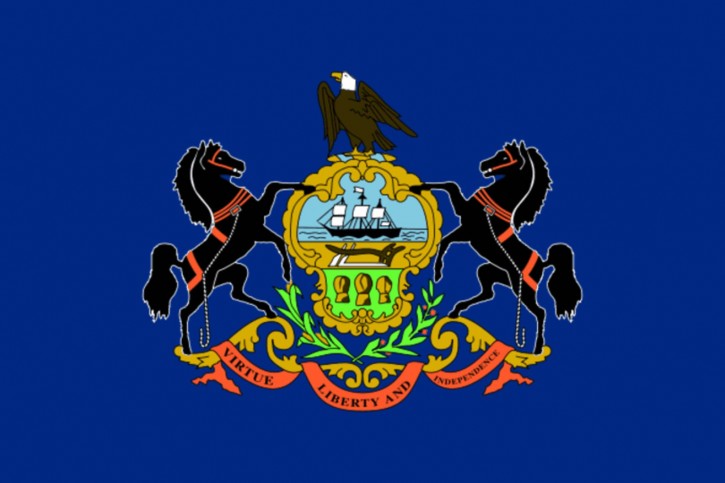
State Flag
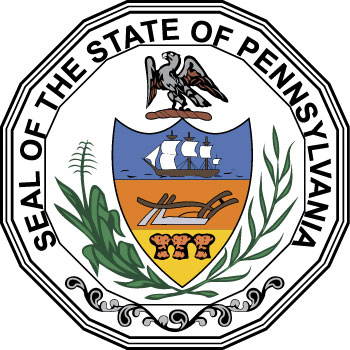
Great Seal
Nickname
The Keystone State
Motto
Virtue, Liberty, and Independence

Bird
Ruffed Grouse
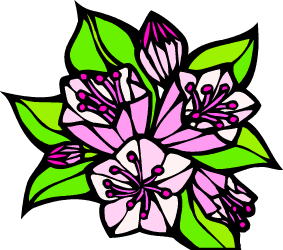
Flower
Mountain Laurel
Tree
Eastern Hemlock
Mammal
White-tailed Deer
Dog
Great Dane
Fish
Brook Trout
Insect
Pennsylvania Firefly
Beverage
Milk
Fossil
Phacops rana (Trilobite)
Song
"Pennsylvania"