
 English
 Español
 中文
中文 हिन्दी
 Français
On this page
Overview
Rhode Island is the smallest U.S. state by area, in the New England region of the northeastern United States, bordered by Massachusetts to the north and east, Connecticut to the west, and Rhode Island Sound and the Atlantic Ocean to the south. With roughly 1.10 million residents across 1,545 square miles, it is the seventh-least populous state but the second-most densely populated (after New Jersey).
Rhode Island ratified the U.S. Constitution as the 13th and last of the original states on May 29, 1790 — more than two and a half years after Delaware became the first. The state had held out for the addition of a Bill of Rights and ratified only after threats of trade restrictions. The official name of the state was "State of Rhode Island and Providence Plantations" until November 2020, when voters approved a constitutional amendment shortening it to "State of Rhode Island." The "Providence Plantations" name referred to seventeenth-century farming settlements, not to chattel slavery — but its inclusion had drawn objections.
Providence at the head of Narragansett Bay is the state capital and the largest city. Despite Rhode Island’s small land area, the state has more than 400 miles of coastline thanks to the deep estuary of Narragansett Bay, which extends 28 miles north into the state and contains more than 30 islands. The state is nicknamed the "Ocean State" — no community in Rhode Island is more than about 30 miles from saltwater. Founded in 1636 by Roger Williams, a religious dissenter banished from Puritan Massachusetts, Rhode Island was the first English colony in North America to formally guarantee religious freedom and the separation of church and state.
Geography & Climate
Rhode Island is dominated by Narragansett Bay, which divides the state into two main mainland sections (the East Bay and the West Bay) plus the islands of Aquidneck Island (the largest, containing Newport, Middletown, and Portsmouth), Conanicut Island (Jamestown), Prudence Island, and others. The "Rhode Island" name was originally applied to Aquidneck Island; later it spread to the entire colony and state. Block Island, 13 miles off the south coast in Block Island Sound, is a popular summer resort island.
The state’s 400 miles of tidal shoreline are extraordinary for its tiny area — only Florida, Alaska, Hawaii, and a handful of other states have more coastline within their state borders. The South County beaches — Misquamicut, Narragansett, and others — anchor much of the state’s summer-tourism economy. Jerimoth Hill in Foster, near the Connecticut border, at 812 feet, is the state’s highest point — the lowest "highest point" of any state.
The climate is humid continental with a strong oceanic moderation: summers are warm and humid (cooler on the coast than inland), and winters are cold but milder than inland New England. Snowfall is significant but the immediate Atlantic coast often sees mixed precipitation. Narragansett Bay has historically been one of the great deepwater anchorages of the U.S. East Coast and is the strategic reason for the long U.S. Navy presence at Newport.
History
For thousands of years before European contact, Rhode Island was home to the Narragansett, Wampanoag, Niantic, and Pequot peoples, with the Narragansett occupying most of present-day Rhode Island. In 1636, Roger Williams — a Puritan minister banished from the Massachusetts Bay Colony for his radical views on religious tolerance and his insistence that Indigenous nations be paid for their land — founded Providence on land granted to him by the Narragansett sachem Canonicus. Anne Hutchinson, William Coddington, and other religious dissenters founded Portsmouth on Aquidneck Island in 1638. Roger Williams’s 1644 Patent united Providence, Portsmouth, and Newport as the Colony of Rhode Island and Providence Plantations — establishing the first government in the Western world founded on the principle of complete separation of church and state.
Rhode Island became a refuge for religious dissenters across Europe and the Americas. The Touro Synagogue in Newport, completed in 1763, is the oldest standing synagogue building in the United States. Rhode Island was a major commercial colony — its merchants played a substantial role in the transatlantic slave trade (carrying African captives to the Caribbean and to mainland North America) and in the broader colonial maritime economy.
Rhode Island was the first U.S. colony to formally renounce allegiance to King George III, on May 4, 1776 — two months before the Continental Congress adopted the Declaration of Independence. Rhode Island declined to send delegates to the Constitutional Convention in Philadelphia in 1787 and waited until May 29, 1790 to ratify the U.S. Constitution, finally doing so 34-32 only after Congress passed the Bill of Rights and threatened economic sanctions. Rhode Island was thus the 13th and last of the original states to enter the Union.
In 1793, the British-trained millwright Samuel Slater built the first successful water-powered cotton-spinning mill in North America at Pawtucket, launching the American Industrial Revolution. Throughout the nineteenth and early twentieth centuries, Rhode Island became one of the most industrialized states per capita in the United States — textiles, jewelry (Providence was for decades the "Jewelry Capital of the World"), metalwork, and rubber manufacturing dominated the economy. The 1840 Dorr Rebellion expanded voting rights to non-property-owning white men. Gilded Age industrialists built the "Newport Cottages" — including the Vanderbilts’ The Breakers — making Newport the summer capital of America’s ultra-wealthy from roughly 1870 to 1914. The U.S. Navy established a major presence at Newport in 1869 that continues today with the Naval War College, the Naval Undersea Warfare Center, and several other commands.
Economy
Rhode Island hosts a small but distinctive economy anchored by healthcare and bioscience, higher education, defense (especially U.S. Navy undersea warfare), financial services and insurance, tourism, and a substantial advanced-manufacturing sector.
- Healthcare and bioscience: Lifespan (formerly Rhode Island Hospital and affiliates) and Care New England are the state’s two largest hospital systems and among the state’s largest employers. Brown University’s Warren Alpert Medical School and the affiliated teaching hospitals make Providence a substantial U.S. biomedical-research center. CVS Health, headquartered in Woonsocket, is one of the largest companies in the United States by revenue and the parent of Aetna.
- Higher education: Brown University in Providence, founded in 1764, is the seventh-oldest college in the United States and a member of the Ivy League. The Rhode Island School of Design (RISD) — directly adjacent to Brown — is one of the most prestigious U.S. art and design colleges. Providence College, the University of Rhode Island (Kingston), Bryant University (Smithfield), Roger Williams University (Bristol), and the Naval War College (Newport) round out a higher-education sector that anchors the state’s economy.
- Defense and undersea warfare: Naval Station Newport hosts the U.S. Naval War College, the Naval Undersea Warfare Center (the U.S. Navy’s lead center for submarine and undersea-vehicle research), the Officer Training Command, and many other commands — collectively employing about 17,000 military and civilian personnel. General Dynamics Electric Boat operates major facilities in Quonset Point, building submarines for the U.S. Navy (the Virginia-class and Columbia-class). Raytheon Technologies (now RTX) has substantial Rhode Island operations.
- Financial services, insurance, and consumer brands: FM Global (Johnston) is one of the largest U.S. mutual insurance companies. Citizens Financial Group (Providence) is one of the largest U.S. retail and commercial banks. Amica Mutual Insurance (Lincoln) and Hasbro (Pawtucket — maker of Monopoly, Mr. Potato Head, G.I. Joe, My Little Pony, and the Transformers franchise) anchor a substantial corporate sector.
- Tourism: Tourism is a major industry. Newport draws over 3.5 million visitors a year for its Gilded Age "summer cottages" (The Breakers, Marble House, The Elms — most owned today by the Preservation Society of Newport County), the International Tennis Hall of Fame, the Cliff Walk, the Newport Jazz and Folk Festivals (founded by George Wein in 1954 and 1959), and as one of the world’s great sailing capitals. Block Island, the South County beaches, the Roger Williams Park Zoo in Providence, and Federal Hill (Providence’s Italian neighborhood) round out a substantial tourism economy.
Government
Rhode Island operates under its 1986 constitution (heavily amended in 1986; the underlying constitution dates to 1843). The Rhode Island General Assembly is bicameral, with a 38-member Senate and a 75-member House of Representatives, both serving two-year terms. There are no legislative term limits.
The Governor of Rhode Island serves a four-year term and is limited to two consecutive terms. The state also separately elects a Lieutenant Governor (separately from the Governor since 2014, when voters reverted to non-joint election), Attorney General, Secretary of State, and General Treasurer. In November 2020, Rhode Island voters approved a constitutional amendment shortening the official name of the state from "State of Rhode Island and Providence Plantations" to "State of Rhode Island."
Rhode Island has two seats in the U.S. House of Representatives plus two U.S. Senators. The Rhode Island Supreme Court has five justices appointed by the governor with consent of both chambers of the General Assembly, serving for life on good behavior. The state capital is Providence, whose Rhode Island State House — opened in 1904 — has the fourth-largest self-supporting marble dome in the world (after St. Peter’s in Rome, the Minnesota State Capitol, and the Taj Mahal).
Culture
Rhode Island culture is built on its Italian, Portuguese (especially Azorean and Cape Verdean), Irish, French Canadian, African American, and Latino heritage and on a long maritime tradition. The Federal Hill neighborhood of Providence is one of the most-celebrated Italian-American neighborhoods in the country, and Rhode Island has the highest percentage of Italian Americans of any U.S. state. The Portuguese-speaking communities — Azorean Portuguese, Cape Verdean, and Brazilian — give parts of Pawtucket, East Providence, and Fall River (just across in Massachusetts) one of the largest Lusophone concentrations in the United States.
Rhode Island has one of the most distinctive U.S. regional food cultures. Coffee milk — milk flavored with sweetened coffee syrup, especially Autocrat — is the official state drink. New England clam chowder (creamy) is universal in New England; Rhode Island clam chowder has a clear broth, no milk or cream, and is unique to the state. Stuffies (stuffed quahog clams), clam cakes (deep-fried clam fritters), and "shore dinners" of steamed clams, lobster, corn, and watermelon are everywhere on summer menus. Del’s Lemonade (a frozen lemonade slush originated in Cranston in 1948), Awful Awfuls (a milkshake), Newport Creamery cabinets (milkshakes — "cabinet" is the local term), grinders, and clam shacks are central. The hot weiner ("New York System") — a small steamed Coney-style wiener with meat sauce, onions, mustard, and celery salt, lined up the cook’s forearm — is a Providence specialty.
Rhode Island culture is anchored in the Providence creative scene — the Brown / RISD axis has produced an enormous number of artists, designers, and writers. Notable figures associated with Rhode Island include horror writer H.P. Lovecraft (born and died in Providence), the painter Gilbert Stuart (Saunderstown — painter of George Washington), the architect Cass Gilbert (longtime Newport resident — designer of the Woolworth Building and U.S. Supreme Court), and many contemporary figures. The Newport Folk Festival (1959 — Bob Dylan’s famous 1965 "Dylan goes electric" appearance happened here) and the Newport Jazz Festival (1954) draw international audiences each summer.
Notable Cities
- Providence — State capital and largest city, at the head of Narragansett Bay where the Providence, Woonasquatucket, and Moshassuck rivers meet, with a city population of roughly 190,000 and a metropolitan area of about 1.6 million spanning into Massachusetts. Home of Brown University (founded 1764, one of the oldest colleges in the United States and an Ivy League member), the Rhode Island School of Design (RISD), the Providence Place mall, the Rhode Island State House, the historic Federal Hill Italian neighborhood, the Providence Performing Arts Center, the Providence Bruins (AHL hockey), and the seasonal WaterFire art installation along the downtown rivers.
- Warwick — Second-largest city, on the western shore of Narragansett Bay south of Providence, with a population of roughly 82,000. Home of T.F. Green International Airport (the principal Rhode Island airport), the Rhode Island Mall, multiple Narragansett Bay marinas, and the historic Pawtuxet Village.
- Cranston — Third-largest city, immediately south of Providence, with a population of roughly 82,000. Home of the Garden City Center shopping district, the original Del’s Lemonade stand (since 1948), and a substantial Italian, Portuguese, and Cape Verdean American community.
- Pawtucket — Fourth-largest city, on the Blackstone River immediately north of Providence, with a population of roughly 75,000. The birthplace of the American Industrial Revolution — Samuel Slater built the first successful water-powered cotton-spinning mill in North America here in 1793, now preserved as the Slater Mill Historic Site. Home of Hasbro, the McCoy Stadium (longtime home of the Pawtucket Red Sox, now relocated), and a substantial Cape Verdean and Portuguese American community.
- East Providence — Fifth-largest city, on the east bank of the Providence River and Narragansett Bay opposite downtown Providence, with a population of roughly 47,000. Home of the East Providence Riverside area, the Crescent Park Carousel (a National Historic Landmark), and a substantial Portuguese-American and Cape Verdean community.
State Symbols
Rhode Island’s official state symbols, designated by the Rhode Island General Assembly, celebrate the maritime identity, the Narragansett Bay shellfish heritage, the religious-freedom founding, and the distinctive food culture of the Ocean State.
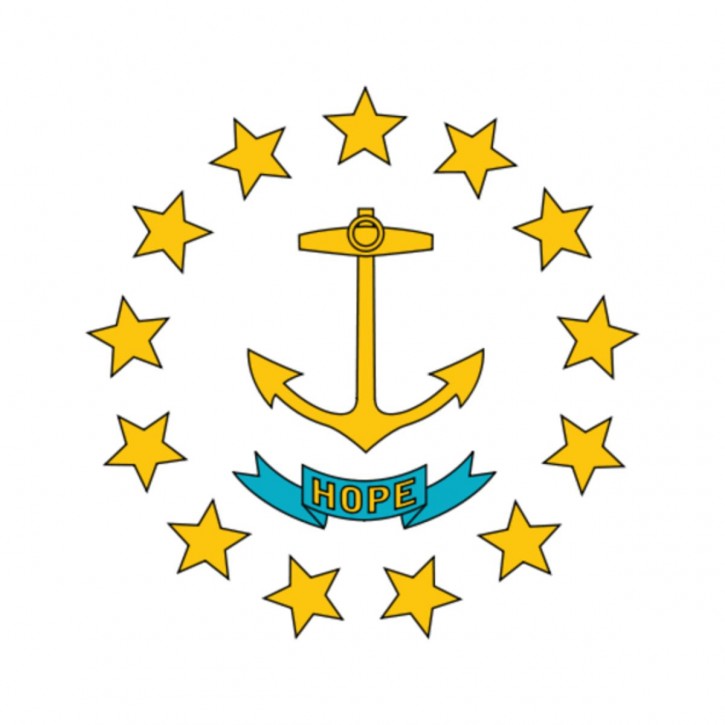
State Flag
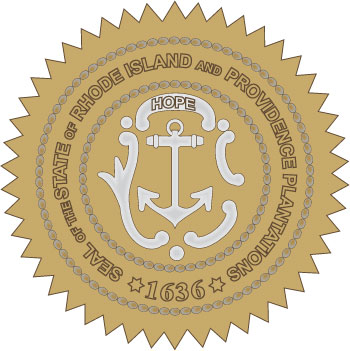
Great Seal
Nickname
The Ocean State / Little Rhody
Motto
Hope

Bird
Rhode Island Red Chicken
Flower
Violet
Tree
Red Maple
Shell
Quahog
Fish
Striped Bass
Mineral
Bowenite
Rock
Cumberlandite
Drink
Coffee Milk
Fruit
Rhode Island Greening Apple
Song
"Rhode Island, It’s for Me"