
 English
 Español
 中文
中文 हिन्दी
 Français
On this page
Overview
Oregon is a state in the Pacific Northwest region of the western United States, bordered by Washington across the Columbia River to the north, Idaho across the Snake River to the east, Nevada and California to the south, and the Pacific Ocean to the west. With roughly 4.27 million residents across 98,379 square miles, it is the 27th-most populous state and the 9th largest by area.
Oregon entered the Union as the 33rd state on February 14, 1859 — the only state ever admitted on Valentine’s Day. The name "Oregon" first appeared in an English document in 1765, but its origin is uncertain; possibilities include a Connecticut River Algonquian word "wauregan" (meaning "good water" or "beautiful"), a Spanish term referring to the West, or a clerk’s misreading of the French "ouisconsin." Salem in the Willamette Valley is the state capital. Portland on the Columbia and Willamette rivers is by far the largest city and the cultural and economic anchor of the state.
Oregon is famous for its dramatic Pacific coastline (every inch of which is legally protected public land thanks to the 1967 Beach Bill), the snow-capped volcanic Cascade Range — including Mount Hood and Crater Lake (the deepest lake in the United States) — the Willamette Valley pinot-noir wine country, the high desert and canyonlands of the east, the immense Douglas-fir and Western redcedar forests, and a long progressive political tradition that gave the country the first bottle-deposit law (1971), the first vote-by-mail elections (1998), Death with Dignity (1994), and recreational cannabis (2014).
Geography & Climate
Oregon spans eight major geographic regions. The Pacific coast — 363 miles of beaches, headlands, dunes, and rocky shore, every foot of it publicly accessible thanks to the 1967 Oregon Beach Bill — is backed by the rugged Coast Range. East of the Coast Range, the Willamette Valley runs north-south for 150 miles between Eugene and Portland — Oregon’s richest farmland and most populous region. The Cascade Range divides Oregon: Mount Hood (11,250 feet, an active stratovolcano) is the highest point. Crater Lake, formed in the collapsed caldera of Mount Mazama’s ancient eruption, is the deepest lake in the United States at 1,943 feet.
East of the Cascades, Oregon becomes high desert. The Columbia Plateau covers the north, the Blue Mountains and Wallowa Mountains cover the northeast (with Hells Canyon, the deepest river gorge in North America at 7,993 feet, on the Idaho border), and the Basin and Range and Owyhee canyonlands cover the southeast. The Columbia River, which forms most of Oregon’s northern border, is the largest river of the Pacific Northwest. The Willamette, Deschutes, John Day, Snake, and Rogue are the principal interior rivers.
Oregon’s climate ranges from mild and very wet on the coast and west side of the Cascades (Portland and Astoria are famously rainy in winter) to arid and continental east of the Cascades (the Alvord Desert near Steens Mountain receives less than 7 inches of rain a year). The dramatic rain-shadow contrast across the Cascades is one of the most extreme in the United States. The state contains substantial portions of three major national forests and the Mount Hood National Forest, plus Crater Lake National Park and the Oregon Caves National Monument.
History
For thousands of years before European contact, Oregon was home to dozens of Indigenous nations including the Chinook, Klamath, Modoc, Nez Perce, Umatilla, Cayuse, Wasco, Tillamook, Tutuni, and others. Lewis and Clark, descending the Columbia River, wintered at Fort Clatsop near present-day Astoria from December 1805 through March 1806 — among the most challenging months of their journey. The Oregon Country was held jointly by the United States and Great Britain from 1818 until the 1846 Treaty of Oregon, which set the border at the 49th parallel from the Rocky Mountains to the Strait of Juan de Fuca.
The Oregon Trail — the great 2,170-mile overland route from Independence, Missouri, to the Willamette Valley — drew tens of thousands of American migrants in the 1840s and 1850s. The Oregon Territory was organized in 1848, and Oregon was admitted as the 33rd state on February 14, 1859. The original Oregon Constitution included some of the harshest racial exclusion laws of any U.S. state — provisions that were not formally repealed until the twentieth century and that continue to shape Oregon’s demographic history.
The late nineteenth and early twentieth centuries built Oregon on timber, fisheries, and shipping. The Great Depression and World War II brought massive Bonneville Power Administration hydroelectric development on the Columbia, the Kaiser shipyards in Portland-Vancouver, and a major in-migration of African American workers to the Vanport housing project (destroyed in the 1948 flood). Postwar Oregon developed a distinctive environmentalist and progressive political tradition: Republican Governor Tom McCall’s 1967 Beach Bill — guaranteeing public access to the entire Oregon coast — and his 1971 Bottle Bill — the first beverage-container deposit law in the United States — set national templates that have been widely copied.
Oregon was the first U.S. state to adopt vote-by-mail (1998), to legalize physician-assisted dying (the 1994 Death with Dignity Act), to legalize recreational cannabis (2014), and to decriminalize possession of small amounts of all drugs (2020, partially rolled back in 2024). The "Silicon Forest" — Intel’s largest U.S. operations cluster in Hillsboro, Tektronix, Mentor Graphics, and many others — emerged in the western Portland suburbs from the 1980s. Nike was founded in Beaverton in 1964 by University of Oregon track coach Bill Bowerman and his former runner Phil Knight.
Economy
Oregon hosts one of the most diversified economies on the U.S. West Coast, anchored by technology, advanced manufacturing, outdoor and athletic apparel, forestry and wood products, agriculture and food (especially Willamette Valley wine), and port-of-Portland logistics.
- Technology — "Silicon Forest": Intel’s Hillsboro campus is the company’s largest U.S. operations center, with more than 22,000 employees — Oregon’s largest private employer. Intel’s Ronler Acres, Aloha, Jones Farm, and Hawthorn Farm sites form the core of the "Silicon Forest." Other major tech employers include Tektronix (Beaverton), Mentor Graphics/Siemens EDA (Wilsonville), Lattice Semiconductor (Hillsboro), Autodesk, Salesforce, Google, Amazon Web Services, and Apple (data centers in central Oregon).
- Athletic and outdoor apparel: Nike (Beaverton) is the world’s largest athletic shoe and apparel company by revenue, headquartered in Oregon and inseparable from the state’s identity. Columbia Sportswear (Portland) is one of the largest U.S. outdoor-apparel companies. Adidas North America is headquartered in Portland, Under Armour and many other athletic brands have major Pacific Northwest operations, and the state hosts Keen footwear, Dr. Martens’ Americas headquarters, Hi-Tec, Yogi Tea, and dozens of smaller outdoor brands.
- Forestry and wood products: Oregon is the leading U.S. producer of softwood lumber, plywood, engineered wood, and processed Douglas-fir. Major firms include Weyerhaeuser (although headquartered in Washington, with major Oregon timberland), Roseburg Forest Products, Stimson Lumber, and Boise Cascade. The state still has more than 30 million acres of forestland — about half its total land area.
- Agriculture and food: Oregon is the largest U.S. producer of hazelnuts (about 99 percent of U.S. production), Christmas trees, peppermint, blackberries, boysenberries, and a top producer of pears, sweet cherries, hops (the Willamette and Hood River valleys are major hops regions for the U.S. craft-beer industry), and dairy. The Willamette Valley is the leading U.S. producer of cool-climate Pinot Noir wine — Oregon has nearly 1,000 wineries, anchored around Dundee Hills and McMinnville.
- Ports, manufacturing, and craft beverages: The Port of Portland is the principal U.S. Pacific Northwest port for wheat, autos, and minerals. Boeing operates major fabrication operations in Portland and Gresham. Daimler Trucks North America (Portland) is the largest U.S. heavy-truck manufacturer. Portland has more breweries per capita than any other major U.S. city — earning the nickname "Beervana" — and is a leading U.S. coffee-roasting, distilling, and food-cart center.
Government
Oregon operates under its 1857 constitution. The Oregon Legislative Assembly is bicameral, with a 30-member Senate (four-year terms) and a 60-member House of Representatives (two-year terms). There are no legislative term limits since voters repealed them in 2002.
The Governor of Oregon serves a four-year term and is limited to two terms in any 12-year period (effectively eight years). Oregon has no separately elected Lieutenant Governor — the Secretary of State is first in line of gubernatorial succession. The state also separately elects an Attorney General, Treasurer, Superintendent of Public Instruction, and the Bureau of Labor and Industries Commissioner.
Oregon has six seats in the U.S. House of Representatives plus two U.S. Senators. The Oregon Supreme Court has seven justices elected statewide on nonpartisan ballots to six-year terms. The state capital is Salem, selected by the territorial legislature in 1851 and confirmed by popular vote in 1864.
Culture
Oregon culture combines a long progressive political tradition, a deep outdoor-recreation identity, and a distinctive Pacific Northwest aesthetic shaped by rain, evergreen forests, and a relatively small population concentrated overwhelmingly along Interstate 5 in the Willamette Valley. Portland’s "Keep Portland Weird" identity — Powell’s Books (the largest independent bookstore in the world), Voodoo Doughnut, hundreds of food carts, the Saturday Market, and a vibrant independent-music and craft-beer scene — has made the city a cultural touchstone. The "Portlandia" television series (2011–2018) was a satirical love letter to the city’s self-conscious quirks.
Oregon outdoor culture is intense and central. The Pacific Crest Trail, the Oregon Coast Trail, and the Timberline Trail around Mount Hood are foundational U.S. long-distance hikes. Crater Lake, Cannon Beach (Haystack Rock), Multnomah Falls in the Columbia River Gorge, Smith Rock (the birthplace of U.S. sport climbing), and the Painted Hills of the John Day Fossil Beds anchor the state’s scenic identity. Skiing and snowboarding at Mount Bachelor, Mount Hood Meadows, and Timberline Lodge (the only year-round ski area in North America) are major statewide pursuits.
Oregon has produced an outsized share of major American cultural figures: novelist Ken Kesey (Eugene — "One Flew Over the Cuckoo’s Nest," "Sometimes a Great Notion"), poet William Stafford (Lake Oswego), children’s author Beverly Cleary (Portland), playwright Jane Smiley (raised in Eugene), historian John Reed (Portland — "Ten Days That Shook the World"), filmmaker Gus Van Sant (Portland-based), and many musicians. The University of Oregon Ducks (Eugene) and Oregon State Beavers (Corvallis) anchor the state’s college sports identity, with the annual Civil War game one of the oldest U.S. college football rivalries. Portland’s Trail Blazers won the 1977 NBA championship; Hayward Field at the University of Oregon, redeveloped in 2020, has hosted Olympic Track and Field Trials more times than any other U.S. venue and hosted the 2022 World Athletics Championships — the first ever held in the United States.
Notable Cities
- Portland — Largest city in Oregon, on the Willamette River at its confluence with the Columbia, with a city population of roughly 630,000 and a metropolitan area of about 2.51 million that straddles the Washington state line. Home of Powell’s City of Books, Voodoo Doughnut, the Portland Art Museum, the Oregon Zoo, the Portland Japanese Garden (one of the most authentic Japanese gardens outside Japan), the Portland Trail Blazers (NBA), the Portland Timbers (MLS), and headquarters of Nike (in suburban Beaverton), Columbia Sportswear, Adidas North America, Daimler Trucks North America, and Precision Castparts.
- Salem — State capital and third-largest city, in the central Willamette Valley on the Willamette River, with a city population of roughly 175,000. Home of the Oregon State Capitol (rebuilt in 1938 with its distinctive Art Deco "Gold Man" statue atop the dome), Willamette University (the oldest university in the western United States, founded 1842), and the Oregon Garden in nearby Silverton.
- Eugene — Second-largest city, in the southern Willamette Valley where the Willamette and McKenzie rivers meet, with a city population of roughly 175,000. Home of the University of Oregon (and Hayward Field, one of the most famous track-and-field venues in the world), the Cuthbert Amphitheater, the Saturday Market, the Hult Center for the Performing Arts, and Symantec, with a deep counterculture identity dating to the 1960s.
- Gresham — Fourth-largest city, immediately east of Portland at the foot of Mount Hood, with a population of roughly 113,000. A residential and increasingly diverse Portland suburb that anchors the eastern end of Multnomah County, with the Mt. Hood Community College and the Gresham Center for the Arts.
- Hillsboro — Fifth-largest city, in the western Portland suburbs, with a population of roughly 110,000. The heart of the "Silicon Forest," with Intel’s largest U.S. operations site, plus major operations of Salesforce, Yahoo, eBay, and many other technology firms. Home of the Hillsboro Hops (the Portland area’s only minor league baseball team) and the Oregon International Air Show.
State Symbols
Oregon’s official state symbols, designated by the Oregon Legislative Assembly, celebrate the Pacific coast, the Cascade and Coast Range forests, the high desert, and the natural and Indigenous heritage of the Beaver State.
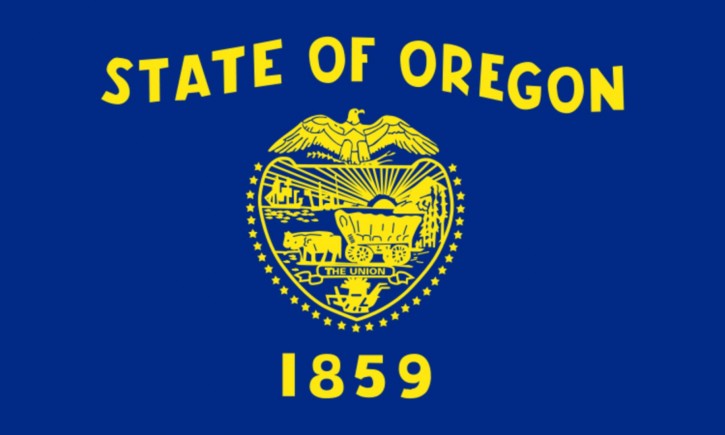
State Flag
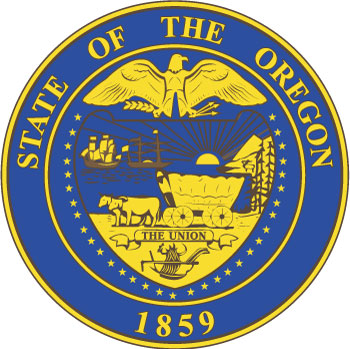
Great Seal
Nickname
The Beaver State
Motto
Alis Volat Propriis ("She Flies with Her Own Wings")

Bird
Western Meadowlark

Flower
Oregon Grape
Tree
Douglas-fir
Mammal
American Beaver
Fish
Chinook Salmon
Insect
Oregon Swallowtail
Gemstone
Oregon Sunstone
Rock
Thunderegg
Nut
Hazelnut (Filbert)
Song
"Oregon, My Oregon"