
 English
 Español
 中文
中文 हिन्दी
 Français
On this page
Overview
Ohio is a state in the Midwestern United States, bordered by Lake Erie and the Canadian province of Ontario to the north, Pennsylvania to the east, West Virginia and Kentucky across the Ohio River to the south, and Indiana to the west. With roughly 11.8 million residents across 44,826 square miles, it is the seventh-most populous state and the 34th largest by area.
Ohio entered the Union as the 17th state on March 1, 1803 — the first state carved entirely out of the Northwest Territory established by the Northwest Ordinance of 1787. The state takes its name from the Ohio River, whose name derives from the Seneca word "ohi:yo" meaning "great river" or "large creek." Columbus, in the geographic center of the state, is the state capital and (since 1990) the largest city. Cleveland on Lake Erie and Cincinnati on the Ohio River anchor the other two members of the "Three C’s" of the state’s historic urban core.
Ohio is the "Buckeye State" — named for the Ohio buckeye tree (Aesculus glabra) — and one of the most economically and politically influential states in U.S. history. Seven U.S. presidents were born in Ohio: Ulysses S. Grant, Rutherford B. Hayes, James A. Garfield, Benjamin Harrison, William McKinley, William Howard Taft, and Warren G. Harding. An eighth, William Henry Harrison, lived there at the time of his election. Ohio is the cradle of American aviation (the Wright brothers built and tested their first flying machines in Dayton), the historical center of the U.S. rubber, glass, and steel industries, and a perpetual bellwether in U.S. presidential politics.
Geography & Climate
Ohio sits at the meeting place of the Eastern Forest, the Great Lakes basin, and the Appalachian uplands. The Allegheny Plateau covers the rugged hilly eastern third of the state — Ohio’s share of the Appalachians — including the most-forested areas, the Hocking Hills, and significant deposits of coal, oil, and natural gas. The Till Plains across the central and western parts of the state are flat to gently rolling glacial deposits and contain most of Ohio’s farmland and largest cities. The Lake Plains run along Lake Erie in the north, including the Toledo lacustrine plain and the Lake Erie Islands.
Campbell Hill in Logan County, at 1,549 feet, is Ohio’s highest point — only modestly elevated by U.S. standards. The Ohio River forms the entire 451-mile southern boundary, and Lake Erie forms 312 miles of the northern boundary. The Cuyahoga, Scioto, Maumee, Great Miami, Little Miami, Muskingum, and Ohio rivers are the principal drainages. Lake Erie’s Western Basin (around the Bass Islands, Kelleys Island, and Put-in-Bay) is one of the most-fished walleye and yellow perch waters in North America.
The climate is humid continental in the north and transitions to humid subtropical in the far south, with cold, snowy winters along Lake Erie (the city of Cleveland is in the Lake Erie snow belt) and warm, humid summers across the state. Ohio sits at the western edge of the historical American Manufacturing Belt and at the southern edge of the Great Lakes basin, giving it an unusually diverse landscape and economy for a state of its size.
History
Before European contact, Ohio was home to the Shawnee, Miami, Wyandot (Huron), Lenape (Delaware), Ottawa, Mingo, and other peoples. The Hopewell and Adams cultures had previously built the great earthworks of central and southern Ohio — including the Great Serpent Mound near Peebles and the Newark Earthworks (which UNESCO designated a World Heritage Site in 2023). French explorer Robert de La Salle is believed to have reached the Ohio Valley in 1669; the region was contested between France and Britain until the British prevailed in the 1763 Treaty of Paris.
After the American Revolution, the U.S. government organized the Northwest Territory in 1787 under the Northwest Ordinance — a foundational document that established procedures for new state admission, banned slavery in the territory, and protected basic civil liberties. The first permanent U.S. settlement in the Northwest Territory was Marietta, founded by Revolutionary War veterans in 1788. The 1794 Battle of Fallen Timbers (near present-day Toledo) and the 1795 Treaty of Greenville opened most of Ohio to U.S. settlement.
Ohio was admitted as the 17th state on March 1, 1803 — the first state created from the Northwest Territory. The 1825 opening of the Erie Canal in New York and the 1832 completion of the Ohio and Erie Canal linked Lake Erie to the Ohio River, transforming Ohio into one of the great commercial corridors of nineteenth-century America. The state became a center of abolitionism and the Underground Railroad — Cincinnati’s John Rankin House and many other Ohio sites were major Underground Railroad stations. Author Harriet Beecher Stowe wrote much of "Uncle Tom’s Cabin" while living in Cincinnati.
Ohio supplied more soldiers per capita to the Union Army during the Civil War than any other state, and contributed three of the war’s leading Union generals — Ulysses S. Grant, William Tecumseh Sherman, and Philip Sheridan — all Ohio natives. The late nineteenth and early twentieth centuries built Ohio’s heavy-industry economy: tires in Akron (Goodyear, Firestone, B.F. Goodrich), steel in Cleveland and Youngstown, glass in Toledo, machine tools in Cincinnati, soap and consumer goods in Cincinnati (Procter & Gamble), and the world-changing 1903 first powered flight by Wilbur and Orville Wright — who built and tested their aircraft in their Dayton bicycle shop. Ohio became known as the "Mother of Modern Presidents" — seven U.S. presidents born here, plus one (William Henry Harrison) elected from here.
Economy
Ohio hosts one of the largest and most diversified economies in the Midwestern United States, anchored by manufacturing, healthcare, financial services, consumer goods, agriculture, and a substantial logistics and distribution sector.
- Manufacturing: Ohio remains one of the top three U.S. manufacturing states by gross output and employment. Major automakers — Honda (Marysville and East Liberty), General Motors (Lordstown — recently transformed to Ultium Cells battery production), Ford (Cleveland and Avon Lake), and Stellantis (Toledo Jeep plant) — anchor a deep automotive cluster. Akron remains the U.S. tire-industry headquarters, with Goodyear, Bridgestone, and many tire-related firms. Toledo is one of the largest U.S. glass-manufacturing centers (Owens-Illinois, Libbey, Pilkington), and Cincinnati and Dayton have major machine-tools and aerospace operations (GE Aerospace, formerly GE Aviation, is headquartered in Evendale).
- Healthcare: The Cleveland Clinic, founded in 1921, is consistently ranked among the top two or three hospitals in the world. The Cleveland Clinic, University Hospitals Cleveland, Nationwide Children’s Hospital (Columbus), and Cincinnati Children’s Hospital make Ohio one of the leading U.S. centers for medical care and research. Major insurer Medical Mutual, the Battelle Memorial Institute (Columbus — the world’s largest non-profit independent research and development organization), and pharmaceutical distributor Cardinal Health (Dublin) anchor a substantial healthcare-services economy.
- Financial services: Ohio is a major banking center. Fifth Third Bancorp is headquartered in Cincinnati, KeyCorp in Cleveland, Huntington Bancshares in Columbus, and Nationwide Insurance (one of the largest insurance and financial services companies in the United States) in Columbus. JPMorgan Chase has its largest concentration of U.S. employees in Columbus, making the Columbus area one of the largest U.S. operations hubs for financial services.
- Consumer goods and retail: Procter & Gamble, founded in Cincinnati in 1837, is one of the largest consumer-goods companies in the world. Kroger (Cincinnati) is the largest U.S. supermarket chain. Macy’s (Cincinnati), L Brands/Bath & Body Works (Columbus), Cintas (Cincinnati), Wendy’s (Dublin), Sherwin-Williams (Cleveland), and Cleveland-Cliffs steel (Cleveland) all maintain global headquarters in Ohio.
- Agriculture and food: Ohio is a top-ten U.S. producer of soybeans, corn, eggs (the state is consistently in the top three), milk, and processing tomatoes — Heinz operates one of the largest tomato canneries in the world at Fremont. The state is also among the leaders in maple syrup, wine grapes, and Swiss cheese (Holmes County contains the largest Amish settlement in the world, anchoring an artisan dairy and cheese economy).
Government
Ohio operates under its 1851 constitution, the second in its history. The Ohio General Assembly is bicameral, with a 33-member Senate (four-year terms, two consecutive-term limit) and a 99-member House of Representatives (two-year terms, four consecutive-term limit). Ohio was one of the early-adopting U.S. states for legislative term limits, in 1992.
The Governor of Ohio serves a four-year term and is limited to two consecutive terms. The state also separately elects a Lieutenant Governor (jointly with the Governor since 1979), Attorney General, Secretary of State, Treasurer, and Auditor. Ohio is uniquely associated with the phrase "as goes Ohio, so goes the nation" in U.S. presidential politics — no Republican has ever won the presidency without carrying Ohio, and Ohio voted with the eventual winner in every presidential election from 1964 through 2020 except for one (1960).
Ohio has 15 seats in the U.S. House of Representatives plus two U.S. Senators. The Supreme Court of Ohio has seven justices elected statewide on partisan ballots (since 2021) to six-year terms. The state capital is Columbus, named for Christopher Columbus and chosen as the new capital in 1812 because of its central location.
Culture
Ohio culture is profoundly shaped by the contrast among the "Three C’s" — Cleveland, Columbus, and Cincinnati. Cleveland, on Lake Erie, was a steel-and-industrial city now anchored by the Cleveland Clinic, Case Western Reserve University, the Rock and Roll Hall of Fame and Museum (it was Cleveland disc jockey Alan Freed who coined the phrase "rock and roll" in 1951), and the Cleveland Orchestra (one of the "Big Five" U.S. orchestras). Cincinnati, on the Ohio River, has a deep German heritage that shapes everything from architecture (Over-the-Rhine is one of the largest and best-preserved 19th-century urban neighborhoods in the United States) to Cincinnati chili (a Greek-Macedonian-style chili sauce served over spaghetti, distinct from any other "chili" in the country). Columbus, the capital, has become one of the fastest-growing U.S. metropolitan areas, anchored by the Ohio State University (the second-largest U.S. university by single-campus enrollment).
Beyond the Three C’s, Ohio is famous for the Amish — Holmes County is home to the largest Amish settlement in the world (more than 30,000 Amish residents), and Geauga and Wayne counties also have substantial Amish populations. The Wright Brothers’ Dayton continues to anchor U.S. aviation and aerospace, including Wright-Patterson Air Force Base — the largest U.S. Air Force base by population and home of the National Museum of the U.S. Air Force. Akron’s rubber and tire heritage, Youngstown’s steel decline and revival, and Toledo’s glassworks each define their own regional identity.
Ohio has produced an extraordinarily large share of major American cultural and political figures, including astronauts Neil Armstrong (Wapakoneta) and John Glenn (Cambridge, then later U.S. Senator), inventor Thomas Edison (born in Milan), filmmaker Steven Spielberg (Cincinnati), novelists Toni Morrison (Lorain — Nobel laureate), Sherwood Anderson, James Thurber, and Harvey Pekar (Cleveland — "American Splendor"), humorist Erma Bombeck, basketball superstar LeBron James (Akron — born and raised, and brought the city the 2016 NBA Championship with the Cleveland Cavaliers), and seven U.S. presidents. Ohio State Buckeyes football is one of the most-decorated programs in college football, and the Ohio State–Michigan rivalry ("The Game") is arguably the most intense annual rivalry in U.S. sports.
Notable Cities
- Columbus — State capital and largest city, in central Ohio at the confluence of the Scioto and Olentangy rivers, with a city population of roughly 910,000 and a metropolitan area of about 2.2 million. Home of the Ohio State University (one of the largest U.S. universities by enrollment), the Ohio State Capitol, the Columbus Museum of Art, COSI (Center of Science and Industry), and headquarters of Nationwide Insurance, Cardinal Health, L Brands/Bath & Body Works, Wendy’s, Big Lots, and JPMorgan Chase’s largest U.S. operations hub.
- Cleveland — Second-largest city, on the south shore of Lake Erie at the mouth of the Cuyahoga River, with a city population of roughly 360,000 and a metropolitan area of about 2.05 million. Home of the Rock and Roll Hall of Fame and Museum, the Cleveland Clinic, Case Western Reserve University, the Cleveland Museum of Art, the Cleveland Orchestra, the Cleveland Browns (NFL), the Cleveland Cavaliers (NBA), the Cleveland Guardians (MLB), and headquarters of Sherwin-Williams, KeyCorp, Cleveland-Cliffs, and Progressive Insurance (suburb Mayfield Village).
- Cincinnati — Third-largest city, on the north bank of the Ohio River across from Kentucky, with a city population of roughly 310,000 and a metropolitan area of about 2.27 million spanning Ohio, Kentucky, and Indiana. Home of the University of Cincinnati, Xavier University, the Cincinnati Reds (the first professional baseball team, founded 1869), the Cincinnati Bengals (NFL), and headquarters of Procter & Gamble, Kroger, Fifth Third Bancorp, Macy’s, Cintas, and the Western & Southern Financial Group.
- Toledo — Fourth-largest city, at the western tip of Lake Erie on the Maumee River, with a city population of roughly 265,000. Long known as the "Glass City" for its glass-manufacturing dominance — Owens-Illinois (the world’s largest glass-bottle maker) and Libbey are headquartered there. Home of the University of Toledo, the Toledo Museum of Art (with one of the most important glass collections in the world), and major operations of Stellantis (the Toledo Jeep plant).
- Akron — Fifth-largest city, in northeast Ohio south of Cleveland, with a city population of roughly 190,000. The historic "Rubber Capital of the World," anchored by Goodyear Tire and Rubber Company (still headquartered there), and the boyhood home of basketball legend LeBron James. Home of the University of Akron, the Akron Art Museum, and the National Inventors Hall of Fame.
State Symbols
Ohio’s official state symbols, designated by the Ohio General Assembly, celebrate the Allegheny foothills, the Lake Erie shore, the agricultural heartland, and the natural history of the Buckeye State.
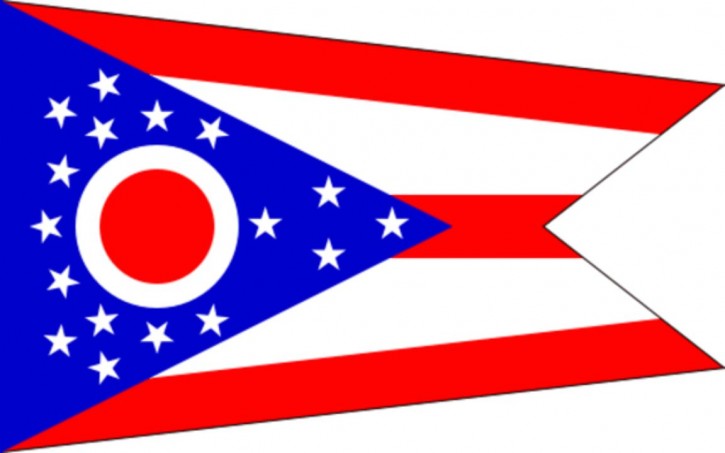
State Flag
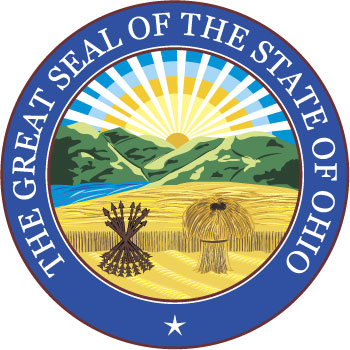
Great Seal
Nickname
The Buckeye State
Motto
With God, all things are possible

Bird
Cardinal

Flower
Scarlet Carnation
Tree
Ohio Buckeye
Mammal
White-tailed Deer
Fish
Walleye
Reptile
Northern Black Racer
Insect
Ladybug
Gem
Ohio Flint
Beverage
Tomato Juice
Song
"Beautiful Ohio"