
 English
 Español
 中文
中文 हिन्दी
 Français
On this page
Overview
North Carolina is a state in the Southeastern United States, bordered by Virginia to the north, the Atlantic Ocean to the east, South Carolina and Georgia to the south, and Tennessee to the west. With roughly 10.7 million residents across 53,819 square miles, it is the ninth-most populous state and the 28th largest by area — one of the fastest-growing states in the country.
North Carolina ratified the U.S. Constitution as the twelfth state on November 21, 1789, more than two years after the Constitution was adopted — at first it had declined to ratify, demanding that a Bill of Rights be added. The state takes its name from King Charles I of England (in Latin, Carolus). Raleigh is the state capital, named for English explorer Sir Walter Raleigh, who founded the doomed Roanoke Colony on the North Carolina coast in 1585. Charlotte in the Piedmont is the largest city.
North Carolina contains three of the largest metropolitan areas in the U.S. Southeast: Charlotte, the Research Triangle (Raleigh-Durham-Chapel Hill), and the Piedmont Triad (Greensboro–Winston-Salem–High Point). The state is a national leader in banking (Charlotte is the second-largest U.S. banking center after New York), biotechnology and pharmaceuticals (the Research Triangle Park is one of the largest research parks in the world), furniture, textiles, tobacco (historically the largest tobacco-producing state), and U.S. military presence — Fort Liberty (formerly Fort Bragg) is one of the largest military installations in the world.
Geography & Climate
North Carolina is divided into three distinct geographic regions running roughly north-to-south. The Atlantic Coastal Plain in the east is a flat, low-lying region of swamps, blackwater rivers, tidal estuaries, and the famous Outer Banks — a 200-mile chain of narrow barrier islands that includes Cape Hatteras National Seashore and Cape Lookout National Seashore. The Outer Banks shelter the Pamlico Sound and Albemarle Sound, two of the largest estuarine systems in the United States.
The Piedmont, the central rolling plateau region, runs from the Fall Line near Raleigh westward to the foothills of the Appalachians. It contains nearly all of the state’s major cities — Charlotte, Raleigh, Durham, Greensboro, Winston-Salem, High Point, Cary, and Fayetteville — and most of the state’s industry, banking, and population. The Yadkin–Pee Dee, Catawba, Cape Fear, and Neuse rivers drain the Piedmont to the Atlantic.
The Mountain Region in the west includes the Blue Ridge Mountains and the Great Smoky Mountains — the highest range in the eastern United States. Mount Mitchell in Yancey County, at 6,684 feet, is the highest peak east of the Mississippi River. Great Smoky Mountains National Park (shared with Tennessee) is the most-visited U.S. national park, and the Blue Ridge Parkway between Asheville and Cherokee is the most-visited unit of the entire National Park System. The climate ranges from humid subtropical on the coast and Piedmont to humid continental in the higher elevations of the Mountain Region.
History
For thousands of years before European contact, North Carolina was home to the Cherokee in the western mountains, the Catawba and Tuscarora in the Piedmont and Coastal Plain, and the Algonquian-speaking Roanoke, Croatan, and Secotan peoples of the Outer Banks. Sir Walter Raleigh’s 1585 Roanoke Colony — established on what is now Roanoke Island in the Outer Banks — was the first English attempt to settle North America. By the time supply ships returned in 1590, the colony had vanished, leaving only the word "CROATOAN" carved into a post — the "Lost Colony" of Roanoke, one of the enduring mysteries of American history.
Permanent English settlement began in the 1660s with Carolina colonists from Virginia. The Province of Carolina split in 1729 into the separate royal colonies of North and South Carolina. North Carolinians adopted the Halifax Resolves on April 12, 1776 — the first formal act by an American colony directly authorizing its delegates at the Continental Congress to vote for independence from Britain. The 1781 Battle of Guilford Courthouse near present-day Greensboro was a pyrrhic British victory that effectively decimated Lord Cornwallis’s army and set up the final Yorktown campaign.
North Carolina ratified the U.S. Constitution as the twelfth state on November 21, 1789, two years after the document was adopted; the state had refused to ratify until a Bill of Rights was guaranteed. North Carolina seceded in May 1861, suffered roughly 40,000 Confederate combat deaths (the most of any Southern state), and was the site of the largest single Civil War surrender — General Joseph E. Johnston to General William T. Sherman at Bennett Place near Durham on April 26, 1865.
On December 17, 1903, on the windswept dunes of Kill Devil Hills near Kitty Hawk, Wilbur and Orville Wright made the first powered, controlled flight in human history — a 12-second, 120-foot hop in their Wright Flyer. The twentieth century built the modern North Carolina economy on tobacco (R.J. Reynolds in Winston-Salem, American Tobacco in Durham), textiles, furniture (High Point), and banking (Charlotte, anchored by the merger that created Bank of America in 1998). The 1959 founding of Research Triangle Park between Raleigh, Durham, and Chapel Hill created the engine of the state’s pharmaceutical and biotech economy. North Carolina was central to the U.S. Civil Rights Movement: the February 1, 1960, sit-in at the Greensboro Woolworth lunch counter by four North Carolina A&T students helped launch the nationwide sit-in movement.
Economy
North Carolina hosts one of the most diversified economies in the southeastern United States, anchored by banking, biotechnology and pharmaceuticals, research, agriculture, advanced manufacturing, U.S. military presence, and a major tourism economy.
- Banking and finance: Charlotte is the second-largest U.S. banking center after New York. Bank of America — the second-largest U.S. bank by assets — is headquartered in Charlotte. Truist Financial Corporation is also headquartered in Charlotte. Wells Fargo maintains its East Coast headquarters there. The Federal Reserve Bank of Richmond’s Charlotte branch anchors a substantial federal-banking presence.
- Biotechnology and pharmaceuticals: Research Triangle Park (RTP), founded in 1959 between Raleigh, Durham, and Chapel Hill, is one of the largest research parks in the world. RTP houses major operations of GSK, Pfizer, Merck, Eli Lilly, IBM, Cisco, BASF, Bayer CropScience, IQVIA, and hundreds of other firms. North Carolina is one of the leading U.S. states for biotechnology employment and is among the top states for clinical-trial activity.
- Military: North Carolina hosts an exceptionally large U.S. military footprint. Fort Liberty (formerly Fort Bragg, near Fayetteville) is one of the largest military installations in the world by active-duty population and home of the 82nd Airborne Division, U.S. Army Special Operations Command, and the JFK Special Warfare Center. Camp Lejeune (Jacksonville) is the major U.S. Marine Corps East Coast base; Marine Corps Air Station Cherry Point and Seymour Johnson Air Force Base (Goldsboro) add to one of the largest concentrations of military per capita in the country.
- Agriculture and food: North Carolina is the second-largest U.S. producer of hogs (Smithfield Foods has its largest operations in eastern NC), the leading U.S. producer of sweet potatoes and tobacco, and a top producer of poultry, Christmas trees (Fraser firs from the western mountains), and turkeys. Major food brands with NC roots include Krispy Kreme (founded in Winston-Salem in 1937), Cheerwine, Bojangles, Texas Pete, and Hardee’s.
- Manufacturing, technology, and tourism: High Point is the "Furniture Capital of the World" and hosts the High Point Market — the largest furnishings industry trade show on Earth, drawing roughly 75,000 attendees twice a year. North Carolina’s twelve-month tourism economy is anchored by Great Smoky Mountains National Park (the most-visited U.S. national park), the Outer Banks, the Blue Ridge Parkway, Asheville, the Biltmore Estate (the largest privately owned home in the United States), and Charlotte (Carowinds, NASCAR Hall of Fame, NFL Panthers, NBA Hornets).
Government
North Carolina operates under its 1971 constitution, the third in its history. The North Carolina General Assembly is bicameral, with a 50-member Senate and a 120-member House of Representatives, both elected to two-year terms. There are no legislative term limits.
The Governor of North Carolina serves a four-year term and is limited to two consecutive terms. The state also elects a Lieutenant Governor (separately from the Governor), Attorney General, Secretary of State, Treasurer, Auditor, Superintendent of Public Instruction, Commissioner of Agriculture, Commissioner of Insurance, and Commissioner of Labor — one of the most expansive sets of independently elected state executive officials in the country.
North Carolina has 14 seats in the U.S. House of Representatives plus two U.S. Senators. The Supreme Court of North Carolina has seven justices elected statewide on partisan ballots to eight-year terms. The state capital is Raleigh, planned and laid out in 1792 specifically to serve as the state capital.
Culture
North Carolina culture is deeply regional. The Outer Banks and coastal Carolina preserve a distinct maritime "High Tider" or "Hoi Toider" dialect on Ocracoke and Harkers Island that draws from seventeenth-century English. The Piedmont, anchored by the rapidly growing Charlotte and Triangle, is one of the most economically dynamic regions of the U.S. South. The Mountain Region is the cultural heart of Appalachian bluegrass and old-time music, anchored by Doc Watson’s Deep Gap and the MerleFest festival in Wilkesboro. Western North Carolina is also home of the Eastern Band of Cherokee Indians, who maintain the Qualla Boundary reservation and the Museum of the Cherokee Indian in Cherokee.
College basketball is the defining cultural passion of North Carolina. The "Tobacco Road" rivalry — Duke (Durham), UNC (Chapel Hill), NC State (Raleigh), and Wake Forest (Winston-Salem) — has produced more NCAA Final Four appearances and championships than any comparable cluster in the country. North Carolina High School Athletic Association basketball is among the strongest in the country, and Michael Jordan (Wilmington, UNC) and many other NBA greats came up through it.
North Carolina foodways center on Eastern-style barbecue (whole hog, vinegar-and-pepper sauce) and Lexington-style barbecue (pork shoulder, tomato-vinegar dip) — divided by a famous geographic line through the state. Krispy Kreme doughnuts (founded in Winston-Salem in 1937), Cheerwine cherry soda (Salisbury, 1917), Pepsi (invented in New Bern in 1893), country ham, sweet potato pie, and Calabash-style fried seafood are all NC originals. The state has produced major American cultural figures including evangelist Billy Graham (Charlotte), novelist Thomas Wolfe (Asheville), poet Maya Angelou (longtime Wake Forest professor in Winston-Salem), musicians James Taylor and Doc Watson, broadcaster Charles Kuralt, and actors Andy Griffith and Ava Gardner.
Notable Cities
- Charlotte — Largest city in North Carolina, in the south-central Piedmont, with a city population of roughly 911,000 and a metropolitan area of about 2.8 million. The second-largest banking center in the United States (after New York) and home of Bank of America, Truist Financial, Lowe’s (nearby Mooresville), Honeywell, Duke Energy, the Carolina Panthers (NFL), the Charlotte Hornets (NBA), the NASCAR Hall of Fame, and the Charlotte Douglas International Airport (one of the busiest U.S. airports by passenger traffic).
- Raleigh — State capital and second-largest city, in the east-central Piedmont, with a city population of roughly 470,000 and a Research Triangle metropolitan area of about 1.5 million. Home of North Carolina State University, the North Carolina Museum of Art, the North Carolina Museum of Natural Sciences, the State Capitol, and a key anchor of the Research Triangle Park economy.
- Greensboro — Third-largest city, in the central Piedmont, with a city population of roughly 300,000 and a Triad metropolitan area shared with Winston-Salem and High Point of about 1.7 million. Home of the International Civil Rights Center & Museum (preserving the site of the February 1, 1960 Greensboro sit-in), the University of North Carolina at Greensboro, North Carolina A&T State University (the largest U.S. historically Black university), and major operations of Volvo Trucks, Honda Aircraft, and Boom Supersonic.
- Durham — Fourth-largest city, in the Research Triangle, with a city population of roughly 290,000. Home of Duke University, North Carolina Central University, the historic Durham Athletic Park (the "Bull Durham" tobacco-warehouse downtown), and a fast-growing technology and biotech cluster anchored by Research Triangle Park.
- Winston-Salem — Fifth-largest city, in the western Piedmont, with a city population of roughly 250,000. Long the historic headquarters of R.J. Reynolds Tobacco Company and the original Krispy Kreme doughnut shop (1937). Home of Wake Forest University, the Wake Forest Innovation Quarter, the North Carolina School of the Arts, and the Old Salem Moravian historic district.
State Symbols
North Carolina’s official state symbols, designated by the North Carolina General Assembly, celebrate the Appalachians, the Coastal Plain and Outer Banks, the agricultural heritage, and the natural history of the Tar Heel State.
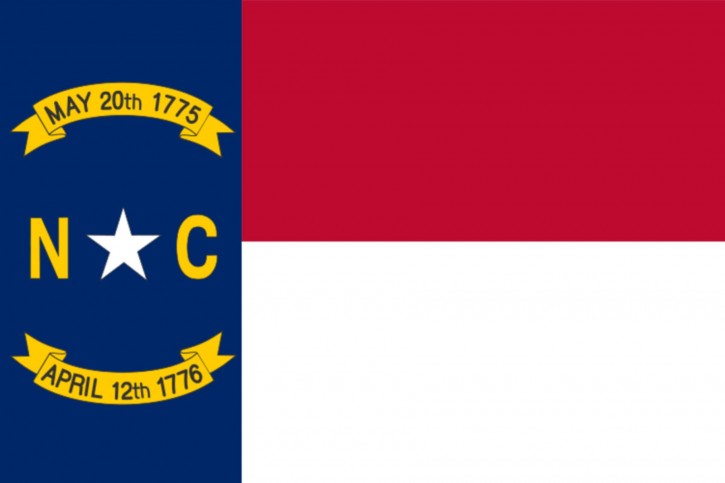
State Flag
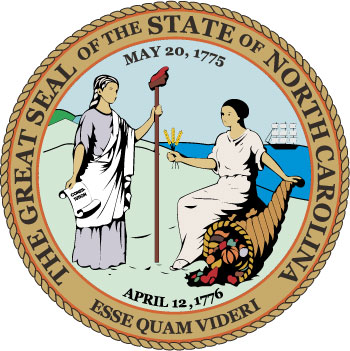
Great Seal
Nickname
The Tar Heel State / The Old North State
Motto
Esse quam videri ("To be, rather than to seem")

Bird
Cardinal

Flower
Flowering Dogwood
Tree
Longleaf Pine
Mammal
Eastern Gray Squirrel
Fish
Channel Bass (Red Drum)
Saltwater Fish
Channel Bass; Freshwater Fish: Southern Appalachian Brook Trout
Insect
Honeybee
Gem
Emerald
Stone
Granite
Song
"The Old North State"