
 English
 Español
 中文
中文 हिन्दी
 Français
On this page
Overview
New Mexico is a state in the Southwestern United States, bordered by Colorado to the north, Oklahoma and Texas to the east, Texas and the Mexican states of Chihuahua and Sonora to the south, and Arizona to the west. With roughly 2.11 million residents across 121,590 square miles, it is the 36th-most populous state and the 5th-largest by area, with one of the lowest population densities in the country.
New Mexico entered the Union as the 47th state on January 6, 1912 — the last of the contiguous 48 states (alongside Arizona, admitted six weeks later). The state takes its name from the territory of Nuevo México, named in 1563 by Spanish colonist Francisco de Ibarra after the Aztec Valley of Mexico to the south. Santa Fe, founded in 1610 as the Spanish colonial capital, is the oldest state capital in the United States. Albuquerque on the Rio Grande is by far the largest city.
New Mexico is internationally known as the "Land of Enchantment" — a phrase popularized in the early twentieth century and adopted as the official state nickname in 1999. The state is unique among U.S. states for its tri-cultural identity, weaving together Indigenous Pueblo, Navajo, and Apache nations, a 400-year-old Hispano (Nuevomexicano) Spanish-speaking community that long predates U.S. statehood, and Anglo-American settlement. Spanish has co-official legal status with English in many state proceedings, and roughly 10 percent of New Mexicans identify as Native American — by far the largest share of any state.
Geography & Climate
New Mexico is dominated by four major physiographic regions. The Colorado Plateau in the northwest features striking sandstone mesas, canyons, and the ancestral Pueblo cultural landscape at Chaco Canyon. The Southern Rocky Mountains stretch south from Colorado into north-central New Mexico; Wheeler Peak in the Sangre de Cristo Mountains east of Taos, at 13,167 feet, is the state’s highest point. The Great Plains cover the eastern third of New Mexico. The Basin and Range province in the south is a stretched, faulted landscape of high desert basins and sky-island mountain ranges.
The Rio Grande — the third-longest river in the United States and the natural border between Texas and Mexico farther downstream — flows the entire length of New Mexico from north to south, defining the cultural and demographic spine of the state. Carlsbad Caverns National Park in the south preserves some of the largest cave chambers in the world. White Sands National Park in the Tularosa Basin protects the world’s largest gypsum dunefield. The Gila Wilderness in southwestern New Mexico, designated in 1924 by the U.S. Forest Service at the urging of Aldo Leopold, was the first wilderness area set aside by any government in the world.
The climate is arid to semi-arid almost everywhere, with hot summers and cold winters in the north and milder winters in the south. The Sangre de Cristo Mountains near Taos receive heavy snowfall and support a major ski-resort economy. The deserts and mountains together create one of the most strikingly varied landscape mosaics of any U.S. state — sand dunes, badlands, lava flows, sky-island spruce forests, broad valleys, and the volcanic Jemez Mountains all within driving distance of one another.
History
New Mexico has been continuously inhabited for at least 12,000 years. The Ancestral Puebloans built Chaco Canyon (roughly 850–1150 CE) — one of the most sophisticated pre-Columbian urban centers in North America — and Mesa Verde and Aztec Ruins. Their Pueblo descendants today live in 19 federally recognized pueblos along and near the Rio Grande, including Acoma ("Sky City" — the oldest continuously inhabited community in the United States, occupied since at least 1100 CE), Taos Pueblo, Zuni Pueblo, and many others. The Navajo Nation, the largest Indigenous nation in the United States by reservation area, occupies much of northwestern New Mexico. Apache nations — Mescalero, Jicarilla — also maintain sovereign reservations.
Spanish conquistador Francisco Vázquez de Coronado entered New Mexico in 1540 in search of the legendary Seven Cities of Gold. Juan de Oñate established the first permanent European settlement at San Juan de los Caballeros (near present-day Ohkay Owingeh) in 1598. Santa Fe was founded in 1610 as the capital of Spanish New Mexico — the oldest U.S. state capital. The Pueblo Revolt of 1680, led by Po’pay of Ohkay Owingeh, drove the Spanish entirely out of New Mexico for twelve years — the most successful Indigenous uprising in U.S. history before the Plains Wars.
Mexico won independence from Spain in 1821, and New Mexico became a department of the new Republic of Mexico. The U.S.–Mexican War ended in 1848 with the Treaty of Guadalupe Hidalgo, by which Mexico ceded most of New Mexico (plus California, Nevada, Utah, and parts of Arizona, Colorado, and Wyoming) to the United States. The 1853 Gadsden Purchase added the southwestern bootheel. New Mexico Territory was organized in 1850. The 1862 Battle of Glorieta Pass east of Santa Fe — the "Gettysburg of the West" — turned back a Confederate invasion of the Far West during the Civil War.
New Mexico was admitted as the 47th state on January 6, 1912 — last of the contiguous 48 states by six weeks. The Manhattan Project established the secret Los Alamos Laboratory in 1943 to design the first atomic bombs. The first nuclear weapon test in history — codename Trinity — took place at the White Sands Proving Ground on July 16, 1945. Postwar national-laboratory work at Los Alamos, Sandia (in Albuquerque), and Air Force facilities throughout the state continues to anchor much of New Mexico’s economy. The 1947 "Roswell Incident" — a weather-balloon crash widely associated with extraterrestrial-life folklore — made Roswell a worldwide UFO-tourism destination.
Economy
New Mexico hosts an economy anchored by federal scientific research and military, oil and gas production, tourism, ranching and agriculture, and a fast-growing film, aerospace, and renewable-energy sector.
- Federal research and defense: Los Alamos National Laboratory and Sandia National Laboratories — both managed for the U.S. Department of Energy — are among the largest scientific-research institutions in the world, with combined employment of more than 30,000. Kirtland Air Force Base (Albuquerque), Holloman AFB, Cannon AFB, the White Sands Missile Range, and Spaceport America (the world’s first purpose-built commercial spaceport, near Truth or Consequences) anchor a vast defense and aerospace footprint.
- Oil and gas: The southeastern corner of New Mexico lies within the Permian Basin — the most productive U.S. oil-producing region. New Mexico has become the second-largest U.S. oil-producing state, behind only Texas. Lea, Eddy, and Chaves counties account for the bulk of production. The state also produces substantial natural gas and is a major potash producer (Carlsbad area).
- Tourism and culture: Santa Fe — the oldest U.S. state capital and the third-largest U.S. art market — and Taos, Albuquerque, and Carlsbad Caverns anchor tourism. The Albuquerque International Balloon Fiesta each October is the largest hot-air balloon event in the world. The Santa Fe Indian Market each August is the largest Native American art market in the world. Major ski resorts (Taos Ski Valley, Angel Fire, Ski Apache) anchor a winter-tourism economy in the Sangre de Cristo and Sacramento mountains.
- Film and media: New Mexico is one of the most generous film-incentive states in the country and has become a major U.S. production center. "Breaking Bad," "Better Call Saul," "No Country for Old Men," "Sicario," much of "The Avengers," many Westerns, and Netflix’s ABQ Studios all anchor a steady production economy. Netflix bought ABQ Studios in 2018 and has since expanded it into one of the largest studio complexes in the United States.
- Agriculture and ranching: New Mexico is the largest U.S. producer of pecans, a major producer of dairy products and beef cattle, and the heart of the U.S. green chile industry. The town of Hatch in southern New Mexico styles itself as "the Chile Capital of the World." The "official state question" — "Red or green?" — refers to the choice of chile sauce on New Mexican food (or "Christmas" if you want both).
Government
New Mexico operates under its 1911 constitution, adopted just before statehood. The New Mexico Legislature is bicameral, with a 42-member Senate (four-year terms) and a 70-member House of Representatives (two-year terms). There are no legislative term limits. The Legislature meets in regular session for 60 days in odd-numbered years and 30 days in even-numbered years — one of the shorter legislative calendars among U.S. states.
The Governor of New Mexico serves a four-year term and is limited to two consecutive terms. The state also separately elects a Lieutenant Governor (jointly with the Governor), Attorney General, Secretary of State, Treasurer, State Auditor, Commissioner of Public Lands, and three Public Regulation Commissioners. New Mexico’s 1911 constitution includes unusually strong protections for the Spanish language and for the property rights and cultural heritage of the Nuevomexicano Hispanic population dating to the Spanish and Mexican periods.
New Mexico has three seats in the U.S. House of Representatives plus two U.S. Senators. The Supreme Court of New Mexico has five justices initially appointed by the governor with consent of the state senate, who then face partisan election to retain their seats. The state capital is Santa Fe — founded in 1610, the oldest state capital in the United States.
Culture
New Mexico culture is unlike anywhere else in the United States — a tri-cultural fusion of Pueblo, Navajo, and Apache Indigenous nations; a 400-year-old Hispanic Nuevomexicano community whose Spanish dialect preserves features lost elsewhere; and Anglo-American settler culture. Roughly half of New Mexicans identify as Hispanic, the largest share of any state, and roughly 10 percent identify as Native American, by far the largest share of any state. The 19 New Mexico Pueblos remain sovereign governments and maintain distinct ceremonial calendars, languages (Tiwa, Tewa, Towa, Keres, and Zuni), and pottery, weaving, and silverwork traditions.
New Mexican cuisine — distinct from broader "Tex-Mex" and "Cal-Mex" — is centered on Hatch and Chimayó chile (red or green), blue corn tortillas, sopaipillas, posole, carne adovada, chiles rellenos, biscochitos (the official state cookie), tamales at Christmas, and frybread with honey. The official state question "Red or green?" (or "Christmas" for both) is asked at every New Mexican restaurant. Santa Fe Plaza-bordering Spanish Market and Indian Market each summer, the Hatch Chile Festival, and the Albuquerque International Balloon Fiesta are statewide cultural anchors.
New Mexico has been a magnet for artists since the early twentieth century. Mabel Dodge Luhan’s Taos circle drew Georgia O’Keeffe (who lived for decades at Ghost Ranch and Abiquiu — the Georgia O’Keeffe Museum is in Santa Fe), D.H. Lawrence, Ansel Adams, Bruce Nauman, and many others. Native American artists at the Institute of American Indian Arts in Santa Fe — Maria Martinez of San Ildefonso, R.C. Gorman, T.C. Cannon, Pablita Velarde, Allan Houser — have shaped contemporary American art. Writers Tony Hillerman, Rudolfo Anaya ("Bless Me, Ultima"), Leslie Marmon Silko, and N. Scott Momaday have made New Mexico an exceptionally literary state.
Notable Cities
- Albuquerque — Largest city in New Mexico, on the Rio Grande, with a city population of roughly 565,000 and a metropolitan area of about 920,000. Home of the University of New Mexico, Kirtland Air Force Base, Sandia National Laboratories, the National Museum of Nuclear Science & History, the historic Old Town, the Sandia Peak Tramway (one of the world’s longest aerial trams), and the annual Albuquerque International Balloon Fiesta each October.
- Las Cruces — Second-largest city, in the Mesilla Valley of the Rio Grande in south-central New Mexico, with a population of roughly 110,000. Home of New Mexico State University, the New Mexico Farm & Ranch Heritage Museum, the historic Mesilla Plaza, and the gateway community for White Sands National Park and the Hatch chile region.
- Rio Rancho — A city of roughly 105,000 immediately northwest of Albuquerque, the third-largest city in the state and one of the fastest-growing communities in the Albuquerque metro. Home to the Santa Ana Star Center, Intel Corporation’s historic Fab 11X semiconductor plant (one of Intel’s largest manufacturing facilities), and HP Inc. operations.
- Santa Fe — State capital, in the foothills of the Sangre de Cristo Mountains, with a population of roughly 89,000. Founded in 1610 as the Spanish colonial capital — the oldest state capital in the United States. Home of the Georgia O’Keeffe Museum, the New Mexico Museum of Art, the Palace of the Governors (the oldest continuously occupied public building in the United States), the Santa Fe Opera, the Institute of American Indian Arts, and the annual Santa Fe Indian Market.
- Roswell — A city of roughly 48,000 in southeastern New Mexico. Anchor of the Pecos Valley agricultural economy and home to New Mexico Military Institute. Worldwide famous for the 1947 "Roswell Incident" — a weather-balloon crash whose ongoing extraterrestrial folklore has made the city a major UFO-tourism destination, with the International UFO Museum and Research Center anchoring an annual UFO Festival.
State Symbols
New Mexico’s official state symbols, designated by the New Mexico Legislature, celebrate the desert, mountain, and Pueblo landscapes; the layered Indigenous, Spanish, Mexican, and Anglo heritage; and the natural history of the Land of Enchantment.
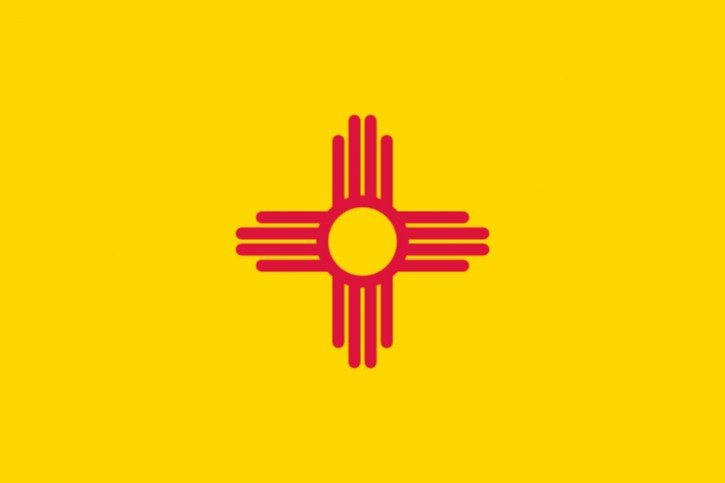
State Flag
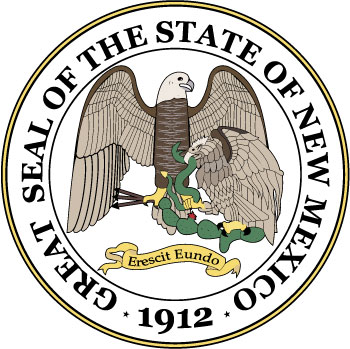
Great Seal
Nickname
The Land of Enchantment
Motto
Crescit eundo ("It grows as it goes")

Bird
Greater Roadrunner
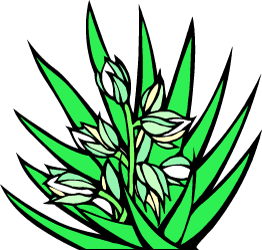
Flower
Yucca Flower
Tree
Two-needle Piñon Pine
Mammal
Black Bear
Fish
Rio Grande Cutthroat Trout
Reptile
New Mexico Whiptail Lizard
Insect
Tarantula Hawk Wasp
Gem
Turquoise
Cookie
Bizcochito
State Question
"Red or Green?" (chile preference)