
 English
 Español
 中文
中文 हिन्दी
 Français
On this page
Overview
South Carolina is a state in the Southeastern United States, bordered by North Carolina to the north, the Atlantic Ocean to the east, and Georgia across the Savannah River to the south and west. With roughly 5.4 million residents across 32,020 square miles, it is the 23rd-most populous state and the 40th largest by area.
South Carolina ratified the U.S. Constitution as the eighth state on May 23, 1788. The state takes its name from King Charles I of England, who granted the original Province of Carolina to a group of supporters in 1663; "Carolina" is from the Latin "Carolus" (Charles). Columbia, in the geographic center of the state, is the state capital and one of the first planned U.S. state capitals (laid out in 1786). Charleston on the Atlantic Coast is the largest city and the historical and cultural anchor of the state.
South Carolina is the "Palmetto State" — named for the sabal palmetto tree that grows in profusion along the coast and that played a heroic role in the state’s defense during the American Revolution. The state was central to colonial and antebellum America — the eighth state to ratify the U.S. Constitution, the first state to secede from the Union (December 20, 1860), and the place where the American Civil War began with the Confederate bombardment of Fort Sumter in Charleston Harbor on April 12, 1861. Today South Carolina is one of the fastest-growing U.S. states, with the BMW Group’s largest worldwide plant in Spartanburg County and Boeing’s 787 Dreamliner final-assembly plant in North Charleston.
Geography & Climate
South Carolina is divided into three major geographic regions running northeast-to-southwest. The Atlantic Coastal Plain covers the eastern two-thirds of the state and includes the Low Country (the Lowcountry around Charleston, Beaufort, and the Sea Islands), the Pee Dee, and the Sand Hills. The Piedmont covers the upper one-third of the state, with rolling red-soil farmland and the major textile cities (Greenville, Spartanburg, Anderson) of the Upstate. The Blue Ridge Mountains rise in the far northwestern corner — Sassafras Mountain in Pickens County, at 3,560 feet, is the state’s highest point.
South Carolina’s 187-mile Atlantic coastline includes the Grand Strand around Myrtle Beach (one of the most-visited family-beach destinations in the United States), the Charleston Harbor area, and the Sea Islands stretching south to Hilton Head Island and the Savannah River. The Sea Islands — including Hilton Head, Daufuskie, Edisto, James, Johns, and Kiawah — are barrier and salt-marsh islands that historically anchored the Gullah Geechee African American culture. The Savannah, Santee, Pee Dee, Edisto, Ashley, and Cooper rivers are the principal drainages.
The climate is humid subtropical, with hot, humid summers and mild winters along the coast and slightly cooler winters in the upstate mountains. South Carolina sits in the Atlantic hurricane corridor and has been struck by major storms including Hugo (1989, which devastated Charleston), Floyd (1999), Hugo follow-ons, and Matthew (2016). The Lowcountry’s tidal marshes and the Carolina Sandhills support distinctive ecological communities.
History
Before European contact, South Carolina was home to the Catawba, Cherokee, Yamasee, Edisto, Cusabo, and many other Indigenous peoples. Spain attempted the first European settlement at San Miguel de Gualdape in 1526; it failed. English settlers founded Charles Town (later Charleston) in 1670 — the first permanent English settlement in the future South Carolina. The Province of Carolina was granted by King Charles II in 1663 to the eight Lords Proprietors. North and South Carolina were formally separated in 1729 and each became a royal colony.
South Carolina built one of the wealthiest pre-Revolutionary economies on rice (Carolina Gold), indigo, and (later) cotton plantations worked by enslaved Africans. By the mid-eighteenth century, South Carolina was a majority-Black colony — enslaved Africans were the majority of the population for most of the eighteenth and nineteenth centuries — and Charleston became the largest U.S. slave port on the Atlantic Coast. The June 28, 1776, defense of Sullivan’s Island against a British naval attack — during which a palmetto-log fort under Colonel William Moultrie absorbed British cannon fire — became the foundational legend of the state’s Revolutionary identity and the source of the "Palmetto State" nickname.
South Carolina ratified the U.S. Constitution as the eighth state on May 23, 1788. The nineteenth century brought the rise of nullification (the 1832–1833 Nullification Crisis was a near-secession), and ultimately the December 20, 1860, secession ordinance — the first U.S. state to formally secede from the Union. South Carolina forces fired on the U.S.-held Fort Sumter in Charleston Harbor on April 12, 1861, beginning the American Civil War. General William T. Sherman’s March through the Carolinas burned Columbia (February 17, 1865) and effectively ended Confederate resistance in the Deep South.
Reconstruction (1865–1877) briefly elected three African American U.S. representatives from South Carolina. The state then plunged into the longest, harshest Jim Crow era of any U.S. state — South Carolina did not formally readmit African Americans to the voter rolls in numbers until the 1965 federal Voting Rights Act. The 1968 Orangeburg Massacre, in which three young Black men were killed by state troopers at South Carolina State University, was a defining tragedy of the late-stage U.S. Civil Rights Movement. Hurricane Hugo devastated coastal South Carolina in September 1989. On June 17, 2015, a white supremacist gunman killed nine African American parishioners during a Bible study at Mother Emanuel AME Church in Charleston — leading directly to the 2015 removal of the Confederate battle flag from the South Carolina State House grounds.
Economy
South Carolina hosts a fast-growing economy anchored by automotive and aerospace manufacturing, tourism, port logistics, healthcare, advanced materials, and agriculture.
- Automotive manufacturing: BMW Group’s Plant Spartanburg, opened in 1994 and the company’s largest worldwide plant, builds the X3, X5, X6, X7, and other X-series sport utility vehicles — making BMW the largest U.S. vehicle exporter by value. Volvo Cars Charleston builds the EX90 and Polestar 3 electric SUVs near Ridgeville. Mercedes-Benz Vans (Ladson), General Electric (Greenville gas turbines), and Michelin North America (headquartered in Greenville since 1988) anchor a deep Upstate manufacturing cluster.
- Aerospace: Boeing’s North Charleston plant is one of two final-assembly sites in the world for the 787 Dreamliner, and the only one outside Everett, Washington. Lockheed Martin operates F-16 production in Greenville. The aerospace cluster extends across the Charleston, Greenville-Spartanburg, and Columbia areas.
- Tourism: Charleston has been named "America’s Top City" by Travel + Leisure readers more than a decade running. Myrtle Beach and the Grand Strand draw roughly 14 million annual visitors. Hilton Head Island and the Sea Islands anchor a high-end golf and resort economy. South Carolina’s plantation tours, Historic Charleston walking tours, and Civil War sites (Fort Sumter, Fort Moultrie) generate substantial year-round visitation.
- Port logistics: The Port of Charleston is one of the busiest U.S. East Coast container ports, ranking in the top 10 nationally. The South Carolina Ports Authority operates terminals at Charleston, the inland Port Greer (near Spartanburg), the inland Port Dillon, and Georgetown. Strong container, automobile, and forestry-products throughput supports tens of thousands of related jobs across the state.
- Agriculture: South Carolina is a top-five U.S. producer of peaches (the "Tasty Peach State" actually grows roughly twice as many peaches as Georgia, despite the latter’s nickname), cotton, tobacco, peanuts, and soybeans. The Lowcountry rice-growing tradition has nearly disappeared but is preserved by specialty growers reviving Carolina Gold rice. Tyson, Smithfield, and other major processors anchor a substantial poultry and pork industry.
Government
South Carolina operates under its 1895 constitution. The South Carolina General Assembly is bicameral, with a 46-member Senate (four-year terms) and a 124-member House of Representatives (two-year terms). There are no legislative term limits.
The Governor of South Carolina serves a four-year term and is limited to two consecutive terms. The state also separately elects a Lieutenant Governor (jointly with the Governor since 2018), Attorney General, Secretary of State, Treasurer, Comptroller General, Commissioner of Agriculture, Adjutant General (made appointive in 2010), and Superintendent of Education. Until the 2018 amendment, the Lieutenant Governor was elected separately and served as the constitutional president of the Senate — a Reconstruction-era arrangement.
South Carolina has seven seats in the U.S. House of Representatives plus two U.S. Senators. The Supreme Court of South Carolina has five justices elected by the General Assembly (not the governor) — a unique arrangement among U.S. states. The state capital is Columbia, designed and laid out by the General Assembly in 1786 — making it one of the first planned state capitals in the United States.
Culture
South Carolina culture is shaped above all by Charleston and the Lowcountry — one of the most distinctive regional cultures in the United States. Charleston’s eighteenth-century architecture (the Charleston single house, the joggling board, Rainbow Row, the Battery), the deeply African-influenced Gullah Geechee culture and language of the Sea Islands, the historic Charleston neighborhoods of Anson Street and Calhoun Street, and a long literary tradition (Pat Conroy, Josephine Humphreys, Bret Lott) make the Lowcountry feel like a foreign country to many visitors. The Spoleto Festival USA in Charleston each spring is one of the most-acclaimed performing-arts festivals in the United States, an offshoot of the Spoleto Festival in Italy.
South Carolina food culture is one of the most distinctive in the U.S. South. The four official barbecue sauces of South Carolina — mustard-based (the German-influenced "South Carolina Gold" of the central counties), vinegar-pepper (Pee Dee), light tomato (Upstate), and heavy tomato (border with North Carolina) — divide the state into four roughly equal barbecue regions. Shrimp and grits, she-crab soup, Lowcountry boil (shrimp, sausage, corn, potatoes), Frogmore stew, hoppin’ John (black-eyed peas and rice), red rice, benne wafers, Charleston ice-cream cones, and the distinctive sweet "Hostess Cake" pineapple-cheese-pecan congealed salads are all South Carolina creations or specialties. The state is the historic home of Carolina Gold rice and Sea Island Red Peas.
College football is a defining cultural passion, with the in-state rivalry between Clemson University’s Tigers and the University of South Carolina’s Gamecocks (the "Palmetto Bowl") one of the most intense annual games in the country. Notable South Carolinians include James Brown (Barnwell — "the Godfather of Soul"), Stephen Colbert (raised in Charleston), Joe Frazier (Beaufort — heavyweight boxing champion), Chubby Checker, Eartha Kitt (North), Pat Conroy (Beaufort), Strom Thurmond (longest-serving U.S. Senator at the time of his retirement), and Vice President John C. Calhoun. The Gullah Geechee Cultural Heritage Corridor — a federally designated heritage area spanning the Sea Islands from North Carolina through South Carolina, Georgia, and northern Florida — preserves one of the most-distinctive surviving African-derived cultures in the United States.
Notable Cities
- Charleston — Largest city in South Carolina, on the Atlantic coast where the Ashley and Cooper rivers meet to form Charleston Harbor, with a city population of roughly 155,000 and a metropolitan area of about 850,000. Founded in 1670, the historical and cultural anchor of the state. Home of Fort Sumter (where the Civil War began), the Historic Charleston walking-tour district, the Charleston City Market, Rainbow Row, the Battery, the College of Charleston, the Citadel, the Medical University of South Carolina, the Charleston Museum (the oldest museum in the United States, founded 1773), and the Spoleto Festival USA.
- Columbia — State capital and second-largest city, in the geographic center of the state at the confluence of the Saluda and Broad rivers (forming the Congaree), with a city population of roughly 140,000 and a metropolitan area of about 850,000. Home of the South Carolina State House (still showing scars from Sherman’s 1865 burning), the University of South Carolina (Gamecocks), Riverbanks Zoo, the South Carolina State Museum, and Fort Jackson — the largest U.S. Army basic training facility in the country.
- North Charleston — Third-largest city, immediately north of Charleston, with a population of roughly 120,000. Home of the Boeing 787 Dreamliner final-assembly plant, the North Charleston Coliseum, the North Charleston Performing Arts Center, the SC Stingrays (ECHL hockey), Joint Base Charleston (a major U.S. Air Force and Navy installation), and the former Charleston Naval Shipyard (closed 1996, now redeveloped as the Navy Yard at Noisette).
- Mount Pleasant — Fourth-largest city, immediately east of Charleston across the Cooper River via the Arthur Ravenel Jr. Bridge (the longest cable-stayed bridge in the Western Hemisphere when opened in 2005), with a population of roughly 92,000. Home of Patriots Point (with the aircraft carrier USS Yorktown), Boone Hall Plantation, and Sullivan’s Island (where the Revolutionary War defense of June 28, 1776 took place).
- Rock Hill — Fifth-largest city, just south of Charlotte, North Carolina, in York County, with a population of roughly 75,000. A historic textile-mill city now reinventing itself as a Charlotte-area commercial and educational center, home of Winthrop University, the Rock Hill Galleria, and the Rock Hill BMX Supercross Track (the world’s only USA Cycling-sanctioned BMX Supercross venue).
State Symbols
South Carolina’s official state symbols, designated by the South Carolina General Assembly, celebrate the palmetto-tree Revolutionary heritage, the Lowcountry coastal landscape, the Sea Islands wildlife, and the agricultural identity of the Palmetto State.
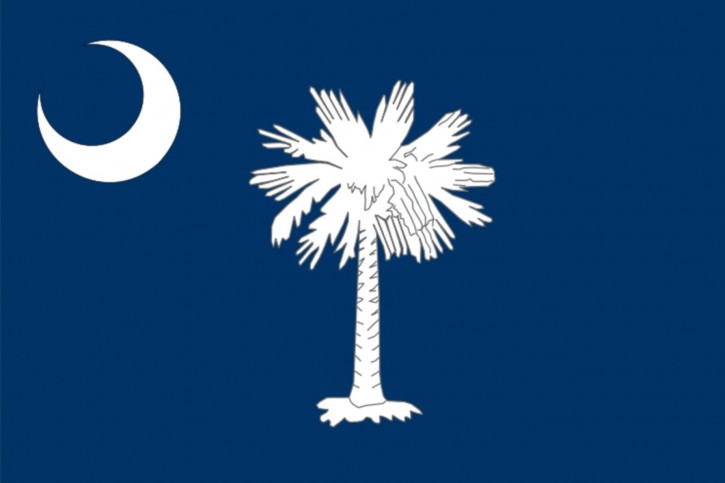
State Flag
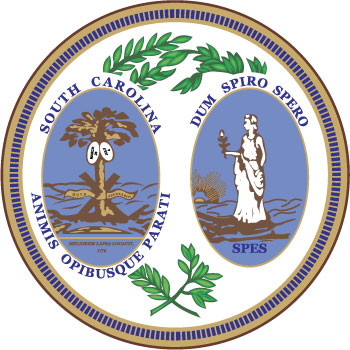
Great Seal
Nickname
The Palmetto State
Motto
"Dum Spiro Spero" ("While I Breathe, I Hope") and "Animis Opibusque Parati" ("Prepared in Mind and Resources")

Bird
Carolina Wren

Flower
Yellow Jessamine
Tree
Sabal Palmetto
Mammal
White-tailed Deer
Reptile
Loggerhead Sea Turtle
Fish
Striped Bass
Insect
Carolina Mantid
Butterfly
Eastern Tiger Swallowtail
Beverage
Milk
Song
"Carolina"