
 English
 Español
 中文
中文 हिन्दी
 Français
On this page
Overview
Tennessee is a state in the Southeastern region of the United States, bordered by Kentucky and Virginia to the north, North Carolina to the east, Georgia, Alabama, and Mississippi to the south, and Arkansas and Missouri across the Mississippi River to the west. With roughly 7.0 million residents across 42,144 square miles, it is the 15th-most populous state and the 36th largest by area. Tennessee is unusual in bordering eight other U.S. states (tied with Missouri for the most), reflecting its long, narrow east-west geography.
Tennessee entered the Union as the 16th state on June 1, 1796, the first state created from territory ceded to the federal government. The state takes its name from the Cherokee town of Tanasi on the Little Tennessee River, although the precise meaning of the word is not known. Nashville, in the center of the state on the Cumberland River, is the state capital and the second-largest city in the Southeast by metropolitan population. Memphis on the Mississippi River, Knoxville in the eastern foothills, Chattanooga in the Tennessee River Valley, and Clarksville near the Kentucky border round out the major cities.
Tennessee is internationally famous as a music state — the birthplace of commercial country music (Bristol, 1927), the heart of the country recording industry (Nashville, "Music City"), the birthplace of rock and roll and the home of Elvis Presley (Memphis), and a foundational center of the blues (Beale Street, Memphis). The state is also famous for Great Smoky Mountains National Park (the most-visited U.S. national park), the Tennessee whiskey industry (Jack Daniel's in Lynchburg, George Dickel in Cascade Hollow), the Federal Express global hub at Memphis, the Oak Ridge National Laboratory, and a college football culture centered on the Tennessee Volunteers and the Vanderbilt Commodores.
Geography & Climate
Tennessee is traditionally divided into three "Grand Divisions" — East, Middle, and West Tennessee — that are formally recognized in the state constitution and represented by the three stars on the state flag. The divisions are not just political: they have different geography, economies, and even regional cultures. East Tennessee is mountainous, anchored by Knoxville and Chattanooga. Middle Tennessee is the rolling Highland Rim and Central Basin around Nashville. West Tennessee is the flat, fertile Mississippi alluvial plain anchored by Memphis.
The Appalachian Mountains run along the eastern border with North Carolina, including the Great Smoky Mountains — the highest part of the Appalachians, with Clingmans Dome reaching 6,643 feet (the highest point in Tennessee and the third-highest peak in the eastern United States). Great Smoky Mountains National Park, established in 1934 and straddling the Tennessee-North Carolina border, receives more than 13 million visitors a year — by far the most-visited U.S. national park. The Tennessee River flows south through East Tennessee, then westward across northern Alabama before turning north and flowing through West Tennessee into the Ohio River in Kentucky.
The Cumberland Plateau, a rugged sandstone-capped highland, divides East Tennessee from Middle Tennessee. Middle Tennessee's Nashville Basin is a fertile lowland of phosphate-rich soils ideal for tobacco, livestock, and Tennessee walking horses. West Tennessee descends gradually to the Mississippi River and includes Reelfoot Lake, formed by the 1811-1812 New Madrid earthquakes when the Mississippi River temporarily flowed backward. The climate is humid subtropical across most of the state, with hot, humid summers, mild winters, and frequent thunderstorms; tornadoes are common in Middle and West Tennessee.
History
For thousands of years before European contact, present-day Tennessee was home to Mississippian-culture mound builders (Pinson Mounds in the west, Chucalissa near Memphis) and later to the Cherokee, Chickasaw, Shawnee, and Yuchi peoples. The Cherokee Nation in particular regarded much of East Tennessee as homeland, with major towns including Chota (the Cherokee "Beloved Town") on the Little Tennessee River. Spanish expeditions led by Hernando de Soto crossed Tennessee in 1540; British, French, and later American traders followed in the 1700s.
The Watauga Association of 1772, an early self-government compact among settlers in present-day northeast Tennessee, was one of the first attempts at independent democratic government on the North American continent. Tennessee was part of North Carolina until 1789, then briefly the State of Franklin (1784-1788, unrecognized) and the Southwest Territory (1790-1796), before being admitted as the 16th state in 1796. The nickname "Volunteer State" originated in the War of 1812, when Tennessee volunteers under Andrew Jackson played a decisive role at the 1815 Battle of New Orleans; it was reinforced during the Mexican-American War, when Tennessee provided far more volunteers than its quota.
The 1830 Indian Removal Act, signed by Tennessee's own President Andrew Jackson, forced the Cherokee, Chickasaw, and other southeastern tribes from their homelands. The 1838-1839 Trail of Tears — the forced removal of the Cherokee Nation from East Tennessee, North Carolina, and Georgia to present-day Oklahoma — caused the deaths of an estimated 4,000 Cherokee from exposure, disease, and starvation. Tennessee was the last state to secede from the Union and the first to be readmitted after the Civil War. The state was the site of more Civil War battles than any state except Virginia, including the bloody battles of Shiloh (1862), Stones River (1862-1863), Chattanooga (1863), Franklin (1864), and Nashville (1864).
The Tennessee Valley Authority, created by Franklin D. Roosevelt in 1933, transformed the state through massive hydroelectric dam construction, flood control, and rural electrification on the Tennessee River and its tributaries. Oak Ridge in East Tennessee, built in secret during World War II, was one of the three principal sites of the Manhattan Project — producing the enriched uranium used in the Hiroshima bomb. Tennessee was the 36th and final state required to ratify the 19th Amendment to the U.S. Constitution in 1920, giving women the right to vote (the deciding vote was cast by 24-year-old representative Harry Burn after a letter from his mother). The civil rights era brought the 1968 assassination of Dr. Martin Luther King Jr. at the Lorraine Motel in Memphis, now the National Civil Rights Museum.
Economy
Tennessee hosts a large and diverse economy anchored by healthcare, automobile manufacturing, music and entertainment, distribution and logistics, agriculture, tourism, and federal research at Oak Ridge.
- Healthcare: Nashville is one of the largest U.S. healthcare-industry centers, home to HCA Healthcare (the largest U.S. for-profit hospital operator), Community Health Systems, and more than 400 healthcare-related companies. The Vanderbilt University Medical Center is one of the leading academic medical centers in the South. Memphis is home to St. Jude Children's Research Hospital — internationally renowned for its pediatric cancer research and treatment.
- Automotive manufacturing: Tennessee has become one of the largest U.S. automobile-manufacturing states. Nissan North America is headquartered in Franklin and operates the largest Nissan plant in North America in Smyrna and a massive engine plant in Decherd. Volkswagen Group of America operates a major assembly plant in Chattanooga (Atlas, ID.4). General Motors operates a Spring Hill assembly plant. Ford is building the BlueOval City electric-vehicle and battery complex in West Tennessee — one of the largest U.S. EV investments to date.
- Music and entertainment: Nashville ("Music City") is the global center of country-music recording and one of the three principal U.S. music-industry cities (with Los Angeles and New York). The city hosts the Grand Ole Opry, the Country Music Hall of Fame and Museum, Music Row, and the Bridgestone Arena. Memphis is foundational to blues, soul, and rock and roll — home of Beale Street, Sun Studio (where Elvis Presley first recorded in 1954), Stax Records, and Graceland (Elvis's home, now the second-most-visited house museum in the United States).
- Distribution and logistics: Memphis is the global hub of FedEx Express, the largest cargo airline in the world by tonnage carried; Memphis International Airport is consistently one of the top cargo airports in the world. Memphis is also a major Mississippi River barge port and a national railroad junction. Nashville and Knoxville are central distribution nodes for the Southeast.
- Agriculture and federal research: Tennessee is a leading U.S. producer of soybeans, cotton, tobacco, corn, beef cattle, dairy, and Tennessee walking horses. Bourbon County across the border in Kentucky and the Tennessee whiskey industry (Jack Daniel's in Lynchburg, the world's best-selling American whiskey; George Dickel in Cascade Hollow) are central to the agricultural identity. Oak Ridge National Laboratory, operated by UT-Battelle for the U.S. Department of Energy, is the largest national laboratory in the U.S. DOE system and a global center of nuclear, materials, supercomputing, and neutron-scattering research.
Government
Tennessee operates under its 1870 constitution — adopted at the close of Reconstruction and only modestly amended since. The Tennessee General Assembly is bicameral, with a 33-member Senate (four-year terms) and a 99-member House of Representatives (two-year terms). There are no legislative term limits. The General Assembly meets in regular session beginning in January each year and is one of the lower-paid U.S. state legislatures (officially part-time, in practice nearly full-time during session).
The Governor of Tennessee serves a four-year term and is limited to two consecutive terms. Tennessee is unusual in that it has no separately elected Lieutenant Governor; the office is held ex officio by the Speaker of the State Senate, who is selected by the senators. The Attorney General is appointed by the Tennessee Supreme Court (rather than elected) — the only U.S. state with this arrangement. The Secretary of State, Treasurer, and Comptroller are elected by joint vote of the General Assembly.
Tennessee has nine seats in the U.S. House of Representatives plus two U.S. Senators. The Tennessee Supreme Court has five justices, appointed by the governor (with legislative confirmation since 2014) and retained by uncontested election to eight-year terms. The state has no general personal income tax — Tennessee phased out its narrow Hall income tax on investment income in 2021. Major revenue comes from a 7 percent state sales tax (among the highest in the U.S., often pushed to 9.5 percent or more by local options).
Culture
Tennessee culture is anchored by the three Grand Divisions, by music, by Appalachian and African American heritage, by college football, and by Southern Christianity. East Tennessee — historically Unionist and Republican — has Appalachian mountain culture, bluegrass music, the University of Tennessee Volunteers in Knoxville, and Dollywood theme park in Pigeon Forge. Middle Tennessee, anchored by Nashville, is the music industry, Vanderbilt University, and historic plantation country (the Hermitage, home of Andrew Jackson). West Tennessee — historically Democratic and aligned with the Mississippi Delta cotton economy — is anchored by Memphis and its African American cultural heritage.
Nashville's music scene is one of the most concentrated music industries in the world. The Grand Ole Opry, which began as a 1925 WSM radio broadcast, is the longest-running radio program in U.S. history and the most prestigious country-music institution. The Country Music Hall of Fame and Museum, the Ryman Auditorium (the "Mother Church of Country Music"), Music Row's recording studios, and an unmatched concentration of professional songwriters give the city its identity. Memphis music heritage includes Beale Street blues, Sun Studio (where Elvis, Johnny Cash, Jerry Lee Lewis, and Carl Perkins all recorded), Stax Records (Otis Redding, Isaac Hayes, the Staple Singers), and Hi Records (Al Green).
Tennessee sports culture revolves around college football — the Tennessee Volunteers ("Vols") play in 102,000-seat Neyland Stadium in Knoxville, one of the largest college-football stadiums in the world. Nashville hosts the NFL Tennessee Titans, the NHL Nashville Predators, and Major League Soccer's Nashville SC. Memphis hosts the NBA Memphis Grizzlies. Tennessee whiskey, hot chicken (a Nashville specialty), Memphis dry-rub barbecue, Memphis wet-mop barbecue, sweet tea, and cornbread are central to Tennessee food culture. Notable Tennesseans include Presidents Andrew Jackson, James K. Polk, and Andrew Johnson; civil-rights leader Ida B. Wells (born in Mississippi but rose to prominence in Memphis); musicians Elvis Presley, Dolly Parton, Aretha Franklin (born in Memphis), Tina Turner, Johnny Cash, and Hank Williams; and novelist Cormac McCarthy (raised in Knoxville).
Notable Cities
- Nashville — State capital and largest city, in north-central Tennessee on the Cumberland River, with a city population of roughly 690,000 and a metropolitan area of about 2.1 million. The economic, cultural, and political center of the state — "Music City" — and the global center of the country-music industry. Home of the Grand Ole Opry, the Country Music Hall of Fame, the Ryman Auditorium, Music Row, the Tennessee State Capitol, the Parthenon (a full-scale replica in Centennial Park), Vanderbilt University, Belmont University, Fisk University, Tennessee State University, and the NFL Tennessee Titans.
- Memphis — Second-largest city, in the far southwest on the Mississippi River, with a city population of roughly 625,000 and a metropolitan area of about 1.3 million. The largest city on the Mississippi River between St. Louis and New Orleans, foundational to blues and rock and roll, and the global hub of FedEx Express. Home of Beale Street, Graceland (Elvis Presley's home), Sun Studio, Stax Museum, the National Civil Rights Museum at the Lorraine Motel, St. Jude Children's Research Hospital, the University of Memphis, and the NBA Memphis Grizzlies.
- Knoxville — Third-largest city, in East Tennessee at the foot of the Great Smoky Mountains and on the Tennessee River, with a city population of roughly 195,000 and a metropolitan area of about 880,000. The economic and educational center of East Tennessee. Home of the University of Tennessee flagship campus, the 102,000-seat Neyland Stadium, the 1982 World's Fair Sunsphere, the Tennessee Theatre, and the gateway to Great Smoky Mountains National Park and the Pigeon Forge / Gatlinburg tourist corridor.
- Chattanooga — Fourth-largest city, in southeast Tennessee on the Tennessee River at the foot of Lookout Mountain, with a city population of roughly 185,000 and a metropolitan area of about 575,000. A historically important rail junction (immortalized in the 1941 Glenn Miller song "Chattanooga Choo Choo") that has transformed since the 1980s into a model riverfront-redevelopment city. Home of the Tennessee Aquarium, Lookout Mountain (Rock City, Ruby Falls, the Incline Railway), the Volkswagen North American assembly plant, and the University of Tennessee at Chattanooga.
- Clarksville — Fifth-largest city, in north-central Tennessee on the Cumberland River near the Kentucky border, with a city population of roughly 170,000. The economic center of the Clarksville-Fort Campbell metropolitan area; immediately adjacent to Fort Campbell (the U.S. Army's 101st Airborne Division home base, straddling the Tennessee-Kentucky border). Home of Austin Peay State University and one of the fastest-growing mid-sized cities in the United States.
State Symbols
Tennessee's official state symbols, designated by the Tennessee General Assembly, celebrate the music heritage, Appalachian wildlife, agricultural traditions, and natural identity of the Volunteer State.
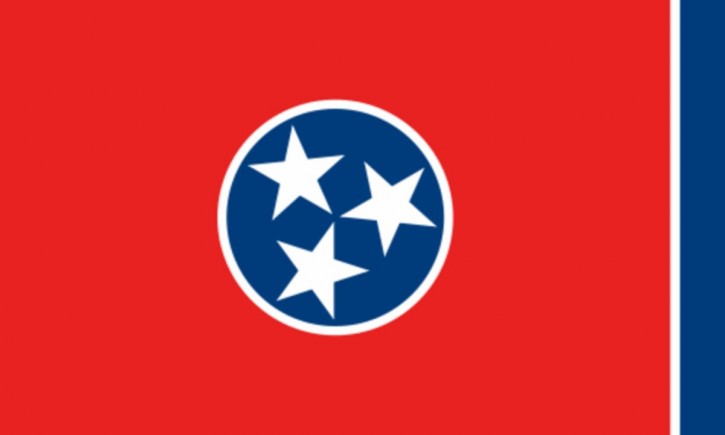
State Flag
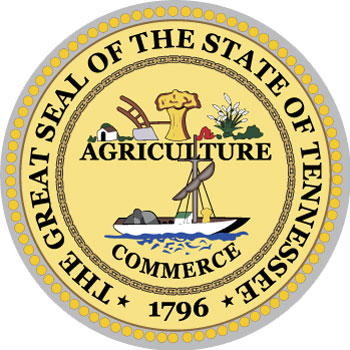
Great Seal
Nickname
The Volunteer State
Motto
Agriculture and Commerce

Bird
Northern Mockingbird

Flower
Iris
Tree
Tulip Poplar
Animal
Raccoon
Fish
Smallmouth Bass (game) / Channel Catfish (commercial)
Insect
Firefly and Ladybug (agricultural); Honeybee
Gem
Tennessee River Pearl
Mineral
Agate
Songs
Ten state songs including "Rocky Top" and "Tennessee Waltz"
Beverage
Milk