
 English
 Español
 中文
中文 हिन्दी
 Français
On this page
Overview
Texas is a state in the South Central region of the United States, bordered by Oklahoma to the north, Arkansas to the northeast, Louisiana to the east, the Gulf of Mexico to the southeast, the Mexican states of Tamaulipas, Nuevo León, Coahuila, and Chihuahua across the Rio Grande to the south and southwest, and New Mexico to the west. With roughly 30.5 million residents across 268,596 square miles, it is the second-most populous state and the second largest by area, after Alaska — larger than every country in Europe except Russia and Ukraine.
Texas entered the Union as the 28th state on December 29, 1845, the only U.S. state to enter as a previously independent sovereign republic (the Republic of Texas, 1836-1845). The state takes its name from the Caddo word "tejas," meaning "friends" or "allies." Austin, in the central Hill Country, is the state capital and one of the fastest-growing U.S. cities. Houston is the largest city and one of the most ethnically diverse in the United States. Texas is the only U.S. state to have been an independent republic, and its frontier history — Spanish missions, the Alamo, the Texas Revolution, cattle drives, the oil boom — has shaped its distinctive culture and identity.
Texas is famous for its size, its energy industry (the largest U.S. oil and natural-gas producer by far), its space industry (NASA Johnson Space Center in Houston), its cattle and ranching heritage, its Tex-Mex cuisine, its barbecue, its country and Tejano music traditions, its rodeo culture, its high-school and college football culture (Friday Night Lights), and a national reputation for political conservatism and a strong sense of state identity. The "Six Flags Over Texas" phrase — referring to the six nations that have governed the territory (Spain, France, Mexico, Republic of Texas, Confederate States, United States) — is woven into Texas civic identity and gives its name to the original Six Flags theme park near Dallas.
Geography & Climate
Texas is large enough that it contains four major physiographic regions and a striking range of landscapes. The Gulf Coastal Plain in the east — including Houston, Galveston, the Big Thicket, and the lower Rio Grande Valley — is humid, low-lying, and sub-tropical. The Interior Lowlands (the Cross Timbers and the rolling Blackland Prairie around Dallas-Fort Worth and Austin) form a transition zone. The Great Plains (the High Plains around Amarillo and Lubbock, and the Edwards Plateau / Hill Country around San Antonio and the Texas wine country) cover much of central and northwestern Texas. The Basin and Range Province in the far west — including the Big Bend country, the Davis Mountains, and Guadalupe Peak (8,751 feet, the highest point in Texas) — is arid Chihuahuan Desert.
The Rio Grande forms the entire 1,254-mile southern and southwestern border with Mexico. The Red River forms most of the northern border with Oklahoma. The Sabine River forms much of the eastern border with Louisiana. Major rivers running through the state include the Trinity (Dallas, Houston), the Brazos (Waco), the Colorado of Texas (Austin), the Pecos (West Texas), and the Nueces (Corpus Christi). Texas has no natural lakes of any significant size; nearly all its lakes are reservoirs created by dams (Caddo Lake on the Louisiana border is the principal natural exception).
The climate ranges from humid subtropical in the east through semi-arid in the center to arid in the west. Texas experiences extreme weather: severe thunderstorms, large hail, and tornadoes (Tornado Alley runs through the northern and central state); hurricanes off the Gulf coast (Hurricane Harvey in 2017 was one of the most damaging U.S. natural disasters); summer heat regularly above 100 °F; ice and snowstorms in the north (the February 2021 winter storm Uri caused widespread power-grid failure across the state); and persistent multi-year droughts. The state contains both Big Bend National Park (Chihuahuan Desert, mountains, and the Rio Grande canyons) and Guadalupe Mountains National Park (the southernmost Rocky Mountain extension).
History
For thousands of years before European contact, present-day Texas was home to a remarkable diversity of Indigenous peoples: the Caddo confederacies of East Texas (the source of the name "Texas"), the Karankawa of the Gulf coast, the Coahuiltecan of the south, the Apache and later the Comanche on the southern Great Plains, the Wichita of the north, the Tonkawa of the center, and many others. The Comanche, who acquired horses from Spanish New Mexico in the late 1600s, became the dominant power on the southern Plains for more than a century — the "Comanchería" extended from West Texas through eastern New Mexico, the Texas Panhandle, and into present-day Oklahoma and Kansas.
Spain claimed Texas as part of New Spain after 1519. Spanish missions were established at San Antonio (Mission San Antonio de Valero, later the Alamo, 1718), Goliad, Nacogdoches, and elsewhere, but Spanish settlement remained sparse. Mexico achieved independence from Spain in 1821 and inherited Texas. The Mexican government invited American settlers (including Stephen F. Austin) to colonize the territory. Rising tension between the Mexican government and the Anglo-American settlers led to the Texas Revolution of 1835-1836: the siege of the Alamo (February-March 1836, in which all roughly 200 Texian defenders were killed by Mexican forces under General Santa Anna, including Davy Crockett, Jim Bowie, and William B. Travis), the Goliad Massacre, and finally the decisive Battle of San Jacinto (April 21, 1836), in which Sam Houston's Texians defeated and captured Santa Anna in 18 minutes.
The Republic of Texas existed as an independent nation from 1836 to 1845, with capitals at Washington-on-the-Brazos, Houston, and finally Austin. Sam Houston served as the first and third president. The Republic was annexed by the United States in 1845 as the 28th state — an annexation that helped trigger the Mexican-American War (1846-1848), which ended with the Treaty of Guadalupe Hidalgo, in which Mexico ceded the rest of the modern American Southwest. Texas seceded from the Union in 1861 to join the Confederate States and was readmitted in 1870.
Cattle drives along the Chisholm Trail and Goodnight-Loving Trail to the railheads in Kansas defined the late 1800s. The 1901 Spindletop oil gusher near Beaumont launched the Texas oil boom and the modern petroleum industry. The Permian Basin in West Texas remains the largest U.S. oil-producing region today. World War II brought massive military investment and shipbuilding to Texas. NASA established the Manned Spacecraft Center (now Johnson Space Center) in Houston in 1961; the famous "Houston, we have a problem" exchange dates from Apollo 13 in 1970. The November 22, 1963 assassination of President John F. Kennedy in Dallas remains one of the defining American historical events of the 20th century. The 1986 Texas State Sesquicentennial celebrated 150 years since the Republic of Texas. The state has grown explosively in population since the 1970s, driven by oil, technology, immigration, and a low cost of living.
Economy
Texas hosts the second-largest U.S. state economy after California — anchored by energy (oil and natural gas), technology, healthcare and biomedical research, aerospace and space, agriculture and ranching, manufacturing, international trade with Mexico, and finance.
- Energy: Texas is by far the largest U.S. producer of both crude oil (roughly 43 percent of the U.S. total) and natural gas. The Permian Basin in West Texas is the most productive U.S. oil-and-gas basin and one of the most productive in the world. Houston is the global "Energy Capital," home to dozens of multinational oil and gas company headquarters and divisions including ExxonMobil (corporate headquarters relocated to Houston in 2023), Chevron, ConocoPhillips, Phillips 66, Halliburton, and Marathon Oil. Texas is also the largest U.S. producer of wind power and is rapidly building solar capacity. The Electric Reliability Council of Texas (ERCOT) operates the state's largely self-contained electric grid, which is unique in covering most of one state.
- Technology: Austin ("Silicon Hills") is a major U.S. tech hub, home to Dell Technologies (Round Rock), Tesla (corporate headquarters moved to Austin in 2021), Oracle (headquarters moved to Austin in 2020, then Nashville in 2024), Indeed, IBM, AMD, NXP Semiconductors, Apple's second-largest U.S. campus, Samsung Austin Semiconductor, and a vast technology-services and startup ecosystem. South by Southwest (SXSW), held in Austin each March, is one of the most important global technology, music, and film festivals. Dallas-Fort Worth and Houston also host major technology operations.
- Healthcare and biomedical: The Texas Medical Center in Houston is the largest medical complex in the world, with roughly 60 institutions on a contiguous campus including MD Anderson Cancer Center (one of the world's leading cancer centers), Texas Children's Hospital, Houston Methodist, Memorial Hermann, and Baylor College of Medicine. UT Southwestern Medical Center in Dallas is a leading research institution. The state hosts dozens of medical schools, research hospitals, and biotechnology companies.
- Aerospace and defense: NASA's Johnson Space Center in Houston is the center of U.S. human spaceflight: home of Mission Control for all U.S. crewed missions and the U.S. astronaut corps. SpaceX operates its Starbase launch site at Boca Chica in South Texas, where the Starship vehicle is developed. Bell Helicopter (Bell Textron) is headquartered in Fort Worth; Lockheed Martin Aeronautics builds the F-35 in Fort Worth. Major U.S. Air Force, Army, and Navy installations include Fort Cavazos (formerly Fort Hood, the largest U.S. Army installation by population), Lackland Air Force Base (San Antonio), Naval Air Station Corpus Christi, and Ellington Field.
- Agriculture, manufacturing, and trade: Texas is the largest U.S. producer of cattle (roughly 12 percent of U.S. beef), cotton (the largest U.S. cotton producer by a wide margin), goats, sheep, mohair, and hay. The Port of Houston is one of the busiest U.S. ports by tonnage and the largest U.S. petrochemical complex. The state has the longest U.S.-Mexico border (1,254 miles) and dominates U.S.-Mexico trade through border crossings at Laredo, El Paso, Brownsville, McAllen, Eagle Pass, and Del Rio. Toyota Motor North America headquarters relocated to Plano in 2014; American Airlines and Southwest Airlines are headquartered at Fort Worth and Dallas respectively.
Government
Texas operates under its 1876 constitution — the seventh and current Texas constitution and one of the longest U.S. state constitutions, with more than 500 amendments. The Texas Legislature is bicameral, with a 31-member Senate (four-year terms) and a 150-member House of Representatives (two-year terms). The Texas Legislature meets in regular session only every other year, for 140 days beginning the second Tuesday in January of odd-numbered years — a deliberate constitutional design intended to limit government activity. There are no legislative term limits.
The Governor of Texas serves a four-year term with no limit on the number of terms (Texas had not enacted gubernatorial term limits as of 2026). However, the Texas governor is constitutionally weak compared with most U.S. state governors; the state operates a "plural executive" in which the Lieutenant Governor, Attorney General, Comptroller, Land Commissioner, Agriculture Commissioner, and three Railroad Commissioners are all independently elected. The Lieutenant Governor, as president of the Texas Senate, controls the legislative calendar and committee assignments — making the office arguably more powerful in day-to-day governance than the governor.
Texas has 38 seats in the U.S. House of Representatives (the second-most after California) plus two U.S. Senators, for a total of 40 electoral votes. The Texas Supreme Court (nine justices) handles civil cases; the Texas Court of Criminal Appeals (nine justices) handles criminal cases — Texas is one of two U.S. states (with Oklahoma) with separate civil and criminal courts of last resort. All Texas appellate judges are elected in partisan elections to six-year terms. Texas has no general personal or corporate income tax; major revenue comes from sales tax, oil and gas severance taxes, and property tax (among the highest U.S. effective property-tax rates, with no state property tax — all property tax is levied locally).
Culture
Texas culture is shaped by its independent-republic heritage, by Mexican and Anglo-American settler traditions, by a strong African American history (especially in East Texas), by ranching and the cowboy/cattle-drive era, by oil-boom prosperity, and by recent rapid immigration from Mexico, Central America, and Asia. The state contains seven of the 15 fastest-growing large U.S. cities (Austin, Frisco, McKinney, San Antonio, Fort Worth, Houston, and Dallas), and the Hispanic and Latino population is roughly 40 percent of the state. Spanish is widely spoken, and Tex-Mex is one of the most influential U.S. regional cuisines. Texas barbecue, particularly Central Texas (Austin, Lockhart) brisket-and-pit-smoking style, is a distinct culinary tradition with international following.
Music heritage includes Tejano music (Selena, La Mafia), Texas blues (Stevie Ray Vaughan, Lightnin' Hopkins, Janis Joplin from Port Arthur), Texas country and Western swing (Bob Wills, Willie Nelson, George Strait, Miranda Lambert), Houston rap and hip-hop (the chopped-and-screwed sound), zydeco in southeast Texas, and Austin's legendary live-music scene ("Live Music Capital of the World"). The Houston Livestock Show and Rodeo is the largest livestock show and rodeo in the world. State Fair of Texas in Dallas (with the 55-foot Big Tex statue) is a Texas institution.
Texas sports culture revolves around football, both college (Texas Longhorns in Austin, Texas A&M Aggies in College Station, the SEC) and high school (Friday Night Lights — the bestselling H. G. Bissinger book and movie set in Odessa). The state hosts NFL franchises in Dallas (Cowboys) and Houston (Texans); NBA franchises in San Antonio (Spurs), Houston (Rockets), and Dallas (Mavericks); MLB franchises in Houston (Astros) and Arlington (Rangers); the NHL Dallas Stars; and MLS Austin FC, FC Dallas, and Houston Dynamo. Notable Texans include Presidents Lyndon B. Johnson, George H. W. Bush, George W. Bush, and (briefly residing in Texas) Donald J. Trump; musicians Beyoncé (born in Houston), Selena, Willie Nelson, Buddy Holly (Lubbock), Janis Joplin, ZZ Top, Stevie Ray Vaughan; and astronaut Neil Armstrong's mission control crew at Johnson Space Center.
Notable Cities
- Houston — Largest city in Texas and fourth-largest in the United States, on the Gulf Coast in southeast Texas, with a city population of roughly 2.30 million and a metropolitan area of about 7.5 million. The economic engine of Texas, the global "Energy Capital," and one of the most ethnically diverse U.S. cities. Home of NASA Johnson Space Center (Mission Control for U.S. human spaceflight), the Texas Medical Center (the largest medical complex in the world), the Port of Houston, the Museum District, the Houston Livestock Show and Rodeo, Rice University, the University of Houston, the NFL Houston Texans, the NBA Houston Rockets, and the MLB Houston Astros.
- San Antonio — Second-largest city in Texas and seventh-largest in the United States, in south-central Texas, with a city population of roughly 1.50 million and a metropolitan area of about 2.7 million. Anchored by the historic San Antonio Missions UNESCO World Heritage Site (including the Alamo), the famous River Walk, Lackland Air Force Base, Fort Sam Houston, the Pearl Brewery cultural district, the Tower of the Americas (HemisFair Park), and the NBA San Antonio Spurs. One of the most predominantly Hispanic large U.S. cities.
- Dallas — Third-largest city in Texas and ninth-largest in the United States, in north-central Texas, with a city population of roughly 1.30 million and a metropolitan area (Dallas-Fort Worth-Arlington) of about 8.1 million. The economic and financial center of North Texas. Home of the Dallas Arts District (one of the largest urban arts districts in the United States, including the Dallas Museum of Art, Nasher Sculpture Center, Meyerson Symphony Center), the Sixth Floor Museum at Dealey Plaza (site of the November 1963 Kennedy assassination), the State Fair of Texas, the AT&T Stadium (in Arlington — home of the NFL Dallas Cowboys), the NBA Dallas Mavericks, and the MLB Texas Rangers.
- Austin — State capital and fourth-largest city in Texas, in the central Hill Country, with a city population of roughly 980,000 and a metropolitan area of about 2.5 million. The seat of state government and one of the fastest-growing U.S. cities. Home of the Texas State Capitol (the largest U.S. state capitol building), the University of Texas at Austin (the flagship of the UT System), Sixth Street and the "Live Music Capital of the World," South by Southwest (SXSW), the Dell Technologies / Tesla / Apple / Samsung tech corridor ("Silicon Hills"), Lady Bird Lake, and Zilker Park.
- Fort Worth — Fifth-largest city in Texas and thirteenth-largest in the United States, immediately west of Dallas, with a city population of roughly 970,000. The historic cattle-drive endpoint and "Cowtown" of the Old West, today a major aerospace and logistics center. Home of the Fort Worth Stockyards historic district (with daily cattle drives), the Kimbell Art Museum and Modern Art Museum of Fort Worth (one of the best concentrations of museums per capita in the United States), the Bass Performance Hall, American Airlines headquarters, Bell Textron, Lockheed Martin Aeronautics (F-35 production), and Texas Christian University (TCU).
State Symbols
Texas's official state symbols, designated by the Texas Legislature, celebrate the cattle-and-cowboy heritage, the Lone Star independence tradition, the diverse natural environments, and the cultural identity of the Lone Star State.
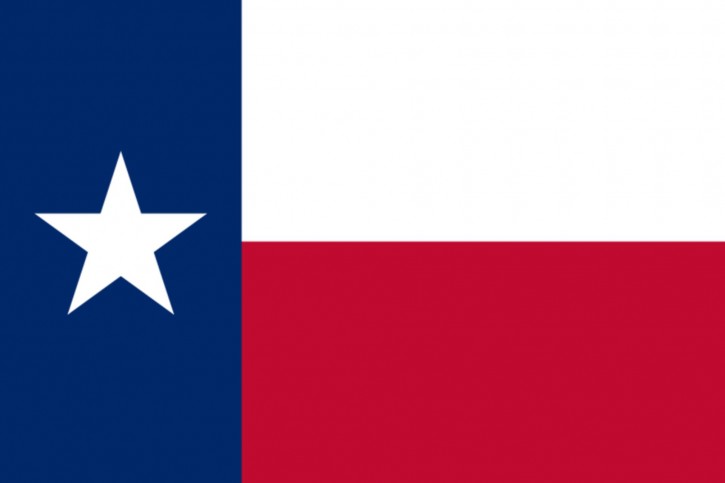
State Flag
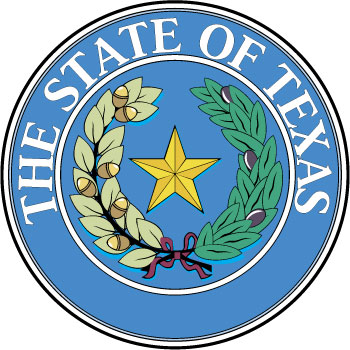
Great Seal
Nickname
The Lone Star State
Motto
Friendship

Bird
Northern Mockingbird

Flower
Bluebonnet
Tree
Pecan
Mammal (Large)
Longhorn
Mammal (Small)
Armadillo
Mammal (Flying)
Mexican Free-tailed Bat
Fish
Guadalupe Bass
Reptile
Texas Horned Lizard
Gem
Texas Blue Topaz
Song
"Texas, Our Texas"