
 English
 Español
 中文
中文 हिन्दी
 Français
On this page
Overview
Vermont is a state in the New England region of the United States, bordered by Massachusetts to the south, New Hampshire to the east across the Connecticut River, the Canadian province of Quebec to the north, and New York to the west across Lake Champlain. With roughly 648,000 residents across 9,616 square miles, it is the second-least-populous U.S. state (after Wyoming) and the sixth-smallest by area. Vermont is the only New England state without a coastline on the Atlantic Ocean or a Great Lake.
Vermont entered the Union as the 14th state on March 4, 1791 — the first state admitted after the original 13 colonies. The state takes its name from the French "vert" (green) and "mont" (mountain), reflecting the Green Mountains that run north-south down the center of the state. Montpelier, with a population of about 8,000, is the state capital and the smallest U.S. state capital by population. Burlington on Lake Champlain is by far the largest city; together with its suburbs (South Burlington, Essex Junction, Colchester), the Burlington area contains roughly a quarter of the state's population.
Vermont is internationally famous for its autumn foliage (the brilliant red, orange, and yellow display of maple, birch, and oak in late September and October draws roughly four million "leaf-peeper" visitors a year), its maple syrup industry (the largest U.S. producer by a wide margin), its dairy and cheese industries (Ben & Jerry's, Cabot Creamery, Vermont cheddar), its ski resorts (Killington, Stowe, Stratton, Sugarbush, Okemo, Mount Snow), its progressive politics, and its rural, small-town character. Vermont was the first U.S. state to abolish slavery (1777, when still a republic), the first to legalize civil unions for same-sex couples (2000), and the only state to have a contiguous Republic-of-Vermont history before joining the United States.
Geography & Climate
Vermont sits on the western edge of the New England region, straddling the Green Mountains. The Green Mountains, part of the broader Appalachian system, run the full north-south length of the state — Mount Mansfield (4,395 feet, near Stowe) is the highest peak, followed by Killington Peak, Mount Ellen, Camel's Hump, and Jay Peak. The Green Mountain National Forest covers roughly 400,000 acres in the south-central and southern part of the state.
Lake Champlain, on the western border with New York, is the state's defining natural feature: 120 miles long and up to 12 miles wide, the sixth-largest U.S. lake by surface area. The lake is named for French explorer Samuel de Champlain, who reached it in 1609. The Champlain Valley is Vermont's most fertile agricultural region, with rich clay soils and a milder climate than the highlands. The Connecticut River forms the entire eastern border with New Hampshire. Vermont's major rivers — the Winooski, the Lamoille, the Otter Creek, the White, and the Battenkill — all rise in the Green Mountains and flow either west to Lake Champlain or east to the Connecticut River.
The climate is humid continental with cold, snowy winters (Burlington averages over 80 inches of snow a year; many mountain locations exceed 200 inches) and warm, humid summers. The classic Vermont sequence — mud season (March-April), spring (May-June), summer (July-August), foliage (late September-October), stick season (early November), winter (December-March) — defines the rural rhythm of the state. The September-October fall foliage display is one of the most celebrated natural events in the eastern United States, with peak color generally moving south from the Northeast Kingdom through the rest of the state over two to three weeks.
History
For thousands of years before European contact, present-day Vermont was home to the Abenaki people, an Algonquian-speaking nation. The Western Abenaki — including the Missisquoi band along Lake Champlain and the Cowasuck and other bands in the central state — used Vermont as hunting, fishing, and gathering territory, with seasonal villages along Lake Champlain and the major rivers. French explorer Samuel de Champlain reached the lake that bears his name in 1609, encountering and fighting an Iroquois war party near Crown Point. French missionaries and traders followed; the territory was claimed by France as part of New France until the British conquest in 1759-1760.
After the French and Indian War, both New Hampshire (via Governor Benning Wentworth's "New Hampshire Grants") and New York claimed jurisdiction over the territory and issued conflicting land grants. The settlers of the New Hampshire Grants, led by Ethan Allen and his Green Mountain Boys, resisted New York's claims through the 1760s and 1770s. On May 10, 1775, Ethan Allen and Benedict Arnold captured Fort Ticonderoga from the British in the first American military victory of the Revolutionary War. In 1777, Vermont declared itself an independent republic — the Vermont Republic — and adopted a constitution that was the first in North America to prohibit adult slavery and the first to authorize universal manhood suffrage without property qualifications.
The Vermont Republic existed as an independent nation from 1777 to 1791, with capitals at Windsor, Norwich, Westminster, and others. It minted its own coinage, ran its own postal service, and negotiated independently with the Continental Congress and the new United States. Vermont was admitted as the 14th state on March 4, 1791 — the first state added to the original 13. The state was a Whig and then Republican stronghold from the 1850s through the 1980s; the first Republican state, Vermont voted Republican in every presidential election from 1856 to 1988 except for 1964 (Lyndon Johnson) — the longest streak of any U.S. state. The state has since become one of the most reliably Democratic U.S. states, voting Democratic in every presidential election since 1992.
Vermont in the 19th century was a major agricultural state — particularly for Merino sheep (the "Merino mania" of the 1810s-1840s) and then dairy. The Marble Belt of central Vermont supplied much of the marble used in U.S. government buildings, including parts of the U.S. Supreme Court Building, the Lincoln Memorial, and the New York Public Library. The Granite Belt around Barre supplied stone for countless monuments and gravestones across the United States. The 1927 Great Vermont Flood was the deadliest natural disaster in state history. Senator Bernie Sanders, an independent socialist who represents Vermont in the U.S. Senate, made two competitive runs for the Democratic presidential nomination in 2016 and 2020 — making him perhaps the best-known Vermonter of the 21st century.
Economy
Vermont hosts a small but distinctive economy anchored by tourism (autumn foliage, skiing, agritourism), dairy and agriculture, specialty food and beverage production, financial and professional services, healthcare, and education.
- Tourism: Vermont tourism — autumn foliage in late September and October, downhill and cross-country skiing in winter, and lakes-and-mountains outdoor recreation in summer — accounts for roughly $3 billion in annual visitor spending. The major ski resorts include Killington (the largest in the eastern U.S.), Stowe, Stratton, Sugarbush, Okemo, Mount Snow, Jay Peak, and Smugglers' Notch. Lake Champlain summer recreation, the Long Trail (the oldest long-distance hiking trail in the United States, predating the Appalachian Trail), and the Northeast Kingdom's remote forests anchor non-ski tourism.
- Dairy and agriculture: Vermont is one of the most dairy-intensive U.S. states by farms-per-capita; dairy and dairy products account for roughly 70 percent of state agricultural sales. Famous Vermont dairy brands include Cabot Creamery (cheddar cheese), Ben & Jerry's (ice cream, founded in a Burlington gas station in 1978 and now owned by Unilever), and dozens of artisanal cheesemakers. Vermont is also the largest U.S. producer of pure maple syrup by a wide margin — roughly half of U.S. production — with maple sugaring a deep cultural and economic tradition. The state is a leader in small-farm, organic, and direct-to-consumer agriculture.
- Specialty food and beverage: Vermont has built a strong specialty-food and craft-beverage economy. Ben & Jerry's, King Arthur Baking Company (Norwich), Cabot Creamery, Vermont Smoke and Cure, and dozens of artisanal cheesemakers and chocolatiers anchor the food sector. Vermont craft beer is internationally famous; The Alchemist (Stowe — Heady Topper), Hill Farmstead (Greensboro — repeatedly rated among the best breweries in the world), and Lawson's Finest Liquids (Waitsfield) attract beer-tourism visits. Vermont distilleries (WhistlePig rye whiskey, Caledonia Spirits Barr Hill gin) also have national reputations.
- Financial, professional services, and tech: The Burlington-South Burlington metropolitan area hosts Burlington-headquartered National Life Group (insurance), the University of Vermont, and a growing technology and professional-services cluster. GlobalFoundries (formerly an IBM semiconductor plant) operates a major chip-fabrication facility in Essex Junction. Beta Technologies (Burlington) develops electric vertical-takeoff aircraft.
- Healthcare and education: The University of Vermont Medical Center (Burlington) is the only academic medical center in the state and the principal healthcare provider for much of northern Vermont and northeastern New York. The University of Vermont (Burlington) is the flagship public research university; Middlebury College, Norwich University (the oldest U.S. private military college), Vermont State University, Saint Michael's College, Bennington College, and Champlain College are other major institutions.
Government
Vermont operates under its 1793 constitution — the second-oldest U.S. state constitution still in use (only Massachusetts' 1780 constitution is older). The Vermont General Assembly is bicameral, with a 30-member Senate and a 150-member House of Representatives — both serving two-year terms. There are no legislative term limits. The General Assembly meets in regular session beginning the first Wednesday in January each year and typically adjourns in May.
The Governor of Vermont serves a two-year term — one of only two U.S. states (with New Hampshire) where the governor is elected biennially rather than every four years. There are no gubernatorial term limits. The state separately elects a Lieutenant Governor, Attorney General, Secretary of State, Treasurer, and Auditor of Accounts — also to two-year terms. If no gubernatorial candidate receives a majority of the popular vote, the General Assembly chooses the winner from among the top three candidates (this has happened multiple times in Vermont history, most recently in 2016).
Vermont has one seat in the U.S. House of Representatives plus two U.S. Senators. The Vermont Supreme Court has five justices appointed by the governor (with Senate confirmation) and retained by uncontested legislative vote to six-year terms. The state capital is Montpelier, which at about 8,000 people is the smallest U.S. state capital by population. Vermont was the only U.S. state for many years to allow incarcerated felons to vote (a right it retains today, along with Maine and Washington, D.C.); voting is open to all U.S. citizens 18 and over regardless of incarceration status.
Culture
Vermont culture is shaped by a long tradition of rural self-sufficiency, town-meeting direct democracy, environmental conservation, progressive politics, and a strong sense of state identity. The annual March Town Meeting Day — when residents of each Vermont town gather in person to vote on the town budget, elect local officers, and debate public issues — is one of the most direct surviving forms of New England town-meeting democracy. Vermont was the first U.S. state to abolish slavery (in its 1777 constitution while still an independent republic), the first to ban Coca-Cola and other sodas from public schools (2002), the first to legalize civil unions for same-sex couples (2000), and an early adopter of right-to-die legislation (2013).
Foliage season — late September through mid-October — is the cultural high point of the Vermont year, drawing roughly four million visitors. Maple sugaring season (the "sugar season" in late February to early April, when warming days and freezing nights cause sap to rise in the maple trees) is a deep tradition; the annual Vermont Maple Festival in St. Albans and small sugar-shack operations across the state attract both Vermonters and visitors. Foliage-and-covered-bridge driving tours, country store visits, and farm stands together define the Vermont visitor experience.
Vermont sports culture is small-state but distinctive. The University of Vermont Catamounts (men's ice hockey, men's and women's basketball, men's and women's soccer) compete in NCAA Division I in the America East Conference and Hockey East. Vermont has no major professional sports teams; the closest are the Boston-area Red Sox, Patriots, Celtics, and Bruins, which command much of Vermont sports allegiance. Notable Vermonters include Presidents Chester A. Arthur and Calvin Coolidge; senators Bernie Sanders, Patrick Leahy, Robert Stafford, and George Aiken; and singer-songwriter Phish (formed at UVM in 1983), Ethan Allen (Vermont Republic founder), Brigham Young (born in Whitingham), Joseph Smith Jr. (born in Sharon, founder of the Latter-day Saints movement), and the writer Robert Frost (who farmed in Ripton).
Notable Cities
- Burlington — Largest city in Vermont, on Lake Champlain in the northwest, with a city population of roughly 45,000 and a metropolitan area of about 220,000 — roughly a third of the state. The economic, cultural, and educational center of the state. Home of the University of Vermont, Champlain College, the Church Street Marketplace (a four-block pedestrian shopping district), the ECHO Lake Aquarium and Science Center, the Burlington Waterfront Park on Lake Champlain, and the Vermont Lake Monsters minor-league baseball team. Bernie Sanders served as mayor from 1981 to 1989.
- Essex / Essex Junction — Second-largest community by population, immediately northeast of Burlington, with a combined population of roughly 22,000. Home of the GlobalFoundries semiconductor fabrication plant (formerly IBM Burlington) — one of the largest private employers in the state. The Champlain Valley Exposition fairgrounds host the Champlain Valley Fair, the largest annual fair in Vermont.
- South Burlington — Third-largest community, immediately south of Burlington on Lake Champlain, with a population of roughly 20,000. The retail and office hub of the Burlington metropolitan area, home of Burlington International Airport, the University Mall, and substantial residential development. The fastest-growing community in Vermont.
- Colchester — Fourth-largest community, immediately north of Burlington on Lake Champlain, with a population of roughly 17,000. Home of Saint Michael's College, the Vermont National Guard headquarters at Camp Johnson, and the Hazelett Strip-Casting Corporation (one of the state's notable manufacturers).
- Rutland — Largest city in central and southern Vermont, in west-central Vermont in the Marble Belt, with a population of roughly 15,000. Historically the second-largest Vermont city (until eclipsed by Burlington-area communities), Rutland was a major railroad and marble-quarrying center. Today an arts and small-manufacturing hub, home of the Paramount Theatre, the Vermont State Fair (the oldest in the state), and Killington Resort just to the east.
State Symbols
Vermont's official state symbols, designated by the Vermont General Assembly, celebrate the Green Mountains, the maple sugaring tradition, the dairy and agricultural heritage, and the natural identity of the Green Mountain State.
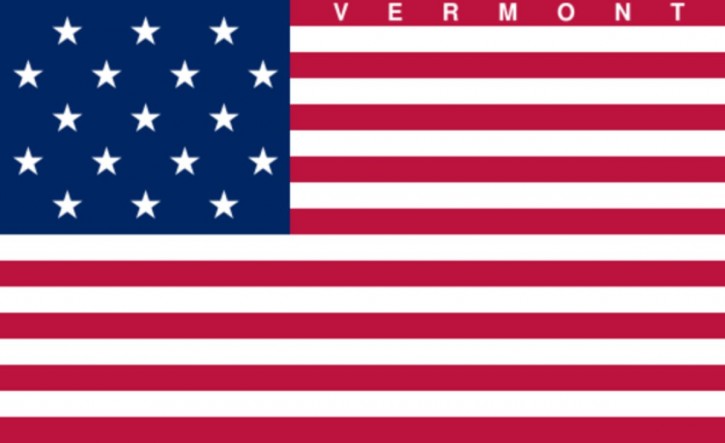
State Flag
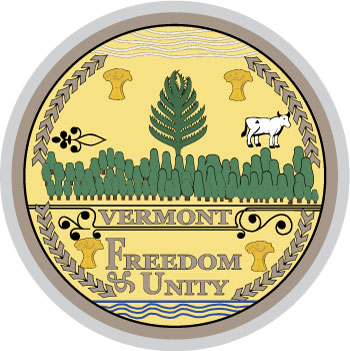
Great Seal
Nickname
The Green Mountain State
Motto
Freedom and Unity

Bird
Hermit Thrush
Flower
Red Clover
Tree
Sugar Maple
Animal
Morgan Horse
Fish (Cold-water)
Brook Trout
Fish (Warm-water)
Walleye Pike
Insect
Honeybee
Gem
Grossular Garnet
Beverage
Milk
Song
"These Green Mountains"