
 English
 Español
 中文
中文 हिन्दी
 Français
On this page
Overview
Virginia is a state on the Atlantic coast of the United States, in the Mid-Atlantic and Southeastern regions, bordered by Maryland and the District of Columbia to the north and northeast, the Atlantic Ocean to the east, North Carolina and Tennessee to the south, Kentucky to the west, and West Virginia to the north and west. With roughly 8.7 million residents across 42,775 square miles, it is the 12th-most populous state and the 35th largest by area. Virginia is the only U.S. state that fully bisects another U.S. state — its long western "tail" reaches across the Appalachian crest.
Virginia's formal name is the Commonwealth of Virginia — one of four U.S. states (with Kentucky, Massachusetts, and Pennsylvania) styled as commonwealths. Virginia was the site of the first permanent English settlement in North America (Jamestown, 1607) and one of the original 13 colonies. It ratified the U.S. Constitution on June 25, 1788 as the 10th state. The Commonwealth takes its name from Queen Elizabeth I of England, the "Virgin Queen." Richmond, on the James River in the east-central part of the state, is the capital. Virginia Beach is the most populous city; the Virginia Beach-Norfolk-Newport News area (Hampton Roads) and the Northern Virginia suburbs of Washington, D.C. together contain the majority of the state's population.
Virginia is famous as the "Mother of Presidents" — eight U.S. presidents have been born in Virginia, more than any other state: Washington, Jefferson, Madison, Monroe, William Henry Harrison, Tyler, Taylor, and Wilson. Virginia was the location of the Revolutionary War's decisive 1781 Siege of Yorktown, the Civil War capital of the Confederacy (Richmond), and the site of more Civil War battles than any other state. Today the state is famous for its colonial and Civil War heritage (Jamestown, Williamsburg, Mount Vernon, Monticello, Yorktown, Manassas, Appomattox), the Pentagon and the U.S. Navy presence at Hampton Roads (the largest naval base in the world), the federal-government and contractor concentration in Northern Virginia, and a wine and agritourism industry centered in the Blue Ridge foothills.
Geography & Climate
Virginia is divided into five physiographic regions running roughly parallel to the coast. The Tidewater (Coastal Plain), in the east, includes the Hampton Roads area and the Chesapeake Bay shoreline — flat, low-lying, and threaded by tidal estuaries (the Potomac, Rappahannock, York, and James rivers). The Piedmont, the largest region, is a gently rolling plateau between the Tidewater and the Blue Ridge, anchored by Richmond and Charlottesville. The Blue Ridge Mountains run northeast-southwest along the western edge of the Piedmont. The Ridge and Valley region west of the Blue Ridge — the Shenandoah Valley in the north and a series of parallel ridges to the south — is among the most productive agricultural and limestone-cave regions in the eastern United States. The Appalachian Plateau in the far southwest is a coal-mining region.
The Chesapeake Bay — the largest estuary in the United States — defines eastern Virginia. The Bay's western shore runs the length of the Tidewater; the Eastern Shore (a long peninsula east of the Bay) is part of Virginia but accessible from mainland Virginia only via the 17.6-mile Chesapeake Bay Bridge-Tunnel. The James River flows from the Blue Ridge across the Piedmont to the Chesapeake Bay at Hampton Roads, providing the historic colonial route. The Potomac River forms the entire northern border with Maryland and the District of Columbia. Mount Rogers (5,729 feet, in the Mount Rogers National Recreation Area) is the highest point in Virginia.
The climate is humid subtropical in the Tidewater and Piedmont, transitioning to humid continental in the higher Appalachian elevations. Tidewater and Hampton Roads experience hot, humid summers and mild winters with occasional ice storms; Atlantic hurricanes and nor'easters occasionally cause significant coastal flooding. The Blue Ridge and Appalachian highlands have cooler summers and snowier winters, with autumn foliage drawing visitors to Skyline Drive and the Blue Ridge Parkway in October. Virginia contains Shenandoah National Park (Blue Ridge highlands), the southern terminus of Skyline Drive, and the northern terminus of the Blue Ridge Parkway.
History
For thousands of years before European contact, present-day Virginia was home to Algonquian-speaking peoples east of the Fall Line (the Powhatan Confederacy of the Tidewater, with its capital at Werowocomoco and roughly 14,000-21,000 people in 1607), Iroquoian-speaking peoples (the Nottoway and Meherrin in the southeast and the Cherokee in the southwest), and Siouan-speaking peoples (the Monacan and Manahoac of the Piedmont). The Powhatan paramount chief Wahunsenacawh (known to the English as "Chief Powhatan") ruled a confederacy of roughly 30 chiefdoms when the English arrived in 1607.
Jamestown, founded May 13-14, 1607, was the first permanent English settlement in North America — predating Plymouth by 13 years. The colony nearly failed in the "Starving Time" winter of 1609-1610 but survived through the leadership of Captain John Smith, the relationship between English settler John Rolfe and Powhatan princess Pocahontas (Matoaka), and the development of tobacco as a cash crop. The first representative legislative assembly in the New World — the Virginia House of Burgesses — met at Jamestown on July 30, 1619. The first enslaved Africans in English North America arrived in Virginia in August 1619, marking the beginning of more than two centuries of chattel slavery in the future United States.
Virginia was the largest and most influential of the original 13 colonies. Williamsburg replaced Jamestown as the colonial capital in 1699. Patrick Henry's 1775 "Give me liberty, or give me death!" speech, Thomas Jefferson's 1776 authorship of the Declaration of Independence, George Washington's wartime leadership, and the decisive defeat of British General Cornwallis at the Siege of Yorktown (October 1781) made Virginia central to the American Revolution. The Virginia Plan, presented by Edmund Randolph at the 1787 Constitutional Convention, became the framework of the U.S. Constitution. James Madison, the "Father of the Constitution," and James Monroe ("Era of Good Feelings") followed Washington and Jefferson into the presidency.
Virginia seceded from the Union on April 17, 1861, after Fort Sumter. Richmond became the Confederate capital. More Civil War battles were fought on Virginia soil than in any other state: First Manassas (Bull Run, 1861), the Seven Days (1862), Second Manassas (1862), Fredericksburg (1862), Chancellorsville (1863), the Wilderness, Spotsylvania, and Cold Harbor (1864), Petersburg (1864-1865), and finally Appomattox Court House on April 9, 1865, where Robert E. Lee surrendered to Ulysses S. Grant. Virginia's western counties refused to secede and formed the separate state of West Virginia in 1863. Massive Resistance to school desegregation in the late 1950s closed several Virginia public school systems rather than comply with Brown v. Board of Education. The 2017 Unite the Right rally and the killing of Heather Heyer in Charlottesville brought renewed national attention to Confederate monuments and racial conflict; most Confederate statues in Richmond and Charlottesville have since been removed.
Economy
Virginia hosts one of the most diverse U.S. state economies, anchored by federal government and defense contracting (especially in Northern Virginia and Hampton Roads), technology and data centers, agriculture, military presence, tourism, finance, and shipbuilding.
- Federal government and defense contracting: Virginia hosts the Pentagon (Arlington, headquarters of the U.S. Department of Defense), the Central Intelligence Agency headquarters (Langley), the U.S. Department of Defense headquarters in Arlington, and dozens of other federal agencies in Northern Virginia. The state has the largest concentration of federal defense and intelligence contractors in the United States — including Northrop Grumman headquarters (Falls Church), General Dynamics headquarters (Reston), Booz Allen Hamilton headquarters (McLean), and major operations of Leidos, CACI, ManTech, and Science Applications International (SAIC). Federal employment and contracting account for the largest share of the Northern Virginia economy.
- Technology and data centers: Northern Virginia (especially Loudoun County and Ashburn) is the world's largest concentration of data centers. Roughly 70 percent of all internet traffic passes through the data centers in the corridor — making Northern Virginia the most important global internet exchange point. Amazon Web Services' largest U.S. region (US-East-1) is headquartered there. Amazon's second headquarters (HQ2) in Arlington/Crystal City brought tens of thousands of new technology jobs. Other major employers include AOL/Verizon Media (Dulles), Capital One (McLean), Hilton Worldwide (McLean), Freddie Mac (McLean), Fannie Mae (Reston), Gannett (McLean), and a vast cybersecurity industry.
- Military presence and shipbuilding: Naval Station Norfolk in Hampton Roads is the largest naval base in the world, home to the U.S. Atlantic Fleet, six aircraft carriers, and roughly 75 ships. Naval Air Station Oceana (Virginia Beach) is one of two U.S. Navy master jet bases. Joint Base Langley-Eustis (Hampton) hosts F-22 Raptors. The Marine Corps Base Quantico south of Washington trains officers and hosts the FBI Academy. Newport News Shipbuilding (a division of HII) is the only U.S. shipyard building nuclear-powered aircraft carriers and one of two yards building nuclear submarines. The Pentagon and CIA headquarters give Virginia outsized military-industrial influence.
- Agriculture, tourism, and wine: Virginia is a top U.S. producer of tobacco (a fading but historically central crop), peanuts, soybeans, hay, cotton, and apples. Virginia ham (Smithfield Foods country-cured ham) is internationally recognized. Tourism is anchored by Colonial Williamsburg, Jamestown Settlement, Yorktown Victory Center (the "Historic Triangle"), Mount Vernon (Washington's home), Monticello (Jefferson's home, a UNESCO World Heritage Site), Shenandoah National Park, the Blue Ridge Parkway, Virginia Beach, and Busch Gardens Williamsburg. The Virginia wine country in the Blue Ridge foothills (Albemarle County, Loudoun County) has grown to more than 300 wineries since the 1970s.
- Finance and headquarters: Capital One Financial Corporation is headquartered in McLean and is one of the largest U.S. consumer banks. Hilton Worldwide (McLean) is one of the largest U.S. hospitality companies. Genworth Financial (Richmond), Markel Corporation (Richmond), Altria Group (Richmond — Marlboro cigarettes), MeadWestvaco/WestRock (Richmond), Performance Food Group (Goochland), and Smithfield Foods (Smithfield) are among Virginia's notable Fortune 500 headquarters.
Government
Virginia operates under its 1971 constitution — the most recent of seven Virginia constitutions, replacing the 1902 constitution that had codified Jim Crow racial discrimination. Virginia is formally a Commonwealth (not a State), one of four U.S. commonwealths. The Virginia General Assembly is the oldest continuous legislative body in the Western Hemisphere — descended directly from the 1619 Virginia House of Burgesses. It is bicameral, with a 40-member Senate (four-year terms) and a 100-member House of Delegates (two-year terms). The General Assembly meets in regular session beginning the second Wednesday in January each year — for 60 days in even-numbered years and 30 days in odd-numbered years.
The Governor of Virginia serves a four-year term and is the only U.S. governor constitutionally prohibited from serving consecutive terms — a Virginia tradition since the colonial era. (The governor may serve again later, after one term out of office; Mills Godwin in the 1970s did so.) Virginia separately elects a Lieutenant Governor (also four-year term), an Attorney General, and three statewide officers. Statewide elections are held in odd-numbered years — Virginia is one of only two U.S. states (with New Jersey) to hold gubernatorial elections in odd-numbered years, making them frequent off-year political bellwethers.
Virginia has 11 seats in the U.S. House of Representatives plus two U.S. Senators. The Supreme Court of Virginia has seven justices elected by the General Assembly to twelve-year terms — Virginia is one of only two U.S. states (with South Carolina) where the legislature, not the governor or voters, elects the high court. The state capital is Richmond. Virginia is one of only four U.S. states (with Maine, Vermont, and Wisconsin) without a death-penalty statute as of 2026; Virginia repealed capital punishment in 2021, becoming the first Southern state to do so.
Culture
Virginia culture is shaped by its colonial and Founding Fathers heritage, by Civil War and African American history (slavery, emancipation, civil rights, and Massive Resistance), by the federal government and military presence, and by significant regional diversity: a cosmopolitan Northern Virginia oriented toward Washington, D.C.; a coastal Tidewater oriented toward Hampton Roads and Chesapeake Bay seafood; a Piedmont anchored by Richmond; the Shenandoah Valley with Pennsylvania-German agricultural traditions; and an Appalachian southwest with deep ties to coal mining and bluegrass music. The state is often described as the cultural meeting point of the Mid-Atlantic North and the Upper South.
Virginia history sites draw millions of visitors a year. The Historic Triangle of Jamestown, Williamsburg, and Yorktown — connected by the scenic Colonial Parkway — is the most-visited concentration of U.S. colonial-era historic sites. Mount Vernon (Washington's plantation home on the Potomac) and Monticello (Jefferson's home near Charlottesville, also a UNESCO World Heritage Site) are among the most-visited founder homes. Civil War battlefields preserved by the National Park Service include Manassas, Fredericksburg, Chancellorsville, the Wilderness, Spotsylvania, Cold Harbor, Petersburg, and Appomattox Court House. Arlington National Cemetery and the Tomb of the Unknown Soldier sit on the former Lee family plantation across the Potomac from Washington, D.C.
Virginia sports culture revolves around college athletics: the Virginia Tech Hokies (Blacksburg, ACC football and basketball with the famous "Enter Sandman" entrance), the Virginia Cavaliers (Charlottesville, ACC, 2019 NCAA basketball champions), James Madison University, William & Mary, Old Dominion, and the University of Richmond. Virginia hosts no major-league professional sports franchises, though it has Triple-A baseball (Norfolk Tides, Richmond Flying Squirrels), Major League Soccer's D.C. United training facility in Loudoun, and the WNBA Washington Mystics in Northern Virginia. Notable Virginians include Presidents Washington, Jefferson, Madison, Monroe, William Henry Harrison, Tyler, Taylor, and Wilson; Confederate general Robert E. Lee; Pocahontas; statesmen Patrick Henry and George Mason; tennis champion Arthur Ashe; civil-rights leader Booker T. Washington; jazz singer Ella Fitzgerald; and country-music star Patsy Cline.
Notable Cities
- Virginia Beach — Most populous city in Virginia, on the Atlantic coast at the mouth of the Chesapeake Bay, with a city population of roughly 460,000 and part of the Hampton Roads metropolitan area of about 1.8 million. A major Atlantic beach resort with 35 miles of coastline, the largest pleasure-beach resort in the United States by some measures, and home to Naval Air Station Oceana (one of two U.S. Navy master jet bases). Old Cape Henry Lighthouse (1792, one of the first federally built lighthouses) and the Virginia Aquarium are major attractions.
- Norfolk — Second-most populous Virginia city and the cultural and economic anchor of Hampton Roads, on the Elizabeth River south of the Chesapeake Bay, with a city population of roughly 235,000. Home of Naval Station Norfolk (the largest naval base in the world), the Port of Virginia (one of the largest U.S. East Coast container ports), the Chrysler Museum of Art, the USS Wisconsin battleship at Nauticus, Old Dominion University, and Norfolk State University. The Norfolk-Newport News-Virginia Beach metropolitan area is one of the most military-dense in the United States.
- Chesapeake — Third-most populous Virginia city, in Hampton Roads south of Norfolk, with a city population of roughly 250,000. Created in 1963 by the merger of South Norfolk and Norfolk County. Home of the Great Dismal Swamp National Wildlife Refuge (a vast unique cypress-forest wetland straddling the North Carolina border), the Albemarle and Chesapeake Canal, and significant industrial-port and military-contracting employment.
- Richmond — State capital, on the James River in east-central Virginia, with a city population of roughly 230,000 and a metropolitan area of about 1.3 million. The economic, cultural, and political center of central Virginia. Home of the Virginia State Capitol (designed by Thomas Jefferson), the Virginia Museum of Fine Arts, the Maggie L. Walker National Historic Site, the American Civil War Museum, the Federal Reserve Bank of Richmond (one of 12 Federal Reserve districts), Virginia Commonwealth University, Altria, Markel, Genworth, and a vibrant restaurant and arts scene along Cary Street and in the historic Fan District.
- Arlington — Largest community in Northern Virginia (and a major Washington, D.C. suburb), directly across the Potomac River from Washington, with a population of roughly 240,000. Home of the Pentagon (headquarters of the U.S. Department of Defense), Arlington National Cemetery, the Marine Corps War Memorial (Iwo Jima Memorial), Reagan National Airport, the second Amazon headquarters (HQ2) in Crystal City / National Landing, and dozens of federal defense and intelligence contractors. The Rosslyn-Ballston corridor is one of the densest, most transit-oriented commercial corridors in the United States.
State Symbols
Virginia's official state symbols, designated by the Virginia General Assembly, celebrate the colonial and Founding Fathers heritage, the agricultural and tobacco traditions, the Chesapeake Bay ecology, and the natural identity of the Commonwealth and Old Dominion.
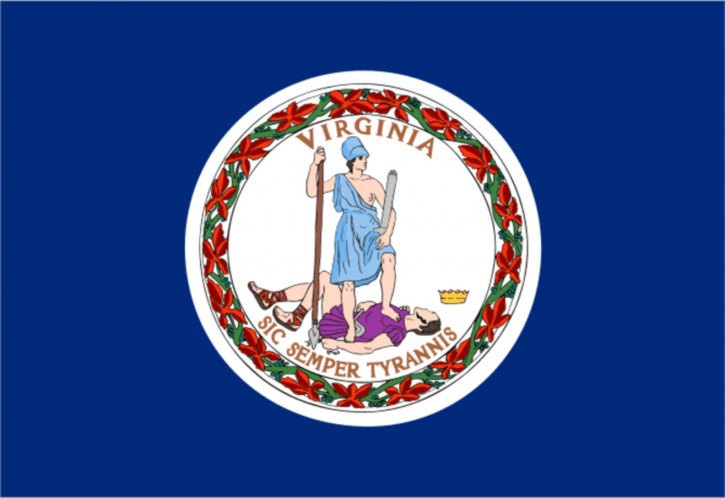
State Flag
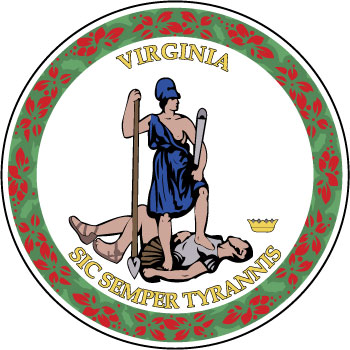
Great Seal
Nickname
The Old Dominion / The Mother of Presidents
Motto
Sic Semper Tyrannis (Thus Always to Tyrants)

Bird
Northern Cardinal

Flower
American Dogwood
Tree
American Dogwood
Dog
American Foxhound
Fish (Salt-water)
Striped Bass
Fish (Fresh-water)
Brook Trout
Shell
Eastern Oyster
Insect
Tiger Swallowtail Butterfly
Beverage
Milk
Song
"Our Great Virginia" (traditional) / "Sweet Virginia Breeze" (popular)