
 English
 Español
 中文
中文 हिन्दी
 Français
On this page
Overview
Utah sits in the heart of the American West, straddling the Rocky Mountains, the Great Basin, and the Colorado Plateau. The state is famous for its dramatic landscapes — the Great Salt Lake, the Wasatch Range, and the red-rock canyons that form its five national parks — and for the distinctive role that The Church of Jesus Christ of Latter-day Saints has played in shaping its settlement, society, and culture since pioneer settlers arrived in 1847.
Modern Utah combines a rapidly growing technology corridor along the Wasatch Front with a deep outdoor-recreation economy anchored by skiing, hiking, and national-park tourism. The state has one of the youngest median ages in the country and one of the highest population growth rates, with most residents concentrated in a narrow band of cities between Provo and Ogden.
Geography & Climate
Utah covers approximately 84,900 square miles and is the 13th largest state by area. Three major physiographic regions meet within its borders: the Rocky Mountains in the north, the Great Basin in the west, and the Colorado Plateau in the south and east. The Wasatch Range runs north to south through the state and forms the eastern edge of the Salt Lake Valley, where the majority of Utah’s residents live.
The Great Salt Lake — the largest saltwater lake in the Western Hemisphere — occupies a closed basin in the state’s northwest. Southern Utah is dominated by the canyons, mesas, and arches of the Colorado Plateau, home to five national parks (Arches, Bryce Canyon, Canyonlands, Capitol Reef, and Zion) and several national monuments. Climate ranges from semi-arid in the valleys to alpine in the high Wasatch and Uinta ranges, with deep winter snowfall that supports the state’s ski industry.
History
The land that is now Utah has been home to Indigenous peoples for at least twelve thousand years, including the Ute, Paiute, Goshute, Shoshone, and Navajo nations. Spanish explorers reached the region in the late 1500s, and the Dominguez–Escalante expedition mapped much of central Utah in 1776. The territory passed from Mexico to the United States with the 1848 Treaty of Guadalupe Hidalgo.
In 1847 Brigham Young led members of The Church of Jesus Christ of Latter-day Saints into the Salt Lake Valley, beginning a wave of settlement that gave Utah a uniquely organized agrarian society. The Utah Territory was established in 1850, but conflicts over the practice of plural marriage delayed statehood for nearly half a century. After the Church officially renounced the practice in 1890, Utah was admitted as the 45th state on January 4, 1896. The twentieth century brought mining, defense, and university research, followed in recent decades by rapid growth in software, finance, and tourism.
Economy
Utah has one of the fastest-growing economies in the United States, driven by technology, professional services, mining, finance, and tourism. The state consistently ranks near the top of national lists for job growth, business climate, and population growth, and the Wasatch Front has become one of the country’s most active technology corridors.
- Technology: The "Silicon Slopes" corridor between Lehi and Provo hosts Adobe, Qualtrics, Domo, Pluralsight, and a deep bench of venture-backed software startups.
- Mining and energy: Copper from the historic Bingham Canyon Mine, natural gas, coal, and an emerging lithium industry support Utah’s industrial economy.
- Tourism: The five national parks (the "Mighty 5"), world-class ski resorts at Park City, Snowbird, and Alta, and the Sundance Film Festival together draw tens of millions of visitors a year.
- Finance and insurance: Utah is home to a concentration of industrial banks, fintech firms, and one of the largest call-center workforces in the country.
- Higher education and research: The University of Utah, Brigham Young University, and Utah State University anchor a strong research-and-development ecosystem.
Government
Utah operates under a constitution adopted in 1895 and is led by a Governor and Lieutenant Governor with a bicameral legislature consisting of a 29-member Senate and a 75-member House of Representatives. The Utah Supreme Court has five justices appointed by the Governor and retained by voter election. Salt Lake City has served as the state capital since the Utah Territory was organized in 1850, and the State Capitol sits on Capitol Hill at the north end of downtown.
Culture
Utah’s cultural identity is shaped by the long-running influence of The Church of Jesus Christ of Latter-day Saints, by a powerful outdoor-recreation tradition, and by the artistic legacy of the Sundance Film Festival. The state’s ski culture and its red-rock landscapes have produced one of the strongest action-sports and adventure-travel scenes in North America. Distinctive local food traditions include fry sauce, funeral potatoes, and pastrami burgers, and Salt Lake City has become a notable destination for craft brewing and an emerging restaurant scene.
Notable Cities
- Salt Lake City — state capital and economic anchor of the Wasatch Front; host of the 2002 Winter Olympics and slated to host again in 2034.
- West Valley City — second-largest city in the state; a diverse residential and industrial center southwest of Salt Lake.
- Provo — home of Brigham Young University and a fast-growing software hub.
- West Jordan — rapidly growing southern suburb of Salt Lake City.
- Orem — paired with Provo as the "Silicon Slopes" technology corridor.
- Ogden — historic rail town at the foot of the northern Wasatch with revitalized downtown and aerospace industry.
- St. George — gateway city to Zion National Park and one of the fastest-growing metro areas in the country.
- Logan — home of Utah State University in the agricultural Cache Valley.
State Symbols
Officially designated symbols of the State of Utah — established by the State Legislature to celebrate the state’s natural and cultural identity.
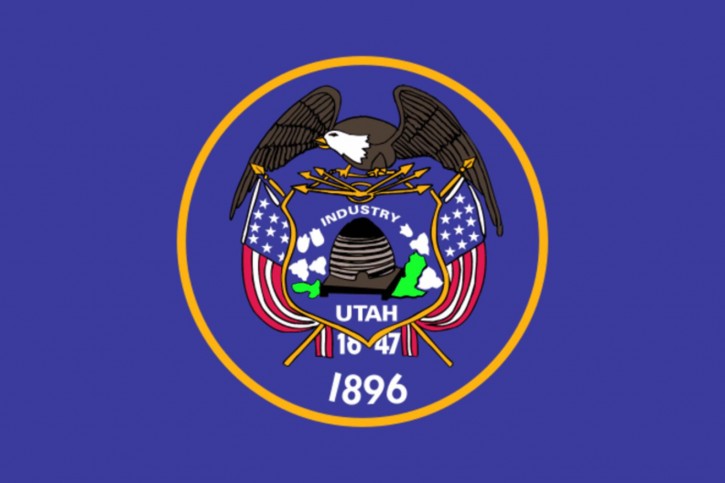
State Flag

Great Seal
Nickname
The Beehive State
Motto
Industry

Bird
California Gull

Flower
Sego Lily
Animal
Rocky Mountain Elk
Tree
Quaking Aspen
Fish
Bonneville Cutthroat Trout
Insect
Honeybee
Mineral
Copper
Song
"Utah, This Is the Place"