
 English
 Español
 中文
中文 हिन्दी
 Français
On this page
Overview
Washington is a state in the Pacific Northwest region of the United States, bordered by the Canadian province of British Columbia to the north, Idaho to the east, Oregon across the Columbia River to the south, and the Pacific Ocean to the west. With roughly 7.8 million residents across 71,362 square miles, it is the 13th-most populous state and the 18th largest by area. Washington is the only U.S. state named after a U.S. president — George Washington, the first president.
Washington entered the Union as the 42nd state on November 11, 1889. Olympia, on Puget Sound in the western lowlands, is the state capital. Seattle, on Puget Sound between Lake Washington and the Olympic Peninsula, is by far the largest city; the Seattle-Tacoma metropolitan area contains roughly half of the state's population. The state is divided geographically and culturally by the Cascade Range into a wet, densely populated, Pacific-facing western half (where most people live) and a much drier, more agricultural eastern half (the Columbia Plateau).
Washington is internationally famous as the home of some of the most influential global corporations: Microsoft (Redmond), Amazon (Seattle), Boeing (Renton — commercial aircraft assembly), Starbucks (Seattle), Costco (Issaquah), Nordstrom (Seattle), and T-Mobile US (Bellevue). The state is also famous for its dramatic natural setting — Mount Rainier, Mount St. Helens (the 1980 eruption was the deadliest U.S. volcanic event), the Olympic Peninsula's temperate rainforest, the Cascades, Puget Sound — for its leadership in software, aerospace, and biotechnology, for the apple, hops, and wine industries of the Yakima Valley, for its progressive politics, and for Seattle music heritage including grunge (Nirvana, Pearl Jam, Soundgarden, Alice in Chains).
Geography & Climate
Washington is divided by the Cascade Range into two strikingly different halves: Western Washington (lush, wet, mountainous, oriented toward Puget Sound and the Pacific) and Eastern Washington (dry, agricultural, oriented toward the Columbia River and the wheat country of the Palouse). The Cascade crest receives some of the heaviest snowfall in the contiguous United States — Mount Baker recorded the world record annual snowfall of 1,140 inches in 1998-1999. The Olympic Peninsula's Hoh and Quinault rainforests receive over 12 feet of rain a year, while the eastern Columbia Basin's rain-shadow desert receives less than 8 inches a year — one of the most dramatic precipitation gradients in the United States.
Mount Rainier (14,411 feet) is the highest peak in Washington and the most heavily glaciated mountain in the contiguous United States. Mount St. Helens (8,363 feet today, reduced by the May 18, 1980 eruption from 9,677 feet) is one of the most-studied volcanoes in the world. Mount Adams, Glacier Peak, and Mount Baker complete the major Washington Cascade volcanoes. Puget Sound is a complex saltwater estuary connecting the state to the Pacific through the Strait of Juan de Fuca and supporting major ports at Seattle, Tacoma, and Everett. The Columbia River — the largest river in the Pacific Northwest — forms most of the southern border with Oregon and runs through eastern Washington, where the Grand Coulee Dam (1942) is one of the largest concrete structures ever built.
The climate ranges from oceanic in Western Washington (cool, wet winters; mild, dry summers; very rare snow in the lowlands) to humid continental and semi-arid in Eastern Washington (cold winters, hot summers, low rainfall). Seattle's reputation for constant rain is partly mythical — it receives less annual rainfall than many U.S. cities but has many overcast, drizzly days. Wildfires increasingly affect Eastern Washington summers. The state contains Olympic National Park (rainforest, glaciated mountains, and Pacific beaches — a UNESCO World Heritage Site), Mount Rainier National Park, North Cascades National Park, and Mount St. Helens National Volcanic Monument.
History
For thousands of years before European contact, present-day Washington was home to one of the highest concentrations of Indigenous peoples north of Mexico, organized around the salmon-rich Pacific coast, Puget Sound, and Columbia River. The Coast Salish peoples (Duwamish, Suquamish, Lummi, Skagit, Snohomish, Puyallup, Nisqually) dominated Puget Sound; the Quinault, Quileute, Makah, and Hoh occupied the Olympic Peninsula; the Chinook of the lower Columbia developed Chinook Jargon as a regional trade language; the Yakama, Wanapum, Palus, Spokane, Colville, Coeur d'Alene, and other Plateau peoples occupied the Columbia Plateau. Many groups practiced highly developed salmon-fishing and cedar woodworking, including longhouses, dugout canoes, and totem-pole art.
Spanish, British, and Russian explorers reached the Pacific Northwest in the late 1700s. The Lewis and Clark Expedition reached the Columbia River and the Pacific in November 1805. The Oregon Country was jointly occupied by the United States and Great Britain from 1818 to 1846, when the Oregon Treaty established the 49th parallel as the border. The Oregon Territory was organized in 1848 and split into the smaller Oregon Territory and the new Washington Territory on March 2, 1853 (with original boundaries including most of present-day Idaho and parts of Montana and Wyoming). The 1855 Treaties of Medicine Creek, Point Elliott, Point No Point, Walla Walla, and others extinguished Indigenous land claims and established reservations.
Washington was admitted as the 42nd state on November 11, 1889 — one of the "Omnibus Statehood" states (with North Dakota, South Dakota, and Montana). Olympia became the state capital. The Klondike Gold Rush of 1897-1899 transformed Seattle into a major regional metropolis as the main jumping-off point for prospectors heading to the Yukon. Boeing was founded in Seattle in 1916; commercial aircraft manufacturing has been a defining Washington industry ever since. World War II brought massive shipbuilding to the Puget Sound Naval Shipyard at Bremerton and the Hanford Engineer Works in eastern Washington (one of the three principal Manhattan Project sites, producing plutonium for the Nagasaki bomb).
Postwar Washington saw the rise of the technology economy. Microsoft was founded in 1975 by Bill Gates and Paul Allen (Seattle-area natives) and relocated its headquarters to Redmond in 1986. Amazon was founded by Jeff Bezos in Seattle in 1994. The 1962 Century 21 Exposition in Seattle introduced the Space Needle and the monorail. The May 18, 1980 Mount St. Helens eruption — the deadliest U.S. volcanic event, killing 57 people — released a massive ash plume across eastern Washington and the world. The 1999 Battle of Seattle protests against the World Trade Organization meeting made Seattle a global symbol of anti-globalization activism. Washington legalized recreational cannabis in 2012 (alongside Colorado), becoming the first two U.S. states to do so.
Economy
Washington hosts one of the largest U.S. state economies, anchored by technology (Microsoft, Amazon), aerospace (Boeing commercial aircraft assembly), agriculture (apples, hops, wheat), maritime trade through the Ports of Seattle and Tacoma, retail and consumer companies headquartered in the state, and a major U.S. Navy and Hanford-region federal presence.
- Technology: Washington's technology sector is one of the largest in the United States. Microsoft (Redmond, founded 1975) is one of the largest software companies in the world; its Redmond campus has more than 50,000 employees. Amazon (Seattle, founded 1994) is one of the largest U.S. employers and the leading global cloud-computing provider via Amazon Web Services. T-Mobile US (Bellevue) is the second-largest U.S. wireless carrier. Other major Washington tech employers include Expedia, Zillow, Tableau (acquired by Salesforce), Big Fish Games, Valve, Bungie, Nintendo of America, F5 Networks, Costco (Issaquah), and the U.S. operations of countless Bay Area and global tech firms.
- Aerospace: The Boeing Company (founded in Seattle in 1916, headquarters in Arlington VA since 2022 but with most engineering and commercial-aircraft manufacturing in Washington) produces the 737, 747 (until 2022), 767, 777, and 787 aircraft at Renton and Everett. The Everett facility is the largest building in the world by volume. Aerospace supports a vast supplier network across Washington. Blue Origin (Jeff Bezos's space-vehicle company) is headquartered in Kent. Smaller aerospace firms include Aerojet Rocketdyne and dozens of suppliers.
- Agriculture: Washington is the largest U.S. producer of apples (Yakima Valley, the Columbia Basin), sweet cherries, pears, hops (Yakima Valley produces roughly 75 percent of U.S. hops), and red raspberries; a top producer of wheat (the Palouse country of the southeastern state), potatoes, asparagus, dairy, and Riesling and other cool-climate wine grapes. Washington has the second-largest U.S. wine industry by volume after California — the Columbia Valley, Walla Walla Valley, and Yakima Valley AVAs are home to roughly 1,000 wineries.
- Maritime trade and shipbuilding: The Northwest Seaport Alliance (combined Ports of Seattle and Tacoma) is one of the largest U.S. container-port complexes and the principal U.S. gateway for trans-Pacific trade. The Puget Sound Naval Shipyard at Bremerton is one of the four U.S. Navy shipyards and the largest naval shore facility on the West Coast. Naval Base Kitsap, Naval Air Station Whidbey Island, and Joint Base Lewis-McChord (Tacoma — Army I Corps and Air Force) make the Puget Sound region one of the most military-dense in the United States.
- Retail, beverages, and federal: Seattle and the Puget Sound region host an exceptional concentration of consumer-brand headquarters: Starbucks (Seattle — the world's largest coffee chain), Costco (Issaquah), Nordstrom (Seattle), Weyerhaeuser (Seattle — one of the largest U.S. forestry companies), Alaska Airlines (SeaTac), Expeditors International (Seattle), Russell Investments (Seattle), and Carter's (Seattle). The Hanford Site near Richland — once a Manhattan Project plutonium-production complex — is now the largest U.S. environmental cleanup site, operated by the Department of Energy. Pacific Northwest National Laboratory in Richland is one of the U.S. Department of Energy's 17 national laboratories.
Government
Washington operates under its 1889 constitution, adopted at statehood. The Washington State Legislature is bicameral, with a 49-member Senate (four-year terms) and a 98-member House of Representatives (two-year terms). The Legislature meets in regular session beginning the second Monday in January each year — for 105 days in odd-numbered years and 60 days in even-numbered years. There are no legislative term limits.
The Governor of Washington serves a four-year term with no limit on the number of terms. The state separately elects a Lieutenant Governor, Secretary of State, Treasurer, Auditor, Attorney General, Commissioner of Public Lands, Insurance Commissioner, and Superintendent of Public Instruction — making the Washington executive branch among the most divided in the United States. Washington has held all-mail-ballot elections statewide since 2011 — the second U.S. state (after Oregon) to do so. Washington uses a "top-two" non-partisan primary (the top two finishers advance to the November ballot regardless of party) — one of only three U.S. states with this system (with California and Louisiana).
Washington has 10 seats in the U.S. House of Representatives plus two U.S. Senators. The Washington Supreme Court has nine justices elected to six-year terms in nonpartisan elections. The state capital is Olympia. Washington has no state income tax — its government is funded principally by a state sales tax (6.5 percent base, often pushed to 10 percent or more by local options), a property tax, and a business-and-occupation gross-receipts tax. Washington is one of two U.S. states (with Oregon) where no state senator has ever come to the U.S. Senate as a representative from a Republican administration since 1916.
Culture
Washington culture is shaped by the Pacific Northwest's natural setting (mountains, ocean, salmon, forests), by deep Indigenous Coast Salish traditions, by a long tradition of progressive labor and environmental activism, by Asian American and Pacific Islander communities (one of the highest proportions in any U.S. state), and by the technology and aerospace industries that have made the Seattle area one of the most economically influential metropolitan regions in the world. The Pacific Northwest as a regional identity — encompassing Washington, Oregon, and southwestern British Columbia — is one of the most coherent regional cultures in the United States.
Seattle is a major U.S. cultural center. The Space Needle (built for the 1962 World's Fair), the Museum of Pop Culture (designed by Frank Gehry), the Pike Place Market (founded 1907 — one of the oldest continuously operating U.S. farmers' markets), the Chihuly Garden and Glass, the Seattle Art Museum, and the Olympic Sculpture Park anchor the city's cultural geography. The grunge music movement of the late 1980s and early 1990s — Nirvana, Pearl Jam, Soundgarden, Alice in Chains, and the Sub Pop record label — gave Seattle one of the most globally recognized music identities of any city of its size. Earlier Seattle musical figures include Jimi Hendrix (born in Seattle), Quincy Jones (raised in Seattle), and Ray Charles (lived in Seattle as a young musician).
Washington sports culture revolves around the NFL Seattle Seahawks (Super Bowl XLVIII champions), MLB Seattle Mariners (Safeco/T-Mobile Park), MLS Seattle Sounders FC (Lumen Field), NWSL OL Reign, NHL Seattle Kraken (the 32nd and newest NHL franchise, joined 2021), and college athletics centered on the University of Washington Huskies (Pac-12 / Big Ten, Husky Stadium on Lake Washington) and Washington State Cougars (Pullman, the Apple Cup rivalry). The 12th Man tradition (the Seahawks fan base flying the "12 Flag" before kickoff) is one of the most famous fan rituals in U.S. sports. Notable Washingtonians include Bill Gates and Paul Allen (Microsoft cofounders), Jeff Bezos (Amazon, raised in Houston but built the company in Seattle), Jimi Hendrix, Bing Crosby (Spokane), Bruce Lee (lived in Seattle), and basketball coach John Wooden (born in Indiana but coached UW).
Notable Cities
- Seattle — Largest city in Washington and in the Pacific Northwest, on Puget Sound between Lake Washington and the Olympic Peninsula, with a city population of roughly 750,000 and a metropolitan area of about 4.0 million. The economic, cultural, and technology engine of the Pacific Northwest. Home of the Space Needle, Pike Place Market, Amazon's Spheres, the Museum of Pop Culture (MoPOP), the Seattle Art Museum, the Chihuly Garden and Glass, the University of Washington, the NFL Seahawks, the MLB Mariners, the MLS Sounders, and the NHL Kraken. The headquarters of Amazon, Starbucks, Nordstrom, Alaska Airlines, and Expeditors International.
- Spokane — Second-largest city in Washington, on the Spokane River in eastern Washington near the Idaho border, with a city population of roughly 230,000 and a metropolitan area of about 580,000. The economic, cultural, and medical center of Eastern Washington and the Inland Northwest. Home of Gonzaga University (the prominent Jesuit Catholic university with a national basketball reputation), Eastern Washington University (in nearby Cheney), Riverfront Park (built for the 1974 World's Fair), Mount Spokane, and the Spokane International Airport.
- Tacoma — Third-largest city in Washington, on Commencement Bay in Puget Sound roughly 30 miles south of Seattle, with a city population of roughly 220,000. The historic deepwater port of southern Puget Sound, an important Port of Tacoma container terminal, and home of Joint Base Lewis-McChord just to the south. Famous for the Tacoma Narrows Bridge (the original "Galloping Gertie" famously collapsed in 1940; the current bridges date from 1950 and 2007), the Museum of Glass, Point Defiance Park, and the University of Washington Tacoma campus.
- Vancouver — Fourth-largest city in Washington, on the Columbia River across from Portland, Oregon, with a city population of roughly 195,000. Often confused with Vancouver, British Columbia (which is about 300 miles north), the Washington Vancouver is the largest U.S. city named Vancouver and is part of the Portland-Vancouver metropolitan area of about 2.5 million. Home of Fort Vancouver National Historic Site (the 1820s Hudson's Bay Company headquarters of the Pacific Northwest fur trade) and a major suburban center of southwest Washington.
- Bellevue — Fifth-largest city in Washington, immediately east of Seattle across Lake Washington, with a city population of roughly 152,000. A major tech-business and corporate-headquarters center in its own right. Home of T-Mobile US headquarters, Expedia Group headquarters (relocating from Seattle), the Bellevue Square shopping district, Bellevue College, and the Microsoft executive briefing center. One of the wealthiest cities in the United States by median household income.
State Symbols
Washington's official state symbols, designated by the Washington State Legislature, celebrate the Cascade and Olympic mountain ecosystems, the apple-and-cherry agricultural heritage, the salmon and orca marine identity, and the natural character of the Evergreen State.
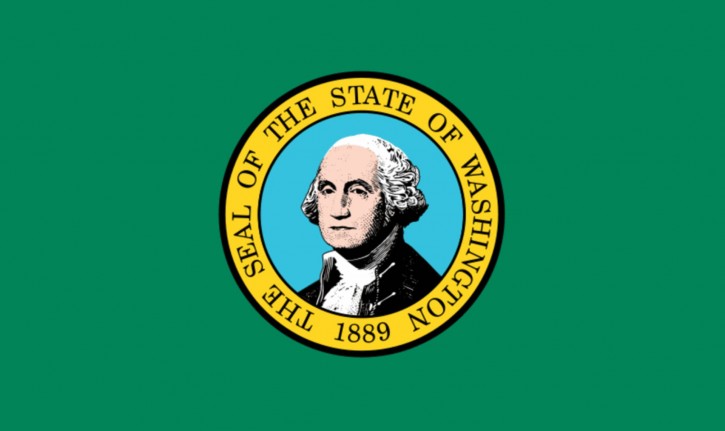
State Flag
Great Seal
Nickname
The Evergreen State
Motto
Alki (Chinook Jargon: "By and By" or "Eventually")

Bird
Willow Goldfinch

Flower
Coast Rhododendron
Tree
Western Hemlock
Mammal (Marine)
Orca (Killer Whale)
Mammal (Endemic)
Olympic Marmot
Fish
Steelhead Trout
Fruit
Apple
Vegetable
Walla Walla Sweet Onion
Gem
Petrified Wood
Song
"Washington, My Home"