
 English
 Español
 中文
中文 हिन्दी
 Français
On this page
Overview
Wisconsin is a state in the Upper Midwest region of the United States, bordered by Michigan to the northeast across Lake Michigan and the Menominee River, Lake Superior and Lake Michigan to the north and east, Illinois to the south, Iowa to the southwest across the Mississippi River, and Minnesota to the west. With roughly 5.9 million residents across 65,498 square miles, it is the 20th-most populous U.S. state and the 25th largest by area. Wisconsin is one of only six U.S. states bordering two Great Lakes (the others being Indiana, Michigan, Minnesota, New York, and Ohio).
Wisconsin entered the Union as the 30th state on May 29, 1848. Madison, in the south-central part of the state on an isthmus between Lake Mendota and Lake Monona, is the state capital and home of the University of Wisconsin's flagship campus. Milwaukee, on Lake Michigan at the mouth of the Milwaukee River, is the largest city and the economic and cultural center of southeastern Wisconsin. The state takes its name from the Wisconsin River, whose name comes ultimately from the Miami Algonquian word "meskonsing" (meaning roughly "where it lies red") describing the river's reddish sandstone valley.
Wisconsin is internationally famous as "America's Dairyland" — the leading U.S. producer of cheese and a top producer of milk and butter — and for the deep beer-brewing heritage of Milwaukee ("Brew City," with Miller and the historic Pabst, Schlitz, and Blatz breweries). The state is also famous for the Green Bay Packers (the only U.S. major-pro sports team owned by its fans, with a unique non-profit community-ownership structure), for the Harley-Davidson Motor Company headquarters in Milwaukee, for the progressive political tradition of Robert "Fighting Bob" La Follette and the Wisconsin Idea (the early-20th-century reforms that originated the U.S. progressive movement), and for the dramatic glacial landscape of forested lakes country in the north and rolling Driftless Area in the southwest.
Geography & Climate
Wisconsin's geography is defined by glaciation and the Great Lakes. Four of the five major Pleistocene glaciations covered most of the state; the most recent (the Wisconsin Glaciation, named for the state) ended about 11,000 years ago and shaped much of the modern landscape — drumlins, kettle lakes, moraines, kames, and the wide flat outwash plains that make up Central Wisconsin. The Driftless Area in the southwest corner — uniquely unglaciated within an otherwise glaciated region — preserves a rugged landscape of deep river valleys, sandstone bluffs, and prairie remnants.
The state has two major Great Lakes coastlines: Lake Superior in the far north (the rugged Apostle Islands National Lakeshore, with 21 islands and 12 miles of mainland coast) and Lake Michigan along the entire east (the Door Peninsula projecting into the lake is one of the most-visited tourism areas in the Midwest). Wisconsin contains roughly 15,000 lakes (Lake Winnebago is the largest entirely within the state) and 84,000 miles of rivers and streams. The Wisconsin River, the longest river entirely in the state, flows from the Northern Highlands south through the Wisconsin Dells (where the river has cut spectacular sandstone gorges) to its confluence with the Mississippi at Prairie du Chien.
The Mississippi River forms the entire western border with Iowa and Minnesota — a corridor of bluffs, river towns, and migratory bird flyways. Door County's 300-mile coastline includes some of the most distinctive lakeshore landscapes in the Midwest. The climate is humid continental with cold, snowy winters and warm, humid summers — though significantly modified by lake-effect snow off Lake Michigan and Lake Superior (Madeline Island in Lake Superior can receive 200 inches of lake-effect snow a year). Notable natural attractions include Devil's Lake State Park (the most-visited Wisconsin state park), the Ice Age National Scenic Trail (1,200 miles tracing the edge of the last glaciation), and the Apostle Islands National Lakeshore.
History
For thousands of years before European contact, present-day Wisconsin was home to the Ho-Chunk (Winnebago), Menominee, Potawatomi, Ojibwe (Chippewa), and Sauk and Fox (Meskwaki) peoples. The Effigy Mounds tradition of southern Wisconsin (700-1200 CE) created thousands of low burial and ceremonial earthworks shaped like birds, bears, panthers, and other animals — among the most distinctive Native American mounds in North America. Several of these mound groups, particularly Lizard Mound County Park and the High Cliff State Park complex, are preserved today.
French explorer Jean Nicolet reached Green Bay in 1634 — the first European to enter present-day Wisconsin — searching for a passage to China (he came ashore dressed in Chinese silk to greet what he expected to be Asian peoples). French fur traders developed an extensive trade network with the Indigenous nations across the region. France ceded the territory to Britain after the French and Indian War (1763), and Britain in turn ceded it to the United States after the Revolutionary War (1783). The Northwest Ordinance of 1787 organized the territory as part of the Northwest Territory; subsequent reorganizations split Wisconsin into the Indiana, Illinois, and Michigan territories before the Wisconsin Territory was organized in 1836.
Wisconsin entered the Union as the 30th state on May 29, 1848. The 1840s and 1850s brought massive German, Norwegian, Polish, and other northern European immigration — by 1890, Wisconsin had a higher percentage of foreign-born residents than any other Midwestern state, and German-Wisconsin culture became central to the state identity. Milwaukee's German breweries — Miller, Pabst, Schlitz, Blatz — made the city the U.S. beer capital. The southwest "Lead Region" around Mineral Point briefly became one of the largest U.S. lead-mining districts in the 1820s-1840s (the "Badgers" nickname is said to derive from the early miners' habit of burrowing into hillsides for shelter).
Wisconsin in the late 1800s and early 1900s pioneered the Progressive movement under Governor and U.S. Senator Robert "Fighting Bob" La Follette Sr. — direct primaries, women's suffrage, workers' compensation, the Wisconsin Idea (the principle that the boundaries of the University of Wisconsin should be the boundaries of the state). The dairy industry expanded explosively after the late-19th-century introduction of the Babcock butterfat test by UW-Madison chemist Stephen Babcock. The 1939 Wisconsin Compromise on labor law in Sheboygan and the 1950s and 1960s growth of unionism shaped the state's strong labor traditions. More recently, Wisconsin has been one of the closest swing states in U.S. presidential elections — decided by less than 1 percent in 2016, 2020, and 2024.
Economy
Wisconsin hosts a large diversified economy anchored by dairy and food processing, manufacturing (paper, machinery, motorcycles, controls), agriculture, tourism, healthcare, financial services, and a major insurance industry concentrated in Milwaukee and Madison.
- Dairy and food: Wisconsin is "America's Dairyland" — the largest U.S. cheese producer (roughly a quarter of all U.S. cheese is made in Wisconsin), the second-largest U.S. milk producer after California, and a leading producer of butter, cranberries (the world's largest cranberry producer, with the Wisconsin Cranberry Growers Association supplying roughly 60 percent of all U.S. cranberries), ginseng (Marathon County around Wausau produces roughly 90 percent of U.S. cultivated ginseng), and corn for silage. Major Wisconsin food companies include Kraft Heinz (Madison), Schreiber Foods, Sargento Foods (Plymouth), Hormel Foods Jennie-O Turkey, Klement's Sausage, and Johnsonville Sausage. The Wisconsin Cheese curd is a state staple, and "supper clubs" remain a unique state institution.
- Manufacturing: Wisconsin is one of the most manufacturing-intensive U.S. states. Major employers include Harley-Davidson Motor Company (Milwaukee headquarters and Menomonee Falls engine plant), Mercury Marine (Fond du Lac — outboard marine engines), Briggs & Stratton (Wauwatosa — small engines), Oshkosh Corporation (Oshkosh — military and specialty vehicles including the JLTV), Kohler Company (Kohler — plumbing, generators), Snap-on (Kenosha — tools), Trek Bicycle (Waterloo), Generac (Waukesha — generators), Mercury Marine (Fond du Lac), Plexus, and Modine Manufacturing. Paper manufacturing — once the dominant Wisconsin industry — remains substantial along the Fox River corridor (Appleton, Green Bay, Neenah).
- Agriculture: Beyond dairy, Wisconsin is a top U.S. producer of corn, soybeans, hay, potatoes (the central sand counties), oats, cranberries, ginseng, snap beans, cherries (Door County), and Christmas trees. Sturgeon Bay shipbuilding on Lake Michigan and a vast network of small-and-medium dairies (still more than 6,000 farms) define the agricultural landscape. The Wisconsin Department of Agriculture, Trade and Consumer Protection oversees one of the most sophisticated U.S. state agricultural extension systems through the University of Wisconsin.
- Insurance and finance: Milwaukee and Madison host a remarkable concentration of insurance and financial-services companies, including Northwestern Mutual (Milwaukee — one of the largest mutual life insurers in the United States), Sentry Insurance (Stevens Point), American Family Insurance (Madison), Wisconsin Physicians Service (WPS), Society Insurance, and CUNA Mutual (Madison — major credit-union insurer). Several Fortune 500 headquarters are in the state: Johnson Controls (Glendale — building technologies), Kohl's (Menomonee Falls — department stores), Fiserv (Brookfield — fintech), Manpower (Milwaukee), and others.
- Tourism: Wisconsin tourism generates roughly $13 billion in annual visitor spending. The Wisconsin Dells calls itself the "Waterpark Capital of the World" with dozens of indoor and outdoor waterparks. Door County (the "Cape Cod of the Midwest") attracts millions of summer visitors. Lake Geneva is a historic resort area for Chicagoans. The Apostle Islands, the Northwoods (Hayward, Minocqua, Eagle River), the EAA AirVenture in Oshkosh (the largest annual aviation event in the world), Summerfest in Milwaukee (one of the largest music festivals in the world), and the Green Bay Packers home games at Lambeau Field are major draws.
Government
Wisconsin operates under its 1848 constitution, one of the oldest still in use among U.S. states. The Wisconsin State Legislature is bicameral, with a 33-member Senate (four-year terms) and a 99-member State Assembly (two-year terms). The Legislature meets in regular session beginning in January of odd-numbered years and operates on a biennial budget. There are no legislative term limits. Wisconsin pioneered the open primary in 1903 — the U.S. state where any registered voter may vote in any party primary without declaring party affiliation.
The Governor of Wisconsin serves a four-year term with no limit on the number of terms. The state separately elects a Lieutenant Governor (jointly with the Governor since 1968), Attorney General, Secretary of State, State Treasurer, and Superintendent of Public Instruction. The Wisconsin governor has one of the strongest partial-veto powers in the United States — the ability to delete individual words and characters from appropriations bills (the "Frankenstein veto"), although this power has been somewhat limited by constitutional amendments since 1990.
Wisconsin has eight seats in the U.S. House of Representatives plus two U.S. Senators. The Wisconsin Supreme Court has seven justices elected to ten-year terms in officially nonpartisan elections — though in practice the court is sharply divided ideologically and supreme-court elections (most recently in April 2024) are among the most expensive U.S. state judicial races. The state capital is Madison. Wisconsin has voted Democratic for president in every election from 1988 through 2024 except 2016 (Trump) — but consistently by very narrow margins, making it one of the closest swing states in U.S. politics.
Culture
Wisconsin culture is shaped by Northern European immigration (German, Norwegian, Polish, Finnish, Swiss), by deep agricultural and small-farm traditions, by lake and outdoor recreation, by Catholic and Lutheran religious heritage, by progressive labor and political traditions, and by an unusually strong sense of state identity centered on dairy, beer, sausage, the Packers, polka, and the supper club. The state has more bowling alleys per capita than any other and more bars per capita than any other; Wisconsin and German-American Wisconsin "Gemütlichkeit" together produce a distinctive friendly, beer-and-brat folk culture.
Major cultural institutions include the Milwaukee Art Museum (the Quadracci Pavilion designed by Santiago Calatrava is internationally famous), the Pabst Mansion, the Harley-Davidson Museum, the Discovery World science museum (Milwaukee), the Wisconsin State Capitol (with the largest granite dome of any U.S. state capitol), Olbrich Botanical Gardens (Madison), the Frank Lloyd Wright-designed Monona Terrace (Madison), Taliesin in Spring Green (Wright's personal home and studio, a UNESCO World Heritage Site), the Circus World Museum (Baraboo — historic home of the Ringling Brothers Circus), and the Wisconsin Maritime Museum (Manitowoc).
Wisconsin sports culture revolves around the Green Bay Packers — the only NFL franchise owned by its fans (a unique non-profit community-ownership structure protected by NFL bylaws), one of the most successful franchises in NFL history (13 NFL championships including 4 Super Bowls), with home games at storied Lambeau Field. The Milwaukee Bucks (NBA, 2021 NBA champions), Milwaukee Brewers (MLB), and university athletics centered on the Wisconsin Badgers (Big Ten, particularly football at Camp Randall Stadium and men's hockey at the Kohl Center) complete the major franchises. Notable Wisconsinites include actors Spencer Tracy (Milwaukee), Orson Welles (Kenosha), Gene Wilder (Milwaukee), Mark Ruffalo (Kenosha), and Frank Lloyd Wright (Richland Center); musicians Liberace and Les Paul (both from Waukesha); and the Ringling Brothers circus founders. Senator Joseph McCarthy of Appleton remains a controversial Wisconsin figure of the 20th century.
Notable Cities
- Milwaukee — Largest city in Wisconsin, on Lake Michigan at the mouth of the Milwaukee, Menomonee, and Kinnickinnic rivers, with a city population of roughly 565,000 and a metropolitan area of about 1.55 million. The economic and cultural center of southeastern Wisconsin. Home of the Milwaukee Brewers (American Family Field), the Milwaukee Bucks (Fiserv Forum), Harley-Davidson Motor Company headquarters, Northwestern Mutual headquarters, Miller Brewing Company, the Milwaukee Art Museum (Quadracci Pavilion), the Pabst Mansion, the Harley-Davidson Museum, Marquette University, the University of Wisconsin-Milwaukee, and Summerfest (one of the largest music festivals in the world).
- Madison — State capital and second-largest city, on an isthmus between Lake Mendota and Lake Monona in south-central Wisconsin, with a city population of roughly 280,000 and a metropolitan area of about 685,000. The political, educational, and intellectual center of the state. Home of the Wisconsin State Capitol (the only U.S. state capitol on an isthmus, with the largest granite dome of any state capitol), the University of Wisconsin-Madison (the flagship public research university with over 50,000 students), the Camp Randall Stadium and Kohl Center, Epic Systems (in nearby Verona — major healthcare-software company), American Family Insurance, Madison Public Market, Olbrich Botanical Gardens, and the Monona Terrace community center (designed by Frank Lloyd Wright).
- Green Bay — Third-largest city in Wisconsin, at the mouth of the Fox River on Green Bay (an arm of Lake Michigan) in northeastern Wisconsin, with a city population of roughly 105,000 and a metropolitan area of about 325,000. Home of the Green Bay Packers (Lambeau Field — the oldest continuously operating NFL stadium and one of the most legendary venues in U.S. sports), the Packers Hall of Fame and the Titletown District, the Heritage Hill State Historical Park, the National Railroad Museum, Bay Beach Amusement Park (a free-admission park), and the headquarters of Schreiber Foods, Georgia-Pacific paper, and Procter & Gamble Charmin tissue.
- Kenosha — Fourth-largest city in Wisconsin, on Lake Michigan in the far southeastern part of the state, with a city population of roughly 100,000 — part of the Chicago metropolitan area. Historic manufacturing center (American Motors Corporation, now Stellantis) that has evolved into a logistics and Chicago-area suburb hub. Home of the University of Wisconsin-Parkside, the Kenosha Public Museum, the Civil War Museum, and the historic Kemper Center on the Lake Michigan shore. Mark Ruffalo and Orson Welles were both born here.
- Racine — Fifth-largest city in Wisconsin, on Lake Michigan about 30 miles south of Milwaukee, with a city population of roughly 76,000. Home of S. C. Johnson & Son (the consumer goods company famous for Glade, Pledge, Raid, Windex, and Ziploc — the company's "Frank Lloyd Wright Headquarters" Administration Building and Research Tower in Racine are a National Historic Landmark), the historic Wind Point Lighthouse, and the strong Danish-American heritage that gives Racine its kringle (a sweet pastry that is the official state pastry of Wisconsin).
State Symbols
Wisconsin's official state symbols, designated by the Wisconsin State Legislature, celebrate the dairy and agricultural heritage, the Great Lakes setting, the Northern European immigrant culture, and the natural identity of the Badger State and America's Dairyland.
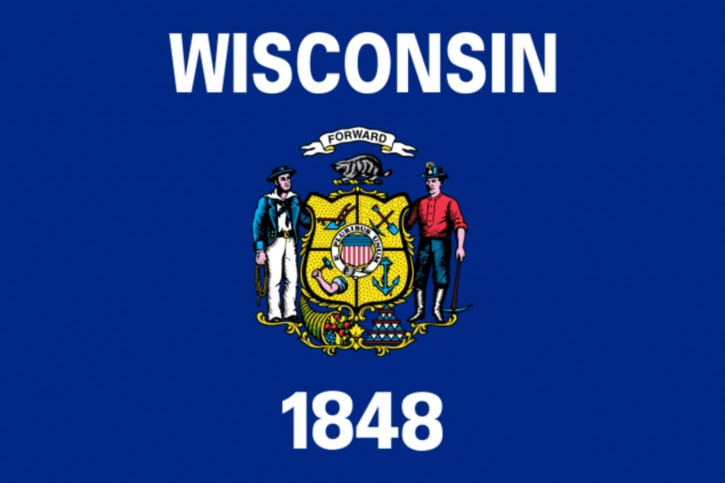
State Flag
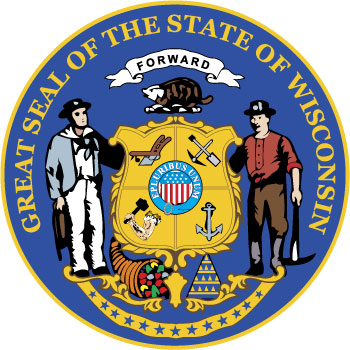
Great Seal
Nickname
The Badger State / America's Dairyland
Motto
Forward
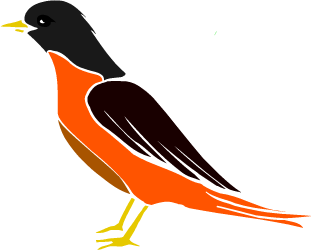
Bird
American Robin

Flower
Wood Violet
Tree
Sugar Maple
Animal (Wildlife)
Badger
Animal (Domestic)
Dairy Cow
Fish
Muskellunge (Musky)
Beverage
Milk
Dance
Polka
Pastry
Kringle
Song
"On, Wisconsin!"