
 English
 Español
 中文
中文 हिन्दी
 Français
On this page
Overview
Wyoming is a state in the Mountain West region of the western United States, bordered by Montana to the north, South Dakota and Nebraska to the east, Colorado to the south, Utah to the southwest, and Idaho to the west. With roughly 585,000 residents across 97,914 square miles, it is the least-populous U.S. state and the 10th largest by area. Wyoming's population density of about 6 people per square mile is the second-lowest of any U.S. state (after Alaska). Wyoming is one of only three U.S. states (with Colorado and Utah) bounded entirely by straight lines of latitude and longitude.
Wyoming entered the Union as the 44th state on July 10, 1890. Cheyenne, in the southeastern corner of the state, is the state capital and the largest city. The state's name comes from the Munsee Delaware word "xwé:wamənk" or the Lenape word "Maughwauwama," meaning "at the big river flat." Wyoming Territory was the first government in U.S. history to grant women the right to vote (December 10, 1869), to seat women on juries, and to allow women to hold elected office — earning the state its motto "Equal Rights" and the nickname "The Equality State." Wyoming was also the first state to elect a female governor (Nellie Tayloe Ross, 1925).
Wyoming is world-famous as the location of Yellowstone National Park (the world's first national park, established 1872, with the largest concentration of geysers on Earth including Old Faithful, plus the Grand Prismatic Spring and Mammoth Hot Springs) and Grand Teton National Park (the dramatic Teton Range and Jackson Hole valley). The state is also famous for Devils Tower National Monument (the first U.S. national monument, designated 1906), for the Yellowstone supervolcano caldera underlying much of the park, for the Powder River Basin coal-mining region (the largest source of U.S. coal), for the Cheyenne Frontier Days rodeo ("The Daddy of 'em All," running since 1897), and for an authentic cowboy and ranching heritage that continues today.
Geography & Climate
Wyoming is the most rural of the contiguous 48 U.S. states and is dominated by the Rocky Mountains in the west and the Great Plains in the east. The Rocky Mountains include several distinct ranges: the Tetons (a small but dramatic range with Grand Teton at 13,775 feet), the Wind River Range (with Gannett Peak at 13,809 feet — the highest point in Wyoming), the Absaroka Range (in Yellowstone), the Bighorn Mountains (in north-central Wyoming), the Wyoming Range, the Salt River Range, the Snake River Range, and the Sierra Madre. The Great Divide Basin in south-central Wyoming is a unique landlocked basin where water flows neither to the Atlantic nor the Pacific.
Yellowstone National Park, in the northwest corner of the state, sits atop the Yellowstone Caldera — one of the largest volcanic systems on Earth (a "supervolcano"). The park contains roughly half of the world's geysers (more than 500), the most famous being Old Faithful, plus the Grand Prismatic Spring (the largest hot spring in the United States, with brilliant rainbow microbial mats), the Grand Canyon of the Yellowstone, Mammoth Hot Springs, and Yellowstone Lake. Wildlife includes the largest U.S. herds of bison, plus grizzly bears, wolves (reintroduced 1995), elk, moose, pronghorn antelope, bighorn sheep, and dozens of other species.
The North Platte River flows through southern Wyoming, the Yellowstone River begins in Yellowstone National Park and flows north into Montana, and the Snake River begins in Yellowstone and flows southwest through Grand Teton National Park and the Jackson Hole valley before continuing into Idaho. The Continental Divide runs north-south through western Wyoming, with rivers east of the divide flowing to the Gulf of Mexico (via the Mississippi system) and rivers west of the divide flowing to the Pacific (via the Snake-Columbia system). The climate is semi-arid steppe across most of the state, with cold, dry winters; cool, dry summers; and dramatic temperature variation between day and night. The high elevations make summer afternoons cool even when valleys are hot.
History
For thousands of years before European contact, present-day Wyoming was hunted by and seasonally inhabited by Indigenous peoples including the Crow (Apsáalooke) in the Bighorn country, the Shoshone in the southwest and the Wind River, the Northern Arapaho and Northern Cheyenne sharing the central plains, the Eastern Shoshone, and various Plains nations who hunted bison across the open grasslands. The Wind River Reservation in central Wyoming, established 1868 and shared between the Eastern Shoshone and the Northern Arapaho, is the largest U.S. Indian reservation in Wyoming and one of the largest in the country.
European exploration began with French and British fur trappers in the late 1700s and early 1800s. John Colter, a member of the Lewis and Clark Expedition who left the expedition to trap independently, was the first known person of European descent to see what would become Yellowstone National Park (c. 1807-1808); his reports of "Colter's Hell" (steaming geothermal features) were widely disbelieved. The Oregon Trail, the California Trail, the Mormon Trail, and the Pony Express all crossed Wyoming through South Pass — the broad, gentle gap through the Continental Divide that made the overland trails to the Pacific feasible. Fort Laramie in eastern Wyoming was a critical waypoint and the site of the 1851 and 1868 Treaties of Fort Laramie with the Sioux Nations.
Wyoming Territory was organized on July 25, 1868. The Wyoming Territorial Legislature passed a law on December 10, 1869, granting women the unrestricted right to vote, sit on juries, and hold public office — the first such law in the United States and one of the first in the world. The motivation was partly principled (advocacy by leading female citizens including Esther Hobart Morris, who became the world's first female justice of the peace) and partly practical (encouraging female settlement in a heavily male territory). When Wyoming applied for statehood, Congress threatened to refuse admission unless the suffrage clause was repealed; the Wyoming legislature replied "We will remain out of the Union 100 years rather than come in without the women." Wyoming was admitted as the 44th state on July 10, 1890, becoming the first state to permanently grant women full voting rights.
Yellowstone became the world's first national park on March 1, 1872, when President Ulysses S. Grant signed the Yellowstone National Park Protection Act. The 1892 Johnson County War — a violent conflict between large absentee cattle ranchers and small homesteaders in Johnson County — became one of the foundational events of U.S. Western mythology and the basis for novels (Owen Wister's "The Virginian," 1902), films, and innumerable popular-culture treatments. The 1925 election of Nellie Tayloe Ross as governor made Wyoming the first U.S. state to elect a female governor. Wyoming's 20th-century economy was driven by ranching, oil and gas (Salt Creek and other fields), and after 1970 by coal (the Powder River Basin became the largest U.S. coal-producing region by the 1990s).
Economy
Wyoming hosts a small but distinctive economy anchored by mining (the largest U.S. coal-producing state and a major producer of natural gas, oil, trona/soda ash, and uranium), tourism (Yellowstone, Grand Teton, Jackson Hole), agriculture and ranching, and a financial-services sector built on the state's zero income tax.
- Mining: Wyoming is by far the largest U.S. coal-producing state — the Powder River Basin in northeastern Wyoming produces roughly 40 percent of all U.S. coal, with massive open-pit surface mines (the Black Thunder Mine and the North Antelope Rochelle Mine are among the largest U.S. coal mines). Wyoming is also one of the largest U.S. producers of natural gas (the Jonah and Pinedale fields), crude oil, trona (soda ash — the world's largest known trona deposits are in southwestern Wyoming's Green River Basin, producing roughly 90 percent of U.S. soda ash for glass, detergent, and chemical use), uranium, and helium.
- Tourism: Wyoming tourism is anchored by Yellowstone National Park (more than 4 million visitors a year), Grand Teton National Park (more than 3 million), Devils Tower National Monument, the Bighorn Mountains, the Wind River Range, and the resort town of Jackson (and adjacent Jackson Hole — one of the wealthiest U.S. ZIP codes by per-capita income and a major luxury-resort and second-home market). The Cheyenne Frontier Days rodeo and Western festival in late July is "The Daddy of 'em All" — the largest outdoor rodeo in the United States, drawing more than 200,000 visitors. The Buffalo Bill Center of the West in Cody is one of the leading U.S. Western art and history museums.
- Agriculture and ranching: Wyoming has more cattle than people (more than 1.2 million cattle versus about 585,000 people). The state ranks high in the production of beef cattle, hay (alfalfa hay is the leading crop), sugar beets, sheep and lamb (Wyoming is consistently one of the top U.S. sheep-producing states), wool, and barley for the brewing industry. Ranching remains a defining state cultural and economic activity, particularly in northern and western Wyoming.
- Finance and corporate domiciles: Wyoming has no state personal income tax, no state corporate income tax, and very business-friendly corporation laws (Wyoming was the first U.S. state to authorize the limited-liability company in 1977). The state has become a leading domicile for U.S. trust companies, family offices, and increasingly for blockchain and cryptocurrency businesses (Wyoming was the first U.S. state to create a special-purpose depository institution charter for digital-asset banks and to recognize DAOs — decentralized autonomous organizations — as a corporate form, in 2021). Despite its small population, Wyoming registers a disproportionate share of U.S. LLC formations.
- Manufacturing and federal: Wyoming has limited large-scale manufacturing — a Sinclair Oil refinery in Sinclair, a Frontier Oil refinery in Cheyenne, and bentonite and trona processing facilities. F. E. Warren Air Force Base in Cheyenne is the headquarters of the 90th Missile Wing, which operates roughly 150 LGM-30G Minuteman III intercontinental ballistic missiles silos across the high plains of southeastern Wyoming, western Nebraska, and northern Colorado. The University of Wyoming (Laramie) is the only four-year university in the state and one of the largest employers.
Government
Wyoming operates under its 1889 constitution, adopted at statehood. The Wyoming Legislature is bicameral, with a 30-member Senate (four-year terms) and a 62-member House of Representatives (two-year terms). The Legislature meets in regular session only for 20 legislative days in even-numbered years (a budget session) and 40 days in odd-numbered years (a general session) — making it one of the most clearly part-time U.S. state legislatures. There are no legislative term limits.
The Governor of Wyoming serves a four-year term and is limited to two consecutive terms (and three terms total, lifetime). The state separately elects a Secretary of State, State Auditor, State Treasurer, and Superintendent of Public Instruction. Wyoming has no Lieutenant Governor — if the Governor dies, resigns, or is removed, the Secretary of State succeeds (a unique feature among U.S. states, though some others use a similar successor arrangement).
Wyoming has one seat in the U.S. House of Representatives plus two U.S. Senators (the smallest possible federal delegation, with three electoral votes). The Wyoming Supreme Court has five justices appointed by the governor (from a list provided by a judicial nominating commission) and retained by uncontested election to eight-year terms. The state capital is Cheyenne. Wyoming has voted Republican for president in every election since 1968 except 1964 (Lyndon Johnson) — the most consistently Republican U.S. state by vote share in recent decades. Wyoming has no state income tax and no state corporate income tax, funding government largely through severance taxes on minerals (coal, oil, gas, trona) plus property taxes.
Culture
Wyoming culture is built on the cowboy, the rancher, the homesteader, the bison and elk, the high lonesome plains and the Rocky Mountains, and on a long tradition of Western individualism, female political pioneering, and quiet self-reliance. The state's nickname "The Equality State" and motto "Equal Rights" both reflect the territory's 1869 enfranchisement of women and the state's subsequent firsts (first female state legislator, first female justice of the peace, first female governor). At the same time, "The Cowboy State" — visible in the bucking-horse-and-rider silhouette that appears on the state license plate, the state quarter, and countless local signs — captures the equally strong ranching identity.
Yellowstone and Grand Teton national parks are central to both the state's economy and its cultural identity. Yellowstone is the world's first national park (1872) and the prototype for the national-park idea globally; Grand Teton is the dramatic alpine companion park immediately to the south. The town of Jackson, at the southern entrance to Grand Teton, has grown from a small ranching town into one of the most internationally famous mountain resort towns, attracting movie stars, billionaires, and serious outdoor athletes. The annual Cheyenne Frontier Days rodeo every late July is the largest outdoor rodeo in the United States and one of the largest in the world, drawing more than 200,000 visitors.
Wyoming has no major-league professional sports franchises; the University of Wyoming Cowboys and Cowgirls (Laramie, Mountain West Conference, with the iconic "War Memorial Stadium" and the "Brown and Gold" colors) anchor state athletic identity. Notable Wyomingites include Esther Hobart Morris (the world's first female justice of the peace, 1870, South Pass City); Nellie Tayloe Ross (first U.S. female governor, 1925; first female director of the U.S. Mint, 1933-1953); Buffalo Bill Cody (William F. Cody, founder of Cody, the show "Buffalo Bill's Wild West"); Owen Wister (author of "The Virginian," 1902); Dick Cheney (former U.S. Vice President, represented Wyoming in the U.S. House for a decade); Liz Cheney (his daughter, former Wyoming U.S. Representative); the painter Jackson Pollock (born in Cody); and the actor Harrison Ford (long resident in Jackson Hole).
Notable Cities
- Cheyenne — State capital and largest city, in the southeastern corner of Wyoming on Crow Creek near the Colorado and Nebraska borders, with a city population of roughly 65,000 and a metropolitan area of about 100,000. The political, economic, and cultural center of southeastern Wyoming. Home of the Wyoming State Capitol (the historic 1888 building, freshly restored), Cheyenne Frontier Days (the largest outdoor rodeo in the United States), F. E. Warren Air Force Base (headquarters of the 90th Missile Wing operating roughly 150 Minuteman III ICBMs), the Cheyenne Botanic Gardens, and the Wyoming State Museum.
- Casper — Second-largest city, on the North Platte River in central Wyoming, with a city population of roughly 60,000 and a metropolitan area of about 80,000. The economic anchor of central Wyoming and historically a major oil and gas center. Home of the National Historic Trails Interpretive Center (the principal museum of the Oregon, California, Mormon, and Pony Express trails, all of which crossed Casper), the Tate Geological Museum (with a complete Allosaurus skeleton), Casper Mountain, and the Werner Wildlife Museum.
- Laramie — Third-largest city, on the Laramie River in southeastern Wyoming about 50 miles west of Cheyenne, with a city population of roughly 32,000. Home of the University of Wyoming (the state's only four-year university, with about 12,000 students), War Memorial Stadium, the iconic Arch on Grand Avenue, the Wyoming Territorial Prison (where Butch Cassidy was once incarcerated, now a state park), and the American Heritage Center. The Snowy Range mountains rise dramatically west of the city.
- Gillette — Fourth-largest city, in northeastern Wyoming in the heart of the Powder River Basin coal-mining region, with a city population of roughly 32,000. The "Energy Capital of the Nation" — the regional headquarters for the largest U.S. coal-mining operations (the Black Thunder and North Antelope Rochelle mines just to the south are among the largest U.S. open-pit coal mines), plus major coalbed methane and oil-and-gas operations. Home of the Campbell County Rockpile Museum.
- Rock Springs — Fifth-largest city, in southwestern Wyoming on the Bitter Creek north of Flaming Gorge Reservoir, with a city population of roughly 23,000. The historic center of Wyoming's coal-mining industry (the company town from the 1860s onward) and now the principal town for the trona (soda ash) industry of the Green River Basin. Sweetwater County is the principal U.S. source of trona. The Western Wyoming Community College and the Sweetwater County Historical Museum anchor the town.
State Symbols
Wyoming's official state symbols, designated by the Wyoming Legislature, celebrate the cowboy and ranching heritage, the bison and pronghorn wildlife, the Yellowstone and Grand Teton landscapes, and the women's-suffrage and Western frontier identity of the Equality State.
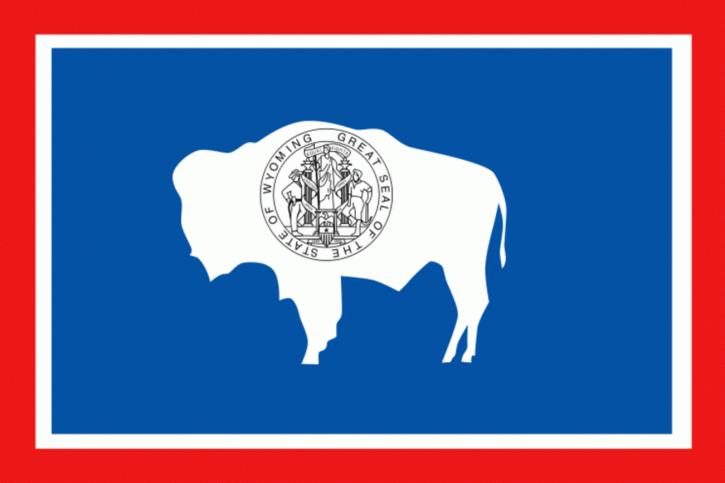
State Flag
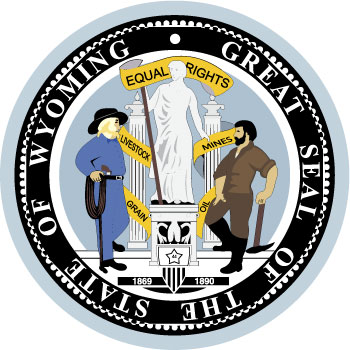
Great Seal
Nickname
The Equality State / The Cowboy State
Motto
Equal Rights

Bird
Western Meadowlark
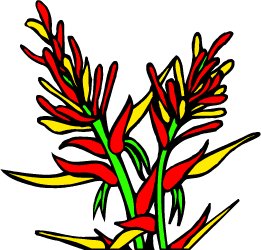
Flower
Indian Paintbrush
Tree
Plains Cottonwood
Mammal
American Bison
Fish
Cutthroat Trout
Reptile
Horned Toad (Greater Short-horned Lizard)
Dinosaur
Triceratops
Gem
Wyoming Jade (Nephrite)
Sport
Rodeo
Song
"Wyoming"