
 English
 Español
 中文
中文 हिन्दी
 Français
On this page
Overview
West Virginia is a state in the Appalachian and Mid-Atlantic regions of the United States, bordered by Pennsylvania to the north, Maryland and Virginia to the east and south, Kentucky to the southwest across the Big Sandy and Tug Fork rivers, and Ohio to the northwest across the Ohio River. With roughly 1.77 million residents across 24,230 square miles, it is the 39th-most populous U.S. state and the 41st largest by area. West Virginia is the only U.S. state entirely within the Appalachian Mountains and is the most mountainous state east of the Mississippi River.
West Virginia entered the Union as the 35th state on June 20, 1863 — during the Civil War, when the western counties of Virginia refused to follow the rest of Virginia into Confederate secession and split off to form a separate Unionist state. It is the only U.S. state created by seceding from another U.S. state during the Civil War. Charleston, on the Kanawha River in the southwestern part of the state, is both the state capital and the largest city. The state takes its name simply from being the western portion of the former Virginia colony.
West Virginia is famous for its mountains and outdoor recreation (the New River Gorge National Park, the Appalachian Trail, the Monongahela National Forest, whitewater rafting on the New, Gauley, and Cheat rivers), for its coal mining industry (historically central to the U.S. industrial economy, though the industry has been in long decline), for the Appalachian musical traditions (bluegrass, old-time fiddle, gospel), for John Denver's 1971 song "Take Me Home, Country Roads" (effectively the unofficial state anthem), and for a complex history including the bitter labor wars of the early 1900s (the 1921 Battle of Blair Mountain was the largest armed labor uprising in U.S. history). The state has long been one of the poorest U.S. states by median household income but is famously rich in natural beauty and tight-knit small-town and family identity.
Geography & Climate
West Virginia is the most mountainous U.S. state east of the Mississippi, with an average elevation of about 1,500 feet — higher than any other state east of the Mississippi. The state is divided into three major regions. The Allegheny Mountains form the eastern third of the state, including Spruce Knob (4,863 feet, the highest point in West Virginia and on the Allegheny Plateau). The Allegheny Plateau covers most of central and western West Virginia — a dissected highland of narrow valleys, steep ridges, and meandering streams. The Eastern Panhandle in the far northeast (an unusual narrow projection between Maryland and Virginia) belongs to the Shenandoah and Potomac valleys and is the most rapidly growing part of the state, oriented toward the Washington, D.C. metropolitan area.
The Ohio River forms the entire 277-mile northwestern border with Ohio. The Big Sandy and Tug Fork rivers form the southwestern border with Kentucky. The New River, which despite its name is one of the oldest rivers in the world, flows north through the state and joins the Gauley to form the Kanawha at Gauley Bridge. The New River Gorge — a deep canyon of the New River in the southern state — was designated New River Gorge National Park in 2020, the newest U.S. national park. The Monongahela River begins at the confluence of the Tygart and West Fork rivers near Fairmont and flows north to join the Allegheny at Pittsburgh to form the Ohio.
The climate is humid continental in the higher elevations and humid subtropical in the lower valleys and Eastern Panhandle. Winters can be severe in the mountains; the central and southern coalfields experience cold winters and warm summers. The state is famous for its dramatic four-season weather, including spectacular spring wildflower displays, vivid autumn foliage (peak color in mid-October), and frequent fog. The Monongahela National Forest covers more than 919,000 acres of the eastern highlands — one of the most extensive eastern U.S. national forests. Cranberry Glades and the Dolly Sods Wilderness preserve unique northern-boreal ecosystems at high Allegheny elevations.
History
For thousands of years before European contact, the rugged Appalachian highlands of present-day West Virginia were a borderland hunted by but not permanently settled by major tribal groups. The Adena culture (1000 BCE-200 CE) and Hopewell culture left earthen mounds, including the impressive Grave Creek Mound in Moundsville (one of the largest conical burial mounds in North America). At the time of European contact, the area was hunted by the Iroquois, Cherokee, Shawnee, and other peoples, but had few permanent villages. European settlers — primarily Scots-Irish, German, and English immigrants pushed inland from Pennsylvania and the Virginia Tidewater — began crossing the Blue Ridge into the Appalachian highlands in the 1730s.
The territory was part of the colony of Virginia from 1607 to 1776, then part of the Commonwealth of Virginia from 1776 to 1863. Tensions between the slaveholding plantation owners of eastern Virginia and the small-farm, free-labor settlers of the western Appalachian counties grew throughout the antebellum era. Western Virginia had few enslaved people, few large plantations, and a population oriented toward the Ohio River economy rather than the tidewater Chesapeake economy. When Virginia voted to secede from the Union on April 17, 1861, delegates from 25 northwestern counties met in Wheeling, declared the Virginia secession illegal, and formed the "Restored Government of Virginia" loyal to the Union.
The Restored Government of Virginia voted in 1862 to detach the western counties as a new state. President Abraham Lincoln signed the West Virginia Statehood Bill on December 31, 1862, and West Virginia was admitted to the Union as the 35th state on June 20, 1863 — the only U.S. state created by seceding from a Confederate state during the Civil War. Wheeling served as the state capital until 1885, when Charleston became permanent capital. Article III of the West Virginia Constitution abolished slavery — making West Virginia the only U.S. state established as a free state during the Civil War.
The late 1800s and early 1900s brought industrial transformation: coal mining boomed across the southern coalfields, glass and pottery manufacturing concentrated along the Ohio River, the chemical industry developed in the Kanawha Valley around Charleston (where DuPont and Union Carbide built major plants), and railroads cut through every mountain valley. The 1920-1921 Coal Wars culminated in the Battle of Blair Mountain (August 1921) — when 10,000 armed coal miners marched against the coal companies in Logan County, the largest armed labor uprising in U.S. history. The U.S. Army was deployed to end the conflict. The 1968 Buffalo Creek Mine collapse killed 125 people. Coal employment has declined dramatically since the 1980s — from over 125,000 miners in 1950 to fewer than 13,000 today — bringing severe economic dislocation but also tourism-led development of the New River Gorge, the Greenbrier Resort, and other Appalachian destinations.
Economy
West Virginia hosts a small economy historically anchored by coal mining and chemical manufacturing, with growing contributions from natural gas (Marcellus Shale), outdoor tourism, healthcare, federal facilities (FBI fingerprint center, NSA Sugar Grove, NRAO Green Bank), and the diversified economy of the Eastern Panhandle near Washington, D.C.
- Coal mining and natural gas: Coal mining has historically defined West Virginia and the state remains one of the top U.S. coal producers, although employment has declined sharply since the 1980s due to mechanization, the rise of cheaper natural gas, and environmental regulations. The state is also one of the largest U.S. producers of natural gas — the Marcellus Shale formation underlies much of the state and has fueled a fracking boom since 2010. The Antero Resources and EQT operations in the northern panhandle are among the largest U.S. natural-gas operators.
- Chemical and manufacturing: The Kanawha Valley around Charleston is the historic "Chemical Valley" of the United States, where DuPont, Dow Chemical (formerly Union Carbide), Bayer CropScience, and other companies built major chemical plants in the early 20th century. The 1984 Bhopal disaster in India focused worldwide attention on the Union Carbide plant in Institute, West Virginia. Manufacturing also includes the Toyota engine plant in Buffalo (one of the largest Toyota engine plants in North America), the Procter & Gamble Tabler Station manufacturing facility in the Eastern Panhandle, and Pratt & Whitney aerospace engine maintenance in the Bridgeport area.
- Tourism and outdoor recreation: New River Gorge National Park (designated 2020) is one of the premier U.S. whitewater rafting destinations, with the New River and the nearby Gauley River drawing tens of thousands of rafters every year. The Greenbrier Resort in White Sulphur Springs is a historic luxury resort that has hosted 27 U.S. presidents and contained a secret Cold War bunker for Congress (declassified 1992). Snowshoe Mountain, Canaan Valley, and Winterplace are major ski resorts. The Appalachian Trail crosses the Eastern Panhandle, and the 78-mile Allegheny Trail traverses the entire state north-south. Harpers Ferry National Historical Park is one of the most-visited Civil War sites in the country.
- Federal installations: The FBI's Criminal Justice Information Services Division in Clarksburg is the largest FBI facility outside of Washington and processes all federal fingerprint records and the National Crime Information Center. The NRAO Green Bank Observatory, in the federally protected National Radio Quiet Zone, operates the world's largest fully steerable radio telescope (the Robert C. Byrd Green Bank Telescope) — an irreplaceable astronomy facility. The Department of Energy's National Energy Technology Laboratory has its principal campus in Morgantown.
- Healthcare, education, and Eastern Panhandle: West Virginia University Health System (headquartered in Morgantown) is the largest healthcare provider in the state. West Virginia University (Morgantown) is the flagship public research university — well known for the Big 12 Mountaineers football and the WVU Health Sciences Center. Marshall University (Huntington) and West Virginia State, Shepherd, Concord, and Fairmont State universities anchor higher education. The Eastern Panhandle — Berkeley, Jefferson, and Morgan counties — has the fastest-growing economy in the state, driven by commuting Washington, D.C.-area workers, the Procter & Gamble facility, IRS operations in Martinsburg, and Coast Guard operations.
Government
West Virginia operates under its 1872 constitution — the second state constitution, adopted to replace the 1863 founding constitution. The West Virginia Legislature is bicameral, with a 34-member Senate (four-year terms) and a 100-member House of Delegates (two-year terms). The Legislature meets in regular session beginning the second Wednesday in January each year for 60 days. There are no legislative term limits.
The Governor of West Virginia serves a four-year term and may serve two consecutive terms (and may run again after one term out of office, but lifetime limit is two terms — the West Virginia constitution was amended in 1970 to allow consecutive gubernatorial terms; previously only one consecutive term was permitted, similar to Virginia). The state separately elects a Lieutenant Governor (the Senate President serves ex officio since 2018), Attorney General, Secretary of State, Treasurer, Auditor, and Commissioner of Agriculture.
West Virginia has two seats in the U.S. House of Representatives (reduced from three after the 2020 Census, reflecting population decline) plus two U.S. Senators. The Supreme Court of Appeals of West Virginia has five justices elected to twelve-year terms in nonpartisan elections (changed to nonpartisan from partisan in 2015). The state capital is Charleston. West Virginia voted Democratic for president in every election from 1932 through 1996 except 1956, 1972, and 1984 — but has voted Republican by large margins in every presidential election since 2000, representing one of the most dramatic partisan realignments of any U.S. state.
Culture
West Virginia culture is built on Appalachian mountain identity, on the legacy of coal mining and labor struggle, on Scots-Irish, German, and English settler heritage, on tight-knit family and small-town networks, and on a long musical tradition. The state's nickname "The Mountain State" and motto "Mountaineers Are Always Free" both reflect the pride in Appalachian highland identity and resistance to outside (including slaveholding Virginia) control. West Virginia has long struggled with poverty and an opioid crisis that has devastated coalfield communities, but the culture is equally famous for its hospitality, its strong family loyalties, and its deep musical traditions.
Appalachian music — old-time fiddle, bluegrass, gospel, mountain ballads — runs deep in West Virginia. The Mountain Stage public-radio program (recorded at the Cultural Center in Charleston since 1983) is one of the longest-running live music broadcasts in the United States. The Vandalia Gathering on Memorial Day weekend in Charleston is the state's premier traditional-music festival. John Denver's 1971 song "Take Me Home, Country Roads" — though not actually about the Eastern Panhandle Blue Ridge as the lyrics suggest — has become the unofficial state anthem and is sung at every West Virginia University football game. The 1987 film and TV series "Matewan" (John Sayles, 1987) dramatized the 1920 mine wars; the 2010 film "Stranger Inside" and the 2018 documentary "King Coal" (2023) continued the cinematic exploration of West Virginia identity.
West Virginia sports culture revolves around the WVU Mountaineers football and men's basketball at Mountaineer Field at Milan Puskar Stadium (capacity ~60,000) in Morgantown — competing in the Big 12 Conference. Marshall University football (the 2006 film "We Are Marshall" tells the story of the 1970 Marshall football plane crash, the worst U.S. sports-related air disaster). West Virginia has no major-league professional sports franchises. Notable West Virginians include Civil War general Stonewall Jackson (born in Clarksburg, fought for the Confederacy after birth state went Union); Mother Jones (the labor organizer); writer Pearl S. Buck (born in Hillsboro, Nobel Prize for Literature 1938); gymnast Mary Lou Retton (born in Fairmont); singer Brad Paisley (born in Glen Dale); golfer Sam Snead; astronaut John Glenn (born in Cambridge, OH but lived in West Virginia briefly); senator Robert C. Byrd (the longest-serving U.S. senator); and actor Don Knotts (born in Morgantown).
Notable Cities
- Charleston — State capital and largest city, at the confluence of the Elk and Kanawha rivers in the southwestern part of the state, with a city population of roughly 47,000 and a metropolitan area of about 250,000. The political, economic, and cultural center of West Virginia. Home of the West Virginia State Capitol (a beautiful 1930s buff-limestone building with a gilded dome), the Cultural Center, the Clay Center for the Arts and Sciences, the University of Charleston, and many chemical and government employers. The Sternwheel Regatta and the Vandalia Gathering are signature Charleston events.
- Huntington — Second-largest city in West Virginia, on the Ohio River in the far southwest at the confluence of the Big Sandy and Ohio rivers, with a city population of roughly 45,000 and a metropolitan area of about 350,000 (extending into Kentucky and Ohio). The historic terminus of the Chesapeake and Ohio Railway, named for railroad magnate Collis P. Huntington, and a major Ohio River port. Home of Marshall University (the Marshall Thundering Herd football team plays at Joan C. Edwards Stadium), the Huntington Mall, and the historic Pullman Square downtown.
- Parkersburg — Third-largest city, on the Ohio River in the western part of the state where the Little Kanawha River joins the Ohio, with a city population of roughly 30,000. A historic Ohio River port and an important glass and chemical manufacturing center. Home of the Blennerhassett Island Historical State Park (an Ohio River island where Aaron Burr planned his 1806 conspiracy with Harman Blennerhassett), the Oil and Gas Museum, and the historic Julia-Ann Square Victorian District.
- Morgantown — Fourth-largest city, on the Monongahela River in the north-central part of the state about 75 miles south of Pittsburgh, with a city population of roughly 30,000 and a metropolitan area of about 140,000. The home of West Virginia University, the state's flagship public university with about 26,000 students. Morgantown is the economic, cultural, and intellectual center of north-central West Virginia, with the WVU Health Sciences Center as one of the largest employers in the state. The famous Personal Rapid Transit (PRT) automated transit system has connected the WVU campuses since 1975.
- Wheeling — Fifth-largest city, in the northern panhandle on the Ohio River about 60 miles southwest of Pittsburgh, with a city population of roughly 27,000. The first capital of West Virginia from 1863 to 1885, and the historic gateway to the West for early American settlers on the National Road. Home of Oglebay Park (an extensive 1,700-acre municipal park with golf, zoo, lights festival, and ski area), the Wheeling Suspension Bridge (built 1849 — the oldest suspension bridge in the United States still in use), the Capitol Theatre, the historic Centre Market, and Wheeling Jesuit University.
State Symbols
West Virginia's official state symbols, designated by the West Virginia Legislature, celebrate the Appalachian mountain ecosystems, the coal-and-glass industrial heritage, the rhododendron forests, and the cultural identity of the Mountain State.
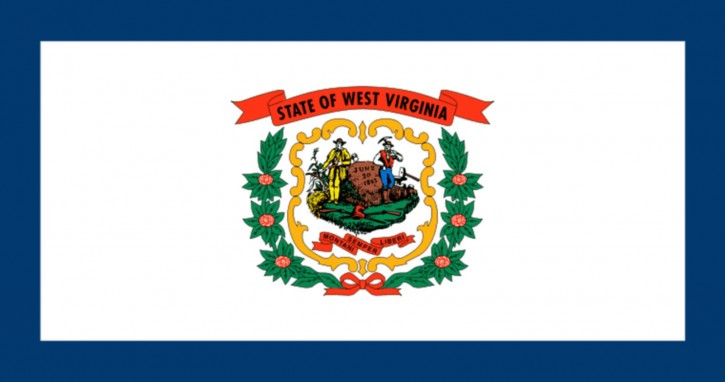
State Flag
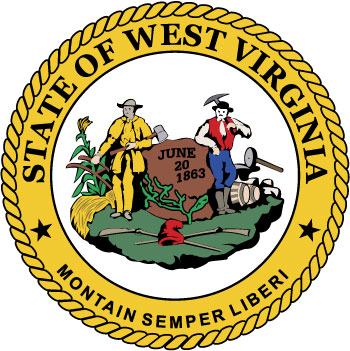
Great Seal
Nickname
The Mountain State
Motto
Montani Semper Liberi (Mountaineers Are Always Free)

Bird
Northern Cardinal

Flower
Rhododendron
Tree
Sugar Maple
Animal
Black Bear
Fish
Brook Trout
Butterfly
Monarch Butterfly
Fruit
Golden Delicious Apple (originated in Clay County, 1905)
Gem
Lithostrotionella (fossil coral)
Rock
Bituminous Coal
Song
Four state songs including "Take Me Home, Country Roads"