
 English
 Español
 中文
中文 हिन्दी
 Français
On this page
Overview
Michigan is a state in the Great Lakes region of the upper Midwestern United States, uniquely composed of two large peninsulas separated by the Straits of Mackinac. The Lower Peninsula, shaped like a mitten, is bordered by Lake Michigan on the west, Lake Huron on the east, Lake Erie on the southeast, and the states of Ohio and Indiana to the south. The Upper Peninsula is bordered by Lake Superior to the north, Lake Michigan to the south, Wisconsin to the southwest, and the Canadian province of Ontario to the east.
With roughly 10.04 million residents across 96,716 square miles, Michigan is the 10th-most populous state and the 11th largest by area. Detroit is the largest city, anchoring a metropolitan area of about 4.4 million on the Detroit River across from Windsor, Ontario. Lansing in the south-central Lower Peninsula is the state capital. Grand Rapids in West Michigan is the second-largest metropolitan area.
Michigan has the longest freshwater coastline of any U.S. state and the second-longest total coastline (after Alaska) once the more than 3,000 miles of Great Lakes shoreline are counted. No point in the state is more than about 85 miles from one of the Great Lakes. Michigan is the global birthplace of the automobile industry, the home of the Motown sound, and a leading producer of cherries, apples, blueberries, dry beans, and milk in the United States.
Geography & Climate
The Lower Peninsula is generally low and rolling, scraped flat by Pleistocene ice sheets and dotted with more than 11,000 inland lakes. The "thumb" on the east bulges into Lake Huron’s Saginaw Bay; the "pinky" forms Leelanau and the Sleeping Bear Dunes National Lakeshore on Lake Michigan in the northwest. The Mackinac Bridge, a five-mile suspension bridge opened in 1957, links the Lower Peninsula to the Upper Peninsula across the Straits of Mackinac.
The Upper Peninsula — locally called "the U.P." and its residents "Yoopers" — is dramatically different in geology, climate, and culture. Mount Arvon in the Huron Mountains is the state’s highest point at 1,979 feet. Pictured Rocks National Lakeshore on Lake Superior preserves multicolored sandstone cliffs; the Porcupine Mountains contain one of the largest remaining stands of old-growth hardwoods east of the Mississippi. The Keweenaw Peninsula juts north into Lake Superior and contains the world’s richest deposits of native (pure-elemental) copper.
Michigan’s climate is humid continental, with cold, snowy winters and warm, humid summers. Lake-effect snow is heavy along the eastern and western shores of Lake Michigan and along Lake Superior in the U.P.; the city of Marquette averages over 140 inches of snow a year. The Great Lakes also moderate summer temperatures and create the long, frost-free growing season that supports Michigan’s major fruit-growing belt in West Michigan.
History
For thousands of years before European contact, Michigan was home to the Anishinaabe (Three Fires) Council — the Ojibwe (Chippewa), Odawa (Ottawa), and Potawatomi peoples — as well as the Wyandot (Huron) and other nations. French Jesuit missionaries and fur-trade explorers reached the region in the early 1600s. Étienne Brûlé likely sighted Lake Superior around 1622; Jean Nicolet reached the Straits of Mackinac in 1634. Jacques Marquette founded Sault Ste. Marie in 1668 — the oldest continuously inhabited European settlement in Michigan — and St. Ignace in 1671.
Antoine de la Mothe Cadillac founded Fort Pontchartrain du Détroit on the Detroit River in 1701. The region passed from France to Britain in 1763 after the French and Indian War, and to the United States after the American Revolution. Michigan was organized as a U.S. territory in 1805. After the brief 1835–1836 "Toledo War" border dispute with Ohio — settled by Congress giving Toledo to Ohio and the Upper Peninsula to Michigan as compensation — Michigan was admitted as the 26th state on January 26, 1837.
The late nineteenth century brought enormous timber, copper, and iron-ore wealth (particularly from the Keweenaw and Marquette ranges of the U.P.) and the rise of the Lower Peninsula as a fruit, dairy, and grain-producing region. In 1903 Henry Ford founded the Ford Motor Company in Detroit; the 1908 Model T and the 1913 moving assembly line revolutionized industry worldwide. Detroit, "the Motor City," became one of the wealthiest U.S. cities of the early twentieth century, anchored by Ford, General Motors (founded in Flint in 1908), and Chrysler (founded in Highland Park in 1925) — the "Big Three" American automakers.
Detroit drew waves of African American migrants from the U.S. South during the Great Migration. In the 1960s Berry Gordy’s Motown Records redefined American popular music with Stevie Wonder, Marvin Gaye, Diana Ross and the Supremes, the Temptations, the Four Tops, and many others. The 1967 Detroit riot and decades of deindustrialization battered the city; the population fell from a 1950 peak of 1.85 million to under 640,000 today. Detroit declared bankruptcy in 2013 — the largest U.S. municipal bankruptcy in history — but has since seen a substantial downtown and Midtown revival.
Economy
Michigan hosts the largest U.S. automotive economy and one of the most diversified Great Lakes manufacturing economies, with major sectors in autos, advanced manufacturing, agriculture, tourism, and a fast-growing technology base.
- Automotive: Michigan is the indisputable U.S. capital of the auto industry. General Motors, Ford, and Stellantis (formerly Chrysler) — the "Detroit Three" — are all headquartered in Metro Detroit. Michigan also hosts major plants and R&D centers of Toyota, Hyundai, Honda, Nissan, and many tier-1 suppliers including Magna, Lear, Aptiv, Visteon, Adient, and Faurecia. The state is the U.S. leader in autonomous-vehicle development through programs at the University of Michigan and the American Center for Mobility.
- Manufacturing: Michigan is one of the most heavily manufacturing-oriented U.S. economies. Beyond autos, the state hosts major operations in defense (the Detroit Arsenal in Warren — home of the U.S. Army TARDEC), furniture (Steelcase, Herman Miller, and Haworth in West Michigan — the world’s "Office Furniture Capital"), pharmaceuticals (Pfizer at Kalamazoo, Stryker at Kalamazoo), and food processing (Kellogg’s at Battle Creek).
- Agriculture: Michigan is the most agriculturally diversified state east of California. It is the nation’s leading producer of tart cherries, dry beans, blueberries, asparagus, and Christmas trees, and a top producer of apples, sweet cherries, sugar beets, grapes, milk, and floriculture. The Fruit Ridge of West Michigan is one of the most productive fruit-growing regions in the United States.
- Tourism and outdoor recreation: The "Pure Michigan" tourism brand draws year-round visitors to the Great Lakes shorelines, Mackinac Island (where automobiles have been banned since 1898), Sleeping Bear Dunes, Pictured Rocks, the Porcupine Mountains, Traverse City’s wine country and cherry orchards, and the Upper Peninsula’s wilderness. Tourism is the state’s second-largest industry.
- Technology and biosciences: Ann Arbor — home of the University of Michigan — has become a major U.S. technology cluster, with operations of Google, Toyota, Hyundai, and Amazon, and a dense layer of robotics, AI, and biotech startups. Detroit’s downtown has seen rapid expansion of fintech and tech firms anchored by Rocket Companies, formerly Quicken Loans.
Government
Michigan operates under its 1963 constitution. The Michigan Legislature is bicameral, with a 38-member Senate (four-year terms) and a 110-member House of Representatives (two-year terms). Legislative term limits adopted by voters in 1992 — originally six years in the House and eight years in the Senate — were modified by a 2022 ballot proposal to a combined 12-year lifetime cap that can be served entirely in either chamber.
The Governor of Michigan serves a four-year term and is limited to two terms. The state also elects a Lieutenant Governor (jointly with the Governor), Attorney General, and Secretary of State. Michigan was the first U.S. state to abolish capital punishment (1846) and one of the last to extend full statehood to two non-contiguous peninsulas — a quirk that has shaped both politics and identity in the state.
Michigan has 13 seats in the U.S. House of Representatives plus two U.S. Senators. The Michigan Supreme Court has seven justices elected to staggered eight-year terms. The state capital is Lansing.
Culture
Michigan culture is divided by an evident north-south split: heavily urbanized, industrially diverse, racially and ethnically rich Metro Detroit and surrounding Lower Peninsula counties; the conservative agricultural mid-state; the West Michigan Dutch Reformed religious and furniture-manufacturing belt around Grand Rapids and Holland; the resort-town Up North culture of the northern Lower Peninsula and around Traverse City; and the rugged, mining-and-forestry-influenced Yooper culture of the Upper Peninsula. Yoopers speak with a distinctive Finnish-influenced accent and eat pasties (Cornish meat hand-pies brought by nineteenth-century miners).
Detroit is one of the great African American cultural cities of the United States, and the home of the Motown sound (Berry Gordy, Stevie Wonder, Marvin Gaye, Aretha Franklin, the Four Tops, the Temptations, Smokey Robinson, the Supremes, the Jackson 5), of techno (Juan Atkins, Derrick May, Kevin Saunderson), and of a long African American literary and artistic tradition. The state is also home to the largest concentration of Arab Americans in the United States, anchored in Dearborn, and to substantial Polish (Hamtramck), Mexican, Bangladeshi, Indian, and Hmong communities.
College football is a defining statewide passion. The University of Michigan Wolverines and Michigan State University Spartans are storied national programs and intense in-state rivals; Michigan Stadium ("The Big House") in Ann Arbor is the largest stadium in the United States and the third-largest in the world by capacity, holding more than 107,000. The Detroit Tigers, Lions, Pistons, and Red Wings are all long-tenured Big Four pro franchises. Michigan beverages — Faygo, Vernors ginger ale, Better Made chips, and Coney Island hot dogs — and West Michigan’s craft-beer scene (Bell’s Brewery, Founders, New Holland) are central regional foods.
Notable Cities
- Detroit — Largest city, on the Detroit River across from Windsor, Ontario, with a city population of roughly 633,000 and a metropolitan area of about 4.4 million. Birthplace of the modern automotive industry, the Motown sound, and Detroit techno. Home of the Detroit Tigers, Lions, Pistons, and Red Wings, the Detroit Institute of Arts, Belle Isle, the historic neighborhoods of Corktown and Greektown, and the headquarters of GM, Stellantis, Rocket Companies, and DTE Energy.
- Grand Rapids — Second-largest city, in West Michigan on the Grand River, with a city population of roughly 200,000 and a metropolitan area of about 1.1 million. A major Dutch Reformed religious and cultural anchor, headquarters of the world office-furniture industry (Steelcase, Herman Miller, Haworth), and the heart of a fast-growing craft-beer and food culture often called "Beer City USA."
- Warren — Third-largest city, in suburban Macomb County north of Detroit, with a population of roughly 140,000. Home of the Detroit Arsenal (the U.S. Army’s lead R&D center for ground vehicles, formerly TARDEC), the GM Technical Center, and the largest African American suburban community in Michigan.
- Sterling Heights — A city of roughly 134,000 in northern Macomb County, immediately north of Warren. A diverse manufacturing and suburban-residential center with the second-largest Iraqi Chaldean population in the world after Iraq itself.
- Ann Arbor — A city of roughly 124,000 about 35 miles west of Detroit, home of the University of Michigan and one of the major U.S. college towns. A major technology, biotech, and education center, host city of the famous Ann Arbor Art Fair, and locally famous for Zingerman’s Delicatessen.
State Symbols
Michigan’s official state symbols, designated by the Michigan Legislature, celebrate the Great Lakes setting, the dramatic landscapes of both peninsulas, and the natural and industrial heritage of the Wolverine State.
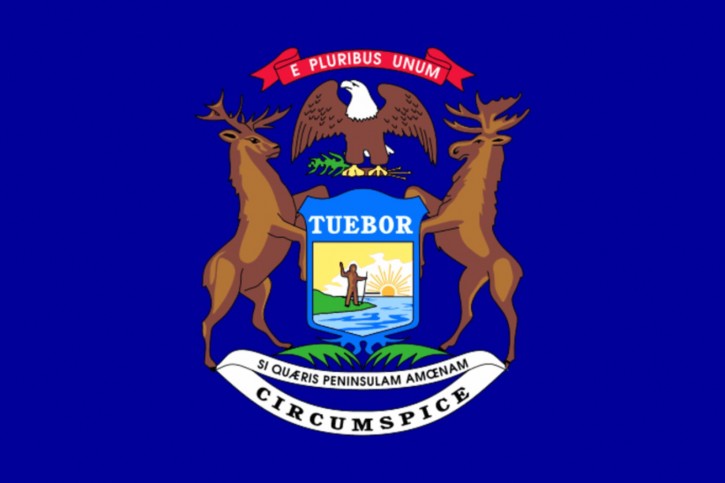
State Flag
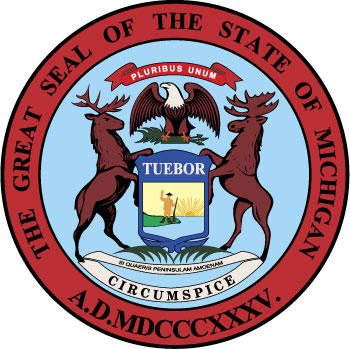
Great Seal
Nickname
The Great Lakes State / The Wolverine State
Motto
Si quaeris peninsulam amoenam circumspice ("If you seek a pleasant peninsula, look about you")
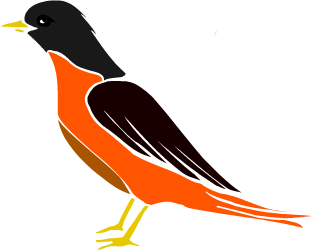
Bird
American Robin
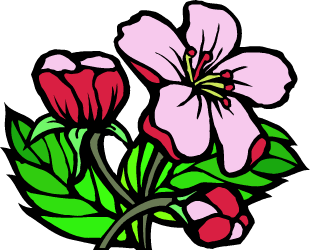
Flower
Apple Blossom
Tree
Eastern White Pine
Wildflower
Dwarf Lake Iris
Game Mammal
White-tailed Deer
Fish
Brook Trout
Reptile
Painted Turtle
Stone
Petoskey Stone (fossilized coral)
Gem
Isle Royale Greenstone (Chlorastrolite)
Song
"My Michigan"