
 English
 Español
 中文
中文 हिन्दी
 Français
On this page
Overview
Louisiana is a state in the Deep South region of the United States, bordered by Arkansas to the north, Mississippi across the Mississippi and Pearl rivers to the east, the Gulf of Mexico to the south, and Texas to the west. With roughly 4.59 million residents across 52,069 square miles, it is the 25th-most populous state and the 31st largest by area. Baton Rouge is the state capital; New Orleans on the Mississippi River delta is the largest city and cultural anchor.
Louisiana is one of the most culturally distinctive states in the United States — and one of the most distinctive subnational entities in North America. French, Spanish, African, West Indian, Native American, Acadian (Cajun), and Anglo-American influences combine to produce a deeply Catholic Francophone-rooted culture in the south and a Protestant Anglo-American culture in the north. Louisiana is the only U.S. state to use parishes instead of counties and the only one whose legal system is based on civil law (rooted in the Napoleonic Code) rather than English common law.
Louisiana entered the Union as the 18th state on April 30, 1812 — just nine years after the United States purchased the Louisiana Territory from France. The state takes its name from King Louis XIV of France, who reigned when the region was first claimed for France in 1682. Louisiana is internationally famous as the birthplace of jazz, as the home of Mardi Gras, as the heart of Cajun and Creole cuisine, and as the largest U.S. center of seafood production, sugarcane farming, and petrochemical manufacturing.
Geography & Climate
Louisiana is mostly a low-lying coastal plain. The southern third of the state is dominated by the Mississippi River Delta, an enormous wetland of bayous, swamps, marshes, and barrier islands built up by the river over thousands of years. The Atchafalaya Basin in south-central Louisiana is the largest contiguous river-swamp system in the United States. Driskill Mountain in north-central Louisiana, at only 535 feet, is the state’s highest natural point — among the lowest highpoints of any state.
Louisiana has roughly 8,000 miles of tidal shoreline once all bayous and bays are counted — more than any state but Alaska and Florida. The Mississippi River, after flowing 2,300 miles from Minnesota, divides into multiple distributaries and finishes at the Gulf of Mexico in extreme southeast Louisiana. The state is uniquely vulnerable to land loss: subsidence, leveed-river sediment starvation, sea-level rise, and recurring hurricanes have caused Louisiana to lose roughly 2,000 square miles of coastal land since the 1930s.
The climate is humid subtropical, with hot, humid summers, mild winters, and abundant rainfall. Louisiana sits squarely in the Atlantic hurricane belt and has been struck by some of the most destructive storms in U.S. history, including the Great Mississippi Flood of 1927, Hurricanes Betsy (1965), Camille (1969), Katrina and Rita (2005), Gustav and Ike (2008), Laura (2020), and Ida (2021). Cypress Island Preserve, Avery Island, Jean Lafitte National Historical Park, and the Atchafalaya National Heritage Area preserve some of the state’s most iconic landscapes.
History
For thousands of years before European contact, Louisiana was home to the Caddo, Choctaw, Chitimacha, Houma, Natchez, Tunica, Atakapa, and other Indigenous peoples. The mound builders of Poverty Point in northeastern Louisiana, around 1700–1100 BCE, were among the earliest large-scale earthwork builders in the Americas. French explorer René-Robert Cavelier, Sieur de La Salle, descended the Mississippi to its mouth in 1682 and claimed the entire river basin for France, naming it "La Louisiane" after King Louis XIV.
The French founded Biloxi (1699), Mobile (1702), Natchitoches (1714 — the oldest permanent European settlement in the Louisiana Purchase territory), and New Orleans (1718). The colony passed to Spain in 1763 after the French defeat in the Seven Years’ War. During the Spanish period (1763–1800), thousands of Acadian refugees expelled from British Nova Scotia found refuge in southern Louisiana — the origin of the modern Cajun community. The colony returned to France in 1800 and was sold to the United States in the Louisiana Purchase of 1803.
Louisiana was admitted as the 18th state on April 30, 1812. General Andrew Jackson defeated a British invasion force at the Battle of New Orleans on January 8, 1815 — fought after the War of 1812 had officially ended but before news of the peace had crossed the Atlantic. The antebellum era was dominated by sugarcane and cotton plantation economies built on enslaved African labor, and New Orleans became one of the largest slave markets in the Americas.
Louisiana seceded in 1861, was captured early in the Civil War (1862), and lived through one of the most violent Reconstruction eras in the South. The twentieth century brought the demagogic governorship of Huey P. Long ("the Kingfish"), the discovery of vast offshore oil and gas, the emergence of jazz from New Orleans, and the rise of a global petrochemical corridor along the Mississippi. Hurricane Katrina’s 2005 strike on New Orleans — and the subsequent failure of federal levees — caused over 1,400 deaths and forced a generation-long rebuilding effort that is still underway.
Economy
Louisiana hosts a heavily resource-based economy anchored by petrochemicals and refining, oil and gas, port logistics, agriculture and seafood, and tourism centered on New Orleans.
- Petrochemicals and refining: The 130-mile stretch of the Mississippi River between Baton Rouge and New Orleans is one of the largest petrochemical and oil-refining corridors in the world, with more than 150 industrial facilities operated by ExxonMobil, Shell, Marathon, Dow, BASF, Air Products, Methanex, Olin, and many others. Louisiana is consistently one of the top three U.S. crude-oil-refining states.
- Oil, gas, and LNG: Louisiana has long been a top U.S. oil and natural-gas producer, particularly from the Gulf of Mexico Outer Continental Shelf and from the onshore Haynesville Shale in the northwest. The Sabine Pass and Calcasieu Pass LNG export terminals in southwest Louisiana are among the largest in the world.
- Ports and logistics: The five Louisiana ports along the lower Mississippi handle more total tonnage than any port complex in the Western Hemisphere. The Port of South Louisiana alone is the largest single port by tonnage in the United States. Louisiana ports anchor U.S. agricultural exports to the world.
- Agriculture and seafood: Louisiana is the leading U.S. producer of crawfish, alligator hides, sweet potatoes, and processed cotton, and a top producer of sugarcane, rice, soybeans, pecans, and corn. The Louisiana seafood industry — oysters, shrimp, blue crab, redfish, and crawfish — supplies roughly one-third of all U.S. domestic seafood by volume.
- Tourism: New Orleans is one of the most visited destinations in the United States, drawing roughly 18 million visitors a year for Mardi Gras, Jazz Fest, the French Quarter, the National WWII Museum, and the city’s cuisine and music. Cajun country in southwest Louisiana and the antebellum plantation country along the River Road support substantial tourism economies of their own.
Government
Louisiana operates under its 1974 constitution, the eleventh in its history. The Louisiana State Legislature is bicameral, with a 39-member Senate and a 105-member House of Representatives, both serving four-year terms with a three-consecutive-term limit. The state is uniquely organized into 64 "parishes" instead of counties, a holdover from its French and Spanish colonial Catholic ecclesiastical organization.
The Governor of Louisiana serves a four-year term and is limited to two consecutive terms. The state also elects a Lieutenant Governor (separately), Attorney General, Secretary of State, Treasurer, Commissioner of Agriculture and Forestry, Commissioner of Insurance, and Superintendent of Education. Louisiana is the only U.S. state to use a civil-law legal system, derived from the Napoleonic Code and earlier French and Spanish colonial law, rather than the English common law followed by all 49 other states.
Louisiana has six seats in the U.S. House of Representatives plus two U.S. Senators. The Supreme Court of Louisiana has seven justices elected to ten-year terms. The state capital is Baton Rouge.
Culture
Louisiana culture is among the most distinctive in the United States — a Catholic, Francophone-influenced South that fused French, Spanish, African, Caribbean, Acadian (Cajun), and Anglo-American traditions over three centuries. New Orleans is internationally famous as the birthplace of jazz: Louis Armstrong, Sidney Bechet, Jelly Roll Morton, the Marsalis family, and many more emerged from the city’s African American, Creole, and brass-band traditions. Cajun and zydeco music continue to thrive in the prairies and bayous west of the Atchafalaya.
Mardi Gras, the carnival season culminating on Fat Tuesday, is celebrated most spectacularly in New Orleans and along the Gulf Coast, but is observed in Cajun country with rural courir de Mardi Gras horseback processions. Louisiana food — gumbo, jambalaya, étouffée, boudin, andouille, beignets, po-boys, muffulettas, blackened redfish, and king cake — is one of the most influential regional cuisines in the United States. Tabasco sauce, made on Avery Island since 1868, is a worldwide export.
Louisiana has produced a deep roster of American cultural figures, from Tennessee Williams and Truman Capote in literature, to Louis Armstrong, Mahalia Jackson, Fats Domino, Allen Toussaint, Dr. John, the Neville Brothers, Lil Wayne, and Beyoncé (Houston-born but raised in part in Louisiana) in music, to Tyler Perry in film. Louisiana State University football and Saints football are statewide passions; the Saints’ 2010 Super Bowl championship was a powerful symbol of post-Katrina recovery.
Notable Cities
- New Orleans — Largest city and cultural anchor, on a bend of the Mississippi River about 100 miles upriver from the Gulf of Mexico, with a city population of roughly 365,000 and a metropolitan area of about 1.0 million. Birthplace of jazz, home of Mardi Gras, the French Quarter, the Garden District, Bourbon Street, the National WWII Museum, Tulane and Loyola universities, and the New Orleans Saints.
- Baton Rouge — State capital and second-largest city, on the Mississippi River about 80 miles upriver from New Orleans, with a city population of roughly 220,000 and a metropolitan area of about 870,000. Home of Louisiana State University, Southern University, the Louisiana State Capitol (the tallest U.S. state capitol at 450 feet), and a major petrochemical complex.
- Shreveport — Largest city in northwestern Louisiana, on the Red River near the Texas border, with a population of roughly 175,000. A regional commercial and casino-tourism center, home to Centenary College and the Louisiana State University Health Sciences Center.
- Lafayette — A city of roughly 120,000 in south-central Louisiana, the cultural and economic capital of Acadiana (Cajun country). Home of the University of Louisiana at Lafayette, the Festival International de Louisiane, and a deep concentration of Cajun and zydeco music venues.
- Metairie — A census-designated place of roughly 140,000 in Jefferson Parish, immediately west of New Orleans. Functionally part of the New Orleans metropolitan area, home to the Lakeside Shopping Center and many of greater New Orleans’ corporate offices.
State Symbols
Louisiana’s official state symbols, designated by the Louisiana State Legislature, celebrate the wetlands, bayou wildlife, agricultural heritage, and Francophone-Caribbean identity of the Pelican State.
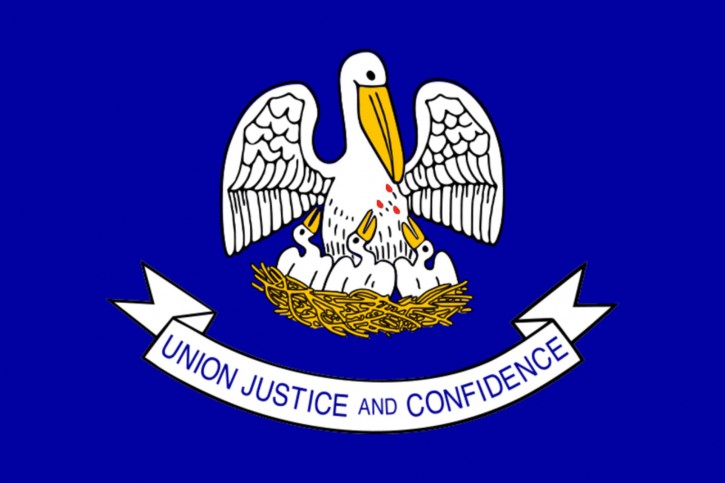
State Flag
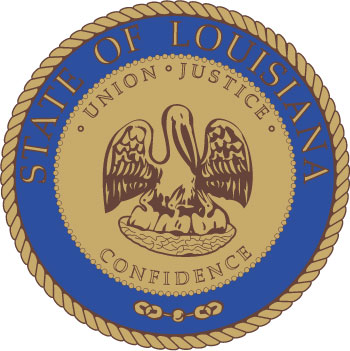
Great Seal
Nickname
The Pelican State
Motto
Union, Justice, Confidence
Bird
Brown Pelican

Flower
Magnolia
Tree
Bald Cypress
Mammal
Louisiana Black Bear
Reptile
American Alligator
Crustacean
Crawfish
Wildflower
Louisiana Iris
Drink
Milk (state drink); Sazerac (state cocktail)
Doughnut
Beignet
Song
"Give Me Louisiana" and "You Are My Sunshine"