
 English
 Español
 中文
中文 हिन्दी
 Français
On this page
Overview
Kansas is a state in the Midwestern United States, bordered by Nebraska to the north, Missouri to the east, Oklahoma to the south, and Colorado to the west. With roughly 2.94 million residents across 82,278 square miles, it is the 36th-most populous state and the 15th largest by area, sitting near the geographic center of the contiguous United States. The geographical center of the lower 48 states lies near Lebanon in north-central Kansas.
Kansas entered the Union as the 34th state on January 29, 1861, just months before the outbreak of the American Civil War. The state takes its name from the Kansa (Kaw) Nation, an Indigenous Siouan-speaking people. Topeka, on the Kansas River in the northeast, is the state capital. Wichita, in south-central Kansas, is the largest city and the global hub of general-aviation manufacturing.
Kansas is one of the most agriculturally productive states in the United States and a national leader in winter wheat, beef cattle, and grain sorghum. The state was the violent crucible of "Bleeding Kansas" in the 1850s, the heart of the great post-Civil War cattle drives that built Dodge City and Abilene, and is widely associated with the iconography of the American Plains — windmills, sunflowers, the Wizard of Oz, and "Home on the Range."
Geography & Climate
Kansas lies entirely within the Great Plains and rises steadily from east to west, gaining roughly 3,000 feet of elevation across the state. The eastern third is gently rolling, with the Flint Hills running north-south through the east-central counties — home to the largest contiguous tallgrass prairie remaining in North America, protected in part as Tallgrass Prairie National Preserve. The central plains are flatter and more agricultural, dominated by winter-wheat farming.
Western Kansas, in the High Plains, is a flat, semi-arid steppe historically maintained by buffalo grazing and now by the deep Ogallala Aquifer that feeds extensive center-pivot irrigation. Mount Sunflower in Wallace County, the state’s highest point at 4,039 feet, lies along the Colorado border. The lowest point, near the Verdigris River in the southeast, is 679 feet.
The climate ranges from humid continental in the east to semi-arid in the west, with cold winters, hot summers, and famously violent severe weather. Kansas sits at the heart of Tornado Alley and averages roughly 80 tornadoes a year — among the most of any U.S. state. Major rivers include the Kansas (Kaw), Arkansas, Republican, Smoky Hill, and Missouri (which forms a short stretch of the northeastern boundary).
History
Before European arrival, Kansas was home to the Kansa, Osage, Pawnee, Wichita, Kiowa, Comanche, Cheyenne, and Arapaho peoples. Spanish explorer Francisco Vázquez de Coronado entered Kansas in 1541 in search of the legendary "Quivira." Most of present-day Kansas became part of the United States through the Louisiana Purchase in 1803, and the Santa Fe Trail and the Oregon and California Trails crossed the territory in the 1820s–1840s.
The Kansas–Nebraska Act of 1854 allowed settlers to decide by popular sovereignty whether the territory would permit slavery. The resulting violence between pro-slavery and antislavery settlers — known as "Bleeding Kansas" — included the 1856 sack of Lawrence, John Brown’s Pottawatomie Massacre, and skirmishes throughout the territory. Kansas was admitted as a free state on January 29, 1861, just weeks before the Civil War began.
After the Civil War, Kansas became the destination of the great cattle drives from Texas. Cowtowns including Abilene, Newton, Wichita, and Dodge City were violent, briefly notorious, and quickly transformed into established cities as the railroads expanded westward. The Homestead Act, the Mennonite immigration of the 1870s (bringing winter-wheat varieties from Russia), and railroad-driven settlement filled the western plains.
The 1930s Dust Bowl, born of severe drought and aggressive plowing, devastated western Kansas, displaced thousands of families, and shaped soil-conservation policy across the United States. Wichita emerged as a global aviation capital from the 1920s onward, anchored by Cessna, Beechcraft, Stearman, and later Boeing, Spirit AeroSystems, and Textron Aviation. Dwight D. Eisenhower, the 34th U.S. President, grew up in Abilene, where the Eisenhower Presidential Library and Museum is located.
Economy
Kansas hosts a diversified economy with anchor sectors in agriculture and food production, general-aviation and aerospace manufacturing, energy, and animal-health science.
- Agriculture: Kansas is the nation’s leading producer of winter wheat and grain sorghum, and one of the top producers of beef cattle, corn, soybeans, and sunflowers. The state slaughters more cattle than any other state, and roughly 90 percent of its land is in farms or ranches — the highest share in the country.
- Aviation and aerospace: Wichita is known as the "Air Capital of the World" and produces roughly two-thirds of all U.S. general-aviation aircraft. Major manufacturers headquartered or operating in Wichita include Textron Aviation (Cessna, Beechcraft, Hawker), Spirit AeroSystems, Bombardier Learjet, and a major Boeing tier-1 supply base.
- Energy: Kansas has long been a top-ten U.S. producer of crude oil and natural gas. The Hugoton Gas Field in southwestern Kansas was once among the largest natural-gas fields in the world. Kansas is also a leading wind-energy state, with wind supplying roughly 47 percent of in-state electricity.
- Animal health: The Kansas City Animal Health Corridor — stretching from Manhattan, Kansas, to Columbia, Missouri — is home to the largest concentration of animal-health and nutrition companies in the world, including Hill’s Pet Nutrition, Boehringer Ingelheim Animal Health, and Bayer Animal Health.
- Food and manufacturing: Major food-processing operations including Tyson, JBS, Cargill, ConAgra, and Frito-Lay run plants across Kansas, and Sporting Kansas City–based Sporting Goods Industries are joined by the Smith & Wesson firearm-manufacturing facility in Maryville, Garmin (Olathe), and the headquarters of Koch Industries (Wichita).
Government
Kansas operates under its 1859 Wyandotte Constitution. The Kansas Legislature is bicameral, with a 40-member Senate (four-year terms) and a 125-member House of Representatives (two-year terms). There are no legislative term limits.
The Governor of Kansas serves a four-year term and is limited to two consecutive terms. The state also elects a Lieutenant Governor (jointly with the Governor since 1972), Attorney General, Secretary of State, Treasurer, and Commissioner of Insurance. Kansas is one of a small number of states that elects a commissioner of insurance directly.
Kansas has four seats in the U.S. House of Representatives plus two U.S. Senators. The Kansas Supreme Court has seven justices appointed by the governor through a merit-selection process and retained by uncontested election. The state capital is Topeka.
Culture
Kansas culture is deeply rooted in Great Plains agricultural identity, the legacy of the Old West, and a tradition of progressive Plains populism. Dodge City, Abilene, Hays, and Wichita preserve the cattle-drive era through museums and reenactments, and the Eisenhower Presidential Library in Abilene draws visitors year-round. The Wizard of Oz, set on a Kansas farm, has made the state shorthand for the American heartland in global popular culture.
Kansas has produced an outsized share of important figures in American science, sport, and the arts. Dr. James Naismith, the inventor of basketball, coached at the University of Kansas, where his protégé Phog Allen built the most successful program in U.S. college basketball history; KU has won multiple national championships. Author Truman Capote spent formative years in Holcomb (the setting of "In Cold Blood"). Astronaut Joe Engle, jazz great Charlie Parker (Kansas City, Kansas, side), the Coen Brothers’ Coen-influenced filmmaker Robert Altman (Kansas City), and the painter John Steuart Curry all came from Kansas or just across the river.
Kansas is a religiously and ethnically diverse state by Great Plains standards, with Catholic German-Russian Volga communities in the central counties, Mennonite communities in Newton and Hillsboro, Czech communities in Wilson, Swedish in Lindsborg, Vietnamese and Hispanic communities in Garden City and Dodge City, and a substantial African American community in Kansas City and Wichita. Barbecue is central to the cuisine, with the Kansas City style — slow-smoked, finished with thick tomato-and-molasses sauce — among the most influential regional styles in U.S. barbecue.
Notable Cities
- Wichita — Largest city in Kansas, in the south-central part of the state on the Arkansas River, with a population of roughly 400,000 and a metropolitan area of about 650,000. Known as the "Air Capital of the World" for its general-aviation industry, home to Wichita State University, Koch Industries headquarters, the Old Cowtown Museum, and the Sedgwick County Zoo.
- Overland Park — Second-largest city, a suburb of Kansas City in Johnson County, with a population of roughly 200,000. Repeatedly ranked among the most-livable U.S. cities, with major operations of Sprint (now part of T-Mobile), AMC Theatres headquarters, Garmin (in adjacent Olathe), and an unusually dense corporate-services economy.
- Kansas City — A city of roughly 155,000 in northeastern Kansas, often confused with the much larger Kansas City, Missouri across the state line. Anchor of Kansas City, Kansas (KCK), home to the Kansas Speedway, the Children’s Mercy Park soccer stadium, and major railroad and manufacturing facilities including the General Motors Fairfax Assembly plant.
- Olathe — A suburb of Kansas City in Johnson County, with a population of roughly 145,000. Home of Garmin’s world headquarters, Mid-America Nazarene University, and the Mahaffie Stagecoach Stop Historic Site, the last surviving stage station on the Santa Fe Trail.
- Topeka — State capital, on the Kansas River, with a population of roughly 125,000. Home of the Kansas State Capitol with the famous John Steuart Curry mural "Tragic Prelude," and the Brown v. Board of Education National Historic Site, commemorating the 1954 U.S. Supreme Court case that ended legal school segregation, which originated in Topeka.
State Symbols
Kansas’s official state symbols, designated by the Kansas Legislature, celebrate the Great Plains landscape, agricultural heritage, and prairie wildlife of the Sunflower State.
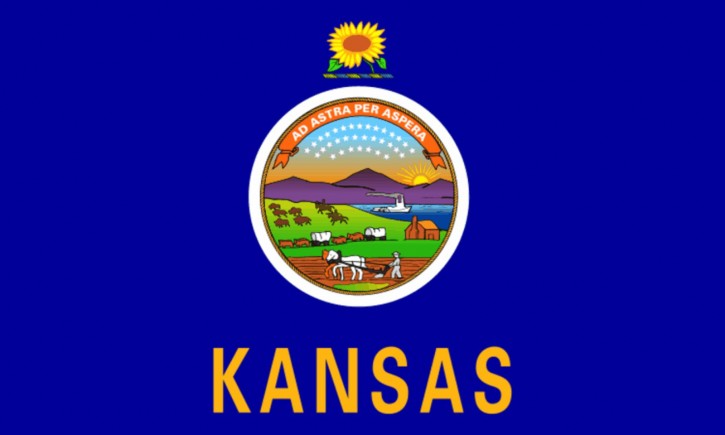
State Flag
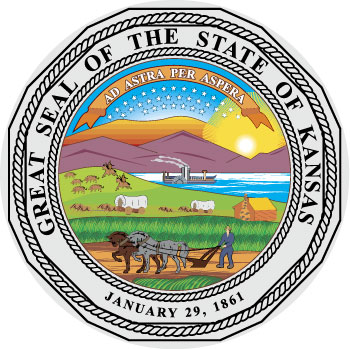
Great Seal
Nickname
The Sunflower State
Motto
Ad Astra per Aspera ("To the Stars Through Difficulties")

Bird
Western Meadowlark

Flower
Wild Native Sunflower
Tree
Eastern Cottonwood
Animal
American Bison
Reptile
Ornate Box Turtle
Amphibian
Barred Tiger Salamander
Insect
Western Honeybee
Grass
Little Bluestem
Soil
Harney Silt Loam
Song
"Home on the Range"