
 English
 Español
 中文
中文 हिन्दी
 Français
On this page
Overview
Indiana is a state in the Midwestern United States, bordered by Lake Michigan and Michigan to the north, Ohio to the east, Kentucky across the Ohio River to the south, and Illinois to the west. With roughly 6.86 million residents across 36,418 square miles, it is the 17th-most populous state and the 38th largest by area — the smallest state west of the Appalachians.
Indiana entered the Union as the 19th state on December 11, 1816. The name "Indiana" means "Land of the Indians," reflecting the territory’s long Indigenous heritage. Indianapolis, in the geographic center of the state, is the capital and largest city. Residents are known as Hoosiers, a nickname of disputed origin that has been in use since at least the 1820s.
Indiana is often called the "Crossroads of America" — its official motto — because more major U.S. interstate highways converge in the state than anywhere else in the country. Indiana is one of the most heavily manufacturing-oriented states in the U.S. by share of state product, ranks among the leading corn and soybean producers, and is home to the Indianapolis 500, the largest single-day sporting event in the world.
Geography & Climate
Indiana is divided into three main regions. The Northern Moraine and Lake Region was scraped by Pleistocene glaciers and is dotted with hundreds of natural lakes and a strip of Lake Michigan shoreline. The Central Till Plain, covering the middle of the state, is a flat, fertile plain that is the agricultural heartland. The Southern Hills and Lowlands region, never reached by the glaciers, is more rugged, with forested hills, caves, and the Ohio River bluffs.
Hoosier Hill in eastern Indiana is the highest point in the state at 1,257 feet — among the lowest "highest points" of any state. The Ohio River forms the entire 350-mile southern border. The Wabash River, Indiana’s official state river, rises in Ohio and flows diagonally across Indiana to the Wabash–Ohio confluence at the southwestern tip of the state.
The climate is humid continental in the north and humid subtropical in the south, with cold winters, warm summers, and tornado-prone springs. The Indiana Dunes along Lake Michigan, protected as Indiana Dunes National Park (designated 2019), preserve some of the most ecologically diverse natural landscapes in the Midwest. Hoosier National Forest covers a large stretch of the southern hills.
History
For thousands of years before European contact, Indiana was home to the Miami, Potawatomi, Lenape (Delaware), Shawnee, Kickapoo, and other peoples. French explorer René-Robert Cavelier, Sieur de La Salle, reached the area in 1679. France controlled the region until 1763, when it was ceded to Britain after the French and Indian War; after the American Revolution it became part of the Northwest Territory and then Indiana Territory in 1800.
The Battle of Tippecanoe in November 1811, fought near present-day Lafayette, was a decisive U.S. victory for Indiana Territory governor William Henry Harrison over Shawnee leader Tecumseh’s confederation. The victory established Harrison as a national figure (he later became the ninth U.S. president) and accelerated the displacement of Indiana’s Indigenous nations. Indiana was admitted as the 19th state on December 11, 1816, with Corydon as the original capital.
Indianapolis, planned from the start as the new state capital, was laid out in 1821 on a grid radiating from a central circle. The Civil War period saw Indiana contribute the second-highest share of soldiers per capita to the Union Army of any northern state. The late nineteenth and early twentieth centuries were Indiana’s literary "Golden Age" — Lew Wallace, Booth Tarkington, James Whitcomb Riley, Theodore Dreiser, and Kurt Vonnegut all hailed from Indiana.
Industrialization transformed Indiana in the twentieth century. U.S. Steel founded the city of Gary in 1906 to host what became the largest integrated steel mill in the world; the auto industry brought factories to Anderson, Kokomo, and South Bend (Studebaker); and Elkhart became the recreational-vehicle capital of the world. Indianapolis Motor Speedway, founded in 1909 and home of the Indianapolis 500 since 1911, made the state a global motorsport center.
Economy
Indiana hosts one of the most manufacturing-intensive economies in the United States, with major sectors in automotive and transportation manufacturing, steel, life sciences, agriculture, and logistics.
- Manufacturing: Indiana ranks first or second among U.S. states in the share of state product from manufacturing. Major operations include Toyota in Princeton and Lafayette, Subaru in Lafayette, Honda in Greensburg, Stellantis in Kokomo, GM in Fort Wayne, Cummins (headquartered in Columbus), and Allison Transmission in Indianapolis. Indiana also produces more recreational vehicles than the rest of the country combined, with most output centered in Elkhart.
- Steel and metals: The Calumet Region of northwestern Indiana, anchored by Gary, is the largest integrated steel producer in the United States. U.S. Steel’s Gary Works, ArcelorMittal’s Burns Harbor and Indiana Harbor facilities, and Cleveland-Cliffs make Indiana the country’s leading steel-producing state.
- Life sciences and pharma: Indianapolis-based Eli Lilly is one of the world’s largest pharmaceutical companies, making Indiana a major U.S. life-sciences hub. Cook Medical (Bloomington), Roche Diagnostics, Anthem, and IU Health anchor a deep cluster in pharmaceuticals, medical devices, diagnostics, and health insurance.
- Agriculture: Indiana is a top-five producer of corn, soybeans, hogs, and eggs. The state is also the leading producer of duck, popcorn, peppermint, and spearmint in the United States. Indiana farms cover roughly 60 percent of the land area.
- Logistics: More U.S. interstate highways converge in Indiana than in any other state, and the Indianapolis area is one of the largest air-cargo hubs in the world, anchored by FedEx Express’s second-largest U.S. hub at Indianapolis International Airport.
Government
Indiana operates under its 1851 constitution, the second in its history. The Indiana General Assembly is bicameral, with a 50-member Senate (four-year terms) and a 100-member House of Representatives (two-year terms). There are no legislative term limits.
The Governor of Indiana serves a four-year term and is limited to eight years in any twelve-year period. The state also elects a Lieutenant Governor, Attorney General, Secretary of State, Auditor, Treasurer, and Superintendent of Public Instruction. Indiana is one of a small number of U.S. states whose constitution requires a balanced budget and provides for strong gubernatorial line-item authority.
Indiana has nine seats in the U.S. House of Representatives plus two U.S. Senators. The Indiana Supreme Court has five justices appointed by the governor through a merit-selection process and retained by uncontested election. The state capital is Indianapolis.
Culture
Indiana culture is shaped by an unusually strong manufacturing and small-town identity for a U.S. state of its population, deep basketball passion that suffuses everyday life, and the global cultural footprint of the Indianapolis 500. The term "Hoosier hospitality" is a self-conscious cultural value. Indiana high-school basketball — until 1997, single-class tournaments produced legendary giant-killings that inspired the film "Hoosiers" — remains a regional identity marker.
The University of Notre Dame, founded in 1842 in South Bend, anchors Indiana’s strong Catholic identity and is a major national cultural and athletic institution. Indiana University in Bloomington, Purdue University in West Lafayette, and the Indianapolis Museum of Art are leading regional cultural and intellectual hubs. The Amish community in northern Indiana — particularly Elkhart and LaGrange counties — is one of the largest in North America.
Indiana has produced an outsized share of major American cultural figures: writers Kurt Vonnegut, Theodore Dreiser, and Booth Tarkington; composer Cole Porter (Peru, Indiana); composer and songwriter Hoagy Carmichael; actor James Dean (Fairmount); the Jackson family (Michael, Janet, and siblings, all from Gary); broadcaster David Letterman; and basketball legends Larry Bird, Oscar Robertson, John Wooden, and Reggie Miller. Indiana University is a leading center of jazz and classical music education.
Notable Cities
- Indianapolis — State capital, largest city, and economic center, with a city population of roughly 880,000 and a metropolitan area of about 2.1 million. Home of the Indianapolis Motor Speedway, the Indianapolis Colts, the Indiana Pacers, the NCAA national headquarters, the Indianapolis Children’s Museum (the largest of its kind in the world), and major corporate headquarters including Eli Lilly, Anthem, and Allison Transmission.
- Fort Wayne — Second-largest city, in northeastern Indiana at the confluence of the St. Joseph, St. Marys, and Maumee rivers, with a population of roughly 270,000. A diversified manufacturing, defense, insurance, and healthcare center, and headquarters of Lincoln Financial Group, Vera Bradley, and Sweetwater Sound.
- Evansville — Largest city in southwestern Indiana, on the Ohio River, with a population of roughly 115,000. Historically a riverboat and manufacturing center; home of the University of Evansville, Indiana University–Purdue University Fort Wayne (IUPUI) sister campus University of Southern Indiana, and Mead Johnson Nutrition.
- South Bend — A city of roughly 105,000 in northern Indiana, on the St. Joseph River. Best known as the home of the University of Notre Dame, but also a former major automobile-manufacturing center (Studebaker) and now a regional hub for health care, education, and technology, anchored by the Notre Dame–led downtown renaissance.
- Carmel — A planned suburban city of roughly 100,000 north of Indianapolis, repeatedly ranked among the top U.S. communities for quality of life, household income, and education. Designed around roundabouts (which Carmel pioneered in the United States) and a walkable Arts and Design District.
State Symbols
Indiana’s official state symbols, designated by the Indiana General Assembly, celebrate the pioneer heritage, natural history, and manufacturing identity of the Hoosier State.
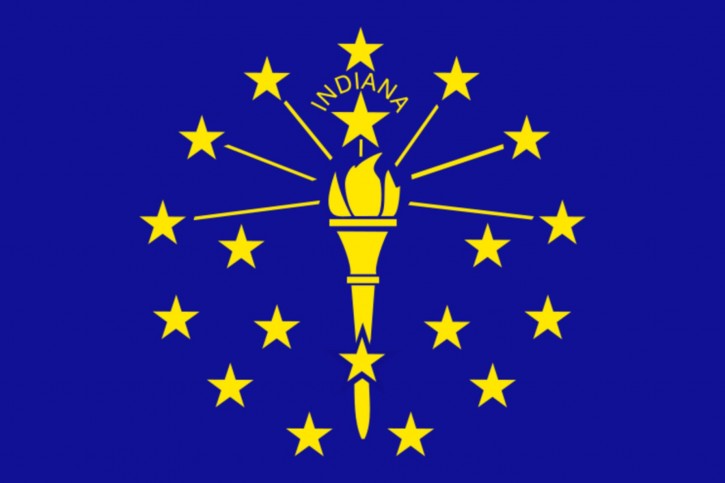
State Flag
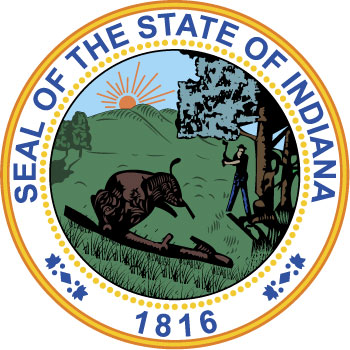
Great Seal
Nickname
The Hoosier State
Motto
The Crossroads of America
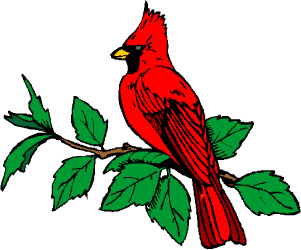
Bird
Northern Cardinal

Flower
Peony
Tree
Tulip Tree (Yellow Poplar)
River
Wabash River
Stone
Indiana Limestone (Salem Limestone)
Insect
Say’s Firefly
Poem
"Indiana" by Arthur Franklin Mapes
Pie
Sugar Cream Pie
Firearm
Grouseland Rifle
Song
"On the Banks of the Wabash, Far Away"