
 English
 Español
 中文
中文 हिन्दी
 Français
On this page
Overview
Hawaii is a state in the western Pacific Ocean, approximately 2,400 miles southwest of California. It is the only U.S. state located entirely outside North America, the only state composed entirely of islands, the only state in the tropics, and the southernmost U.S. state. With roughly 1.44 million residents across 10,931 square miles, it is the 40th-most populous state and 43rd by area.
The Hawaiian archipelago consists of 137 volcanic islands spread across more than 1,500 miles of the central Pacific, of which eight main islands are inhabited or significant: Hawaii (the Big Island), Maui, Oahu, Kauai, Molokai, Lanai, Niihau, and Kahoolawe. Honolulu, on the island of Oahu, is the state capital, largest city, and home to nearly two-thirds of the state population.
Hawaii joined the Union on August 21, 1959, as the fiftieth and most recent state. It is also the most ethnically diverse state in the country, with no single racial or ethnic group forming a majority. Hawaii has the highest proportion of Asian Americans and multiracial Americans in the United States, and Native Hawaiians remain a foundational cultural and political community.
Geography & Climate
The Hawaiian Islands are the exposed peaks of a chain of submarine volcanoes formed by a stationary mantle hotspot in the central Pacific. As the Pacific Plate has drifted northwest over millions of years, the hotspot has produced a long northwesterly trail of progressively older islands and seamounts, with the youngest landforms at the southeast end of the chain. The Big Island, less than one million years old, still has two of the world’s most active volcanoes — Kilauea and Mauna Loa.
Mauna Kea, on the Big Island, rises to 13,803 feet above sea level and is the highest point in the state. Measured from its base on the ocean floor, it is taller than Mount Everest. Mauna Loa is one of the largest volcanoes on Earth by volume. Haleakala on Maui, a dormant shield volcano, rises 10,023 feet and dominates that island. Hawaii Volcanoes National Park and Haleakala National Park protect these landscapes.
The climate is tropical, modified strongly by trade winds and steep elevation gradients. Windward (northeast) sides of the islands are very wet — Mount Waialeale on Kauai is one of the rainiest spots on Earth — while leeward (southwest) sides are dry and sunny. There is no continental shelf; coastlines feature coral reefs, sea cliffs, black-, green-, and white-sand beaches, and deep ocean channels separating the islands.
History
Polynesian voyagers from the Marquesas Islands first settled the Hawaiian archipelago around 1000 to 1200 CE, navigating thousands of miles of open ocean using stars, swells, and bird flight. A second wave from Tahiti followed several centuries later. Over the following centuries, Hawaiians developed a sophisticated society organized around the ahupuaa land system, a complex religion of akua (gods) and mana, and the kapu system of sacred prohibitions.
European contact began with Captain James Cook in 1778. In 1810, after decades of warfare, King Kamehameha I unified the islands into the Kingdom of Hawaii. The kingdom signed treaties with Britain, France, and the United States and was recognized as a sovereign nation. American missionaries arrived in 1820, fundamentally reshaping language, education, and law, and American sugar planters came to dominate the economy.
In January 1893, a group of American and European businessmen, backed by U.S. Marines, overthrew Queen Liliuokalani. The Republic of Hawaii was proclaimed in 1894, and the United States annexed the islands in 1898 over the formal protest of the Hawaiian people. Pearl Harbor became a major U.S. naval base; the Japanese attack on December 7, 1941, drew the United States into World War II.
Hawaii became the fiftieth U.S. state on August 21, 1959. In 1993, the U.S. Congress and President Clinton issued a formal apology to the Native Hawaiian people for the 1893 overthrow. The Native Hawaiian sovereignty movement, the revival of the Hawaiian language, and large-scale land claims continue to shape state politics into the present day.
Economy
Hawaii’s economy is unusually concentrated by U.S. standards, dominated by tourism and the U.S. military, with smaller anchor roles for agriculture, real estate, scientific research, and renewable energy.
- Tourism: Tourism is the single largest private-sector industry, drawing roughly 9 to 10 million visitors a year in normal years and supporting hundreds of thousands of jobs. Waikiki, Maui, the Big Island, and Kauai are the major destinations, and Japanese, U.S. mainland, Canadian, and Korean visitors are the leading source markets.
- Defense: The U.S. military is the second-largest economic sector and one of the largest employers. Pearl Harbor–Hickam is home of U.S. Indo-Pacific Command, the Pacific Fleet, and major Army, Air Force, Marine, and Coast Guard commands. Direct defense spending exceeds $7 billion a year.
- Agriculture: Once dominated by sugarcane and pineapple plantations, Hawaiian agriculture has shifted to high-value specialty crops. Kona coffee, macadamia nuts, papayas, tropical flowers, taro, and seed corn are leading products. Hawaii is the only U.S. state that grows coffee commercially at scale.
- Science and observatories: The summit of Mauna Kea hosts one of the most important astronomical observatory complexes in the world, with thirteen telescopes operated by international consortia. Hawaii is also a center for oceanographic, volcanic, and tropical-ecology research, with the University of Hawaii at the core.
- Renewable energy: Hawaii has the highest electricity prices of any U.S. state because nearly all fuel must be imported. State law commits the islands to 100 percent renewable electricity by 2045 — the most aggressive U.S. target — driving rapid growth in rooftop solar, utility-scale solar and battery storage, wind, and geothermal generation.
Government
Hawaii operates under the state constitution adopted at the 1950 Constitutional Convention and amended at conventions in 1968 and 1978. The Hawaii State Legislature is bicameral, with a 25-member Senate (four-year terms) and a 51-member House of Representatives (two-year terms). There are no legislative term limits.
The Governor of Hawaii serves a four-year term and may serve a maximum of two consecutive terms. The state has only one elected statewide officer besides the Governor and Lieutenant Governor — the office structure is unusually consolidated. Counties are the only form of local government; there are no incorporated municipalities, and the City and County of Honolulu is the consolidated government for the entire island of Oahu.
Hawaii has two seats in the U.S. House of Representatives plus two U.S. Senators. The Supreme Court of Hawaii has five justices appointed by the governor for ten-year terms, subject to retention by the Judicial Selection Commission. Hawaiian is one of two official state languages alongside English.
Culture
Native Hawaiian culture is the foundation of the state’s identity. Hula, the chanted oli, the slack-key guitar style known as kī hōʻalu, the ukulele, the Hawaiian language, and the navigational traditions revived by the Polynesian Voyaging Society and the canoe Hōkūleʻa are all central to public life. The aloha spirit — generosity, hospitality, and harmony with land and people — is enshrined in state law and saturates everyday social norms.
Hawaii is the most ethnically diverse U.S. state. Generations of Chinese, Japanese, Filipino, Korean, Portuguese, Puerto Rican, and Pacific Islander immigration to the plantation labor force produced a distinctive multicultural society. Roughly one quarter of residents identify as multiracial, the highest share in the nation. Hawaiian Pidgin English (technically Hawaii Creole) is a widely spoken local vernacular.
Hawaii is the birthplace of modern surfing, which Native Hawaiians have practiced for centuries and which spread worldwide from Waikiki in the early twentieth century via figures such as Duke Kahanamoku. The state has produced a distinctive musical heritage — slack-key guitar, falsetto vocals, the steel guitar — and a fast-evolving culinary scene built on locally caught fish, tropical fruit, Asian techniques, and the iconic plate lunch.
Notable Cities
- Honolulu — State capital, largest city, and the consolidated City and County government for the entire island of Oahu. Home to roughly 350,000 city residents and roughly one million metropolitan-area residents, Waikiki Beach, Pearl Harbor, Iolani Palace, and the University of Hawaii at Manoa.
- East Honolulu — A census-designated place east of Honolulu proper on the southeastern coast of Oahu, encompassing Hawaii Kai, Kuliouou, Aina Haina, Niu Valley, Wailupe, and Kahala. Among the wealthiest communities in the state.
- Pearl City — A census-designated place on Oahu adjacent to Pearl Harbor. Largely residential, with a population of about 47,000 and a heavy military-affiliated community.
- Hilo — Largest settlement on the Big Island and seat of Hawaii County. Located on the wet windward coast, Hilo is the gateway to Hawaii Volcanoes National Park and the University of Hawaii at Hilo, and the historic center of the Big Island economy.
- Kailua-Kona — A coastal town on the dry leeward (Kona) side of the Big Island, famous as the heart of the Kona coffee region, a major resort destination, and the finish line of the Ironman World Championship triathlon.
State Symbols
Hawaii’s official state symbols, designated by the Hawaii State Legislature, celebrate the unique Polynesian heritage, volcanic landscape, and rich endemic biodiversity of the Aloha State.
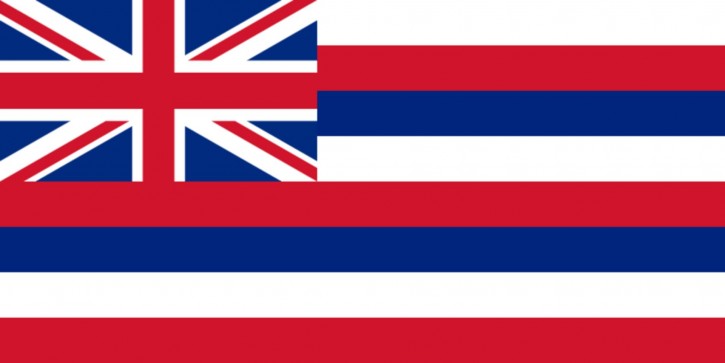
State Flag
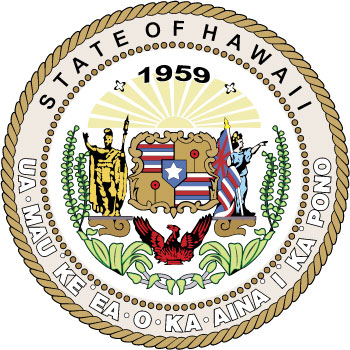
Great Seal
Nickname
The Aloha State
Motto
Ua Mau ke Ea o ka ʻĀina i ka Pono ("The Life of the Land is Perpetuated in Righteousness")
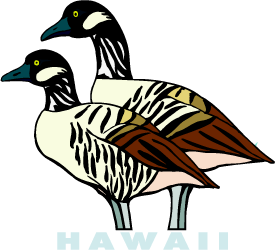
Bird
Nene (Hawaiian Goose)
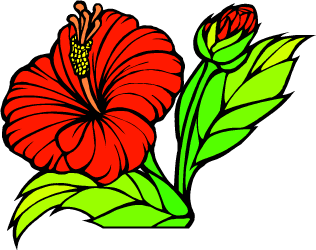
Flower
Yellow Hibiscus (Hibiscus brackenridgei)
Tree
Kukui (Candlenut)
Mammal
Hawaiian Monk Seal
Marine Mammal
Humpback Whale
Fish
Humuhumunukunukuapuaa (Reef Triggerfish)
Gem
Black Coral
Sport
Surfing
Dance
Hula
Song
"Hawaiʻi Ponoʻī"