
 English
 Español
 中文
中文 हिन्दी
 Français
On this page
Overview
Florida is the southeasternmost state of the United States, a long peninsula bordered by Georgia and Alabama to the north, the Gulf of Mexico to the west, the Atlantic Ocean to the east, and the Florida Straits and Caribbean Sea to the south. With roughly 22.6 million residents, it is the third-most populous state, the 22nd largest by area, and the eighth-most densely populated.
Florida has more coastline than any other state in the contiguous United States — about 1,350 miles — and the second-longest tidal shoreline in the country after Alaska. The state is best known for its subtropical climate, white-sand beaches, the Everglades, Walt Disney World, the Kennedy Space Center, and large Cuban, Haitian, and Latin American communities.
Florida’s economy is one of the largest in the nation, with leading roles in tourism, aerospace, agriculture (especially citrus), construction, healthcare, and international trade. As a no-state-income-tax destination, it has attracted decades of population growth — making it one of the fastest-growing large states in the country.
Geography & Climate
Florida is unusual among U.S. states for its low elevation and dominantly limestone bedrock. The state’s highest point — Britton Hill in the Panhandle at 345 feet — is the lowest high point of any U.S. state. Florida sits on a wide carbonate platform; centuries of dissolution have produced thousands of sinkholes, springs, caves, and the artesian aquifer system that supplies most of the state’s freshwater.
The peninsula divides into three broad regions: the Panhandle (north and west), bordering Alabama and Georgia, with rolling pine forests and red clay soils; the central highlands, with citrus groves, lakes, and rolling sand hills; and the south, dominated by the Everglades — a vast, slow-moving river of grass — and the Florida Keys, a 120-mile arc of coral and limestone islands.
Florida’s climate is humid subtropical in the north and tropical in the south, with two distinct seasons: a warm, rainy summer and a mild, dry winter. The state lies in the Atlantic hurricane belt; major hurricanes have shaped its history and built environment. The Gulf Stream warms the Atlantic coast and supports coral reefs along the Keys.
History
Indigenous peoples — the Calusa, Apalachee, Timucua, and Tequesta — lived in present-day Florida for at least 10,000 years before European contact. The Spanish explorer Juan Ponce de León landed in 1513 and named the land “La Florida” for the lush vegetation he encountered during the Easter season (Pascua Florida). St. Augustine, founded by Pedro Menéndez de Avilés in 1565, is the oldest continuously inhabited European-established settlement in the contiguous United States.
Florida changed hands several times among Spanish, British (1763–1783), and again Spanish rule before the United States acquired it via the Adams–Onís Treaty in 1819. Florida Territory was created in 1822; the three Seminole Wars (1817–1858) reshaped the indigenous population, forcing most Seminole people west of the Mississippi while a remnant retreated into the Everglades.
Florida became the 27th state on March 3, 1845. It seceded from the Union in 1861 and was readmitted in 1868. The early 20th century brought the railroad south, the Florida land boom of the 1920s, devastating hurricanes in 1926 and 1928, and the Great Depression.
The post-World War II era transformed Florida. Air conditioning, mosquito control, the interstate highway system, the Cuban diaspora after 1959, Walt Disney World (1971), the Kennedy Space Center, and decades of retiree migration produced one of the fastest population growth rates in U.S. history. Florida’s population grew from roughly 2.8 million in 1950 to more than 22 million today.
Economy
Florida’s economy ranks among the largest in the United States, with major contributions from tourism, aerospace, agriculture, international trade, financial services, and a fast-growing technology and life-sciences sector.
- Tourism: Florida welcomes more than 130 million visitors annually — the most of any U.S. state. Walt Disney World near Orlando is the most-visited theme-park resort in the world; Universal Orlando, SeaWorld, Miami Beach, the Florida Keys, and the cruise ports of Miami and Port Canaveral round out the industry.
- Aerospace and defense: The Kennedy Space Center and Cape Canaveral host SpaceX, NASA, ULA, and Blue Origin launches. Florida also hosts major military installations including MacDill (Tampa), Eglin (Fort Walton Beach), and Naval Air Station Jacksonville.
- Agriculture: Florida produces more oranges and grapefruit than any other state — most of which goes to juice processing. Sugarcane (Lake Okeechobee region), tomatoes, strawberries, cattle, and a major nursery and ornamental-plant industry round out the agricultural sector.
- International trade and finance: Miami is a leading gateway for trade with Latin America and the Caribbean. PortMiami is one of the world’s busiest cruise ports, and Miami International Airport handles a substantial share of all U.S.–Latin America passenger and cargo traffic.
- Healthcare and life sciences: The Mayo Clinic Florida (Jacksonville), University of Miami Health System, Moffitt Cancer Center (Tampa), and Cleveland Clinic Florida (Weston) anchor a fast-growing biomedical sector.
Government
Florida operates under its 1968 constitution, the latest of six state constitutions. The Florida Legislature is bicameral, with a 40-member Senate and a 120-member House of Representatives. Senators serve four-year terms and representatives two-year terms, with eight-year combined limits on each chamber.
The Governor of Florida serves a four-year term and may serve a maximum of two consecutive terms. The state also elects a Lieutenant Governor (running on a ticket with the Governor), Attorney General, Chief Financial Officer, and Commissioner of Agriculture. Florida is unusual for having no state income tax, with state revenue drawn primarily from sales, property, corporate, and tourism-related taxes.
Florida has 28 seats in the U.S. House of Representatives following the 2020 reapportionment, plus two U.S. Senators. The Florida Supreme Court has seven justices appointed by the Governor and subject to retention elections. The state capital is Tallahassee, although the state’s population is concentrated far to the south.
Culture
Florida culture blends the American South, the Caribbean, Latin America, and a major retiree-driven northern-transplant population. The Panhandle and northern Florida feel culturally Southern; central Florida is dominated by suburban development, theme parks, and an international workforce; South Florida (Miami, Fort Lauderdale, the Keys) is bilingual, deeply Caribbean and Latin American, and globally connected.
Miami is one of the most important cultural cities in the Western Hemisphere — a center for Latin American media, music, fashion, and the visual arts. Little Havana, Wynwood, and South Beach are internationally recognized neighborhoods. The annual Art Basel Miami Beach is one of the most important contemporary art fairs in the world.
Florida is also defined by its outdoor culture: beach life, fishing, boating, golf, college football (especially Florida, Florida State, and Miami), and a deep tradition of folk and Cuban-American music. The state hosts spring training for half of Major League Baseball (the Grapefruit League).
Notable Cities
- Jacksonville — Largest city in Florida and the most expansive city by land area in the contiguous United States. A Navy and port city on the St. Johns River, with a growing financial-services and healthcare sector.
- Miami — Florida’s global city and the cultural and financial gateway to Latin America. Home of South Beach, Little Havana, Wynwood, the Vizcaya estate, and PortMiami — the busiest cruise port in the world.
- Tampa — Major port and corporate center on the Gulf Coast, anchored by MacDill Air Force Base, the University of South Florida, and a growing biotech corridor. Adjacent to St. Petersburg and Clearwater across Tampa Bay.
- Orlando — Theme-park capital of the world, anchored by Walt Disney World, Universal Orlando, and SeaWorld. Also a hub for simulation, training, and digital-media industries.
- Tallahassee — State capital, in the Florida Panhandle. Home of Florida State University and Florida A&M, and a center of state government and higher education.
State Symbols
Florida’s official state symbols, designated by the Legislature, celebrate the subtropical environment, citrus heritage, and rich cultural mix of the Sunshine State.
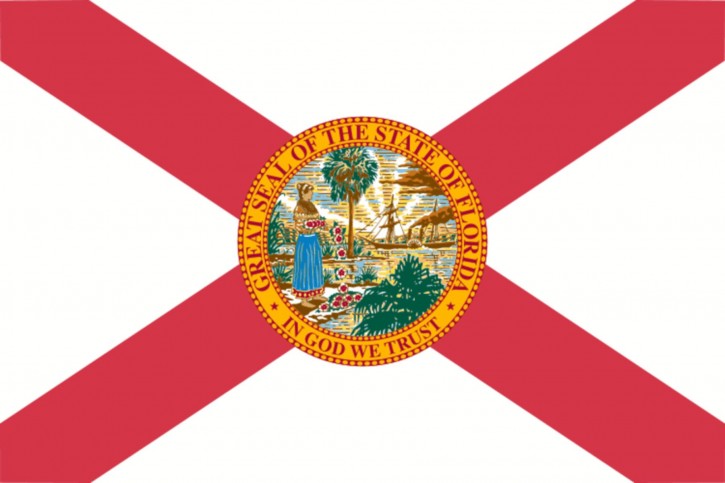
State Flag
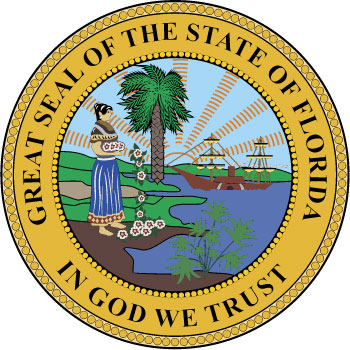
Great Seal
Nickname
The Sunshine State
Motto
In God We Trust
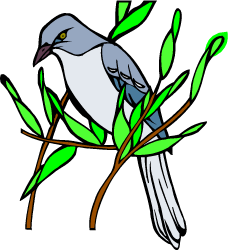
Bird
Northern Mockingbird

Flower
Orange Blossom
Tree
Sabal Palm
Mammal
Florida Panther
Marine Mammal
Manatee
Saltwater Fish
Atlantic Sailfish
Freshwater Fish
Largemouth Bass
Reptile
American Alligator
Butterfly
Zebra Longwing
Song
“The Swanee River” (Old Folks at Home)