
 English
 Español
 中文
中文 हिन्दी
 Français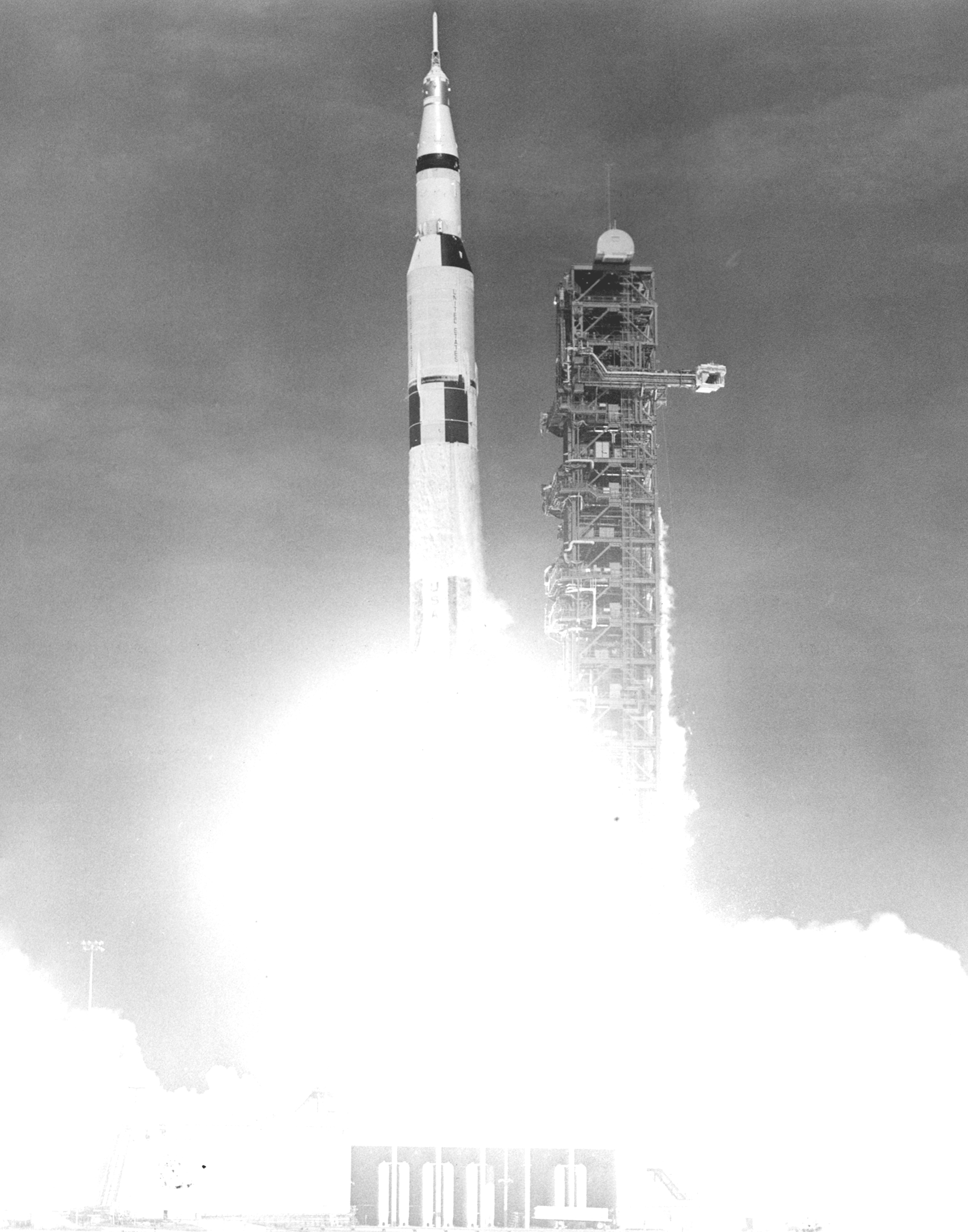
Space Exploration History
From the V-2 rocket to the James Webb Space Telescope — eight decades of reaching beyond Earth.
Space exploration is the direct human and robotic investigation of the regions beyond Earth's atmosphere. In less than a single human lifetime, the field has grown from the first liquid-fuelled rockets of the mid-twentieth century to permanent human habitation in low Earth orbit, rovers operating on Mars, and observatories stationed more than a million kilometres from Earth. The story intertwines scientific curiosity, geopolitical rivalry, engineering ambition, and international cooperation, and it continues to accelerate in the twenty-first century as new national programs and commercial operators enter the field.
Overview
The practical history of space exploration begins in the closing months of the Second World War, when German engineers operating the V-2 ballistic missile demonstrated for the first time that a rocket could carry a useful payload across the boundary of space. In the postwar decades, the rocket technologies, propellants, and guidance systems pioneered for military purposes were adapted by the United States and the Soviet Union to place artificial satellites and then human beings into orbit. What began as a narrow superpower competition quickly widened into a global scientific enterprise involving Europe, Japan, China, India, and dozens of other national and commercial actors.
The Space Age is conventionally dated from October 4, 1957, when the Soviet Union launched Sputnik 1, the first artificial satellite of Earth. Within four years, Soviet cosmonaut Yuri Gagarin had completed the first human orbital flight, and within twelve years the United States had landed astronauts on the surface of the Moon. The subsequent half-century has seen the construction of long-duration space stations, the operation of reusable spaceplanes, the robotic surveying of every major body in the Solar System, and the launch of space telescopes that have fundamentally rewritten humanity's understanding of the universe.
This page covers the history of space exploration from the V-2 rocket of 1944 through the modern era of commercial crewed spaceflight, the International Space Station, the Chinese Tiangong station, and the James Webb Space Telescope. It includes both crewed and robotic missions, and it traces how the principal space programs of the world have developed alongside one another. For related topics, see the pages on the Moon, the Solar System, Earth from space, and observatories around the world.

Key Facts
- First artificial satellite
- Sputnik 1, launched by the Soviet Union on October 4, 1957
- First human in space
- Yuri Gagarin aboard Vostok 1 on April 12, 1961 (one orbit, 108 minutes)
- First American in orbit
- John Glenn aboard Mercury-Atlas 6 on February 20, 1962 (three orbits)
- First woman in space
- Valentina Tereshkova aboard Vostok 6, June 16, 1963
- First spacewalk
- Alexei Leonov during Voskhod 2, March 18, 1965 (approximately 12 minutes)
- First Moon landing
- Apollo 11, July 20, 1969 — Neil Armstrong and Buzz Aldrin walked on the Sea of Tranquility
- Humans to walk on the Moon
- Twelve, across six Apollo missions (Apollo 11, 12, 14, 15, 16, and 17) between 1969 and 1972
- Longest single spaceflight
- Valeri Polyakov aboard Mir, 437 days 18 hours (January 1994 to March 1995)
- ISS continuous habitation
- Since November 2, 2000 — more than 25 years of uninterrupted human presence in orbit as of 2026
- Total humans to fly in space
- More than 700 people from over 40 nations, per the United Nations Office for Outer Space Affairs (UNOOSA) registry
- Farthest human-made object
- Voyager 1, launched September 5, 1977, now more than 24 billion kilometres from Earth in interstellar space
- Space Shuttle program
- 135 missions between April 12, 1981 (STS-1) and July 21, 2011 (STS-135)
Origins: the V-2 to the IGY
Modern space exploration was made possible by the invention of the large liquid-fuelled rocket, a weapon that emerged from Germany during the Second World War. The V-2, designed by a team led by Wernher von Braun at the Peenemünde Army Research Center, entered operational use in 1944. Though it was fielded as a long-range ballistic missile and caused thousands of deaths during its military deployment, the V-2 demonstrated that a rocket could accelerate a payload past the edge of the atmosphere, reaching altitudes of more than 80 kilometres on a standard trajectory and over 175 kilometres on test flights. After the war, captured rockets, technical papers, and hundreds of German engineers were relocated to the United States under Operation Paperclip and to the Soviet Union under parallel programs, providing the technical foundation for both superpower space programs.
Throughout the late 1940s and early 1950s, the United States conducted upper-atmosphere research flights using captured V-2s, Aerobee sounding rockets, and indigenous designs. The Soviet Union pursued its own rocket development under the direction of chief designer Sergei Korolev, ultimately building the R-7 Semyorka intercontinental ballistic missile, the rocket that would place the first satellites and the first humans into orbit. The stage for a civil space program was set by the International Geophysical Year (IGY) of July 1957 through December 1958, a coordinated international scientific effort endorsed by the International Council of Scientific Unions. Both superpowers announced during IGY planning that they intended to launch small scientific satellites as part of their contributions to the year.
On October 4, 1957, the Soviet Union announced the successful launch of Sputnik 1, a polished metal sphere approximately 58 centimetres in diameter carrying a pair of radio transmitters. The satellite orbited the Earth every 96 minutes at an altitude between roughly 215 and 940 kilometres, broadcasting a steady beep that could be received by amateur radio operators worldwide. One month later, Sputnik 2 carried the dog Laika into orbit, the first living creature in space. The United States responded with Explorer 1 on January 31, 1958, which carried a Geiger counter supplied by physicist James Van Allen. Data from Explorer 1 led to the discovery of the charged-particle belts surrounding Earth now known as the Van Allen radiation belts. On July 29, 1958, President Dwight D. Eisenhower signed the National Aeronautics and Space Act, creating the National Aeronautics and Space Administration (NASA) from the preceding National Advisory Committee for Aeronautics, and American civil space activity was placed on a new institutional footing.
The Space Race (1958–1969)
From the late 1950s until 1969, the two superpowers competed for a series of firsts in spaceflight. The opening phase favored the Soviet Union. On April 12, 1961, cosmonaut Yuri Gagarin completed a single orbit of Earth aboard Vostok 1 in a flight lasting 108 minutes, becoming the first human being in space. Less than a month later, on May 5, 1961, American astronaut Alan Shepard made a suborbital flight aboard Mercury-Redstone 3, and John Glenn followed with the first American orbital flight aboard Mercury-Atlas 6 on February 20, 1962. The Vostok program went on to place five more cosmonauts in orbit, including Valentina Tereshkova, who on June 16, 1963, became the first woman in space aboard Vostok 6.
On May 25, 1961, in the wake of Gagarin's flight, United States President John F. Kennedy addressed a joint session of Congress and committed the country to landing an American on the Moon and returning him safely to Earth before the end of the decade. The programs that followed — Mercury, Gemini, and Apollo for the United States, and the parallel Voskhod and Soyuz developments for the Soviet Union — were shaped around this goal. During the two-year Gemini program of 1965 and 1966, American astronauts rendezvoused and docked two spacecraft in orbit, completed long-duration flights of up to fourteen days, and carried out the American program's first spacewalks, all techniques that would be required for a successful Moon mission. Alexei Leonov had already made the first spacewalk from Voskhod 2 on March 18, 1965, stepping outside his spacecraft for approximately twelve minutes. The Soviets pursued their own lunar plans with the N1 rocket and the LOK spacecraft, but their program suffered four consecutive N1 failures between 1969 and 1972 and was ultimately cancelled.
The Apollo Program
The Apollo program was the series of American crewed spaceflights that landed twelve astronauts on the surface of the Moon between 1969 and 1972. It was built around the three-stage Saturn V rocket, at the time the most powerful launch vehicle ever flown, and a three-module spacecraft system comprising the Command Module, the Service Module, and the Lunar Module. Apollo drew on contributions from more than four hundred thousand engineers, scientists, and contractors across the United States, and at the peak of its spending in 1965 and 1966 it consumed approximately 4.4 percent of the federal budget.
The program suffered its first major tragedy on January 27, 1967, when a flash fire in the pure oxygen atmosphere of the Apollo 1 command module on the launch pad during a ground test killed astronauts Gus Grissom, Ed White, and Roger Chaffee. The accident led to a redesign of the command module and a twenty-month pause in crewed flights. Apollo 7 in October 1968 was the first successful crewed mission, testing the redesigned command module in Earth orbit. Apollo 8 in December 1968 became the first crewed spacecraft to leave low Earth orbit, travel to the Moon, and return. During that mission, astronaut William Anders photographed the rising Earth above the lunar horizon, producing the image known as Earthrise, which has been widely credited with shaping the modern environmental movement.
On July 20, 1969, the Apollo 11 Lunar Module Eagle touched down on the Sea of Tranquility. Mission commander Neil Armstrong stepped onto the lunar surface at 02:56 UTC on July 21, followed by lunar module pilot Buzz Aldrin, while Michael Collins remained in lunar orbit aboard the Command Module Columbia. An estimated 650 million people — roughly one fifth of the world's population at the time — watched the live television broadcast. Five more successful lunar landings followed: Apollo 12 (November 1969), Apollo 14 (January 1971), Apollo 15 (July 1971), Apollo 16 (April 1972), and Apollo 17 (December 1972). Apollo 13 in April 1970 suffered an oxygen tank explosion en route to the Moon and did not land, but the crew was returned safely to Earth. The final Apollo Moon landing was Apollo 17, after which American crewed lunar exploration was paused for what has since become more than half a century. Apollo astronauts returned approximately 382 kilograms of lunar samples that remain foundational to planetary science.

The Soviet and Russian program
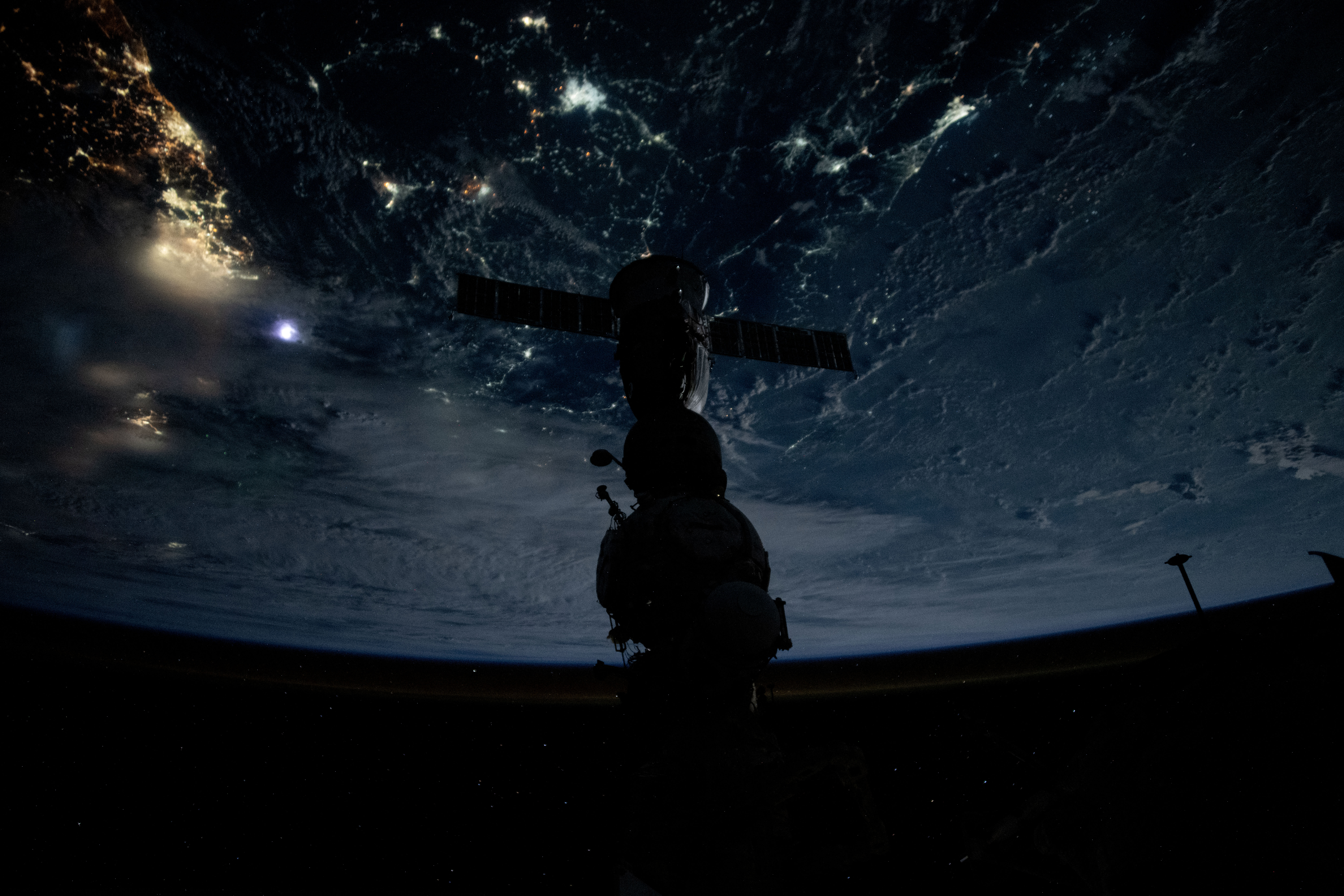
After the cancellation of the Soviet lunar program in the early 1970s, Soviet and later Russian human spaceflight has been dominated by two platforms that remain in use: the Soyuz spacecraft and a succession of Earth-orbiting space stations. The Soyuz, first flown with a crew in 1967, is the longest-serving crewed spacecraft in history. Its design has been repeatedly upgraded but its basic three-module architecture — orbital module, descent module, and instrument/service module — has remained the same for more than five decades. Soyuz served as the primary crew launch vehicle to every Soviet and Russian space station, and from the retirement of the Space Shuttle in 2011 until the debut of commercial crew vehicles in 2020, it was the only means of reaching the International Space Station.
The Salyut program of civilian and military space stations began with Salyut 1 in April 1971, the first space station of any country. Seven Salyut stations flew between 1971 and 1986, accumulating hundreds of days of crewed occupation and establishing much of the engineering and medical knowledge needed for long-duration spaceflight. The program also suffered one of the most serious space accidents, when the Soyuz 11 crew of Georgy Dobrovolsky, Viktor Patsayev, and Vladislav Volkov died during their return from Salyut 1 on June 30, 1971, after a valve opened in their descent module and the cabin depressurized at high altitude.
Salyut's successor, Mir, was launched in stages between 1986 and 1996 and was the first modular space station, assembled from a core module, four specialized science modules, a docking module, and other components. Mir remained continuously crewed from September 1989 until August 1999 and hosted 104 astronauts from twelve countries, including American astronauts flying under the Shuttle-Mir program between 1995 and 1998. The station was deorbited on March 23, 2001, after fifteen years in orbit, with fragments breaking up over the South Pacific. Russia has since operated as a founding partner of the International Space Station, contributing the core Zvezda service module and a succession of additional modules, and continues to launch crewed Soyuz missions from Baikonur Cosmodrome in Kazakhstan.
The Space Shuttle era (1981–2011)
The Space Transportation System, universally known as the Space Shuttle, was the United States' partially reusable crewed launch system between 1981 and 2011. Each Shuttle stack consisted of a winged orbiter approximately 37 metres long, a large external propellant tank, and two solid rocket boosters. The orbiter could carry up to eight crew members and roughly 24,400 kilograms of payload to low Earth orbit, and it returned to Earth as an unpowered glider. Five operational orbiters flew: Columbia, Challenger, Discovery, Atlantis, and Endeavour. Over 135 missions, the Shuttle deployed the Hubble Space Telescope and the Chandra X-ray Observatory, launched and serviced a long list of planetary probes, and carried out the great majority of the on-orbit construction of the International Space Station.
The Shuttle program also suffered the two worst crewed spaceflight accidents in history. On January 28, 1986, seventy-three seconds into the flight of STS-51-L, the Challenger orbiter broke apart over the Atlantic, killing its crew of seven, including teacher-in-space Christa McAuliffe. A presidential commission led by William Rogers traced the accident to the failure of an O-ring seal in a solid rocket booster field joint at unusually cold launch temperatures, and to organizational decision-making that had discounted engineering concerns. On February 1, 2003, during the return of STS-107, the Columbia orbiter disintegrated over Texas and Louisiana during reentry, killing all seven of its crew. Investigators determined that a piece of insulating foam had broken off the external tank during launch and struck the leading edge of the left wing, producing a breach that allowed superheated atmospheric gases to enter the wing during reentry. After the Columbia accident, the Shuttle returned to flight in July 2005 and completed the construction of the International Space Station before the program was retired with STS-135 in July 2011.
The International Space Station
The International Space Station, typically abbreviated ISS, is a modular Earth-orbiting laboratory operated as a partnership between five space agencies: NASA of the United States, Roscosmos of the Russian Federation, the European Space Agency (ESA), the Japan Aerospace Exploration Agency (JAXA), and the Canadian Space Agency (CSA). Assembly began with the launch of the Russian-built Zarya module on November 20, 1998, and continued with more than thirty further launches by Shuttle and expendable rockets through 2011. The station orbits the Earth at an average altitude of approximately 400 kilometres, completing an orbit roughly every 90 minutes and passing over most of the populated regions of the planet every day.
The ISS has been continuously occupied by rotating crews since November 2, 2000, when the Expedition 1 crew of American commander William Shepherd and Russian cosmonauts Yuri Gidzenko and Sergei Krikalev arrived aboard Soyuz TM-31. As of 2026, that continuous human presence in low Earth orbit has exceeded twenty-five years, the longest uninterrupted habitation of space in history. Expedition crews typically consist of six to seven astronauts from multiple countries who live and work in orbit for about six months at a time, carrying out hundreds of experiments in microgravity fluid physics, materials science, human physiology, Earth observation, and fundamental biology. The station's large pressurized volume, comparable to that of a commercial airliner, houses laboratories including the American Destiny module, the European Columbus module, and the Japanese Kibo complex, along with docking ports that support both Russian Soyuz and Progress vehicles and American commercial crew and cargo vehicles.

Robotic exploration of the Solar System
While crewed spaceflight has been largely confined to low Earth orbit and the Moon, robotic probes have visited every planet in the Solar System, along with comets, asteroids, and the Sun itself. The Voyager 1 and Voyager 2 probes, launched by NASA in 1977, took advantage of a rare planetary alignment to conduct flyby surveys of Jupiter, Saturn, Uranus, and Neptune, returning the first close-up images of the giant planets and their moons. Both spacecraft are still operational; Voyager 1 crossed the heliopause into interstellar space in August 2012, and Voyager 2 followed in November 2018. They remain the most distant human-made objects, and their 1977-vintage Voyager Golden Records carry a time-capsule record of Earth into the interstellar medium.
Mars has been the single most-studied planetary target. Beginning with NASA's Mariner 4 flyby in 1965, more than twenty successful missions have orbited, landed on, or roved across the surface. The Viking 1 and Viking 2 landers of 1976 conducted the first full-scale search for Martian life. The Sojourner rover of the 1997 Mars Pathfinder mission was the first wheeled vehicle on another planet. The twin Mars Exploration Rovers, Spirit and Opportunity, operated from 2004 through 2010 and 2018 respectively, vastly outlasting their ninety-day design lives. The Curiosity rover has operated in Gale Crater since August 2012, and the Perseverance rover, which landed in Jezero Crater in February 2021, is caching carefully chosen samples for a future Mars Sample Return mission. Perseverance also carried the Ingenuity helicopter, which became the first machine to achieve powered, controlled flight on another world.
Other landmark robotic missions include Cassini-Huygens, a joint NASA, ESA, and Italian Space Agency mission that orbited Saturn from 2004 to 2017 and deposited the Huygens probe onto the surface of Titan in January 2005; New Horizons, which made the first flyby of Pluto in July 2015 and went on to flyby the Kuiper Belt object Arrokoth in 2019; ESA's Rosetta, which rendezvoused with and orbited comet 67P/Churyumov-Gerasimenko from 2014 and delivered the Philae lander to its surface; and Parker Solar Probe, which has made the closest approaches to the Sun ever achieved. In the orbital astronomy domain, the Hubble Space Telescope has operated since 1990, producing some of the most cited images in modern astronomy, and the James Webb Space Telescope, launched on December 25, 2021, and commissioned at the Sun-Earth L2 Lagrange point, has extended observation into the mid-infrared and returned the deepest images yet obtained of the early universe.

Emerging space powers
The twenty-first century has seen the rise of several national programs that now rank alongside the long-established United States and Russian efforts. The most consequential newcomer has been the People's Republic of China, which became the third country to independently send a human into orbit when Yang Liwei flew aboard Shenzhou 5 on October 15, 2003. The Shenzhou program has since launched more than twenty crewed and uncrewed flights, and taikonaut Wang Yaping became the first Chinese woman to walk in space during a Shenzhou 13 extravehicular activity in November 2021. China's Tiangong space station, assembled in low Earth orbit between 2021 and 2022 from the Tianhe core module and the Wentian and Mengtian laboratory modules, has been continuously crewed by rotating three-astronaut expeditions since mid-2022. The Chang'e lunar program has delivered robotic landers and sample-return missions to both the near side and the far side of the Moon, including Chang'e 4 in January 2019 — the first soft landing on the lunar far side — and Chang'e 5, which returned lunar samples to Earth in December 2020 for the first time since Luna 24 in 1976.
India's space program, administered by the Indian Space Research Organisation (ISRO), has become one of the most cost-effective in the world. The Chandrayaan-1 lunar orbiter of 2008 confirmed the presence of water molecules on the Moon. Mangalyaan, also known as the Mars Orbiter Mission, arrived in Mars orbit in September 2014, making India the first Asian country to reach Mars and the first country in the world to do so on its first attempt. On August 23, 2023, the Chandrayaan-3 mission made India the fourth country to achieve a soft landing on the Moon and the first to land near the lunar south pole. The United Arab Emirates joined the ranks of Mars-orbiting nations with the Hope probe, which entered Mars orbit in February 2021 and has since returned global weather and atmospheric observations.
The European Space Agency, founded in 1975 as a consortium of twenty-two member states, has led several major robotic missions including Rosetta, Mars Express, ExoMars Trace Gas Orbiter, and the Solar Orbiter heliophysics mission, and it is a core ISS partner through the Columbus laboratory and the Automated Transfer Vehicle cargo ships that flew from 2008 to 2014. The Japan Aerospace Exploration Agency has contributed the Kibo ISS module and has operated a long series of scientific missions, including the Hayabusa and Hayabusa2 asteroid sample-return missions, the latter of which delivered samples from the near-Earth asteroid Ryugu to Earth in December 2020. These programs collectively have made spaceflight a genuinely international activity rather than a bipolar superpower enterprise.
Commercial spaceflight
Since the mid-2000s, a new generation of commercial launch and spacecraft operators has begun to share the orbital transportation market with national space agencies. In the United States, NASA's Commercial Orbital Transportation Services and Commercial Resupply Services programs paid private firms to deliver cargo to the International Space Station after the retirement of the Space Shuttle. SpaceX's Dragon cargo spacecraft first reached the station in May 2012, and Northrop Grumman's Cygnus followed in 2013. Under the subsequent Commercial Crew Program, SpaceX's Crew Dragon vehicle carried its first astronauts, Robert Behnken and Douglas Hurley, to the ISS on May 30, 2020. It was the first crewed orbital launch from American soil since STS-135 in 2011 and the first ever crewed flight of a commercially developed spacecraft. Boeing's Starliner spacecraft carried out its first crewed test flight in 2024 and joined Dragon as a certified crew vehicle.
Reusable rockets have been a defining technical achievement of the commercial era. SpaceX's Falcon 9 first stage landed vertically after a successful orbital launch for the first time on December 21, 2015, and individual Falcon 9 boosters have since flown and landed more than fifteen times each. The heavy-lift Falcon Heavy made its first flight in February 2018 and has supported national security, lunar, and planetary missions. The two-stage, fully reusable Starship, undergoing orbital flight testing throughout the mid-2020s, is intended both as a next-generation heavy lifter and as the lunar lander for NASA's Artemis program. Blue Origin's New Shepard has carried paying passengers on short suborbital flights since 2021, and its New Glenn orbital launcher had its first flight in 2025. Commercial space stations, in-orbit manufacturing ventures, and small-satellite constellations have grown alongside these launch programs, and by the mid-2020s the number of active satellites in orbit has risen into the tens of thousands, chiefly driven by broadband constellations.
Sources
Detailed citations, data references, and institutional sources for all CountryReports content are listed on the Sources page. The following space agencies, national archives, museums, and academic and non-profit institutions are the primary authorities we rely on for space exploration content. Each link points to the institution's homepage or directly relevant subsite.
Space agencies and official archives
- NASA History Office — Official historical documentation of United States civil space activity, including the NASA Historical Reference Collection, administrator papers, and the Apollo, Shuttle, and ISS program histories.
- European Space Agency — ESA history — Institutional history of ESA, its predecessor organisations ELDO and ESRO, and the European robotic and human spaceflight programs.
- JAXA — Japan Aerospace Exploration Agency history — Official English-language record of Japanese civilian space activity, from the earliest pencil rockets of the 1950s through current ISS and planetary missions.
- ISRO — Indian Space Research Organisation — Official record of Indian national space activity, including Chandrayaan, Mangalyaan, and human spaceflight development.
- UN Office for Outer Space Affairs — Online Index of Objects Launched into Outer Space — Authoritative international registry of launches and space objects under the 1975 Registration Convention.
- U.S. National Archives — Space Exploration records — Declassified government documentation of American space activity, including presidential correspondence and program decision memoranda.
National museums and scholarly institutions
- Smithsonian National Air and Space Museum — Primary U.S. national museum of flight and spaceflight; custodian of artefacts including the Apollo 11 Command Module Columbia and the Mercury Friendship 7 capsule.
- Smithsonian Institution — Space exploration collections — Object, photograph, and oral history holdings across Smithsonian museums and archives.
- NASA Human Spaceflight — Ongoing NASA program reference site covering the International Space Station, commercial crew, and Artemis.
- NASA SP-4001: Astronautics and Aeronautics Chronology — Multi-volume official chronological record of space activity worldwide, published by the NASA History Series.
Academic and non-profit research
- The Planetary Society — Space missions database — Independent, non-profit reference to past, current, and upcoming robotic and crewed missions across national and commercial operators.
- National Space Society — Ad Astra — Non-profit educational publications and proceedings on space policy, technology, and history.
- NASA Technical Reports Server (NTRS) — Open repository of NASA-funded scientific, engineering, and technical reports, including mission reports and peer-reviewed publications.
- Smithsonian/NASA Astrophysics Data System (ADS) — Peer-reviewed bibliographic database for the astronomical, planetary, and space-science literature.
- American Geophysical Union — Journals — Peer-reviewed journals covering planetary science, space physics, and Earth observation research.
If you notice an error or would like to suggest a correction, please use our contact page to get in touch.