
 English
 Español
 中文
中文 हिन्दी
 Français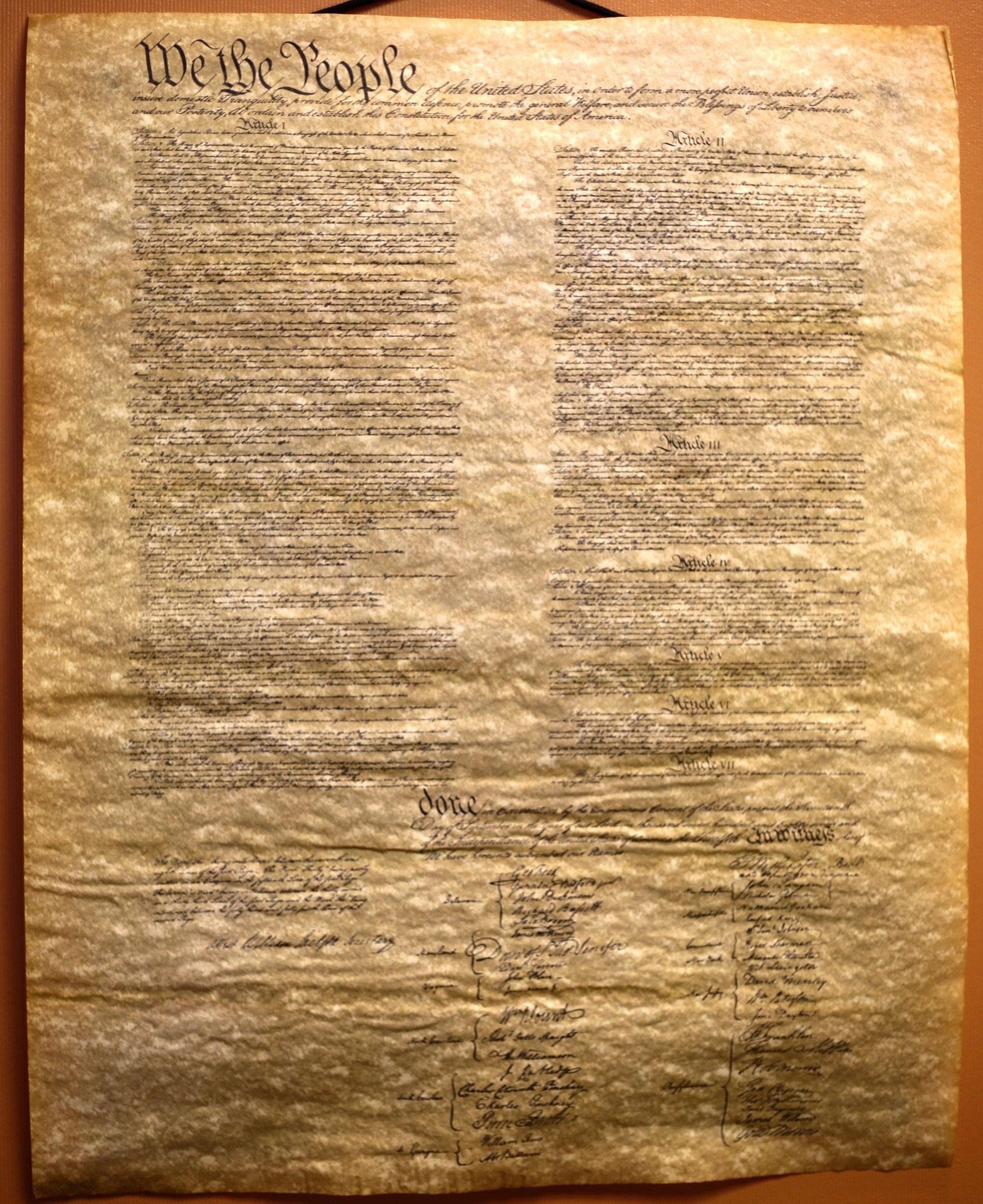
The Declaration of Independence
An Exhaustive History of the Document That Changed the World
An Exhaustive History of the Document That Changed the World
INTRODUCTION
On the fourth day of July in 1776, delegates assembled in the Pennsylvania State House in Philadelphia took a vote that would reverberate across centuries. After years of escalating conflict with the British Crown, after months of agonized debate, and after days of painstaking revision to a document drafted largely by a thirty-three-year-old Virginia lawyer named Thomas Jefferson, the Continental Congress formally adopted the Declaration of Independence. In doing so, they announced to the world that thirteen British colonies along the eastern seaboard of North America had severed their political bonds with Great Britain and constituted themselves as free and independent states.
The Declaration of Independence is, by any measure, one of the most consequential documents in human history. Its preamble contains perhaps the most famous sentences ever composed in the English language: the assertion that all men are created equal, that they are endowed with certain unalienable rights, and that among these are life, liberty, and the pursuit of happiness. These words, though they did not immediately alter the social realities of the new nation — slavery persisted for nearly another century, women could not vote for nearly a century and a half — planted seeds of revolutionary aspiration that have continued to bear fruit not only in the United States but across the globe. Subsequent generations of Americans have invoked the Declaration in struggles for emancipation, suffrage, labor rights, and civil equality. Independence movements in France, Latin America, Vietnam, and across Africa have drawn inspiration from its language and logic.
Yet the Declaration is also a product of its specific historical moment. Its grievances against King George III reflect particular colonial frustrations that had been building for more than a decade. Its language of natural rights emerged from specific Enlightenment philosophical traditions, most notably the writings of John Locke. Its silences — on slavery, on the rights of women, on the status of Indigenous peoples — reflect the limitations and contradictions of the society that produced it. Understanding the Declaration requires attending to both its universal aspirations and its historical particularity.
This article traces the full story of the Declaration of Independence: the colonial grievances that gave rise to it, the political drama of its creation, the philosophical tradition from which its ideas were drawn, the debates and revisions it underwent in Congress, the remarkable group of men who signed it, the physical adventures of the document itself across more than two centuries, and its enduring legacy in American and world history. The Declaration is not merely a historical artifact to be admired behind glass; it is a living text that Americans and people around the world continue to interpret, debate, and invoke as they grapple with questions of justice, equality, and the proper relationship between government and the governed.
Readers who approach the Declaration only through its famous second paragraph often miss the full richness and complexity of the document. The preamble's soaring philosophical language is followed by a lengthy list of specific charges against the British king — charges that reflect a decade of constitutional conflict between the colonies and the mother country. Those charges, in turn, are preceded and followed by passages that address the practical political and legal questions of separation. Reading the Declaration in full, and understanding the historical context from which each of its sections emerged, reveals a document of remarkable sophistication and depth.
CountryReports.org is proud to present this comprehensive treatment of one of humanity's most important political texts. The story of the Declaration of Independence is ultimately a story about the power of ideas — about how philosophical principles articulated in coffee houses and university halls in seventeenth- and eighteenth-century Europe could combine with specific colonial grievances to produce a declaration that changed the course of human history.
The American Declaration of Independence did not emerge from a vacuum. It was the culmination of more than a decade of deepening conflict between the thirteen American colonies and their British rulers — a conflict that began not with a desire for independence but with a dispute over taxation and parliamentary authority, and that escalated through a series of crises until separation seemed the only viable option to many colonists.
To understand why the Declaration was written, one must begin in 1763, with the end of the Seven Years' War (known in North America as the French and Indian War). Britain had emerged from that conflict victorious but deeply in debt. The war had been fought, in large part, to defend and expand the American colonies, and the British government believed it was only reasonable that the colonists should help pay for it. Meanwhile, Britain needed to maintain a standing army in North America to defend the vast new territories it had acquired from France. All of this required revenue, and Parliament turned to the colonies as a source.
The first major piece of revenue legislation was the Stamp Act of 1765, which required colonists to pay a tax on all printed materials — newspapers, legal documents, pamphlets, even playing cards. The act was not unprecedented in British imperial practice, but it differed from earlier measures in a crucial respect: it was an internal tax, levied directly on the colonists rather than a regulation of trade. The colonists objected vigorously, and they did so on constitutional grounds: no taxation without representation. Since the colonists sent no members to the British Parliament, they argued, Parliament had no right to tax them directly. Only their own colonial assemblies, in which they were represented, could levy taxes upon them.
The Stamp Act crisis gave birth to the Stamp Act Congress of 1765, the first major intercolonial political body, which petitioned Parliament for repeal. More dramatically, it gave rise to the Sons of Liberty, a network of radical political organizations that used intimidation, boycotts, and sometimes violence to prevent the act's enforcement. The economic pressure of colonial boycotts on British merchants helped persuade Parliament to repeal the Stamp Act in 1766 — but in the same breath Parliament passed the Declaratory Act, asserting its right to legislate for the colonies in all cases whatsoever. The underlying constitutional conflict had not been resolved; it had merely been deferred.
The next flashpoint came in 1767, when Charles Townshend, the British Chancellor of the Exchequer, proposed a new series of duties on colonial imports, including glass, lead, paint, paper, and tea. The Townshend Acts, as they came to be known, were designed to raise revenue to pay the salaries of colonial governors and judges, making them independent of colonial assemblies. The colonists objected once again, both to the taxes themselves and to the purpose for which they were intended. John Dickinson's influential Letters from a Farmer in Pennsylvania argued that Parliament had no right to levy revenue taxes on the colonies for any purpose. Another round of boycotts ensued, and tensions mounted.
In Boston, the situation grew particularly volatile. The British government stationed troops in the city to maintain order and protect customs officials. The presence of soldiers in a civilian city was itself a major grievance — the colonial tradition, inherited from England, held that standing armies in peacetime were dangerous to liberty. On the evening of March 5, 1770, a confrontation between a group of colonists and a squad of British soldiers escalated into violence; the soldiers fired into the crowd, killing five people. The event was immediately dubbed the Boston Massacre by the colonists and used as propaganda to illustrate the tyrannical nature of British rule. Paul Revere's famous engraving, which depicted the soldiers firing in ordered ranks into a peaceful crowd, was widely circulated and helped inflame colonial opinion, even though it bore little resemblance to what actually occurred.
The same day as the Boston Massacre, Parliament voted to repeal most of the Townshend duties — retaining only the tax on tea, as a symbolic assertion of parliamentary authority. The repeal brought a period of relative calm, but the underlying tensions remained. The Tea Act of 1773 reignited the conflict. The act gave the East India Company the right to sell tea directly to the colonies, cutting out colonial merchants and effectively lowering the price of tea (even with the tax included). The colonists, however, saw it as a scheme to induce them to accept the principle of parliamentary taxation by making taxed tea cheaper than smuggled tea. On the night of December 16, 1773, a group of colonists disguised as Mohawk Indians boarded three ships in Boston Harbor and threw 342 chests of tea into the water. The Boston Tea Party, as it became known, was a direct and dramatic act of defiance.
The British government's response was swift and severe. In the spring of 1774, Parliament passed a series of measures that the colonists immediately labeled the Coercive Acts (and which they also called the Intolerable Acts). The Boston Port Act closed Boston Harbor until the tea was paid for. The Massachusetts Government Act altered the colony's charter, effectively making it a crown colony. The Administration of Justice Act allowed royal officials accused of crimes in Massachusetts to be tried in Britain. The Quartering Act required colonists to house British troops. A fifth act, the Quebec Act, extended the boundaries of Quebec into the Ohio Valley and guaranteed the rights of French Catholics there — which the Protestant colonists viewed as a threat.
These measures, intended to isolate Massachusetts and punish Boston, had precisely the opposite effect. They united the colonies as nothing had before. The First Continental Congress convened in Philadelphia in September 1774, bringing together delegates from twelve of the thirteen colonies (Georgia did not attend). The Congress drafted a Declaration of Colonial Rights, petitioned the king for relief, and organized an economic boycott of British goods through an agreement called the Continental Association. More significantly, it agreed to meet again the following May if the situation had not improved.
It had not improved. In April 1775, British General Thomas Gage sent a detachment of troops to seize colonial military supplies stored at Concord, Massachusetts, and to arrest the Patriot leaders Samuel Adams and John Hancock. On the night of April 18, Paul Revere and others rode through the countryside to warn the colonists. On the morning of April 19, at Lexington, the troops encountered a small band of colonial militia. Someone fired a shot — the famous "shot heard round the world" — and eight militiamen were killed. The troops pressed on to Concord, where they were met by a larger force of militia at the North Bridge. The battle that followed sent the British retreating back to Boston under constant fire from colonial sharpshooters. The American Revolutionary War had begun.
Over the following months, the conflict intensified. The Second Continental Congress convened in Philadelphia on May 10, 1775, and found itself suddenly in charge of a de facto war. Militia from across New England had besieged Boston, and the Congress moved to organize them into a Continental Army, appointing George Washington of Virginia as commander in chief. The Battle of Bunker Hill in June 1775 demonstrated both the colonists' fighting ability and the costliness of the conflict. In August, King George III proclaimed the colonies to be in a state of rebellion. In December, Parliament passed the Prohibitory Act, which essentially declared the colonies outside of royal protection and sanctioned the seizure of American ships.
Yet even as the war escalated, most colonial leaders still professed loyalty to the British crown and framed their conflict as a dispute with Parliament, not the king. The Olive Branch Petition of July 1775, drafted by John Dickinson and signed by all members of Congress, appealed directly to George III for reconciliation. The king refused even to receive it. By early 1776, opinion in the colonies had begun to shift decisively toward independence, and no document did more to accelerate that shift than Thomas Paine's Common Sense.
Published in January 1776, Common Sense sold more than 100,000 copies in its first three months — an extraordinary number in a country with fewer than three million inhabitants, many of them illiterate. Paine attacked not just parliamentary tyranny but the institution of monarchy itself. He argued that hereditary government was absurd and that kings were, by their nature, enemies of liberty. He made the case for American independence in plain, direct language that anyone could understand, and he sketched a vision of republican government that inspired readers across the social spectrum. Common Sense transformed the debate about independence from an abstract constitutional question into a visceral political argument.
By the spring of 1776, several colonies had already moved to allow their delegates to vote for independence. Popular sentiment had swung dramatically. The question was no longer whether the colonies should declare independence, but when and how. That question was answered on June 7, 1776, when Richard Henry Lee of Virginia rose in the Continental Congress and offered the resolution that would set events in motion.
The Second Continental Congress, which convened in Philadelphia on May 10, 1775, was a remarkable institution. It had no legal basis in British law; it was, technically, a revolutionary body. It had no fixed powers, no constitution, and no precedent. Yet it managed, over the course of six years, to direct a revolutionary war, maintain a diplomatic presence abroad, govern a continent in rebellion, and produce some of the most important political documents in human history.
The Congress met in the Pennsylvania State House, a handsome Georgian brick building that would later be known as Independence Hall. The building had been completed in 1753 and served as the seat of the Pennsylvania colonial legislature. When the Continental Congress assembled there, it used the large first-floor chamber that served as the Pennsylvania Assembly's meeting room. This room — about forty feet square, with high ceilings and tall windows — would be the setting for the most consequential political deliberations in American history.
The delegates who assembled in May 1775 came from diverse backgrounds and held a wide range of opinions about what course the colonies should take. Some, like John Dickinson of Pennsylvania, were deeply reluctant to break with Britain and continued to hope for reconciliation until the very last moment. Others, like John Adams of Massachusetts and Richard Henry Lee of Virginia, believed that independence was both inevitable and desirable. Still others occupied various positions along this spectrum, and many changed their minds over the course of the following year.
Several of the delegates were already distinguished figures. Benjamin Franklin, at sixty-nine the eldest member, had spent years in London as a colonial agent, attempting to persuade the British government to treat the colonies more fairly. His failure to achieve any lasting accommodation had finally convinced him that independence was necessary. John Adams, a Boston lawyer and writer, had been one of the most persistent advocates for colonial rights since the Stamp Act crisis. He was intellectually formidable, passionate, and sometimes difficult — qualities that would serve both to advance and complicate his role in the independence movement.
The Congress faced an immediate practical problem: it was, in effect, the government of thirteen separate colonies that had no established mechanism for collective action. Its decisions were technically only recommendations; it had no power to tax, no power to compel military service, and no recognized legal authority. It operated by consensus and persuasion, and it conducted its deliberations in secret, with the windows and doors of the State House closed to prevent eavesdropping. The rule of secrecy was strictly enforced; delegates were not supposed to discuss the proceedings even with family members.
Over the course of the fall and winter of 1775 and into 1776, the Congress steadily expanded its functions. It established a Continental Army and a navy. It authorized the printing of paper currency. It opened contacts with potential foreign allies. It began, in effect, to act like the government of an independent nation even before independence had been formally declared. The logic of events was pushing the delegates toward a formal break even as many of them continued to resist it emotionally and ideologically.
By the spring of 1776, the debate over independence had become impossible to avoid. Paine's Common Sense had transformed public opinion. Several colonies had adopted new constitutions of their own. The British had hired Hessian mercenaries — German soldiers — to fight in America, a step that many colonists found deeply offensive. And the king had rejected the Olive Branch Petition in terms that made clear he had no interest in negotiation. The question was ready to be put to a vote.
The formal movement toward independence began on June 7, 1776, when Richard Henry Lee of Virginia rose in the Congress and offered a resolution that had been drafted by the Virginia Convention. Lee was one of the most eloquent and forceful members of the Congress, a tall, thin man with a commanding presence who had been among the earliest and most consistent advocates of colonial rights. He had lost the fingers of his right hand in a hunting accident and habitually wore a black silk cloth wrapped around the stump, which gave him a distinctive appearance that added to his already considerable air of authority.
Lee's resolution, offered on instructions from Virginia, contained three separate clauses. The first declared that the United Colonies are, and of right ought to be, free and independent states, that they are absolved from all allegiance to the British Crown, and that all political connection between them and the State of Great Britain is, and ought to be, totally dissolved. The second resolved that it was expedient forthwith to take the most effectual measures for forming foreign Alliances. The third called for a plan of confederation to be prepared and transmitted to the respective Colonies for their consideration and approbation.
The resolution prompted immediate and intense debate. Supporters of independence, led by John Adams and Lee himself, argued that the time for hesitation had passed — that the colonies were already at war with Britain, that the king had declared them in rebellion, and that formal independence was necessary to secure foreign alliances, particularly with France. Opponents, led by Dickinson and Robert Livingston of New York, argued that the colonies were not yet ready, that public opinion in some colonies (particularly the middle colonies of New York, Pennsylvania, New Jersey, and Delaware) did not yet support independence, and that a premature declaration might be fatal to the cause.
After debate on June 7 and 8, the Congress voted to postpone the final vote for three weeks, until July 1, to allow the delegations from the more reluctant colonies time to receive new instructions from their home legislatures. But at the same time, recognizing that a declaration would be needed if independence were voted, the Congress appointed a Committee of Five to prepare a suitable document. It was this committee, and the work it undertook over the following weeks, that would produce the Declaration of Independence.
On June 11, 1776, the Continental Congress appointed a Committee of Five to draft a declaration of independence in anticipation of the vote on Lee's resolution. The five members were Thomas Jefferson of Virginia, John Adams of Massachusetts, Benjamin Franklin of Pennsylvania, Roger Sherman of Connecticut, and Robert R. Livingston of New York.
The committee represented a careful geographic and political balance. Jefferson, the youngest of the five at thirty-three, was already recognized as an unusually gifted writer; his Summary View of the Rights of British America (1774) had demonstrated a remarkable ability to articulate colonial grievances in vivid, forceful prose. Adams was the most prominent advocate for independence in the Congress, but he was also recognized as a somewhat combative personality whose involvement as the primary author might make the document seem too closely associated with the Massachusetts radicals. Franklin, at seventy, was the most internationally famous American of the day; his involvement lent prestige to the committee. Sherman and Livingston rounded out the geographic representation.
According to Adams's later recollections, the committee quickly agreed that Jefferson should write the first draft. Adams recalled that he pressed Jefferson to take on the task for several reasons: Jefferson was a Virginian, and Virginia's involvement was crucial to the success of the independence movement; Jefferson had a felicity of expression that far exceeded anything Adams could produce; and Adams was already too well known as an advocate for independence, making it politically important that the document appear to come from a broader range of voices. Jefferson initially demurred, reportedly suggesting that Adams write it, but Adams was insistent.
Jefferson himself later described the process somewhat differently, saying little about the committee's deliberations and emphasizing instead the extent to which his draft drew on his own philosophical thinking and existing political texts. The truth was probably somewhere in between — the committee likely had some discussion of the document's overall structure and content before Jefferson sat down to write, and Jefferson likely drew on a variety of existing texts and his own prior writings while crafting his draft.
The committee met several times to review Jefferson's draft before presenting it to the Congress. Both Adams and Franklin made some alterations to Jefferson's text, though these were relatively minor. Adams later recalled that he made only two or three additions to the draft, while Franklin's most memorable change was the substitution of the phrase sacred and undeniable truths for self-evident truths in what became the famous second paragraph — a change that some scholars dispute and others accept. Whatever the precise nature of their editorial contributions, the Committee of Five submitted the draft to the full Congress on June 28, 1776.
Thomas Jefferson was born on April 13, 1743, at Shadwell plantation in Albemarle County, Virginia. His father, Peter Jefferson, was a self-made planter and surveyor who died when Thomas was fourteen, leaving him a substantial inheritance of land and enslaved people. Thomas was educated at the College of William and Mary in Williamsburg, where he came under the influence of William Small, a Scottish professor who introduced him to the ideas of the British and Scottish Enlightenment, and George Wythe, one of the most distinguished legal minds in colonial America. After studying law with Wythe, Jefferson was admitted to the Virginia bar in 1767 and soon established a successful legal practice.
Jefferson was also a polymath of extraordinary range. He was deeply interested in architecture, natural history, farming, music, and philosophy, and he pursued all of these interests with the same intensity he brought to politics and law. He was an avid reader whose library would eventually number some 6,500 volumes — one of the largest private collections in America — and who was familiar with the major philosophical, scientific, and literary works of his day in their original languages (he read Latin, Greek, French, and Italian). He was elected to the Virginia House of Burgesses in 1769 and quickly established himself as one of the most effective writers in the colonial legislative tradition.
By 1776, Jefferson had already demonstrated his gift for political prose in several notable documents. A Summary View of the Rights of British America (1774), originally drafted as instructions for Virginia's delegates to the First Continental Congress, presented the colonial grievances against Britain in a form that was both intellectually sophisticated and emotionally powerful. It was widely circulated and helped establish Jefferson's reputation as the most capable pen in the colonial political movement. His draft of a constitution for Virginia, written in the same summer as the Declaration, showed the same qualities: a clear logical structure, a facility with the language of natural rights, and a willingness to push the political argument to its logical conclusions.
Despite these accomplishments, Jefferson did not think of himself primarily as a politician. He found public life frequently frustrating and exhausting, and he preferred the private pleasures of Monticello, the remarkable house he was building on a mountaintop in Albemarle County, to the tedium of political meetings. He had come to Philadelphia reluctantly in the spring of 1776, leaving behind his wife Martha, who was in poor health, and his incomplete house. His letters home from Philadelphia during this period reveal a man who longed to be elsewhere — who found the political wrangling of Congress tiresome and who worried constantly about affairs at home.
Yet for all his ambivalence about politics, Jefferson brought to the task of writing the Declaration an intellectual preparation that no one else in the Congress could have matched. He had spent years reading in the tradition of natural rights philosophy — Locke, Sidney, Burlamaqui, Vattel — and he had thought deeply about the philosophical foundations of government. He had also accumulated a detailed knowledge of specific colonial grievances through years of service in the Virginia legislature and his reading of colonial political literature. When he sat down to write the Declaration, he was drawing on a decade of intensive intellectual preparation.
Jefferson later said that in writing the Declaration he was not trying to find new principles or new arguments, never before thought of, but to place before mankind the common sense of the subject, in terms so plain and firm as to command their assent. This statement is often quoted to suggest that the Declaration was simply a compilation of widely shared ideas, but this understates Jefferson's achievement. The genius of the Declaration lies not in the originality of its individual ideas but in the way those ideas are arranged and expressed — in the logical structure of the argument, the precision and beauty of the language, and the way in which particular colonial grievances are embedded within a universal philosophical framework.
The physical setting in which the Declaration was drafted and adopted is inseparable from its history. The Pennsylvania State House, which would later be renamed Independence Hall, stood on Chestnut Street in Philadelphia between Fifth and Sixth Streets. It was a red brick Georgian building of considerable elegance, with a central tower topped by a wooden steeple from which a bell (later known as the Liberty Bell) had rung to call the colonial legislature into session. The building had been completed in 1753 and was the largest and most impressive public building in the colonial city.
The main deliberating chamber of the Congress occupied the east room on the ground floor of the building. It was a relatively modest space — perhaps forty by forty feet — furnished with Windsor chairs and long tables covered with green baize cloth. The delegates sat at these tables in a rough semicircle facing the presiding officer's chair. In the summer of 1776, the room was hot and close; the windows were kept shut during debates to maintain secrecy, and Philadelphia summers are notoriously sweltering. The smell of horses from the street below mixed with the sweat and tobacco smoke of the assembled delegates. It was not a comfortable environment in which to deliberate on the fate of a continent.
Jefferson did not draft the Declaration in the State House itself. He was staying in rented rooms in the southwest corner of Market and Seventh Streets, a short walk from the State House, in a new brick house owned by a bricklayer named Jacob Graff. Jefferson occupied the second floor, consisting of a parlor and a bedroom. It was in this parlor, at a portable writing desk that he had designed himself (the desk is now preserved at the Smithsonian Institution), that Jefferson drafted the Declaration. The lodgings were chosen for their relative quiet and distance from the noise and smells of the Philadelphia markets, and the building, known today as the Declaration House or the Graff House, has been reconstructed and is maintained by the National Park Service as a historic site.
The building was new in 1776, having been completed only the year before, and Jefferson's rooms were comfortable by the standards of the day. He worked at his portable lap desk, a compact piece of furniture that incorporated a drawer for writing supplies and a slanted surface for writing. The desk was Jefferson's own design, and he used it for the rest of his life; it became one of his most treasured possessions and a tangible link to the act of creation he had performed in the summer of 1776. Jefferson later gave the desk to his granddaughter's husband, describing it as the little writing desk on which he had written the document that gave liberty to the world.
Jefferson worked on the Declaration over a period of perhaps two weeks, from approximately June 11 to June 28, 1776. He produced several drafts, revising as he went, before presenting the document to Adams and Franklin for their review. He later said that he consulted no book or pamphlet during the drafting process, relying instead on his own mind, but this claim must be treated with some skepticism given the clear influences on his language and thinking.
The primary intellectual debt was to John Locke, whose Second Treatise of Government (1689) provided the foundational framework for the Declaration's argument. Locke had argued that natural law endowed all human beings with rights to life, liberty, and property; that governments were instituted by the consent of the governed to protect these rights; and that when a government violated these rights consistently enough, the people had the right — indeed the duty — to alter or abolish it. Jefferson translated this Lockean framework into his own language, substituting the pursuit of happiness for Locke's property (a change whose significance has been debated by historians ever since) and embedding the philosophical argument within the specific context of the colonial dispute with Britain.
Jefferson also drew on several existing political texts. George Mason's Virginia Declaration of Rights, adopted by the Virginia Convention on June 12, 1776 — just as Jefferson was beginning work on the Declaration — contained language strikingly similar to the Declaration's preamble. Mason's document declared that all men are by nature equally free and independent and have certain inherent rights, of which, when they enter into a state of society, they cannot by any compact deprive or divest their posterity; namely, the enjoyment of life and liberty, with the means of acquiring and possessing property, and pursuing and obtaining happiness and safety. Whether Jefferson was directly influenced by Mason's declaration or whether both men were drawing from the same common stock of Enlightenment ideas is a question historians have debated without reaching a definitive conclusion.
Jefferson also drew on his own previous writings, particularly A Summary View of the Rights of British America and his draft of a Virginia constitution, both of which contained versions of arguments and phrases that would appear in the Declaration. The list of grievances in the Declaration bears a close resemblance to similar lists in both of these earlier documents. Jefferson was, in a sense, synthesizing and perfecting arguments he had been developing for years.
The initial draft that Jefferson submitted to Adams and Franklin was somewhat longer than the final version adopted by Congress. Both Adams and Franklin made a number of minor alterations. The most significant of Franklin's changes, as noted above, may have been the transformation of self-evident truths from the phrase sacred and undeniable. Adams's changes were similarly modest. The Committee of Five then submitted the draft to the full Congress on June 28, 1776, just four days before the scheduled vote on Lee's resolution.
The Declaration of Independence was not created in an intellectual vacuum. It drew on a rich tradition of political philosophy that had developed in Europe over the preceding century and a half, a tradition that is generally grouped under the heading of the Enlightenment. To understand the Declaration fully, one must understand the philosophical tradition from which its key ideas were drawn.
The most important single influence on the Declaration's political philosophy was John Locke (1632-1704), the English philosopher whose Two Treatises of Government (1689) provided the most systematic articulation of natural rights theory and the social contract. Locke wrote the Two Treatises as a defense of the Glorious Revolution of 1688, which had removed James II from the throne on the grounds that he had violated the constitutional compact between king and people. Locke argued that human beings in the state of nature are endowed by God with certain natural rights — to life, liberty, and property. They enter into civil society and establish governments for the purpose of protecting these rights more effectively than they can do individually. The government's legitimacy rests entirely on its ability to fulfill this protective function; if it fails, or if it actively violates the rights it was created to protect, the people have the right to resist and ultimately to overthrow it.
This framework — natural rights, social contract, the right of revolution — maps almost exactly onto the structure of the Declaration's preamble. Jefferson's phrase that governments are instituted among men, deriving their just powers from the consent of the governed is a direct paraphrase of Lockean political theory. The argument that when any form of government becomes destructive of these ends, it is the right of the people to alter or to abolish it, and to institute new government is the Lockean right of revolution applied to the specific circumstances of the American colonies.
But Locke was not the only influence. Jean-Jacques Burlamaqui, a Swiss philosopher whose Principles of Natural Law (1747) was widely read in the colonies, contributed to Jefferson's thinking about the nature of happiness as a human end and a proper object of political concern. Burlamaqui's emphasis on happiness as part of the natural law tradition may have influenced Jefferson's decision to use the phrase the pursuit of happiness rather than the more standard Lockean formulation of property. Emmerich de Vattel's Law of Nations (1758) provided a framework for thinking about the rights of sovereign states in international law, which was relevant to the Declaration's claim that the new United States were entitled to the separate and equal station to which the Laws of Nature and of Nature's God entitle them.
The Scottish Enlightenment also played a significant role. Francis Hutcheson, a Scottish philosopher who taught at the University of Glasgow, developed the idea that moral judgments are based on a moral sense — an intuitive capacity for perceiving good and evil — and used this framework to argue for the natural equality of human beings and the legitimacy of resistance to tyranny. His influence on American thinking was pervasive; several of the signers of the Declaration had been educated by teachers who were themselves students of Hutcheson's tradition. The phrase self-evident truths in the Declaration may reflect Hutcheson's influence, as Hutcheson used the language of self-evidence extensively in his moral philosophy.
The influence of the English republican tradition — including the writings of Algernon Sidney (1623-1683), whose Discourses Concerning Government argued for popular sovereignty and the right of resistance — should also not be underestimated. Sidney was executed for treason by Charles II and became a martyr to the cause of English liberty; his writings were widely read in the colonies and were cited by Jefferson and others as authoritative statements of the principles of free government.
It is important to note, however, that the Founders did not simply copy these European ideas and apply them mechanically to the American situation. The intellectual tradition they drew on was mediated through decades of colonial political experience and debate. The specific grievances listed in the Declaration reflect not philosophical abstractions but concrete constitutional conflicts that had been the subject of pamphlets, newspaper articles, and legislative debates for more than a decade. The philosophical framework of natural rights and the social contract gave the colonists a language with which to articulate grievances they had been experiencing and thinking about for years. Jefferson's achievement was to fuse this philosophical framework with the specific colonial situation in a way that was both logically coherent and rhetorically powerful.
The Declaration also reflects the influence of what historians have called the civic republican tradition, which drew on the history of ancient Rome and Renaissance Italian city-states to develop ideas about the connection between liberty, civic virtue, and self-government. This tradition, transmitted to the Americans through writers like Niccolò Machiavelli, James Harrington, and the English opposition writers known as the Country Party, emphasized the dangers of corruption, the importance of an active citizenry, and the tendency of power to expand at the expense of liberty. These themes are evident in the Declaration's charge that the king has erected a multitude of new offices, and sent hither swarms of officers to harass our people, and eat out their substance — a classic civic republican warning about the corruption of government through patronage and bureaucratic expansion.
The influence of the Enlightenment on the Declaration was not limited to its political philosophy. The document's characteristic rhetorical mode — its appeal to reason, its invocation of universal principles, its confidence that truth is self-evident and available to all rational beings — reflects the broader Enlightenment faith in reason as the basis for human progress and social organization. The Declaration does not appeal to Scripture, tradition, or dynastic legitimacy. It appeals to the laws of nature and of nature's God — a formulation that gestures toward religious authority while defining that authority in essentially rational, universal terms. This was characteristic of the deistic religious sensibility that many educated Americans of the revolutionary generation shared — a belief in a Creator who had endowed the universe with rational laws that human reason could discover and apply.
When Jefferson's draft was submitted to the full Congress on June 28, 1776, the delegates had already voted, on July 2, to accept Lee's resolution for independence — the actual legal act of separation. The Declaration, therefore, was not the act of independence itself but the public announcement and justification of that act. This distinction is important for understanding the debates that followed: Congress was not deciding whether to declare independence but how to explain and justify what they had already done.
The Congress debated the Declaration on July 2, 3, and 4, 1776. Jefferson sat through these debates in what he later described as tortured silence, wincing as the delegates deleted, altered, and rearranged his text. John Adams, who admired the draft enormously, defended it as best he could, but Congress made substantial changes.
The total number of words deleted from Jefferson's draft in the congressional revision was roughly one-fourth of the original text — some 630 words were cut from a draft of approximately 2,500 words. Many of these deletions were stylistic; Congress tightened and simplified Jefferson's sometimes ornate prose. But some of the changes were substantively significant.
The most dramatic cut was the deletion of Jefferson's lengthy clause on slavery. Jefferson's original draft had included a long passage blaming King George III for the slave trade in language of considerable moral passion. Jefferson wrote that the king had waged cruel war against human nature itself, violating its most sacred rights of life and liberty in the persons of a distant people who never offended him, captivating and carrying them into slavery in another hemisphere. He charged that the king had suppressed every legislative attempt by the colonists to restrain the slave trade and had recently incited enslaved people to revolt against their masters. This passage was deleted entirely.
The deletion of the anti-slavery passage was a significant moral failure of the founding moment, and Jefferson himself acknowledged it, blaming the deletion on South Carolina and Georgia, who had never attempted to restrain the importation of slaves, and he noted that their Northern brethren also felt a little tender under those censures; for though their people have very few slaves themselves yet they had been pretty considerable carriers of them to others. The passage was removed not because Congress disagreed with the charge that the slave trade was evil, but because several delegates, particularly from the Deep South, would not accept language that seemed to condemn an institution on which their economies depended, and because the passage was logically awkward — it blamed the king for a trade in which the colonists themselves had enthusiastically participated.
The deletion of this passage is one of the most consequential editorial decisions in American history. Had it remained in the Declaration, it would have created a formal, public, constitutional tension between the nation's founding principles and the practice of slavery that would have been more difficult to ignore. The deletion allowed the contradictions of a slaveholding republic founded on the principle that all men are created equal to be papered over — temporarily. Those contradictions would ultimately require a civil war to begin to resolve.
Other changes were less dramatic but still significant. Congress added the word equal to the title phrase, making it the unanimous Declaration of the thirteen united States of America. Several passages in the list of grievances were shortened or clarified. A passage criticizing the British people (as distinct from the British government) for failing to heed colonial protests was retained but somewhat softened. The famous phrase sacred and undeniable truths was changed to self-evident truths — though, as noted above, it is unclear whether this change was made by Franklin in committee or by Congress during the floor debate.
Despite these changes — and Jefferson always maintained that Congress had mangled his draft — the Declaration that emerged from the congressional revision was, in most respects, very close to Jefferson's original. The philosophical preamble was virtually untouched. The structure of the argument was preserved. The language remained, for the most part, Jefferson's. The Declaration of Independence as adopted on July 4, 1776, is in all essential respects Thomas Jefferson's creation.
The vote on the Declaration was taken on July 4, 1776. Twelve delegations voted in favor; New York abstained, its delegates having received no instructions from their home legislature authorizing a vote for independence. (New York would formally ratify the Declaration on July 9.) The Declaration was then ordered to be engrossed — written out in a fair hand on parchment — and signed by the members of Congress.
The Declaration of Independence is a carefully structured document, and understanding its structure illuminates its argument. It can be divided into five distinct parts, each of which serves a specific rhetorical and logical purpose.
The first part is the introduction, or preamble, consisting of a single sentence. This sentence explains why the Declaration is being issued: when one people must dissolve its political connection with another, a decent respect to the opinions of mankind requires that they should declare the causes which impel them to the separation. The preamble is both an acknowledgment of international opinion and a claim that the colonists' action requires justification to the world — it assumes that political legitimacy is not simply a matter of power but of justification to rational observers.
The second part is the philosophical section, often called the preamble proper or the philosophical preamble, beginning with We hold these truths to be self-evident. This section, only two paragraphs in the engrossed copy, contains the most famous and most philosophically significant language in the document. It establishes the philosophical framework — natural rights, social contract, right of revolution — within which the specific grievances are to be understood. The claim that all men are created equal and endowed with unalienable rights is the axiomatic foundation of the entire document; everything that follows is presented as flowing logically from these premises.
The third part is the list of charges against King George III, the longest section of the document, consisting of twenty-seven numbered charges. This section has often been undervalued by readers attracted primarily to the philosophical preamble, but it was, in legal and political terms, the heart of the document. The Declaration was structured as a legal brief — it presented charges, and the charges had to be severe and numerous enough to justify the extreme remedy of revolution. The charges are carefully organized: they begin with the king's refusal to assent to colonial legislation, proceed through increasingly egregious violations of constitutional rights, and culminate with military atrocities and the hiring of mercenaries. The progression is from constitutional violation to outright war — from a bad king to a tyrant to an enemy.
The fourth part is the appeal to British public opinion, a passage that addresses British citizens directly and explains why the colonists have been unable to rely on them for relief. This passage is sometimes overlooked but is important to the document's structure: it closes off the possibility of reconciliation by arguing that all avenues have been exhausted, that even the appeals to British common sense and decency have been ignored.
The fifth part is the conclusion, which formally declares independence and specifies the powers that the new states claim as independent nations. The conclusion invokes the Supreme Judge of the world as witness to the rectitude of the colonists' intentions, and closes with the famous pledge in which the signers mutually pledge to each other their Lives, their Fortunes and their sacred Honor.
This structure — philosophical framework, specific charges, conclusion — was well suited to the document's purposes. It presented the declaration of independence not as an act of rebellion but as a reasoned response to intolerable tyranny. It grounded the specific political claims of the American colonists in universal principles applicable to all peoples. And it did so in language of unusual clarity, force, and beauty.
The following is the complete verbatim text of the Declaration of Independence, as transcribed from the Stone Engraving of the parchment Declaration of Independence (the document on display in the Rotunda at the National Archives Museum). The spelling and punctuation reflect the original. This text is reproduced from the official transcript published by the National Archives at www.archives.gov/founding-docs/declaration-transcript. As a 1776 document of the United States government, the Declaration of Independence is in the public domain.
---
In Congress, July 4, 1776
The unanimous Declaration of the thirteen united States of America,
When in the Course of human events, it becomes necessary for one people to dissolve the political bands which have connected them with another, and to assume among the powers of the earth, the separate and equal station to which the Laws of Nature and of Nature's God entitle them, a decent respect to the opinions of mankind requires that they should declare the causes which impel them to the separation.
We hold these truths to be self-evident, that all men are created equal, that they are endowed by their Creator with certain unalienable Rights, that among these are Life, Liberty and the pursuit of Happiness.--That to secure these rights, Governments are instituted among Men, deriving their just powers from the consent of the governed, --That whenever any Form of Government becomes destructive of these ends, it is the Right of the People to alter or to abolish it, and to institute new Government, laying its foundation on such principles and organizing its powers in such form, as to them shall seem most likely to effect their Safety and Happiness. Prudence, indeed, will dictate that Governments long established should not be changed for light and transient causes; and accordingly all experience hath shewn, that mankind are more disposed to suffer, while evils are sufferable, than to right themselves by abolishing the forms to which they are accustomed. But when a long train of abuses and usurpations, pursuing invariably the same Object evinces a design to reduce them under absolute Despotism, it is their right, it is their duty, to throw off such Government, and to provide new Guards for their future security.--Such has been the patient sufferance of these Colonies; and such is now the necessity which constrains them to alter their former Systems of Government. The history of the present King of Great Britain is a history of repeated injuries and usurpations, all having in direct object the establishment of an absolute Tyranny over these States. To prove this, let Facts be submitted to a candid world.
He has refused his Assent to Laws, the most wholesome and necessary for the public good.
He has forbidden his Governors to pass Laws of immediate and pressing importance, unless suspended in their operation till his Assent should be obtained; and when so suspended, he has utterly neglected to attend to them.
He has refused to pass other Laws for the accommodation of large districts of people, unless those people would relinquish the right of Representation in the Legislature, a right inestimable to them and formidable to tyrants only.
He has called together legislative bodies at places unusual, uncomfortable, and distant from the depository of their public Records, for the sole purpose of fatiguing them into compliance with his measures.
He has dissolved Representative Houses repeatedly, for opposing with manly firmness his invasions on the rights of the people.
He has refused for a long time, after such dissolutions, to cause others to be elected; whereby the Legislative powers, incapable of Annihilation, have returned to the People at large for their exercise; the State remaining in the mean time exposed to all the dangers of invasion from without, and convulsions within.
He has endeavoured to prevent the population of these States; for that purpose obstructing the Laws for Naturalization of Foreigners; refusing to pass others to encourage their migrations hither, and raising the conditions of new Appropriations of Lands.
He has obstructed the Administration of Justice, by refusing his Assent to Laws for establishing Judiciary powers.
He has made Judges dependent on his Will alone, for the tenure of their offices, and the amount and payment of their salaries.
He has erected a multitude of New Offices, and sent hither swarms of Officers to harrass our people, and eat out their substance.
He has kept among us, in times of peace, Standing Armies without the Consent of our legislatures.
He has affected to render the Military independent of and superior to the Civil power.
He has combined with others to subject us to a jurisdiction foreign to our constitution, and unacknowledged by our laws; giving his Assent to their Acts of pretended Legislation:
For Quartering large bodies of armed troops among us:
For protecting them, by a mock Trial, from punishment for any Murders which they should commit on the Inhabitants of these States:
For cutting off our Trade with all parts of the world:
For imposing Taxes on us without our Consent:
For depriving us in many cases, of the benefits of Trial by Jury:
For transporting us beyond Seas to be tried for pretended offences:
For abolishing the free System of English Laws in a neighbouring Province, establishing therein an Arbitrary government, and enlarging its Boundaries so as to render it at once an example and fit instrument for introducing the same absolute rule into these Colonies:
For taking away our Charters, abolishing our most valuable Laws, and altering fundamentally the Forms of our Governments:
For suspending our own Legislatures, and declaring themselves invested with power to legislate for us in all cases whatsoever.
He has abdicated Government here, by declaring us out of his Protection and waging War against us.
He has plundered our seas, ravaged our Coasts, burnt our towns, and destroyed the lives of our people.
He is at this time transporting large Armies of foreign Mercenaries to compleat the works of death, desolation and tyranny, already begun with circumstances of Cruelty & perfidy scarcely paralleled in the most barbarous ages, and totally unworthy the Head of a civilized nation.
He has constrained our fellow Citizens taken Captive on the high Seas to bear Arms against their Country, to become the executioners of their friends and Brethren, or to fall themselves by their Hands.
He has excited domestic insurrections amongst us, and has endeavoured to bring on the inhabitants of our frontiers, the merciless Indian Savages, whose known rule of warfare, is an undistinguished destruction of all ages, sexes and conditions.
In every stage of these Oppressions We have Petitioned for Redress in the most humble terms: Our repeated Petitions have been answered only by repeated injury. A Prince, whose character is thus marked by every act which may define a Tyrant, is unfit to be the ruler of a free people.
Nor have We been wanting in attentions to our Brittish brethren. We have warned them from time to time of attempts by their legislature to extend an unwarrantable jurisdiction over us. We have reminded them of the circumstances of our emigration and settlement here. We have appealed to their native justice and magnanimity, and we have conjured them by the ties of our common kindred to disavow these usurpations, which, would inevitably interrupt our connections and correspondence. They too have been deaf to the voice of justice and of consanguinity. We must, therefore, acquiesce in the necessity, which denounces our Separation, and hold them, as we hold the rest of mankind, Enemies in War, in Peace Friends.
We, therefore, the Representatives of the united States of America, in General Congress, Assembled, appealing to the Supreme Judge of the world for the rectitude of our intentions, do, in the Name, and by Authority of the good People of these Colonies, solemnly publish and declare, That these United Colonies are, and of Right ought to be Free and Independent States; that they are Absolved from all Allegiance to the British Crown, and that all political connection between them and the State of Great Britain, is and ought to be totally dissolved; and that as Free and Independent States, they have full Power to levy War, conclude Peace, contract Alliances, establish Commerce, and to do all other Acts and Things which Independent States may of right do. And for the support of this Declaration, with a firm reliance on the protection of divine Providence, we mutually pledge to each other our Lives, our Fortunes and our sacred Honor.
Georgia: Button Gwinnett, Lyman Hall, George Walton
North Carolina: William Hooper, Joseph Hewes, John Penn
South Carolina: Edward Rutledge, Thomas Heyward Jr., Thomas Lynch Jr., Arthur Middleton
Massachusetts: John Hancock
Maryland: Samuel Chase, William Paca, Thomas Stone, Charles Carroll of Carrollton
Virginia: George Wythe, Richard Henry Lee, Thomas Jefferson, Benjamin Harrison, Thomas Nelson Jr., Francis Lightfoot Lee, Carter Braxton
Pennsylvania: Robert Morris, Benjamin Rush, Benjamin Franklin, John Morton, George Clymer, James Smith, George Taylor, James Wilson, George Ross
Delaware: Caesar Rodney, George Read, Thomas McKean
New York: William Floyd, Philip Livingston, Francis Lewis, Lewis Morris
New Jersey: Richard Stockton, John Witherspoon, Francis Hopkinson, John Hart, Abraham Clark
New Hampshire: Josiah Bartlett, William Whipple, Matthew Thornton
Massachusetts: Samuel Adams, John Adams, Robert Treat Paine, Elbridge Gerry
Rhode Island: Stephen Hopkins, William Ellery
Connecticut: Roger Sherman, Samuel Huntington, William Williams, Oliver Wolcott
---
Source: National Archives, https://www.archives.gov/founding-docs/declaration-transcript
The story of who signed the Declaration of Independence, and when, is considerably more complicated than the popular image suggests. The famous scene depicted in John Trumbull's celebrated painting — forty-seven delegates presenting a draft to the presiding officer of Congress on July 4, 1776 — is historically inaccurate. In reality, the signing was a drawn-out process that extended over several months.
On July 4, 1776, after Congress adopted the Declaration, the document was ordered to be printed and distributed. The printer John Dunlap worked through the night to produce what are known as the Dunlap broadsides — printed copies of the Declaration on large sheets of paper that could be distributed to newspapers, state legislatures, and military commanders. These broadsides did not list the names of individual signers; they were identified only as a publication of the Continental Congress.
The engrossed parchment copy — the handsome, calligraphic version that we know today — was not prepared until later. Timothy Matlack, a Pennsylvania clerk, is generally credited with the engrossing, though this is not entirely certain. The engrossed parchment was ready by August 2, 1776, when the formal signing ceremony took place. Most of the delegates who were present in Congress on that date signed on August 2. But several men who had voted for independence on July 2 were not present on August 2 and signed later; and several of those who signed the engrossed parchment on August 2 had not been members of Congress on July 4.
The signing was done in roughly geographical order, beginning with the northernmost colonies and proceeding south. John Hancock, as president of Congress, signed first and in the center of the document, with an unusually large signature that has become one of the most famous in history. The story that Hancock made his signature large so that the King could read it without his spectacles is almost certainly apocryphal, but it has become one of the enduring legends of American history. The phrase John Hancock, meaning one's signature, entered the American vernacular and has remained part of it ever since.
The signing was conducted in secret. Congress had ordered that the Declaration and the names of the signers should not be released until it was considered safe to do so — revealing who had signed was tantamount to providing the British with a list of traitors. The names of the signers were not officially published until January 1777, six months after the vote for independence. By then, the war had been going for more than a year and it was clear that there was no going back.
The risks the signers took were very real. By signing the Declaration, each man was committing treason against the British Crown, punishable by death. Several of the signers did suffer serious consequences as a result of their participation in the independence movement. Richard Stockton of New Jersey was captured by the British, imprisoned, and treated harshly; he recanted his support for independence while in captivity (though he retracted the recantation after his release) and died in 1781, his health broken by his imprisonment. John Hart of New Jersey had his estate destroyed by British forces and spent months hiding in the hills, dying in 1779 before the war ended. Thomas Nelson Jr. of Virginia reportedly ordered the bombardment of his own house in Yorktown when it was being used as a British headquarters. Others lost property, saw family members harmed, or spent years in poverty as a result of their commitment to independence.
Not all fifty-six signers were present on August 2, 1776. Matthew Thornton of New Hampshire signed in November 1776 — he had not even been a member of Congress when the Declaration was adopted. Thomas McKean of Delaware signed later still; he may have added his signature as late as 1781, though this is disputed. The stories of deprivation and heroic sacrifice associated with the signers have been embellished over the years, but the core truth is that these men did commit an act of extraordinary courage in putting their names to the Declaration, and many of them did pay significant personal costs for their commitment to the American cause.
The fifty-six men who signed the Declaration of Independence came from all walks of colonial life. They included lawyers, merchants, farmers, physicians, and clergy. They ranged in age from twenty-six (Edward Rutledge of South Carolina) to seventy (Benjamin Franklin of Pennsylvania). Some were born in the colonies; others were immigrants from England, Ireland, Scotland, and Wales. What united them was a willingness to commit treason against the most powerful empire on earth in pursuit of a principle of self-government. Here follows a survey of each signer, organized by colony as they appear in the engrossed parchment.
GEORGIA
Button Gwinnett (c. 1732-1777) was born in England and emigrated to Georgia around 1765, eventually becoming a planter on St. Catherines Island. He was a relatively obscure figure before his election to Congress, and his tenure there was brief. He is famous today primarily for his rare signature — only about fifty-one of his signatures are known to exist, making them among the most valuable autographs in American history. He died in a duel in May 1777, just months after signing the Declaration.
Lyman Hall (1724-1790) was a physician and planter who had been born in Connecticut but settled in Georgia's St. Johns Parish. He was an early and consistent supporter of colonial rights and was one of Georgia's most prominent revolutionary leaders. After the war, he served as governor of Georgia from 1783 to 1784.
George Walton (1749-1804) was a Virginia-born lawyer who settled in Savannah and became one of Georgia's leading attorneys. He was wounded and captured by the British during the siege of Savannah in 1778. He later served as governor of Georgia and as a United States senator.
William Hooper (1742-1790) was a Boston-born lawyer who had studied under the famous attorney James Otis before moving to North Carolina. He was initially a loyalist sympathizer but shifted to the Patriot cause as tensions with Britain escalated. After the war, he withdrew from public life and died in relative obscurity.
Joseph Hewes (1730-1779) was a New Jersey-born merchant who had settled in Edenton, North Carolina, and become one of the most successful traders in the colony. He was a member of the Marine Committee of Congress and is credited with being one of the founders of the American navy. He died in Philadelphia in 1779, having exhausted himself by his service to the Congress.
John Penn (1741-1788) was a Virginia-born lawyer who settled in Granville County, North Carolina. He was a dedicated Patriot who served in Congress on multiple occasions and continued his public service after the war, serving on the Board of War.
Edward Rutledge (1749-1800) was the youngest signer of the Declaration, born in Charleston, South Carolina, and educated as a lawyer in London at the Middle Temple. He was initially opposed to immediate independence, preferring reconciliation, but ultimately voted for and signed the Declaration. He was captured by the British and held prisoner for nearly a year. He later served as governor of South Carolina.
Thomas Heyward Jr. (1746-1809) was a planter and lawyer who served in the Continental Army and was captured by the British during the fall of Charleston in 1780. He was imprisoned at St. Augustine, Florida, for nearly a year before being exchanged.
Thomas Lynch Jr. (1749-1779) was a planter who had been educated in England and who signed the Declaration despite being in poor health — he had suffered a stroke earlier in the year. He and his wife were lost at sea in 1779 while sailing to the West Indies in search of a healthier climate, making him one of the few signers to die during the Revolutionary War.
Arthur Middleton (1742-1787) was a wealthy South Carolina planter who had been educated in England and was something of a reluctant revolutionary — he signed the Declaration but was temperamentally more suited to the role of aristocratic planter than political agitator. He was captured by the British in 1780 and held prisoner for nearly two years.
MASSACHUSETTS
John Hancock (1737-1793) was the president of the Continental Congress and, as such, signed the Declaration first and most prominently. He was one of the wealthiest men in Massachusetts, having inherited a vast mercantile fortune from his uncle Thomas Hancock. He had been a target of British customs enforcement — the seizure of his sloop Liberty in 1768 had helped provoke the tensions that led to the Boston Massacre. He served as the first governor of Massachusetts under the state constitution and as president of Congress twice.
MARYLAND
Samuel Chase (1741-1811) was a fiery Maryland lawyer who had been one of the most vocal opponents of British taxation since the Stamp Act. He was a large, physically imposing man with a sharp tongue and a combative personality; John Adams nicknamed him Bacon Face. He later served as an Associate Justice of the United States Supreme Court and was the subject of an impeachment attempt in 1804 that ultimately failed.
William Paca (1740-1799) was a Maryland lawyer and planter who had been educated at the College of Philadelphia (now the University of Pennsylvania). He was a consistent supporter of colonial rights and a generous contributor to the revolutionary cause. He served as governor of Maryland from 1782 to 1785.
Thomas Stone (1743-1787) was a Maryland lawyer who was something of a reluctant signer — he had hoped until the last moment for reconciliation with Britain. He retired from public life after the war due to ill health and died in 1787, reportedly of grief following the death of his wife.
Charles Carroll of Carrollton (1737-1832) was the only Roman Catholic among the signers and one of the wealthiest men in the colonies. He added of Carrollton to his signature to distinguish himself from relatives of the same name and to make absolutely clear who was accepting the risk of signing. He was the last surviving signer of the Declaration, dying in 1832 at the age of ninety-five.
VIRGINIA
George Wythe (1726-1806) was one of the most distinguished legal minds in colonial America and one of the first law professors in the nation, teaching at the College of William and Mary. He was Thomas Jefferson's mentor in the law and a lifelong friend. He was murdered in 1806 by his grandnephew, who poisoned him in order to gain an inheritance.
Richard Henry Lee (1732-1794) was the man who had formally moved the resolution for independence on June 7, 1776. He was one of the most eloquent speakers in Congress and a consistent advocate for colonial rights. He served as president of the Continental Congress in 1784-85 and later as a senator from Virginia.
Thomas Jefferson (1743-1826) was the principal author of the Declaration of Independence and would go on to become the first secretary of state, the second vice president, and the third president of the United States. He and John Adams died on the same day — July 4, 1826, the fiftieth anniversary of the adoption of the Declaration — a coincidence so remarkable that many contemporaries saw it as providential.
Benjamin Harrison (1726-1791) was a wealthy Virginia planter and a prominent figure in the Virginia House of Burgesses before the Revolution. He was a large man — John Adams noted that he weighed at least two hundred and forty pounds — and was known for his good humor and his gift for political management. He was the father of President William Henry Harrison and the great-grandfather of President Benjamin Harrison.
Thomas Nelson Jr. (1738-1789) was a Virginia planter and militia officer who commanded Virginia's forces at the siege of Yorktown in 1781. According to legend, he ordered artillery to fire on his own house in Yorktown when he learned it was being used as British General Cornwallis's headquarters. He spent much of his personal fortune supporting the American cause and died in financial difficulties.
Francis Lightfoot Lee (1734-1797) was the younger brother of Richard Henry Lee and, like his brother, one of the most consistent and early advocates for colonial rights in Virginia. He was a quieter and less publicly prominent figure than his brother, but his commitment to the Patriot cause was equally firm.
Carter Braxton (1736-1797) was a wealthy Virginia planter who was among the more conservative signers — he had been skeptical of independence and preferred a more gradual approach to separation. He lost much of his fortune during the Revolution due to British depredations and commercial difficulties.
PENNSYLVANIA
Robert Morris (1734-1806) was a Liverpool-born merchant who had become one of the wealthiest men in Pennsylvania. He was the primary financier of the American Revolution, using his own credit and fortune to keep the Continental Army supplied and paid during the darkest years of the war. He later served as superintendent of finance for the new nation. Despite his enormous wartime contributions, he spent his final years in a debtors' prison.
Benjamin Rush (1745-1813) was one of the most prominent physicians in America, a professor at the College of Philadelphia's medical school, and a passionate advocate for social reform. He was a founder of the first American antislavery society, an advocate for the education of women, and a pioneer in the humane treatment of mental illness. He later helped reconcile John Adams and Thomas Jefferson after their bitter political estrangement.
Benjamin Franklin (1706-1790) was the most famous American in the world in 1776. His scientific experiments with electricity had made him an international celebrity; his service as colonial agent in London had made him the most experienced American diplomat. At seventy, he was the oldest signer, and his presence on the Committee of Five lent the Declaration an authority it could not otherwise have commanded. He would go on to negotiate the alliance with France that proved decisive in the Revolutionary War and the Treaty of Paris that ended it.
John Morton (1725-1777) was a Pennsylvania farmer and judge who was the deciding vote in the Pennsylvania delegation's decision to vote for independence. His was one of the most consequential votes cast in the Continental Congress; without it, Pennsylvania would have voted against independence. He died in April 1777 and reportedly said on his deathbed that he had no regrets about his decision despite the criticism he received from Pennsylvania loyalists.
George Clymer (1739-1813) was a Philadelphia merchant and financier who was among the earliest advocates for independence in Pennsylvania. He had been an orphan, raised by a wealthy merchant uncle, and had built his own successful business. He served on numerous congressional committees and continued in public service after the Revolution, serving in the first Congress under the new Constitution.
James Smith (c. 1719-1806) was an Irish-born lawyer who had settled in York, Pennsylvania. He was one of the older signers and was known for his wit and good humor. He served in Congress but took little prominent role in the debates.
George Taylor (c. 1716-1781) was an Irish immigrant who had come to Pennsylvania as an indentured servant and risen to become a successful ironmaster. He was among the newer members of Congress when he signed the Declaration and died just a few years later in 1781.
James Wilson (1742-1798) was a Scottish-born lawyer who was one of the most intellectually formidable members of the Congress — and of the Constitutional Convention, where he later played a leading role. He was a brilliant legal theorist who had written an important early treatise on the colonies' relationship to Parliament. He served as one of the original Associate Justices of the United States Supreme Court.
George Ross (1730-1779) was a Pennsylvania lawyer and judge. He was an uncle by marriage of Betsy Ross, the flag maker. He served as a delegate to Congress and later as admiralty judge for Pennsylvania.
DELAWARE
Caesar Rodney (1728-1784) is celebrated for his midnight ride from Dover, Delaware, to Philadelphia on July 1-2, 1776, to cast the deciding vote in the Delaware delegation in favor of independence. He made the journey of eighty miles in a single night, arriving at the State House in time to break the deadlock between the other two Delaware delegates (George Read had voted against independence, Thomas McKean for it). He was suffering from cancer throughout this period; half his face was covered by a green silk cloth to conceal the disfigurement of the disease. His ride has become one of the iconic stories of the founding era.
George Read (1733-1798) was the Delaware delegate who had voted against independence on July 2 but who nonetheless signed the engrossed parchment on August 2. This made him one of only two delegates who had voted against independence but still signed the Declaration (the other was Robert Livingston of New York, who had abstained). Read later served as a senator from Delaware and as chief justice of the state's supreme court.
Thomas McKean (1734-1817) was a Pennsylvania-born lawyer who had settled in Delaware and served in its legislature. He signed the Declaration later than most, possibly as late as 1781. He served as president (governor) of Delaware during the Revolution and later as governor of Pennsylvania.
William Floyd (1734-1821) was a Long Island farmer and militia officer. His home and estate were occupied by British forces for seven years during the war, and his family was forced to flee as refugees. He later served in the first Congress under the Constitution.
Philip Livingston (1716-1778) was a New York merchant and member of the powerful Livingston family. He died in June 1778 while still serving in Congress, one of the few signers to die during the Revolutionary War.
Francis Lewis (1713-1802) was a Welsh-born merchant who had survived many adventures — he had been captured and held prisoner during the French and Indian War — before signing the Declaration. His home was destroyed by the British and his wife was taken prisoner; she died shortly after her release, reportedly as a result of her mistreatment in captivity.
Lewis Morris (1726-1798) was a wealthy New York landowner and the half-brother of Gouverneur Morris, the future drafter of the Constitution. He served in the Continental Army as a brigadier general.
Richard Stockton (1730-1781) was a Princeton-educated lawyer who suffered more than almost any other signer for his commitment to independence. He was captured by the British in November 1776, imprisoned, and subjected to harsh treatment — contemporary accounts suggest he was starved and beaten. While in captivity, he reportedly signed a recantation of his support for independence. After his release he retracted the recantation and reaffirmed his commitment to the Patriot cause, but his health never recovered. He died in 1781.
John Witherspoon (1723-1794) was a Scottish-born minister who served as president of the College of New Jersey (now Princeton University). He was the only active clergyman to sign the Declaration and was one of its most forceful advocates. He said that in his view the colonies were not only ripe for independence but in danger of rotting for the want of it.
Francis Hopkinson (1737-1791) was a lawyer, poet, and artist who is credited with designing the first American flag (though this claim is disputed). He was one of the most creative and multitalented members of the Congress, known for his satirical writing in support of the American cause.
John Hart (c. 1711-1779) was a New Jersey farmer who was one of the oldest signers. When British forces swept through New Jersey in late 1776, Hart was forced to flee into the woods and hills, hiding for months while his farm was destroyed. His wife had died earlier in 1776, and he never recovered from the hardships of the war. He died in 1779 before the conflict ended.
Abraham Clark (1726-1794) was a New Jersey farmer and self-taught lawyer known as the poor man's counselor because he often represented indigent clients without charge. Two of his sons were captured by the British and held on the notorious prison ship Jersey, where conditions were horrific; Clark reportedly refused a British offer to release his sons if he would recant his support for independence.
Josiah Bartlett (1729-1795) was a physician and lawyer who was one of the most respected leaders in New Hampshire. He was the first delegate to cast a vote for independence on July 2, 1776, as voting proceeded from north to south. He later served as governor of New Hampshire and as chief justice of its supreme court.
William Whipple (1730-1785) was a New Hampshire merchant and sea captain who had been involved in the slave trade before becoming a Patriot leader. In a symbolic gesture reflecting the ideals of the Declaration, he freed his enslaved man Prince Whipple after the war.
Matthew Thornton (1714-1803) was an Irish immigrant who had become one of New Hampshire's leading physicians and political figures. He signed the Declaration in November 1776, the last delegate to do so, and his signature appears at the end of the document because there was no room for it in the New Hampshire column.
MASSACHUSETTS (second grouping on the document)
Samuel Adams (1722-1803) was the most prominent radical leader of the colonial resistance movement. Often called the Father of the American Revolution, he had been organizing popular opposition to British policies since the Stamp Act crisis and had been one of the organizers of the Boston Tea Party. He was a gifted political organizer and propagandist who had dedicated himself to the cause of American liberty for more than a decade before the Declaration was written.
John Adams (1735-1826) was the most influential advocate for independence in the Continental Congress. He had nominated George Washington as commander in chief of the Continental Army, helped secure the appointment of Jefferson to draft the Declaration, and worked tirelessly to build the votes needed for independence. He was one of America's most important diplomats, serving in France, the Netherlands, and England during the Revolution, and he later served as the first vice president and second president of the United States.
Robert Treat Paine (1731-1814) was a Massachusetts lawyer who had prosecuted the British soldiers accused in the Boston Massacre. He served in Congress and later as attorney general and judge in Massachusetts.
Elbridge Gerry (1744-1814) was a Massachusetts merchant and politician who was one of the most active members of Congress. He later refused to sign the Constitution at the Constitutional Convention because it lacked a bill of rights. He served as governor of Massachusetts and as vice president of the United States under James Madison; the political practice of gerrymandering is named after him, after an electoral district drawn in a contorted shape during his governorship.
Stephen Hopkins (1707-1785) was one of the oldest signers at sixty-nine, and his hand trembled so badly from palsy as he signed that witnesses recorded him saying his hand trembles, but his heart does not. He had been one of the earliest advocates for colonial rights, writing an influential pamphlet against the Stamp Act, and had served as governor of Rhode Island multiple times.
William Ellery (1727-1820) watched the signing ceremony with deliberate attention, studying the faces of each delegate as they signed. He reportedly told a colleague that he was determined to see how they looked as they signed what might be their death warrants. He served in Congress for many years and later as collector of customs for Newport, Rhode Island, a position he held until his death at ninety-two.
CONNECTICUT
Roger Sherman (1721-1793) was the only person to sign all four of the great state papers of the founding era: the Articles of Association (1774), the Declaration of Independence (1776), the Articles of Confederation (1781), and the Constitution (1787). He was a self-educated man who had been a shoemaker, surveyor, and storekeeper before becoming a lawyer and politician. At the Constitutional Convention, he proposed the Connecticut Compromise, which created the bicameral legislature with a Senate having equal representation for each state.
Samuel Huntington (1731-1796) was a Connecticut lawyer and judge who served as president of the Continental Congress from 1779 to 1781. He later served as governor of Connecticut.
William Williams (1731-1811) was a Connecticut merchant and civic leader who had married the daughter of the governor of Connecticut. He was a consistent and reliable supporter of the independence cause.
Oliver Wolcott (1726-1797) was a Connecticut lawyer and militia officer. He served as a general in the Continental Army and participated in the Saratoga campaign. He later served as governor of Connecticut.
The Declaration was adopted on the afternoon of July 4, 1776. That evening, the Congress ordered that copies be printed and distributed throughout the thirteen states. The Congress had an established relationship with John Dunlap, an Irish-born printer who operated a shop on Market Street in Philadelphia, and he was given the assignment of printing the Declaration.
Dunlap worked through the night of July 4-5, setting the text in type and running off printed copies on large sheets of paper. These broadsides, as they were called, measured approximately eighteen by twenty-four inches. They identified the Declaration as a publication of the Continental Congress but did not include the names of individual signers — only John Hancock's name appeared, in his capacity as president of Congress, along with that of Charles Thomson, the secretary.
Approximately 200 copies of the Dunlap broadside were printed, and they were distributed immediately to state legislatures, the Continental Army, and newspapers throughout the colonies. General Washington had the Declaration read aloud to his troops in New York on July 9, 1776; the reading prompted a spontaneous celebration in which a crowd pulled down and destroyed the famous gilded equestrian statue of King George III in Bowling Green, Manhattan. The metal from the statue was reportedly melted down to make bullets.
Twenty-six copies of the Dunlap broadside are known to survive today, making them among the most valuable printed documents in existence. When one of the surviving copies appeared at auction in 2000, it sold for $8.14 million — at the time, the highest price ever paid for a piece of Americana at auction.
The broadsides were reprinted in newspapers throughout the colonies over the following days. The Pennsylvania Evening Post published the text on July 6. The New York Packet published it on July 11. Within weeks, the Declaration had been reprinted in dozens of newspapers from New Hampshire to Georgia, read aloud in town squares and church yards, and celebrated with bonfires, bell-ringing, and militia salutes. The age of American independence had begun.
The public reception of the Declaration in the American colonies was predominantly enthusiastic, though not universally so. In Boston, the Declaration was read from the balcony of the State House on July 18, 1776, to a large crowd that responded with three cheers and then joined in pulling down the royal arms and other symbols of British authority. Similar scenes played out in towns and cities throughout the new states.
The Declaration was also read to the Continental Army, and its effect on soldiers' morale was considerable. Washington ordered it read at the head of each brigade on July 9, remarking that he hoped it would serve as an incentive to every officer and soldier to act with fidelity and courage, as knowing that now the peace and safety of his Country depends (under God) solely on the success of our arms.
Not all Americans greeted the Declaration with enthusiasm, however. A substantial portion of the colonial population — estimates range from twenty to thirty percent — remained loyal to Britain. These Loyalists, or Tories as the Patriots called them, viewed the Declaration as an illegal and treasonous act. Some actively opposed the independence movement; others simply withdrew from public life and tried to avoid taking sides. The Declaration accelerated the social fracturing of colonial society along Loyalist-Patriot lines that would make the Revolutionary War, in many respects, a civil war as well as a war of independence.
In New York, where the population included large numbers of Loyalists and where the British fleet and army were already present in force, the initial public reactions were mixed. The reading of the Declaration in New York City on July 9 was followed by the destruction of the king's statue, but this act of enthusiasm was followed within weeks by the British occupation of Manhattan and the defeat of the Continental Army in the Battle of Long Island — a reminder that the Declaration was a statement of intention, not a guarantee of success.
Among the Indian nations of North America, the Declaration was received with wariness or outright hostility. Many Indigenous peoples had maintained complex relationships with the British Crown, and the Declaration's charge that the king had excited domestic insurrections and brought on the inhabitants of our frontiers, the merciless Indian Savages made clear that the new nation viewed Native peoples as enemies. The Declaration's treatment of Indigenous Americans reflects one of the document's most profound limitations — its vision of natural rights and human equality extended only to those the founders chose to include within its scope.
The reaction to the Declaration of Independence in Britain was far more varied than one might expect. The British government and its supporters condemned it as seditious, treasonous, and philosophically absurd — a collection of tiresome platitudes masking a naked act of rebellion. King George III, who received news of the Declaration in August 1776, reportedly dismissed it contemptuously. The loyalist reaction in Britain was similar: Samuel Johnson, the great lexicographer and conservative man of letters, had already published Taxation No Tyranny (1775), which argued that the colonists had no right to resist parliamentary authority, and the Declaration confirmed his view that the American leaders were hypocritical demagogues.
But a significant portion of British public opinion was sympathetic to the American cause, or at least critical of the government's handling of the colonial crisis. Edmund Burke, the great Whig statesman and political philosopher, had consistently argued in Parliament for a conciliatory approach to the colonies and had warned that the use of force would not solve the constitutional problem. He did not endorse the Declaration, but his famous speeches on American taxation and conciliation with America expressed a view of colonial rights that was not entirely different from the colonists' own position.
Charles James Fox, the Whig leader in the House of Commons, was even more sympathetic. He called the American struggle a noble and glorious one and argued that the British government's policies had been tyrannical. John Wilkes, the radical politician who had been a cause célèbre in Britain for his own battles against arbitrary government, expressed open admiration for the American cause. For these voices, the Declaration's language of natural rights and government by consent was not foreign or threatening; it was the same language they used in their own domestic battles against what they saw as executive overreach and aristocratic privilege.
The Declaration was published in London newspapers in August 1776, and it attracted considerable attention. Some readers were moved by its philosophical preamble; others focused on the list of grievances and debated whether they were justified. The document was widely reprinted as a curiosity and a political text, and it entered the ongoing British debate about the proper constitution of the empire.
In Ireland, which was itself under British rule and had its own complex relationship with the question of parliamentary authority, the Declaration was received with particular interest. Irish Protestant radicals who were pushing for greater autonomy for the Irish Parliament saw the American example as relevant to their own situation. The ideas of the Declaration would circulate in Irish political culture for decades and would eventually influence the Irish independence movement of the nineteenth and twentieth centuries.
The Declaration of Independence had an almost immediate impact on political thought and political movements beyond the borders of North America. Its combination of universal philosophical principles with a practical assertion of national self-determination provided a template that independence and reform movements around the world would draw on for generations.
In France, the Declaration arrived at a moment of intense intellectual and political ferment. The Marquis de Lafayette, who had served with Washington in the Continental Army and returned to France in 1779, was deeply influenced by the American example, and he later played a leading role in the early stages of the French Revolution. The Declaration's language of natural rights, equality, and government by consent resonated powerfully with the ideas being developed by French philosophes like Voltaire, Rousseau, and the Encyclopédistes. The French Declaration of the Rights of Man and the Citizen, adopted by the National Assembly in August 1789, bore obvious resemblances to the American Declaration, both in its philosophical framework and in its specific formulations. Lafayette is said to have drafted the French document in consultation with Thomas Jefferson, who was then serving as American minister to France.
The Declaration's influence spread throughout Latin America over the following decades. Simón Bolívar, the liberator of much of South America, was deeply familiar with Enlightenment political theory, including the Declaration of Independence. Francisco de Miranda, the Venezuelan revolutionary who was Bolívar's predecessor, had actually met some of the American founders and had been directly inspired by the American Revolution. The Latin American independence movements of the early nineteenth century — in Venezuela, Colombia, Argentina, Chile, Mexico, and elsewhere — drew on the American precedent both for inspiration and for practical political models.
In Haiti, the impact was both inspiring and troubling to the founders of the United States. The Haitian Revolution of 1791-1804, led by Toussaint Louverture and ultimately by Jean-Jacques Dessalines, drew on the language of natural rights and human equality that the Declaration had helped to articulate — but applied them to the enslaved people of the French colony of Saint-Domingue in ways that made slaveholders throughout the Americas deeply uncomfortable. Haiti's Declaration of Independence, issued in January 1804, deliberately evoked the American Declaration while announcing the creation of the first free Black republic in the world.
The Declaration's influence on European revolutionary movements in 1848 was also significant. When liberal and nationalist revolutions swept across Europe — in France, Germany, Austria-Hungary, Italy, Poland, and elsewhere — the language of natural rights and popular sovereignty that the Declaration had helped to establish as the common currency of political argument was invoked by revolutionaries in country after country. The Hungarian Declaration of Independence of 1849 drew directly on the American document.
In the twentieth century, the Declaration's influence was felt most powerfully in the anticolonial independence movements that dismantled European empires after the Second World War. Ho Chi Minh, who had spent time in the United States and was familiar with American political traditions, opened his 1945 Vietnamese Declaration of Independence with a direct quotation from the American Declaration: All men are created equal. They are endowed by their Creator with certain unalienable rights; among these are Life, Liberty, and the pursuit of Happiness. This was a deliberate and pointed invocation — Ho Chi Minh was addressing the United States directly, reminding it of its own founding principles and challenging it to recognize Vietnamese independence.
The United Nations' Universal Declaration of Human Rights, adopted in 1948, owes a significant debt to the American Declaration of Independence, both in its philosophical framework and in its specific formulations. The UDHR's opening declaration that all human beings are born free and equal in dignity and rights echoes the Declaration's assertion that all men are created equal. The committee that drafted the UDHR, chaired by Eleanor Roosevelt, drew on a wide range of human rights traditions, but the American Declaration was among the most important of its sources.
The physical history of the Declaration of Independence — the parchment document signed by the fifty-six delegates — is in many ways as dramatic as its political history. The document has survived wars, fires, floods, and centuries of exposure, though not without considerable deterioration. Its physical history is a story of neglect, near-disaster, and ultimately, loving preservation.
After the signing in August 1776, the parchment Declaration remained in the custody of the Continental Congress, traveling with the Congress as it moved from city to city to avoid the advancing British army. When the British occupied Philadelphia in the fall of 1777, Congress fled first to Lancaster, Pennsylvania, and then to York, Pennsylvania, taking the Declaration with it. The document spent the winter of 1777-78 in York while Washington's army endured the terrible winter at Valley Forge.
After the war, the Declaration moved with the Congress again — to Princeton, New Jersey; Annapolis, Maryland; Trenton, New Jersey; and finally New York, which became the first capital of the United States under the Constitution. When the federal government moved to Philadelphia in 1790, the Declaration went with it, and it remained in Philadelphia until the seat of government moved again to the newly constructed capital city of Washington in 1800.
During the War of 1812, when a British force marched on Washington and burned several government buildings, including the White House and the Capitol, State Department clerk Stephen Pleasonton was responsible for the safekeeping of the Declaration and other valuable government documents. Acting quickly, he wrapped the Declaration and other papers in linen bags and transported them to a grist mill in Virginia for safekeeping. This prompt action may have saved the Declaration from destruction; the building where it had been stored was subsequently looted by British troops.
For most of the nineteenth century, the Declaration was housed in the Patent Office in Washington, D.C. During this period, it suffered considerable damage. It was displayed, largely unprotected, in a location where it was exposed to light, humidity, and physical handling. The ink faded significantly, particularly in the bottom half of the document. By the time the document was transferred to the Library of Congress in 1903 for better preservation, much of the text had become difficult or impossible to read on the parchment itself.
From 1841 to 1876, the Declaration was on display at the Patent Office in conditions that modern archivists would regard as deeply inadequate. Direct sunlight through unfiltered windows bleached the ink and parchment. In 1876, for the centennial celebration of independence, the Declaration was exhibited in Philadelphia, where it was on public view for months, further accelerating its deterioration. A comparison of photographs taken in the 1820s and the 1870s shows dramatically how much the document had faded in that fifty-year period.
The State Department commissioned a copperplate engraving of the Declaration in 1820, made by William J. Stone — and this engraving, paradoxically, is now the primary source for the legible text of the Declaration. Stone spent three years creating his engraving by making a wet-ink transfer of the parchment onto a copper plate; the engravings he produced from this plate are far more legible than the faded parchment. The official transcript published by the National Archives is based on Stone's engraving rather than direct reading of the parchment.
The Declaration was transferred from the Library of Congress to the National Archives in 1952. Since then, it has been housed in the National Archives Building in Washington, D.C., where it is displayed in the Rotunda for the Charters of Freedom, alongside the Constitution and the Bill of Rights. The documents are encased in specially designed bullet-resistant, airtight containers filled with humidified argon gas. They rest on aluminum frames and are protected by ultraviolet-filtering glass. Every night, the cases are lowered into a vault twenty feet below the Rotunda floor, where the conditions of temperature and humidity are precisely controlled.
Despite these precautions, the Declaration continues to age. The parchment has shrunk over the centuries; the ink has faded to the point where large portions of the text are barely visible. Modern imaging technologies, including multispectral imaging, have been used to recover text that is no longer visible to the naked eye, and these techniques have provided important information about the document's original condition and the changes made in Jefferson's draft during the congressional debate.
In the decades immediately following the Revolution, the Declaration of Independence was not the nearly sacred document it later became. In the Federalist era of the 1790s and early 1800s, with their emphasis on order, property rights, and strong central government, the Declaration's radical language of equality and natural rights was sometimes viewed with suspicion by conservatives. John Adams, who had been such an enthusiastic supporter of independence in 1776, later expressed ambivalence about the Declaration's long-term influence, fearing that its egalitarian language was being invoked to justify a kind of democratic excess he found alarming.
The document rose to new prominence in the 1820s, as the country prepared to celebrate the fiftieth anniversary of independence. The coincidental deaths of John Adams and Thomas Jefferson on July 4, 1826, the anniversary itself, gave the occasion an almost mystical quality. Both men's deaths seemed to the public to confirm the providential significance of the Declaration; John Adams's reported last words — Thomas Jefferson still survives — (he did not know Jefferson had already died that morning) became one of the most poignant anecdotes in American history.
In the antebellum period, the Declaration became a central battleground in the debate over slavery. Abolitionists, led by figures like William Lloyd Garrison, Frederick Douglass, and Lydia Maria Child, invoked the Declaration's assertion that all men are created equal and endowed with unalienable rights as proof that slavery was incompatible with the nation's founding principles. They argued that the Declaration made an implicit promise that the new nation had conspicuously failed to keep. The Declaration became, in their hands, not merely a historical document but a living standard against which the nation's actual conduct could be measured and found wanting.
No episode in the history of the Declaration's reception better illustrates the document's transformative power than its adoption by the abolitionist movement. The abolitionists recognized that the Declaration's philosophical preamble — particularly its assertion of universal human equality and unalienable rights — was logically incompatible with the institution of slavery. They made this incompatibility the central argument of their critique of American society.
William Lloyd Garrison, the founder of the American Anti-Slavery Society and editor of The Liberator, used the Declaration extensively in his antislavery arguments, but he also criticized the Constitution as a pro-slavery document and at times questioned whether the Declaration's promise could ever be fulfilled within the existing constitutional framework. In a famous act of protest, he publicly burned a copy of the Constitution on July 4, 1854, calling it a covenant with death and an agreement with hell.
Frederick Douglass's famous 1852 speech What to the Slave is the Fourth of July? represents the most powerful and searching engagement with the Declaration's legacy in American history. Douglass, himself an escaped slave and one of the greatest orators of the nineteenth century, delivered the address in Rochester, New York, accepting an invitation to speak at an Independence Day celebration. He began by acknowledging the greatness of the founding generation and the significance of the Declaration, praising the founders as brave men who possessed wisdom, and whose doings were for our country and the wide world. But he then turned to the central question: what did Independence Day mean to the enslaved people of America? Your high independence, he told his audience, only reveals the immeasurable distance between us. The blessings in which you, this day, rejoice, are not enjoyed in common. The rich inheritance of justice, liberty, prosperity and independence bequeathed by your fathers, is shared by you, not by me. This Fourth July is yours, not mine.
Yet Douglass did not reject the Declaration. He concluded by arguing that, rightly interpreted, the Declaration was an antislavery document — that its principles, consistently applied, demanded the abolition of slavery. The Declaration was not the problem; the failure to live up to it was. This interpretation — the Declaration as a promise to be fulfilled rather than a record of achievement — would become the dominant abolitionist and, later, civil rights reading of the document.
Proslavery apologists, by contrast, either denied the Declaration's applicability to enslaved people (arguing that all men meant only property-owning white men) or, more frankly, rejected the Declaration's philosophical premises altogether. John C. Calhoun, the South Carolina senator who became the foremost theorist of the proslavery position, argued that the Declaration's claim that all men are created equal was simply not true — that men were not born free and equal, that inequality was the natural condition of human societies, and that slavery was therefore not a violation of natural law but a positive good. This direct assault on the Declaration's philosophical foundations was shocking to many contemporaries, but it had the virtue of logical consistency; it recognized that the Declaration and slavery were incompatible and chose slavery.
Abraham Lincoln's engagement with the Declaration of Independence was among the most profound and consequential in American history. Lincoln did not regard the Declaration merely as a historical document or a statement of political theory; he saw it as the moral foundation of the American republic — the standard against which the nation's conduct had to be measured and toward which it had to strive.
Lincoln's most famous engagement with the Declaration came in the Gettysburg Address, delivered on November 19, 1863, at the dedication of the soldiers' cemetery at Gettysburg, Pennsylvania. The address — only 272 words long — is one of the greatest pieces of political rhetoric in American history, and it begins with a deliberate reinterpretation of the nation's founding. Fourscore and seven years ago our fathers brought forth on this continent a new nation, conceived in liberty and dedicated to the proposition that all men are created equal.
The opening phrase fourscore and seven years ago dated the nation's founding not to the Constitution (1787) but to the Declaration of Independence (1776), eighty-seven years before. This was a deliberate choice that carried enormous significance: by anchoring the nation in the Declaration rather than the Constitution, Lincoln was placing equality — the Declaration's central proposition — at the foundation of the republic. The Constitution, with its specific protections for slavery and its counting of enslaved people as three-fifths of a person, was not the true founding document; the Declaration, with its promise of equality, was.
Lincoln's reinterpretation of the Declaration was also a reinterpretation of the Civil War itself. The war was not merely a struggle to preserve the Union; it was a struggle to fulfill the Declaration's promise. The great test of whether the nation conceived in liberty and dedicated to the proposition that all men are created equal could long endure was being decided on the battlefield. The war was, in Lincoln's view, a second founding — an opportunity to redeem the original promise that the first founding had failed to fully keep.
Lincoln had been making this argument since at least 1854, when the Kansas-Nebraska Act had reignited the debate over the expansion of slavery. In a speech at Peoria in October 1854, he had argued that the Declaration of Independence was the central document of American political identity and that the extension of slavery was a direct contradiction of its principles. He returned to this theme again and again throughout his political career, most notably in his speech at Independence Hall in Philadelphia in February 1861, where he spoke movingly of the sentiment in the Declaration which gave liberty, not alone to the people of this country, but hope to the world for all future time.
Lincoln's interpretation of the Declaration as primarily a statement about equality, and of American history as a long struggle to fulfill that statement, has become the dominant American understanding of the document. It shaped the Reconstruction amendments — the Thirteenth, Fourteenth, and Fifteenth Amendments — that attempted to constitutionalize the Declaration's promise of equality after the Civil War. And it has provided the framework within which subsequent generations have debated the meaning and obligations of American citizenship.
The Declaration of Independence has continued to be a vital and contested political text throughout the twentieth and twenty-first centuries. It has been invoked by movements seeking to expand the meaning of American freedom and by those seeking to define its limits; it has been cited by liberal reformers and conservative nationalists; it has been used to challenge the status quo and to defend it.
The women's suffrage movement drew explicitly on the Declaration. The Seneca Falls Declaration of Sentiments, drafted by Elizabeth Cady Stanton and adopted at the first women's rights convention in 1848, deliberately echoed the Declaration's language: We hold these truths to be self-evident, that all men and women are created equal. This was not merely rhetorical flourish but a substantive argument — if the Declaration's principles applied to all human beings, then women were included in its promise of equal rights, and the denial of women's suffrage was a violation of the founding principles of the republic.
The civil rights movement of the 1950s and 1960s also relied heavily on the Declaration's language. Martin Luther King Jr., in his Letter from Birmingham Jail (1963) and his I Have a Dream speech at the March on Washington (1963), returned repeatedly to the Declaration as the standard against which America's treatment of its Black citizens had to be measured. King described the Declaration as a promissory note that the American republic had defaulted on for its Black citizens, and he called on the nation to honor its original commitment. The Declaration's phrase all men are created equal was not merely an aspiration but a binding promise, and the civil rights movement was a demand that the promise be kept.
In the twenty-first century, the Declaration has been invoked in debates about immigration, LGBT rights, economic inequality, and environmental justice. Each of these movements has, in some form, argued that the Declaration's promise of equality and unalienable rights extends to their members and situations. The document's enduring relevance is a tribute both to the power of its language and to the flexibility of its central claims, which can be applied to an almost unlimited range of specific situations.
At the same time, the Declaration has been the subject of increasing critical scrutiny by scholars who have emphasized its contradictions and limitations. The document's assertion that all men are created equal was written by a man who owned more than 200 enslaved people and who profited enormously from their labor throughout his life. Its charge against the king for bringing on the merciless Indian Savages reflected and reinforced a genocidal ideology toward Native peoples. Its promise of liberty and equality was originally understood to apply only to white men with property. These are not merely historical footnotes; they are fundamental challenges to the document's moral authority that any honest engagement with the Declaration must address.
The most compelling responses to these challenges do not deny the contradictions but argue, in the tradition of Douglass and Lincoln, that the Declaration's principles are larger than the failures of the men who articulated them — that the ideal of equality, once stated publicly and solemnly as the foundation of a government, acquires a moral force that transcends the intentions of its authors and can be invoked by those whom the authors failed to include.
The Declaration of Independence stands at the head of a long tradition of national founding documents that have shaped the political history of the modern world. Its influence on subsequent declarations of independence, constitutional preambles, and human rights documents has been direct and profound.
The French Declaration of the Rights of Man and the Citizen (1789) shares the American Declaration's philosophical framework of natural rights and draws on much of the same Enlightenment tradition. Both documents assert the natural equality of human beings, identify liberty as a fundamental right, and ground governmental authority in popular sovereignty. The French document goes somewhat further in specifying the social and economic dimensions of rights — it includes the right to resist oppression as an explicit political right — but its basic architecture is recognizably similar to the American Declaration.
The Venezuelan Declaration of Independence (1811), drafted by Francisco de Miranda and others, directly quoted from the American Declaration and explicitly acknowledged the American example as its inspiration. Simón Bolívar, who led the independence movements in Venezuela, Colombia, Ecuador, Peru, and Bolivia, was deeply familiar with both the American Declaration and the French Declaration of the Rights of Man, and his political thought drew on both.
The Haitian Declaration of Independence (1804) is in some respects the most radical of all the declarations inspired by the American example. By applying the language of natural rights and human equality specifically to enslaved people — by making the abolition of slavery the central act of the new nation's founding — the Haitian Declaration completed the logical argument that the American Declaration had begun but left unfinished. It was also, for many years, the most feared document in the slaveholding Americas, precisely because of its implications.
The United Nations Universal Declaration of Human Rights (1948) represents the most ambitious attempt to translate the Declaration's individual rights framework into a universal, binding international standard. Drafted by a committee that included representatives from across the world, including Eleanor Roosevelt, René Cassin of France, P. C. Chang of China, and Charles Malik of Lebanon, the UDHR drew on the natural rights tradition that the American Declaration had helped establish and extended it to cover economic, social, and cultural rights as well as the civil and political rights emphasized in the original Declaration.
More recently, the Declaration's influence has been felt in independence and democracy movements around the world. The Solidarity movement in Poland, the pro-democracy movement in Tiananmen Square in China (1989), the Orange Revolution in Ukraine (2004), and numerous other movements for democratic self-government have invoked the language of natural rights and government by consent that the Declaration first articulated in its modern political form.
The original parchment Declaration of Independence is today displayed in the Rotunda for the Charters of Freedom at the National Archives Building in Washington, D.C. It shares the Rotunda with the United States Constitution and the Bill of Rights — the three foundational documents of American democracy — in a setting designed to communicate their historical and national importance.
The Rotunda was opened to the public in 1952, when the Declaration was transferred from the Library of Congress. The original display cases were bronze-encased, helium-filled containers that allowed public viewing while protecting the documents from light and humidity. In 2003, a major renovation of the Rotunda was completed, and the documents were placed in new encasements made of titanium and aluminum, filled with humidified argon gas, and equipped with ultra-thin glass filters that block virtually all ultraviolet and infrared radiation.
The Rotunda is a magnificent space: a large, circular room with a domed ceiling forty-one feet high, marble floors and walls, and large murals painted by Barry Faulkner in the 1930s depicting the presentation of the Constitution and the Declaration. The documents themselves are displayed in their cases on a slightly raised platform, allowing visitors to approach and read them — though, as noted above, the text of the parchment Declaration is now largely illegible to the naked eye, and most visitors read the text on adjacent display panels rather than on the document itself.
The National Archives receives approximately 800,000 visitors per year, many of whom come specifically to view the Declaration. It is, in the words of the National Archives itself, the most visited document in America. School groups, foreign dignitaries, newly naturalized citizens, and ordinary visitors from across the country and around the world come to stand in the Rotunda and look at the faded parchment that, more than any other single document, defines what the United States of America aspires to be.
The Archives has made high-resolution digital images of the Declaration available online, allowing people around the world to examine the document in detail without traveling to Washington. The official transcript, carefully compared to Stone's engraving, is also available on the Archives website. These digital resources have democratized access to the Declaration in ways that Jefferson and his colleagues could not have imagined.
Every July 4, the National Archives holds special observances in the Rotunda, including a public reading of the Declaration by prominent Americans. New citizens are naturalized in the shadow of the document that promised them, and all human beings, the rights of life, liberty, and the pursuit of happiness.
More than two and a half centuries after its adoption, the Declaration of Independence retains a power and relevance that few documents in history can match. Its enduring significance rests on several foundations.
First, the Declaration established the principle that political authority rests not on divine right or hereditary privilege but on the consent of the governed. This seemingly simple principle was, in the context of 1776, a radical departure from the political traditions of Europe, and it has remained a challenge to authoritarian governments ever since. The Declaration's assertion that governments derive their just powers from the consent of the governed implies that governments which lack such consent are illegitimate — a principle that continues to animate pro-democracy movements around the world.
Second, the Declaration articulated a vision of human equality that, whatever its original limitations, has proven to be one of the most transformative ideas in political history. The claim that all men are created equal has been invoked, expanded, and contested in ways that Jefferson and his colleagues could not have foreseen. Each generation of Americans has had to grapple with what this claim means and what obligations it imposes — on individuals, on social institutions, and on the government itself. The Declaration did not create equality; it made equality a standard against which the actual arrangements of society could be measured and found wanting.
Third, the Declaration established the right of revolution — the right of a people to alter or abolish a government that fails to protect their rights. This is perhaps the most politically dangerous of the Declaration's principles, and it has been invoked in contexts that the founders might not have endorsed. But it represents a fundamental challenge to the idea that established governments have any inherent claim to obedience — that the only legitimate basis for government is the ongoing consent of the governed, and that this consent can be withdrawn.
Fourth, and perhaps most subtly, the Declaration established a particular rhetorical tradition — a way of making political arguments in terms of universal principles rather than merely particular interests. The Declaration did not argue simply that the colonists had specific legal grievances that needed to be addressed; it argued that those grievances reflected violations of universal principles applicable to all people everywhere. This universalizing move — this insistence on translating particular political claims into the language of universal rights — has shaped American political discourse ever since and has given the Declaration its power to speak to people and movements far beyond the borders of the United States.
The Declaration of Independence is, in the end, both a historical document and a living text. As a historical document, it belongs to the specific time and place of its creation — the summer of 1776, the meeting room in the Pennsylvania State House, the desk in Jefferson's rented rooms on Market Street. Its language reflects the philosophical traditions of the eighteenth century, its specific charges reflect the particular grievances of the American colonies, and its silences reflect the limitations and contradictions of the society that produced it.
But as a living text, the Declaration belongs to all the generations that have inherited it, all the people who have read it and found in it a statement of their own deepest aspirations. The schoolchildren who recite its famous opening sentences, the new citizens who pledge their allegiance in its presence, the protesters who invoke its principles in the streets — all of them are participants in a continuing conversation about the meaning of equality, liberty, and the proper basis of government. That conversation, which Thomas Jefferson began in his rented rooms in Philadelphia in the summer of 1776, shows no signs of ending.
SOURCES
The following sources were consulted in the preparation of this article. CountryReports.org is committed to providing accurate, well-sourced historical content.
National Archives of the United States. Declaration of Independence: A Transcription. https://www.archives.gov/founding-docs/declaration-transcript
National Archives of the United States. Declaration of Independence: Overview. https://www.archives.gov/founding-docs/declaration
National Archives of the United States. How Did It Happen? The History of the Declaration. https://www.archives.gov/founding-docs/declaration/how-did-it-happen
National Archives of the United States. Declaration of Independence: How Was It Made? https://www.archives.gov/founding-docs/declaration/how-was-it-made
Avalon Project, Yale Law School. Declaration of Independence, 1776. https://avalon.law.yale.edu/18th_century/declare.asp
Library of Congress. Creating the United States: Road to the Constitution. https://www.loc.gov/exhibits/creating-the-united-states/
Library of Congress. Thomas Jefferson Papers. https://www.loc.gov/collections/thomas-jefferson-papers/
Maier, Pauline. American Scripture: Making the Declaration of Independence. Knopf, 1997.
Ellis, Joseph J. American Creation: Triumphs and Tragedies at the Founding of the Republic. Knopf, 2007.
Becker, Carl. The Declaration of Independence: A Study in the History of Political Ideas. Harcourt Brace, 1942.
Locke, John. Second Treatise of Government. 1689. Available via Project Gutenberg. https://www.gutenberg.org/ebooks/7370
United States Senate Historical Office. Signers of the Declaration of Independence. https://www.senate.gov/artandhistory/history/common/generic/Signers_of_the_Declaration.htm
Independence National Historical Park, National Park Service. Declaration House. https://www.nps.gov/inde/learn/historyculture/declarationhouse.htm
National Park Service. Independence Hall. https://www.nps.gov/inde/learn/historyculture/independencehall.htm
Smithsonian National Museum of American History. Jefferson's Lap Desk. https://americanhistory.si.edu/collections/search/object/nmah_515686
United Nations. Universal Declaration of Human Rights. https://www.un.org/en/about-us/universal-declaration-of-human-rights
Foner, Eric. The Second Founding: How the Civil War and Reconstruction Remade the Constitution. Norton, 2019.
Douglass, Frederick. What to the Slave is the Fourth of July? Rochester, New York, 1852. https://www.loc.gov/item/mfd.25023/
Wills, Garry. Inventing America: Jefferson's Declaration of Independence. Doubleday, 1978.
Armitage, David. The Declaration of Independence: A Global History. Harvard University Press, 2007.
CountryReports.org. www.countryreports.org