
 English
 Español
 中文
中文 हिन्दी
 Français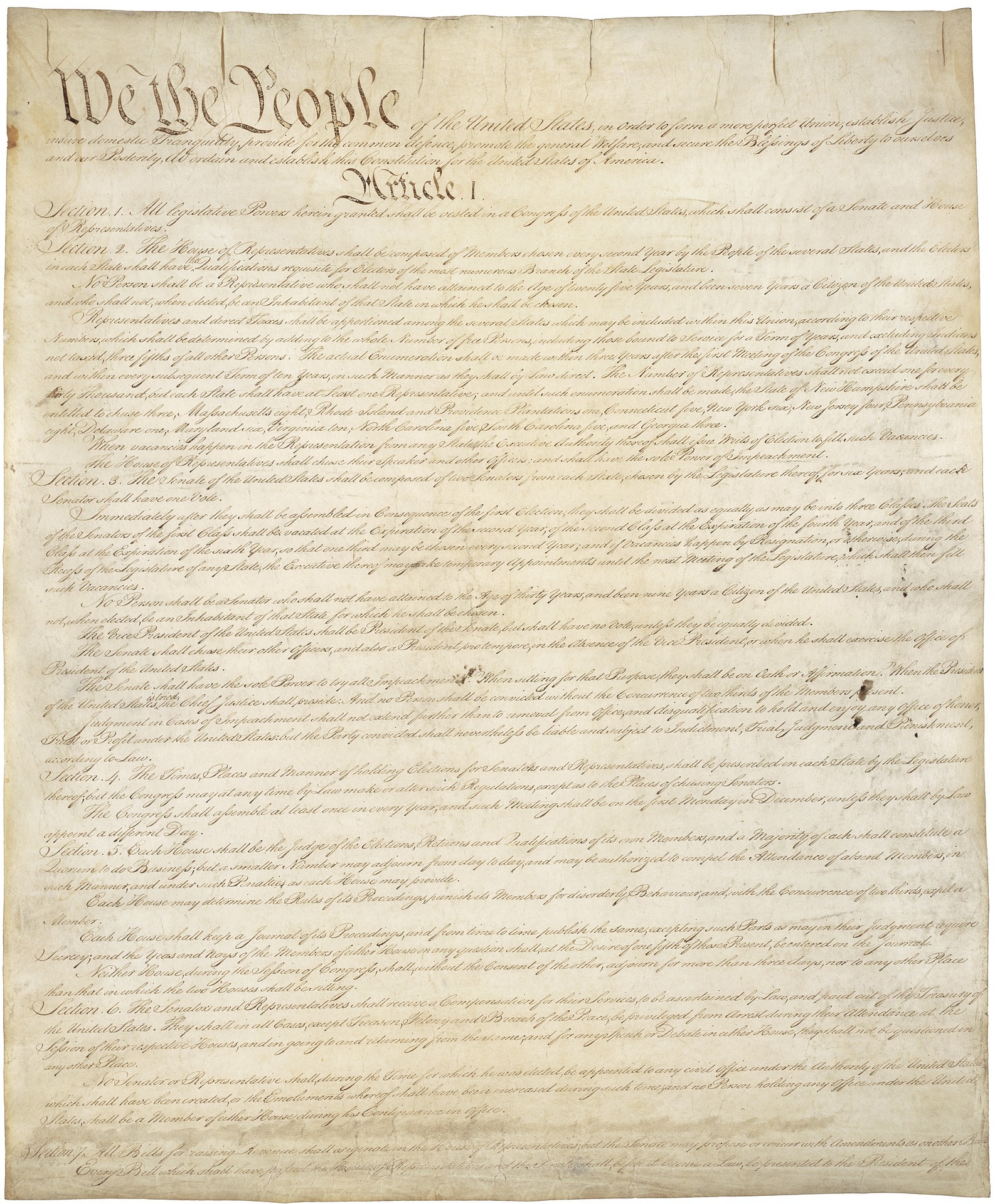
The United States Constitution
To understand why the Constitutional Convention of 1787 was necessary, one must first understand the governing instrument it replaced: the Articles of Confederation and Perpetual Union. Ratified by the thirteen original states on March 1, 1781, the Articles represented the first attempt by the American states to establish a formal framework for cooperation under a common government. They were, in many ways, a direct product of the colonial experience — a deeply suspicious reaction to the centralized power of the British Crown that had come to represent tyranny in the minds of revolutionary Americans.
Under the Articles, the United States was conceived as a loose confederation of sovereign states rather than a unified nation. Each state retained its sovereignty, freedom, and independence, and each state sent delegates to a unicameral Congress that served as the sole institution of the national government. There was no separate executive branch and no national judiciary. Congress could conduct foreign policy, declare war, and make treaties, but it lacked the power to levy taxes directly on the American people. Instead, it could only requisition funds from the states, which frequently ignored or delayed such requests. Congress could not regulate interstate or foreign commerce, leaving trade policy in a chaotic tangle of competing state laws. It could not compel states to comply with its resolutions or with treaties the national government had negotiated. Unanimous consent of all thirteen states was required to amend the Articles, making reform through the existing framework virtually impossible.
The structural deficiencies of the Articles became painfully apparent in the years immediately following the Revolutionary War. The national government found itself unable to service the enormous debts accumulated during the war, unable to enforce the terms of the Treaty of Paris that ended the conflict with Britain, and unable to compel states to treat British creditors fairly as the treaty required. British troops remained in a string of frontier forts in violation of the peace treaty, in part because the American government lacked the financial and military resources to force their removal. Spain closed the Mississippi River to American commerce, striking a devastating blow at western settlers who depended on the river for trade. Pirates from the Barbary Coast of North Africa attacked American merchant ships in the Mediterranean, and Congress had no means to fund a navy sufficient to protect them.
The economic situation within the states was equally dire. The post-war years brought deflation, tight credit, and widespread financial hardship, particularly for farmers and debtors. States printed their own money, often with little backing, and imposed duties on goods crossing their borders. New York taxed firewood from New Jersey and cattle from Connecticut. Virginia and Maryland squabbled over navigation rights on the Potomac River. The commercial chaos threatened to turn the fragile union of states into a collection of petty economic rivals.
Congress itself was barely functional. The Articles required that important measures receive the assent of nine of the thirteen states, and it was frequently impossible even to assemble a quorum. Delegates arrived late, left early, and often skipped sessions entirely. The national government was, in the words of George Washington, little more than a shadow without substance. Alexander Hamilton, writing in The Federalist, would later describe the national government under the Articles as one that could only recommend and not command, as a government that existed in the nominal sense of the word but lacked the essential requisites of authority.
The crisis of governance under the Articles of Confederation reached a dramatic turning point in the autumn of 1786 and winter of 1787, when an armed uprising in western Massachusetts brought the inadequacy of the national government into stark and unmistakable relief. The insurrection known as Shays' Rebellion was named for its principal leader, Daniel Shays, a former captain in the Continental Army who had served with distinction at the Battle of Bunker Hill. Shays and his followers were primarily poor farmers, many of them Revolutionary War veterans, who had fallen into debt in the years following the war.
The immediate causes of the rebellion were rooted in the severe economic depression that gripped rural Massachusetts in the mid-1780s. The state government, dominated by creditors and merchants in the eastern coastal towns, required that taxes be paid in hard currency — gold and silver — at a time when cash was desperately scarce in the agricultural interior. Farmers who could not pay their taxes or their debts faced the seizure of their property and imprisonment for debt. When the Massachusetts legislature refused to provide relief, groups of farmers began gathering in armed protest, marching on courthouses to prevent the prosecution of debt cases. The state government appealed to the national Congress for troops, but Congress, having no funds to pay soldiers, could not respond effectively. The crisis was ultimately suppressed in early 1787 by a militia force funded by wealthy Boston merchants and commanded by General Benjamin Lincoln — a conspicuously private solution to a public emergency.
The alarm that Shays' Rebellion sent through the political leadership of the new nation can scarcely be overstated. George Washington, in retirement at Mount Vernon, wrote to correspondents with unusual urgency, expressing his fear that the country was fast verging to anarchy and confusion and that, without a vigorous national government capable of maintaining order, everything the Revolution had achieved might be lost. Henry Knox, the former Secretary of War, reported to Washington that the insurgents of Massachusetts wanted to abolish all debts public and private, and to have a new division of property. James Madison observed that the situation revealed the fundamental weakness of a government that depended entirely on the voluntary compliance of its constituent members. Alexander Hamilton, never one to underestimate a crisis, concluded that a general government must be able to act upon individuals and not merely upon states, or it would never be capable of governing at all.
In September 1786, even before Shays' Rebellion had run its course, delegates from five states had met at Annapolis, Maryland, to discuss problems with interstate commerce. The meeting, which had been organized by Madison and which included Hamilton among its participants, was too sparsely attended to accomplish its ostensible purpose. But the delegates who gathered in Annapolis issued a report calling for a broader convention to be held the following May in Philadelphia, at which delegates from all thirteen states would consider measures necessary to render the constitution of the federal government adequate to the exigencies of the Union. The Congress of the Confederation, whose own inadequacy was precisely the subject of the proposed convention, endorsed the call in February 1787, authorizing the states to send delegates to Philadelphia for the sole and express purpose of revising the Articles of Confederation.
The Constitutional Convention convened at the Pennsylvania State House in Philadelphia on May 25, 1787 — the building now known to the world as Independence Hall, where the Declaration of Independence had been adopted eleven years earlier. The formal opening was delayed from the originally scheduled date of May 14 because of the tardiness with which delegates arrived from distant states, a delay that itself illustrated the communication and transportation challenges of the era. On May 25, when a quorum of seven states was finally present, the Convention organized itself for business.
The delegates almost immediately departed from their stated mandate to revise the Articles of Confederation. Within days it became clear that a majority intended to replace the Articles entirely with a new and substantially more powerful frame of government. This was a fateful and audacious decision. The convention had been authorized only to propose revisions, and it would be acting far beyond its legal mandate by scrapping the existing constitution altogether. But the delegates in Philadelphia — pragmatic men who believed the crisis of governance was acute — were determined to be equal to the moment.
The Convention voted at the outset to conduct its deliberations in strict secrecy, a decision that has been both praised and criticized by historians ever since. No official records were kept of the debates, though several delegates maintained private notes. The most invaluable of these records are the notes kept by James Madison, who sat at a table directly in front of the presiding officer and recorded the substance of each day's discussions with remarkable diligence. Madison's notes, not published until after his death in 1836, remain the most comprehensive account of what was said and argued in Philadelphia during those pivotal months.
The Convention met in formal session for nearly four months, from the end of May through September 17, 1787. The sessions were typically held six days a week, often running from late morning through the afternoon. The summer of 1787 was particularly hot and humid in Philadelphia, and the windows of the Assembly Room of Independence Hall were kept tightly shut to preserve the secrecy of the deliberations, adding physical discomfort to the intellectual intensity of the proceedings. Through all of this, the delegates wrestled with some of the most difficult questions in the theory and practice of republican government: How should power be divided between the national government and the states? How should the legislature be structured? How should the executive be constituted and selected? How should the interests of large and small states be balanced? And above all, how should the morally repugnant institution of slavery be accommodated within a constitutional framework premised on the ideals of liberty and equality?
Fifty-five delegates ultimately attended the Constitutional Convention, representing twelve of the thirteen states. Rhode Island, whose legislature was dominated by debtors suspicious of a powerful national government, declined to send any delegates at all — an absence noted with considerable irritation by the other states. The delegates who did attend were, by any measure, a remarkable gathering of political talent, legal learning, and practical experience in governance.
The oldest delegate was Benjamin Franklin of Pennsylvania, who was eighty-one years old and in frail health. Franklin was transported to and from the sessions in an enclosed sedan chair carried by prisoners from the Walnut Street jail, the only conveyance smooth enough for his painful case of gout. Though his contributions to the floor debates were limited by his age and health, Franklin's wisdom and moral authority were immensely valuable to the Convention, and his motion for a compromise resolution on the final day of deliberations helped to bring dissenters toward acceptance of the Constitution.
George Washington of Virginia was elected president of the Convention by unanimous vote on its opening day, a choice that was both obvious and indispensable. Washington's prestige was without equal in the new nation, and his presence at the Convention — and his implicit endorsement of whatever emerged from it — was widely understood to be crucial to its legitimacy and to the eventual ratification of any document it produced. Washington presided over the proceedings with characteristic dignity and restraint, rarely speaking on substantive matters but exercising a constant steadying influence on the proceedings.
James Madison of Virginia, though only thirty-six years old at the time, came to Philadelphia better prepared than any other delegate. He had spent months before the Convention studying the history and theory of republican governments, ancient and modern, and had drafted a detailed memorandum on the Vices of the Political System of the United States that served as an intellectual foundation for his contributions to the Convention. Madison arrived early, helped organize the Virginia delegation's proposal for a new government, and maintained the most comprehensive notes of the debates. His central role in shaping the Constitution's architecture earned him, in later years, the title of Father of the Constitution.
Alexander Hamilton of New York attended the Convention but played a somewhat limited role in its actual deliberations. His views were so extreme in the direction of strong central government — he proposed, on one occasion, a president and Senate serving during good behavior, essentially for life — that even delegates sympathetic to his general position found him impractical. His most significant contribution to the founding was to come after the Convention, in his authorship of the majority of the Federalist Papers. Hamilton also signed the Constitution as the sole delegate from New York; his two fellow delegates, Robert Yates and John Lansing, had left the Convention in protest before the signing.
Other notable delegates included Gouverneur Morris of Pennsylvania, who would play the crucial role of giving the Constitution its final literary form; James Wilson, also of Pennsylvania, one of the most legally learned men in America; John Dickinson of Delaware, who had drafted the Articles of Confederation; Roger Sherman of Connecticut, whose practical wisdom and political instincts would prove decisive in breaking the Convention's most dangerous impasse; Charles Pinckney and Charles Cotesworth Pinckney of South Carolina; Elbridge Gerry and Rufus King of Massachusetts; and Luther Martin and Daniel Carroll of Maryland. Several men who would later play major roles in American history were absent: Thomas Jefferson was serving as American minister to France, John Adams was minister to Britain, Patrick Henry refused to attend (reportedly declaring that he smelled a rat), and John Jay was occupied with his duties as Secretary of Foreign Affairs.
James Madison arrived in Philadelphia on May 5, two weeks before the Convention formally opened, and he used the intervening time to meet with fellow Virginia delegates and to continue the intellectual preparation he had been conducting for months. His document entitled Vices of the Political System of the United States, completed earlier in 1787, identified the fundamental problems of the existing confederation with analytical precision: the failure of states to comply with congressional requisitions, encroachments on the federal authority by the states, violations of the laws of nations and of treaties, trespasses of the states on the rights of each other, want of concert in matters where common interest requires it, want of guaranty to the states of their constitutions and laws against internal violence, want of sanction to the laws and of coercive power over delinquent members, and a lack of ratification by the people giving the general government sufficient authority.
Madison's solution to these problems was embodied in what would become known as the Virginia Plan — a comprehensive proposal for a radically new form of government that went far beyond anything the Convention's mandate technically permitted. The Virginia Plan called for a bicameral national legislature with representation proportioned to population in both chambers; a national executive chosen by the legislature; a national judiciary; and a national veto over state laws — the last being perhaps the most controversial of Madison's proposals. The plan gave the national government direct coercive power over individuals, not merely over states, and it effectively proposed to transform the confederation of sovereign states into a single national government.
Beyond his specific proposals, Madison's broader contribution to the Convention was intellectual and analytical. He understood, with unusual clarity, the theory of republican government that was being tested and refined in America. His concept of an extended republic — the idea that a large, diverse nation was actually better suited to republican governance than a small, homogenous community, because the very size and diversity of the nation would prevent any single faction from dominating — became one of the most influential ideas in American political thought, later elaborated in Federalist No. 10. Madison also articulated the crucial principle of separated powers with checks and balances, drawing on Montesquieu and refining the concept for American application.
It was not Madison's Virginia Plan, however, that ultimately emerged as the Constitution. The Convention substantially modified his proposals in ways he often found disappointing. The Senate was structured on the basis of equal state representation rather than population, a compromise Madison initially opposed. The national veto over state laws was rejected. The executive was made independently selected rather than chosen by the legislature. Madison later acknowledged that the Constitution was not the work of any single mind but rather the product of many minds and many compromises — a complex negotiation among men who disagreed on fundamental questions and found their way, imperfectly but remarkably, to a workable consensus.
The Virginia Plan, presented to the Convention on May 29, 1787, by Edmund Randolph of Virginia, represented the agenda of the large states and of those delegates most committed to a strong national government. The plan proposed a bicameral legislature with representation based on either population or financial contributions to the national treasury; a separate national executive chosen by the legislature; and a national judiciary. Crucially, the national legislature under the Virginia Plan would have the power to legislate in all cases in which the states were separately incompetent or in which the harmony of the United States might be interrupted by the exercise of individual legislation. The plan also proposed that the national government could negatively nullify all state laws contrary to the articles of union.
The Virginia Plan was greeted with immediate and intense opposition from delegates representing the smaller states. New Jersey, Delaware, Connecticut, and Maryland sent delegates who feared that a legislature based on population would overwhelm the interests of less populous states and render them essentially powerless in the new government. These delegates coalesced around an alternative proposal presented by William Paterson of New Jersey on June 15, 1787: the New Jersey Plan.
The New Jersey Plan proposed to retain the basic structure of the Articles of Confederation — a single-chamber legislature in which each state had one vote — while significantly strengthening the powers of the national government. Congress would be given the power to levy taxes and regulate commerce, and its acts and treaties would be declared the supreme law of the respective states. A plural executive and a federal judiciary would be created. But the fundamental principle of the Articles — equal state representation — would be preserved.
The debate between the Virginia and New Jersey Plans consumed much of June and drove the Convention to the edge of collapse. On June 28, a visibly agitated Benjamin Franklin rose to address the Convention and proposed opening each day's session with a prayer, observing that in the beginning of the contest with Britain, the Convention had daily prayer in this room for divine protection. Franklin's motion was not adopted — the Convention had no funds to pay a chaplain and feared that bringing one in might signal alarm to the public — but the episode illustrated how desperate the situation had become. The clash between large and small states over representation appeared irreconcilable.
The resolution to the great impasse between the Virginia and New Jersey Plans came in the form of what is known as the Great Compromise, or the Connecticut Compromise, proposed in its essential form by Roger Sherman of Connecticut and Oliver Ellsworth, also of Connecticut. Sherman was one of the most experienced and pragmatic men in the Convention — he had signed both the Declaration of Independence and the Articles of Confederation, and he had a gift for finding workable middle ground in contentious disputes.
The Connecticut Compromise proposed a solution elegant in its simplicity: a bicameral legislature in which the lower house, the House of Representatives, would be apportioned by population, satisfying the large states, while the upper house, the Senate, would give each state equal representation with two senators per state, satisfying the small states. All revenue bills would originate in the House. The Senate would have special powers over treaties and appointments. The two chambers would serve as checks on each other, requiring agreement between both to enact legislation.
A committee of eleven delegates, one from each state, was appointed on July 2 to work out the details of the compromise. The committee, chaired by Elbridge Gerry of Massachusetts, presented its report on July 5, and after further debate the Convention voted to accept the compromise on July 16 by a margin of five states to four, with one state divided. The vote was agonizingly close, and Madison and several other delegates from large states were bitterly disappointed. Madison believed that equal state representation in the Senate was a concession to state sovereignty that would in the long run undermine the national character of the government and lead to gridlock. His fears were not entirely unfounded, but the compromise was the price of union, and without it there might have been no Constitution at all.
The Connecticut Compromise shaped the subsequent architecture of the Convention's deliberations and ultimately of the Constitution itself. With the fundamental question of representation resolved, the delegates could turn to the many other difficult issues that remained: the nature of the executive, the structure and jurisdiction of the federal judiciary, the regulation of commerce, the powers of Congress, and above all, the deeply divisive questions surrounding slavery.
Of all the compromises reached at the Constitutional Convention, none was more morally fraught or more consequential for the subsequent history of the nation than the Three-Fifths Compromise. The question of how to count enslaved people in determining representation and direct taxation was one of the Convention's most contentious, and it drove a sharp geographic wedge between the delegates from the northern and southern states.
The issue was essentially one of political power. Delegates from the southern states, where enslaved people constituted a significant fraction of the population, wanted enslaved people counted for purposes of determining each state's representation in the House of Representatives. More enslaved people counted would mean more representatives for the southern states. Delegates from the northern states, where slavery was uncommon or declining, objected strenuously: if enslaved people were property, as the southerners insisted when it served their interests, they should not be counted for representation any more than horses or cattle. But if they were to be counted for representation, they should also be counted for taxation.
The compromise that resolved this impasse had its roots in a 1783 proposal for apportioning taxes among the states, and it allocated a fractional value to each enslaved person for the purpose of both representation and direct taxation. The specific fraction chosen was three-fifths — a number that had no particular philosophical justification but that reflected a rough negotiated middle point between counting no enslaved people and counting all of them. The Three-Fifths Compromise was written into Article I, Section 2 of the Constitution, where representatives and direct taxes were to be apportioned by adding to the whole number of free persons the number of those bound to service for a term of years, excluding Indians not taxed, and three fifths of all other persons — a carefully crafted euphemism that never used the words slave or slavery.
The political consequences of the Three-Fifths Compromise were enormous. By counting three-fifths of the enslaved population for apportionment purposes, the southern states received substantially more seats in the House of Representatives than they would have if enslaved people had not been counted at all. This extra representation — sometimes called the slave power in antebellum political debates — allowed the South to exercise disproportionate influence over national policy, including the selection of presidents through the Electoral College, for the first several decades of the republic. Several of the first nine presidents were Virginia slaveholders, and the slave power influence on national policy would remain a defining feature of American politics until the Civil War.
The Three-Fifths Compromise was one of the Constitution's original sins — a moral accommodation to the institution of slavery that contradicted the Declaration of Independence's proclamation that all men are created equal. It was effectively nullified by Section 2 of the Fourteenth Amendment in 1868, which required that representatives be apportioned by counting the whole number of persons in each state.
Slavery generated two additional major compromises at the Constitutional Convention, both related to the regulation of commerce and the international slave trade. These compromises further illustrated the extent to which the Constitution's framers were willing to accommodate slavery in order to secure the participation of the southern states in the union.
The first was the Commerce Compromise. The southern states feared that a national government with the power to regulate commerce might use that power to impose export taxes on southern agricultural products, particularly tobacco and rice, or to require that American goods be shipped on American vessels — a requirement that might benefit northern shipbuilders and merchants at the expense of southern planters who relied on cheaper British shipping. Delegates from South Carolina and Georgia threatened to walk out of the Convention if Congress were given unrestricted power over commerce. A committee negotiated a resolution: Congress would have the power to regulate commerce and impose tariffs on imports, but it could impose no taxes on exports, and it could not interfere with the importation of enslaved people until 1808 — a period of twenty years during which the international slave trade would be constitutionally protected.
The second was the Fugitive Slave Clause. Article IV, Section 2 of the Constitution required that any person held to service or labor in one state, under the laws thereof, escaping into another, shall be delivered up on claim of the party to whom such service or labor may be due. This provision required the free states to participate in the enforcement of slavery by returning escaped enslaved people to their owners — a requirement that would generate fierce political controversy in the antebellum era and that was effectively overridden by the Thirteenth Amendment in 1865.
These commerce and slavery compromises, taken together, represented a fundamental bargain between the northern and southern states: the North got a strong national government with broad powers over commerce, while the South got constitutional protection for slavery and the slave trade for at least two decades, plus a fugitive slave clause that obligated the northern states to cooperate in the enforcement of southern slave codes. It was a bargain that many Americans in subsequent generations would come to view as a deeply immoral foundation for the republic.
With the major structural questions resolved by mid-July 1787, the Convention turned the task of drafting a detailed constitutional text to a Committee of Detail, appointed on July 24. The committee consisted of five members: John Rutledge of South Carolina (chairman), Edmund Randolph of Virginia, Nathaniel Gorham of Massachusetts, Oliver Ellsworth of Connecticut, and James Wilson of Pennsylvania. The Convention then recessed from July 26 to August 6 to allow the committee to do its work.
The Committee of Detail performed the essential work of translating the Convention's resolutions into an actual constitutional text. Working from the various resolutions the Convention had adopted, from the Virginia and New Jersey Plans, from the constitutions of the individual states, and from the Articles of Confederation, the committee drafted a preliminary text that was presented to the full Convention on August 6. This draft, which ran to twenty-three articles, established the basic organization that would survive in the final Constitution, including the enumeration of Congress's legislative powers in Article I, Section 8 — the famous enumerated powers clause — and the Supremacy Clause of Article VI.
The Convention then spent another six weeks in detailed deliberation over the committee's draft, debating specific provisions, accepting some, rejecting others, and modifying many. By early September, the Convention had reached substantial agreement on the text of the Constitution. On September 8, a Committee of Style and Arrangement was appointed to give the document its final literary form, to consolidate and arrange its provisions in clear and elegant language, and to remove inconsistencies and redundancies.
The Committee of Style consisted of five members: William Samuel Johnson of Connecticut (chairman), Alexander Hamilton of New York, Gouverneur Morris of Pennsylvania, James Madison of Virginia, and Rufus King of Massachusetts. The committee worked quickly, presenting its final draft to the Convention on September 12. The document they produced was substantially the text of the Constitution as it was ultimately signed five days later.
The actual writing of the Constitution's final text was the work primarily of one man: Gouverneur Morris of Pennsylvania. Morris was assigned the task by the Committee of Style and executed it with remarkable skill, transforming the disjointed resolutions and committee drafts of the Convention into a document of unusual clarity, elegance, and precision. Morris was perhaps the most gifted prose stylist among the delegates, and he approached the task with both the lawyer's attention to exactitude and the writer's sensitivity to language.
Morris made numerous substantive alterations to the draft in the process of giving it literary form — changes that were not merely stylistic but that affected the meaning of specific provisions. Most famously, he transformed the Preamble from a listing of the states that were parties to the Constitution — We the People of the States of New Hampshire, Massachusetts, and so on through all thirteen — to the majestic and now universally recognized opening: We the People of the United States, in Order to form a more perfect Union, establish Justice, insure domestic Tranquility, provide for the common defence, promote the general Welfare, and secure the Blessings of Liberty to ourselves and our Posterity, do ordain and establish this Constitution for the United States of America. This transformation was not merely rhetorical: by grounding the Constitution in the authority of the people of the United States as a whole rather than in the authority of the individual states, Morris gave the document a nationalist character that would prove enormously significant in subsequent interpretations.
Morris also wrote the final text with the engrosser Jacob Shallus, an assistant clerk to the Pennsylvania General Assembly, who physically inscribed the Constitution on four large sheets of parchment in the elegant calligraphic hand that would be preserved for posterity at the National Archives. Shallus worked through the night of September 16 to have the document ready for signing the following day.
The physical document that emerged from this process was not a long one — four pages of parchment, approximately 4,500 words in its original seven articles — but it was of a compressed density unusual in legal drafting, each provision carrying enormous weight and implications that generations of lawyers, judges, and scholars would continue to unpack long after its framers were gone.
On September 17, 1787, the final day of the Constitutional Convention, the delegates gathered in the Assembly Room of Independence Hall for the solemn ceremony of signing. The day began with a final address by Benjamin Franklin, who had prepared remarks that he was too frail to deliver himself and so asked James Wilson to read on his behalf. Franklin acknowledged that there were provisions of the Constitution that he did not personally approve, but he observed that no such complex document, drafted by so many minds in so short a time, could be perfect, and that he marveled that it should approach so near to perfection as it did. He urged every delegate present who had objections to the document to doubt a little of his own infallibility and to sign it.
The motion before the Convention was framed with characteristic political ingenuity by Gouverneur Morris, who proposed that the Constitution be signed by the delegates in their capacity as witnesses to the unanimous consent of the states present, rather than as individuals giving their personal agreement. This formula was designed to make it easier for delegates with reservations to sign — they would be witnessing the agreement of their states rather than personally endorsing every provision. It was a subtle but important distinction.
When the moment came for signing, thirty-nine of the forty-one delegates then present affixed their names to the document. George Washington signed first, as president of the Convention, followed by the other delegates in geographic order from north to south. The thirty-nine signers represented twelve states — all the states that had sent delegations, minus the three whose delegates refused to sign. The signatures appear at the foot of the final page, organized by state, with William Jackson's attestation as secretary beneath them.
Franklin, after the signing was complete, pointed to the painting of a sun on the back of the president's chair that Washington had occupied throughout the Convention. He observed that artists always found it difficult to distinguish a rising sun from a setting sun in their paintings, and that throughout the proceedings he had often looked at that picture and wondered whether it was rising or setting. Now, at last, he said, I have the happiness to know that it is a rising and not a setting sun. It was the kind of moment that becomes historical legend because it captures, with perfect compression, the meaning of what has just occurred.
The signed Constitution was then transmitted to the Congress of the Confederation sitting in New York, which forwarded it to the states on September 28, 1787, for ratification — a process that would prove at least as contentious and dramatic as the Convention itself.
Three delegates who were present on September 17, 1787, declined to sign the Constitution: George Mason of Virginia, Edmund Randolph of Virginia, and Elbridge Gerry of Massachusetts. Their refusals reflected genuine and substantial objections to the document, not mere pique, and their criticisms helped to shape the subsequent ratification debate and, ultimately, the adoption of the Bill of Rights.
George Mason was the author of the Virginia Declaration of Rights of 1776, one of the earliest and most influential American bills of rights, and he had attended the Convention with deep commitment to the protection of individual liberties. His principal objection to the Constitution was that it contained no bill of rights — no explicit enumeration of the fundamental rights of American citizens that the national government would be forbidden to violate. Mason had moved on the Convention's last day that a committee be appointed to draft a bill of rights to be prefixed to the Constitution, but the motion was rejected by a vote of ten states to none, the delegates apparently believing that the existing state constitutions provided adequate protection and that enumerated rights were unnecessary in a government of limited enumerated powers. Mason also objected to the Constitution's provisions protecting the slave trade for twenty years, to the Commerce Clause's authorization of Congress to enact navigation acts by a simple majority rather than a two-thirds supermajority, and to the absence of a council of state to advise the president.
Edmund Randolph of Virginia had actually introduced the Virginia Plan at the beginning of the Convention and had been one of its most active participants. But by September, he had come to believe that the document before him was flawed in ways he could not in good conscience endorse. Like Mason, he objected primarily to the lack of a bill of rights. He also believed the Constitution gave too much power to the Senate. Randolph proposed that the state ratifying conventions be authorized to propose amendments, which would then be considered by a second federal convention before the Constitution took effect. When this proposal was rejected, he declined to sign.
Elbridge Gerry of Massachusetts had participated actively in the Convention and had served on the Committee of Detail. His objections were numerous: he was disturbed by the power of the vice president to preside over the Senate, concerned about the broad powers of Congress, troubled by the absence of a bill of rights, and alarmed by what he saw as the potentially aristocratic tendencies of the new government. Despite his refusal to sign, Gerry would later serve as governor of Massachusetts, vice president under James Madison, and a member of both the House and Senate — and he would lend his name, through a notorious piece of electoral gerrymandering he approved as governor, to the political practice known as gerrymandering.
Their absence from the signatories did not, in the end, prevent the Constitution's ratification, but it gave the Anti-Federalists respectable and articulate voices in the debate that followed.
The Constitution that emerged from Independence Hall on September 17, 1787, was not the law of the land. It would not become law until ratified by at least nine of the thirteen states, as provided by Article VII. And ratification was not certain. Almost immediately, the document generated fierce and sophisticated opposition from Americans who feared that the new national government it created would destroy the sovereignty of the states, oppress the people with excessive taxes, and lead ultimately to monarchy or tyranny.
The ratification debate was one of the most intellectually rich and politically consequential public arguments in American history. On one side stood the Federalists — those who supported the Constitution — arguing that the new frame of government was necessary to save the republic from the chaos and weakness of the Articles of Confederation. On the other stood the Anti-Federalists, who offered a sophisticated critique of the Constitution's concentration of power, its lack of a bill of rights, and its potential threat to both state sovereignty and individual liberty. The debate played out in pamphlets, newspapers, town meetings, and state ratifying conventions across the country, generating an outpouring of political argumentation that has never been fully equaled in the American experience.
The Federalist side was led by men of extraordinary ability and organizational skill. Alexander Hamilton coordinated the effort in New York, one of the most hostile states; James Madison and John Jay joined him in producing the Federalist Papers. In Virginia, the Federalist cause was championed by Madison, John Marshall, and Edmund Randolph, who overcame his earlier refusal to sign and endorsed ratification. In Massachusetts, Rufus King and Nathaniel Gorham worked to persuade a skeptical convention.
The Anti-Federalist opposition was equally talented and equally earnest. In Virginia, the redoubtable Patrick Henry dominated the ratifying convention with forensic brilliance, delivering speech after speech against the Constitution's alleged dangers to liberty and state sovereignty. George Mason, who had refused to sign, provided intellectual ammunition for the opposition. In New York, Robert Yates and John Lansing argued against ratification. In Massachusetts, opponents included some of the state's most respected figures. The anonymous Anti-Federalist authors published under names like Brutus, Centinel, the Federal Farmer, and the Federal Republican, producing pamphlets and essays that remain important documents of American political thought to this day.
The most enduring intellectual product of the ratification debate was a series of eighty-five essays written by Alexander Hamilton, James Madison, and John Jay, published in New York newspapers between October 1787 and May 1788 under the collective pseudonym Publius. These essays, known collectively as The Federalist Papers or simply The Federalist, were written primarily to persuade the citizens of New York to support ratification, but they quickly achieved a broader significance as the most authoritative and sophisticated exposition of the Constitution's purposes and principles.
Hamilton was the driving force behind the project and its most prolific contributor, writing fifty-one of the eighty-five essays. Madison contributed twenty-nine essays, including the two most celebrated: Federalist No. 10, which argued that a large republic was better suited than a small one to the control of faction and the protection of minority rights, and Federalist No. 51, which articulated the theory of separated powers and checks and balances with the formula: Ambition must be made to counteract ambition. John Jay, then serving as Secretary of Foreign Affairs, contributed five essays dealing primarily with foreign policy.
Federalist No. 10 stands as perhaps the most influential single piece of American political theory. In it, Madison argued against the conventional wisdom, associated with the French philosopher Montesquieu, that republican government was suitable only for small territories. Madison contended that in an extended republic encompassing a great variety of interests, parties, and sects, the very multiplicity of factions would prevent any single faction from oppressing others. A large republic, Madison argued, would better protect minority rights precisely because no single majority would be permanently dominant, forcing coalitions that must appeal to diverse interests. This insight — that size and diversity were constitutional virtues rather than vices — represented a fundamental contribution to republican theory.
The Federalist Papers were recognized as authoritative from an early date. Thomas Jefferson, writing to Madison, called them the best commentary on the principles of government which was ever written. The Supreme Court has cited them thousands of times as evidence of the framers' intent in interpreting constitutional provisions. Scholars and politicians around the world have looked to them as a guide to the principles underlying the American constitutional system. They remain, more than two centuries after their publication, essential reading for anyone who wishes to understand the Constitution and the philosophy of government it embodies.
The Anti-Federalists were not merely opponents of the Constitution; they were the advocates of an alternative vision of republican government that has never entirely disappeared from American political discourse. Their central concern was power — specifically, the fear that concentrated power, however nominally constrained by parchment barriers, would inevitably corrupt and oppress. They drew on a long tradition of British and American political thought, associated with the Country party tradition and the writings of such figures as John Trenchard and Thomas Gordon, that regarded concentrated governmental power as the eternal enemy of liberty.
The most intellectually powerful of the Anti-Federalist arguments came from the anonymous essays of Brutus, published in New York between October 1787 and April 1788 and now generally attributed to Robert Yates of New York. Brutus argued, among other things, that the Supremacy Clause and the Necessary and Proper Clause gave Congress virtually unlimited power to legislate on any matter it chose; that the federal judiciary, composed of judges with lifetime tenure accountable to no one, would inevitably expand the powers of the national government at the expense of the states; and that a republic as large as the United States could not be governed on genuinely republican principles because the representatives would be too distant from their constituents to truly represent their interests and concerns.
The Federal Farmer, another influential Anti-Federalist writer, raised the absence of a bill of rights as a fundamental objection. If the new national government had the power to tax, to regulate commerce, to raise armies and navies, and to do everything else the Constitution authorized, what guarantee did American citizens have that it would not use those powers to violate their fundamental liberties — freedom of speech, freedom of the press, freedom of religion, the right to trial by jury, protection against unreasonable searches and seizures? The Constitution as drafted provided no such guarantee. Federalists responded that a bill of rights was unnecessary in a government of enumerated powers, since whatever was not granted was not possessed, but this argument failed to satisfy many Americans who had vivid memories of British violations of colonial liberties.
The demand for a bill of rights proved to be the most potent and ultimately the most productive of the Anti-Federalist arguments. Several state ratifying conventions, including Massachusetts, recommended amendments to the Constitution as a condition of ratification. James Madison, who had initially opposed a bill of rights as unnecessary and potentially harmful (because a list of protected rights might imply that rights not listed were not protected), came to recognize its political necessity and became its primary champion in the First Congress. The result was the first ten amendments to the Constitution — the Bill of Rights — ratified in 1791.
The ratification campaign proceeded state by state, with each state holding a specially elected ratifying convention to consider the Constitution. The Confederation Congress had specified that ratification would require the approval of nine of the thirteen states, as Article VII prescribed. Delaware was the first to ratify, doing so unanimously on December 7, 1787. Pennsylvania followed on December 12, despite bitter Anti-Federalist opposition that led to accusations of procedural railroading.
New Jersey ratified unanimously on December 18, 1787, and Georgia followed suit unanimously on January 2, 1788. Connecticut ratified on January 9, 1788, by a comfortable margin. Massachusetts was the first major test of Federalist resolve: the state's convention was initially opposed to ratification, and the outcome was in doubt until John Hancock, the presiding officer, and Samuel Adams, the great popular hero of the Revolution, were persuaded to support ratification with a recommendation that a bill of rights be adopted as amendments. Massachusetts ratified on February 6, 1788, by the relatively narrow margin of 187 to 168, accompanied by proposed amendments.
Maryland ratified on April 28, 1788, by 63 to 11. South Carolina ratified on May 23, 1788, by 149 to 73. New Hampshire became the crucial ninth state, the one required to bring the Constitution into legal effect, ratifying on June 21, 1788, by 57 to 47. With New Hampshire's ratification, the Constitution of the United States became the supreme law of the land for the ratifying states.
But the new government could not function without the two most important states: Virginia and New York. Virginia's ratifying convention was the most intellectually distinguished deliberative body in America, featuring Patrick Henry, George Mason, and James Monroe on the Anti-Federalist side and James Madison, John Marshall, George Wythe, and Edmund Randolph on the Federalist side. After weeks of debate, Virginia ratified on June 25, 1788, by 89 to 79. New York, where Hamilton had labored heroically to overcome fierce opposition, ratified on July 26, 1788, by the extraordinarily narrow margin of 30 to 27, accompanied by recommendations for numerous amendments.
North Carolina declined to ratify in its first convention, holding out until November 1789, after the new government had been established and the Bill of Rights had been proposed. Rhode Island, which had boycotted the Constitutional Convention entirely, did not ratify until May 29, 1790 — after the new government had been operating for more than a year — and then only by the paper-thin margin of 34 to 32.
The First Congress of the United States met in New York City in March 1789. George Washington was inaugurated as the first President on April 30, 1789. The Constitution of the United States was in operation.
The Constitution of the United States is organized into a Preamble, seven Articles, and twenty-seven Amendments. Its organization reflects the fundamental architecture of the government it establishes: a separation of powers among three branches of the federal government, a federal system dividing authority between the national government and the states, and a mechanism for orderly constitutional change through the amendment process.
Article I, the longest article, establishes the legislative branch: the Congress of the United States, consisting of the Senate and the House of Representatives. It defines the qualifications, terms of office, and compensation of members; enumerates the powers granted to Congress; and specifies both the limitations on congressional power and the limitations on state legislative power. Article I, Section 8 contains the enumerated powers of Congress, including the power to lay and collect taxes, borrow money, regulate commerce, coin money, establish post offices, declare war, raise armies, and — crucially — to make all laws which shall be necessary and proper for carrying into execution the foregoing powers. This last clause, the Necessary and Proper Clause, has been the basis for an enormous expansion of federal legislative power through the course of American history.
Article II establishes the executive branch. It vests the executive power in a President of the United States, who serves a four-year term together with a Vice President chosen by the same process. It defines the method of presidential election through the Electoral College, the qualifications for the office, the president's powers and duties, and the provisions for removal through impeachment. Article III establishes the judicial branch, vesting the judicial power of the United States in one Supreme Court and in such inferior courts as Congress may establish. It defines the jurisdiction of the federal courts and provides for jury trial in criminal cases and the specific definition of treason.
Articles IV through VII address miscellaneous but important matters: the relationship among the states and between the states and the federal government (Article IV); the process for amending the Constitution (Article V); the supremacy of the Constitution, federal law, and treaties over state law (Article VI); and the ratification process (Article VII).
The Preamble to the Constitution is the document's most famous passage, a statement of purpose so beautifully composed and so compactly meaningful that it has been memorized by generations of American schoolchildren and cited by advocates of every conceivable constitutional position. The Preamble was written in its final form by Gouverneur Morris, who transformed it from a mere listing of the ratifying states into a declaration of the sovereign authority of the American people.
The Preamble reads as follows in the original:
We the People of the United States, in Order to form a more perfect Union, establish Justice, insure domestic Tranquility, provide for the common defence, promote the general Welfare, and secure the Blessings of Liberty to ourselves and our Posterity, do ordain and establish this Constitution for the United States of America.
Each of its stated purposes has become a touchstone of constitutional argument. The formation of a more perfect Union invokes both the inadequacy of the Articles of Confederation and the aspirational quality of the constitutional project — it is not a perfect union that is promised, but a more perfect one, acknowledging the imperfection of any human institution. The establishment of Justice has been cited in arguments for and against nearly every major constitutional development from the Civil War amendments to modern civil rights legislation. The insuring of domestic Tranquility invokes the concern, sharpened by Shays' Rebellion, for internal order. The provision for the common defence explains one of the federal government's most fundamental responsibilities. The promotion of the general Welfare has been used to justify an enormous range of federal programs and activities. And the securing of the Blessings of Liberty to ourselves and our Posterity has served as the ultimate statement of the Constitution's purpose: not merely to organize government, but to protect the freedom of those who live under it and those who will come after.
The Preamble does not itself grant any powers to the federal government; it is a statement of intent rather than a conferral of authority. Courts have consistently held that the Preamble cannot be used as an independent source of federal power. But as a guide to the purposes of the Constitution and as a statement of the values it is meant to serve, the Preamble occupies a unique place in American constitutional culture.
The following is the complete verbatim text of the Constitution of the United States as transcribed by the National Archives from the original parchment document on display in the Rotunda of the National Archives Museum in Washington, D.C. The spelling and punctuation reflect the original.
We the People of the United States, in Order to form a more perfect Union, establish Justice, insure domestic Tranquility, provide for the common defence, promote the general Welfare, and secure the Blessings of Liberty to ourselves and our Posterity, do ordain and establish this Constitution for the United States of America.
All legislative Powers herein granted shall be vested in a Congress of the United States, which shall consist of a Senate and House of Representatives.
The House of Representatives shall be composed of Members chosen every second Year by the People of the several States, and the Electors in each State shall have the Qualifications requisite for Electors of the most numerous Branch of the State Legislature.
No Person shall be a Representative who shall not have attained to the Age of twenty five Years, and been seven Years a Citizen of the United States, and who shall not, when elected, be an Inhabitant of that State in which he shall be chosen.
Representatives and direct Taxes shall be apportioned among the several States which may be included within this Union, according to their respective Numbers, which shall be determined by adding to the whole Number of free Persons, including those bound to Service for a Term of Years, and excluding Indians not taxed, three fifths of all other Persons. The actual Enumeration shall be made within three Years after the first Meeting of the Congress of the United States, and within every subsequent Term of ten Years, in such Manner as they shall by Law direct. The Number of Representatives shall not exceed one for every thirty Thousand, but each State shall have at Least one Representative; and until such enumeration shall be made, the State of New Hampshire shall be entitled to chuse three, Massachusetts eight, Rhode-Island and Providence Plantations one, Connecticut five, New-York six, New Jersey four, Pennsylvania eight, Delaware one, Maryland six, Virginia ten, North Carolina five, South Carolina five, and Georgia three.
When vacancies happen in the Representation from any State, the Executive Authority thereof shall issue Writs of Election to fill such Vacancies.
The House of Representatives shall chuse their Speaker and other Officers; and shall have the sole Power of Impeachment.
The Senate of the United States shall be composed of two Senators from each State, chosen by the Legislature thereof, for six Years; and each Senator shall have one Vote.
Immediately after they shall be assembled in Consequence of the first Election, they shall be divided as equally as may be into three Classes. The Seats of the Senators of the first Class shall be vacated at the Expiration of the second Year, of the second Class at the Expiration of the fourth Year, and of the third Class at the Expiration of the sixth Year, so that one third may be chosen every second Year; and if Vacancies happen by Resignation, or otherwise, during the Recess of the Legislature of any State, the Executive thereof may make temporary Appointments until the next Meeting of the Legislature, which shall then fill such Vacancies.
No Person shall be a Senator who shall not have attained to the Age of thirty Years, and been nine Years a Citizen of the United States, and who shall not, when elected, be an Inhabitant of that State for which he shall be chosen.
The Vice President of the United States shall be President of the Senate, but shall have no Vote, unless they be equally divided.
The Senate shall chuse their other Officers, and also a President pro tempore, in the Absence of the Vice President, or when he shall exercise the Office of President of the United States.
The Senate shall have the sole Power to try all Impeachments. When sitting for that Purpose, they shall be on Oath or Affirmation. When the President of the United States is tried, the Chief Justice shall preside: And no Person shall be convicted without the Concurrence of two thirds of the Members present.
Judgment in Cases of Impeachment shall not extend further than to removal from Office, and disqualification to hold and enjoy any Office of honor, Trust or Profit under the United States: but the Party convicted shall nevertheless be liable and subject to Indictment, Trial, Judgment and Punishment, according to Law.
The Times, Places and Manner of holding Elections for Senators and Representatives, shall be prescribed in each State by the Legislature thereof; but the Congress may at any time by Law make or alter such Regulations, except as to the Places of chusing Senators.
The Congress shall assemble at least once in every Year, and such Meeting shall be on the first Monday in December, unless they shall by Law appoint a different Day.
Each House shall be the Judge of the Elections, Returns and Qualifications of its own Members, and a Majority of each shall constitute a Quorum to do Business; but a smaller Number may adjourn from day to day, and may be authorized to compel the Attendance of absent Members, in such Manner, and under such Penalties as each House may provide.
Each House may determine the Rules of its Proceedings, punish its Members for disorderly Behaviour, and, with the Concurrence of two thirds, expel a Member.
Each House shall keep a Journal of its Proceedings, and from time to time publish the same, excepting such Parts as may in their Judgment require Secrecy; and the Yeas and Nays of the Members of either House on any question shall, at the Desire of one fifth of those Present, be entered on the Journal.
Neither House, during the Session of Congress, shall, without the Consent of the other, adjourn for more than three days, nor to any other Place than that in which the two Houses shall be sitting.
The Senators and Representatives shall receive a Compensation for their Services, to be ascertained by Law, and paid out of the Treasury of the United States. They shall in all Cases, except Treason, Felony and Breach of the Peace, be privileged from Arrest during their Attendance at the Session of their respective Houses, and in going to and returning from the same; and for any Speech or Debate in either House, they shall not be questioned in any other Place.
No Senator or Representative shall, during the Time for which he was elected, be appointed to any civil Office under the Authority of the United States, which shall have been created, or the Emoluments whereof shall have been encreased during such time; and no Person holding any Office under the United States, shall be a Member of either House during his Continuance in Office.
All Bills for raising Revenue shall originate in the House of Representatives; but the Senate may propose or concur with Amendments as on other Bills.
Every Bill which shall have passed the House of Representatives and the Senate, shall, before it become a Law, be presented to the President of the United States; If he approve he shall sign it, but if not he shall return it, with his Objections to that House in which it shall have originated, who shall enter the Objections at large on their Journal, and proceed to reconsider it. If after such Reconsideration two thirds of that House shall agree to pass the Bill, it shall be sent, together with the Objections, to the other House, by which it shall likewise be reconsidered, and if approved by two thirds of that House, it shall become a Law. But in all such Cases the Votes of both Houses shall be determined by yeas and Nays, and the Names of the Persons voting for and against the Bill shall be entered on the Journal of each House respectively. If any Bill shall not be returned by the President within ten Days (Sundays excepted) after it shall have been presented to him, the Same shall be a Law, in like Manner as if he had signed it, unless the Congress by their Adjournment prevent its Return, in which Case it shall not be a Law.
Every Order, Resolution, or Vote to which the Concurrence of the Senate and House of Representatives may be necessary (except on a question of Adjournment) shall be presented to the President of the United States; and before the Same shall take Effect, shall be approved by him, or being disapproved by him, shall be repassed by two thirds of the Senate and House of Representatives, according to the Rules and Limitations prescribed in the Case of a Bill.
The Congress shall have Power To lay and collect Taxes, Duties, Imposts and Excises, to pay the Debts and provide for the common Defence and general Welfare of the United States; but all Duties, Imposts and Excises shall be uniform throughout the United States;
To borrow Money on the credit of the United States;
To regulate Commerce with foreign Nations, and among the several States, and with the Indian Tribes;
To establish an uniform Rule of Naturalization, and uniform Laws on the subject of Bankruptcies throughout the United States;
To coin Money, regulate the Value thereof, and of foreign Coin, and fix the Standard of Weights and Measures;
To provide for the Punishment of counterfeiting the Securities and current Coin of the United States;
To establish Post Offices and post Roads;
To promote the Progress of Science and useful Arts, by securing for limited Times to Authors and Inventors the exclusive Right to their respective Writings and Discoveries;
To constitute Tribunals inferior to the supreme Court;
To define and punish Piracies and Felonies committed on the high Seas, and Offences against the Law of Nations;
To declare War, grant Letters of Marque and Reprisal, and make Rules concerning Captures on Land and Water;
To raise and support Armies, but no Appropriation of Money to that Use shall be for a longer Term than two Years;
To provide and maintain a Navy;
To make Rules for the Government and Regulation of the land and naval Forces;
To provide for calling forth the Militia to execute the Laws of the Union, suppress Insurrections and repel Invasions;
To provide for organizing, arming, and disciplining, the Militia, and for governing such Part of them as may be employed in the Service of the United States, reserving to the States respectively, the Appointment of the Officers, and the Authority of training the Militia according to the discipline prescribed by Congress;
To exercise exclusive Legislation in all Cases whatsoever, over such District (not exceeding ten Miles square) as may, by Cession of particular States, and the Acceptance of Congress, become the Seat of the Government of the United States, and to exercise like Authority over all Places purchased by the Consent of the Legislature of the State in which the Same shall be, for the Erection of Forts, Magazines, Arsenals, dock-Yards, and other needful Buildings; And
To make all Laws which shall be necessary and proper for carrying into Execution the foregoing Powers, and all other Powers vested by this Constitution in the Government of the United States, or in any Department or Officer thereof.
The Migration or Importation of such Persons as any of the States now existing shall think proper to admit, shall not be prohibited by the Congress prior to the Year one thousand eight hundred and eight, but a Tax or duty may be imposed on such Importation, not exceeding ten dollars for each Person.
The Privilege of the Writ of Habeas Corpus shall not be suspended, unless when in Cases of Rebellion or Invasion the public Safety may require it.
No Bill of Attainder or ex post facto Law shall be passed.
No Capitation, or other direct, Tax shall be laid, unless in Proportion to the Census or enumeration herein before directed to be taken.
No Tax or Duty shall be laid on Articles exported from any State.
No Preference shall be given by any Regulation of Commerce or Revenue to the Ports of one State over those of another: nor shall Vessels bound to, or from, one State, be obliged to enter, clear, or pay Duties in another.
No Money shall be drawn from the Treasury, but in Consequence of Appropriations made by Law; and a regular Statement and Account of the Receipts and Expenditures of all public Money shall be published from time to time.
No Title of Nobility shall be granted by the United States: And no Person holding any Office of Profit or Trust under them, shall, without the Consent of the Congress, accept of any present, Emolument, Office, or Title, of any kind whatever, from any King, Prince, or foreign State.
No State shall enter into any Treaty, Alliance, or Confederation; grant Letters of Marque and Reprisal; coin Money; emit Bills of Credit; make any Thing but gold and silver Coin a Tender in Payment of Debts; pass any Bill of Attainder, ex post facto Law, or Law impairing the Obligation of Contracts, or grant any Title of Nobility.
No State shall, without the Consent of the Congress, lay any Imposts or Duties on Imports or Exports, except what may be absolutely necessary for executing it's inspection Laws: and the net Produce of all Duties and Imposts, laid by any State on Imports or Exports, shall be for the Use of the Treasury of the United States; and all such Laws shall be subject to the Revision and Controul of the Congress.
No State shall, without the Consent of Congress, lay any Duty of Tonnage, keep Troops, or Ships of War in time of Peace, enter into any Agreement or Compact with another State, or with a foreign Power, or engage in War, unless actually invaded, or in such imminent Danger as will not admit of delay.
The executive Power shall be vested in a President of the United States of America. He shall hold his Office during the Term of four Years, and, together with the Vice President, chosen for the same Term, be elected, as follows
Each State shall appoint, in such Manner as the Legislature thereof may direct, a Number of Electors, equal to the whole Number of Senators and Representatives to which the State may be entitled in the Congress: but no Senator or Representative, or Person holding an Office of Trust or Profit under the United States, shall be appointed an Elector.
The Electors shall meet in their respective States, and vote by Ballot for two Persons, of whom one at least shall not be an Inhabitant of the same State with themselves. And they shall make a List of all the Persons voted for, and of the Number of Votes for each; which List they shall sign and certify, and transmit sealed to the Seat of the Government of the United States, directed to the President of the Senate. The President of the Senate shall, in the Presence of the Senate and House of Representatives, open all the Certificates, and the Votes shall then be counted. The Person having the greatest Number of Votes shall be the President, if such Number be a Majority of the whole Number of Electors appointed; and if there be more than one who have such Majority, and have an equal Number of Votes, then the House of Representatives shall immediately chuse by Ballot one of them for President; and if no Person have a Majority, then from the five highest on the List the said House shall in like Manner chuse the President. But in chusing the President, the Votes shall be taken by States, the Representation from each State having one Vote; A quorum for this Purpose shall consist of a Member or Members from two thirds of the States, and a Majority of all the States shall be necessary to a Choice. In every Case, after the Choice of the President, the Person having the greatest Number of Votes of the Electors shall be the Vice President. But if there should remain two or more who have equal Votes, the Senate shall chuse from them by Ballot the Vice President.
The Congress may determine the Time of chusing the Electors, and the Day on which they shall give their Votes; which Day shall be the same throughout the United States.
No Person except a natural born Citizen, or a Citizen of the United States, at the time of the Adoption of this Constitution, shall be eligible to the Office of President; neither shall any Person be eligible to that Office who shall not have attained to the Age of thirty five Years, and been fourteen Years a Resident within the United States.
In Case of the Removal of the President from Office, or of his Death, Resignation, or Inability to discharge the Powers and Duties of the said Office, the Same shall devolve on the Vice President, and the Congress may by Law provide for the Case of Removal, Death, Resignation or Inability, both of the President and Vice President, declaring what Officer shall then act as President, and such Officer shall act accordingly, until the Disability be removed, or a President shall be elected.
The President shall, at stated Times, receive for his Services, a Compensation, which shall neither be encreased nor diminished during the Period for which he shall have been elected, and he shall not receive within that Period any other Emolument from the United States, or any of them.
Before he enter on the Execution of his Office, he shall take the following Oath or Affirmation: "I do solemnly swear (or affirm) that I will faithfully execute the Office of President of the United States, and will to the best of my Ability, preserve, protect and defend the Constitution of the United States."
The President shall be Commander in Chief of the Army and Navy of the United States, and of the Militia of the several States, when called into the actual Service of the United States; he may require the Opinion, in writing, of the principal Officer in each of the executive Departments, upon any Subject relating to the Duties of their respective Offices, and he shall have Power to grant Reprieves and Pardons for Offences against the United States, except in Cases of Impeachment.
He shall have Power, by and with the Advice and Consent of the Senate, to make Treaties, provided two thirds of the Senators present concur; and he shall nominate, and by and with the Advice and Consent of the Senate, shall appoint Ambassadors, other public Ministers and Consuls, Judges of the supreme Court, and all other Officers of the United States, whose Appointments are not herein otherwise provided for, and which shall be established by Law: but the Congress may by Law vest the Appointment of such inferior Officers, as they think proper, in the President alone, in the Courts of Law, or in the Heads of Departments.
The President shall have Power to fill up all Vacancies that may happen during the Recess of the Senate, by granting Commissions which shall expire at the End of their next Session.
He shall from time to time give to the Congress Information of the State of the Union, and recommend to their Consideration such Measures as he shall judge necessary and expedient; he may, on extraordinary Occasions, convene both Houses, or either of them, and in Case of Disagreement between them, with Respect to the Time of Adjournment, he may adjourn them to such Time as he shall think proper; he shall receive Ambassadors and other public Ministers; he shall take Care that the Laws be faithfully executed, and shall Commission all the Officers of the United States.
The President, Vice President and all civil Officers of the United States, shall be removed from Office on Impeachment for, and Conviction of, Treason, Bribery, or other high Crimes and Misdemeanors.
The judicial Power of the United States, shall be vested in one supreme Court, and in such inferior Courts as the Congress may from time to time ordain and establish. The Judges, both of the supreme and inferior Courts, shall hold their Offices during good Behaviour, and shall, at stated Times, receive for their Services, a Compensation, which shall not be diminished during their Continuance in Office.
The judicial Power shall extend to all Cases, in Law and Equity, arising under this Constitution, the Laws of the United States, and Treaties made, or which shall be made, under their Authority; to all Cases affecting Ambassadors, other public Ministers and Consuls; to all Cases of admiralty and maritime Jurisdiction; to Controversies to which the United States shall be a Party; to Controversies between two or more States; between a State and Citizens of another State; between Citizens of different States; between Citizens of the same State claiming Lands under Grants of different States, and between a State, or the Citizens thereof, and foreign States, Citizens or Subjects.
In all Cases affecting Ambassadors, other public Ministers and Consuls, and those in which a State shall be Party, the supreme Court shall have original Jurisdiction. In all the other Cases before mentioned, the supreme Court shall have appellate Jurisdiction, both as to Law and Fact, with such Exceptions, and under such Regulations as the Congress shall make.
The Trial of all Crimes, except in Cases of Impeachment, shall be by Jury; and such Trial shall be held in the State where the said Crimes shall have been committed; but when not committed within any State, the Trial shall be at such Place or Places as the Congress may by Law have directed.
Treason against the United States, shall consist only in levying War against them, or in adhering to their Enemies, giving them Aid and Comfort. No Person shall be convicted of Treason unless on the Testimony of two Witnesses to the same overt Act, or on Confession in open Court.
The Congress shall have Power to declare the Punishment of Treason, but no Attainder of Treason shall work Corruption of Blood, or Forfeiture except during the Life of the Person attainted.
Full Faith and Credit shall be given in each State to the public Acts, Records, and judicial Proceedings of every other State. And the Congress may by general Laws prescribe the Manner in which such Acts, Records and Proceedings shall be proved, and the Effect thereof.
The Citizens of each State shall be entitled to all Privileges and Immunities of Citizens in the several States.
A Person charged in any State with Treason, Felony, or other Crime, who shall flee from Justice, and be found in another State, shall on Demand of the executive Authority of the State from which he fled, be delivered up, to be removed to the State having Jurisdiction of the Crime.
No Person held to Service or Labour in one State, under the Laws thereof, escaping into another, shall, in Consequence of any Law or Regulation therein, be discharged from such Service or Labour, but shall be delivered up on Claim of the Party to whom such Service or Labour may be due.
New States may be admitted by the Congress into this Union; but no new State shall be formed or erected within the Jurisdiction of any other State; nor any State be formed by the Junction of two or more States, or Parts of States, without the Consent of the Legislatures of the States concerned as well as of the Congress.
The Congress shall have Power to dispose of and make all needful Rules and Regulations respecting the Territory or other Property belonging to the United States; and nothing in this Constitution shall be so construed as to Prejudice any Claims of the United States, or of any particular State.
The United States shall guarantee to every State in this Union a Republican Form of Government, and shall protect each of them against Invasion; and on Application of the Legislature, or of the Executive (when the Legislature cannot be convened) against domestic Violence.
The Congress, whenever two thirds of both Houses shall deem it necessary, shall propose Amendments to this Constitution, or, on the Application of the Legislatures of two thirds of the several States, shall call a Convention for proposing Amendments, which, in either Case, shall be valid to all Intents and Purposes, as Part of this Constitution, when ratified by the Legislatures of three fourths of the several States, or by Conventions in three fourths thereof, as the one or the other Mode of Ratification may be proposed by the Congress; Provided that no Amendment which may be made prior to the Year One thousand eight hundred and eight shall in any Manner affect the first and fourth Clauses in the Ninth Section of the first Article; and that no State, without its Consent, shall be deprived of its equal Suffrage in the Senate.
All Debts contracted and Engagements entered into, before the Adoption of this Constitution, shall be as valid against the United States under this Constitution, as under the Confederation.
This Constitution, and the Laws of the United States which shall be made in Pursuance thereof; and all Treaties made, or which shall be made, under the Authority of the United States, shall be the supreme Law of the Land; and the Judges in every State shall be bound thereby, any Thing in the Constitution or Laws of any State to the Contrary notwithstanding.
The Senators and Representatives before mentioned, and the Members of the several State Legislatures, and all executive and judicial Officers, both of the United States and of the several States, shall be bound by Oath or Affirmation, to support this Constitution; but no religious Test shall ever be required as a Qualification to any Office or public Trust under the United States.
The Ratification of the Conventions of nine States, shall be sufficient for the Establishment of this Constitution between the States so ratifying the Same.
Done in Convention by the Unanimous Consent of the States present the Seventeenth Day of September in the Year of our Lord one thousand seven hundred and Eighty seven and of the Independance of the United States of America the Twelfth. In witness whereof We have hereunto subscribed our Names.
G. Washington, Presidt and deputy from Virginia
Delaware: Geo. Read, Gunning Bedford jun, John Dickinson, Richard Bassett, Jaco. Broom Maryland: James McHenry, Dan of St Thos. Jenifer, Danl. Carroll Virginia: John Blair, James Madison Jr. North Carolina: Wm. Blount, Richd. Dobbs Spaight, Hu Williamson South Carolina: J. Rutledge, Charles Cotesworth Pinckney, Charles Pinckney, Pierce Butler Georgia: William Few, Abr Baldwin New Hampshire: John Langdon, Nicholas Gilman Massachusetts: Nathaniel Gorham, Rufus King Connecticut: Wm. Saml. Johnson, Roger Sherman New York: Alexander Hamilton New Jersey: Wil. Livingston, David Brearley, Wm. Paterson, Jona. Dayton Pennsylvania: B Franklin, Thomas Mifflin, Robt. Morris, Geo. Clymer, Thos. FitzSimons, Jared Ingersoll, James Wilson, Gouv Morris
Attest: William Jackson, Secretary
The Bill of Rights — the first ten amendments to the Constitution — was the direct result of the promise made during ratification debates that the new Congress would promptly propose amendments protecting individual liberties. James Madison, who had initially been skeptical of a bill of rights, became its champion in the First Congress, drafting the amendments himself and shepherding them through the legislative process. Congress approved twelve proposed amendments on September 25, 1789; ten of these were ratified by three-fourths of the states on December 15, 1791, and became the Bill of Rights.
The ten amendments that comprise the Bill of Rights protect freedoms that Americans today regard as among the most fundamental attributes of liberty: freedom of speech, religion, and the press; the right to bear arms; protection against unreasonable searches and seizures; the right to trial by jury; and protection against self-incrimination, double jeopardy, and cruel and unusual punishment. They reflect the specific concerns raised by the Anti-Federalists during the ratification debates and by the bitter experience of British colonial rule that had motivated the Revolution.
The following is the verbatim text of the first ten amendments, as transcribed by the National Archives. (These amendments are sometimes collectively referred to with the heading "Preamble to the Bill of Rights": Congress OF THE United States begun and held at the City of New-York, on Wednesday the fourth of March, one thousand seven hundred and eighty nine. THE Conventions of a number of the States, having at the time of their adopting the Constitution, expressed a desire, in order to prevent misconstruction or abuse of its powers, that further declaratory and restrictive clauses should be added: And as extending the ground of public confidence in the Government, will best ensure the beneficent ends of its institution. RESOLVED by the Senate and House of Representatives of the United States of America, in Congress assembled, two thirds of both Houses concurring, that the following Articles be proposed to the Legislatures of the several States, as Amendments to the Constitution of the United States, all or any of which Articles, when ratified by three fourths of the said Legislatures, to be valid to all intents and purposes, as part of the said Constitution; viz. ARTICLES in addition to, and Amendment of the Constitution of the United States of America, proposed by Congress, and ratified by the Legislatures of the several States, pursuant to the fifth Article of the original Constitution.)
Passed by Congress September 25, 1789. Ratified December 15, 1791.
Congress shall make no law respecting an establishment of religion, or prohibiting the free exercise thereof; or abridging the freedom of speech, or of the press; or the right of the people peaceably to assemble, and to petition the Government for a redress of grievances.
The First Amendment is the most celebrated provision of the Bill of Rights, and the liberties it protects — religion, speech, press, assembly, and petition — are among the most fundamental in the American constitutional order. The Establishment Clause, which prohibits Congress from making any law respecting an establishment of religion, has been interpreted to require the separation of church and state. The Free Exercise Clause protects Americans' right to practice their religion without government interference. The freedoms of speech and press protect expression from government censorship and have been interpreted with unusual breadth by American courts, making the United States one of the nations most protective of free expression in the world. The rights of peaceful assembly and petition protect the ability of citizens to organize politically and to seek redress of their grievances from the government.
Passed by Congress September 25, 1789. Ratified December 15, 1791.
A well regulated Militia, being necessary to the security of a free State, the right of the people to keep and bear Arms, shall not be infringed.
The Second Amendment has been among the most contested provisions of the Constitution in the modern era. For much of American history, it was interpreted primarily as protecting the right of states to maintain militias. In 2008, in District of Columbia v. Heller, the Supreme Court held for the first time that the Second Amendment protects an individual right to keep and bear arms for traditionally lawful purposes, such as self-defense within the home, independent of service in a militia. The scope and limits of this individual right have been the subject of intense legal and political controversy ever since.
Passed by Congress September 25, 1789. Ratified December 15, 1791.
No Soldier shall, in time of peace be quartered in any house, without the consent of the Owner, nor in time of war, but in a manner to be prescribed by law.
The Third Amendment, which prohibits the government from quartering soldiers in private homes without the owner's consent during peacetime, was a direct response to the British practice of billeting soldiers in colonial homes without compensation or consent — one of the specific grievances listed in the Declaration of Independence. In modern America, where no such practice exists, the Third Amendment is rarely litigated and is perhaps the least controversial of all constitutional provisions.
Passed by Congress September 25, 1789. Ratified December 15, 1791.
The right of the people to be secure in their persons, houses, papers, and effects, against unreasonable searches and seizures, shall not be violated, and no Warrants shall issue, but upon probable cause, supported by Oath or affirmation, and particularly describing the place to be searched, and the persons or things to be seized.
The Fourth Amendment protects Americans against unreasonable searches and seizures by the government and requires that warrants be supported by probable cause and specifically describe what is to be searched or seized. The amendment has generated an enormous body of case law as courts have struggled to apply its protections to modern law enforcement techniques, from the automobile to wiretapping to digital searches. The exclusionary rule, developed by the Supreme Court in Mapp v. Ohio (1961), requires that evidence obtained in violation of the Fourth Amendment generally be excluded from criminal trials.
Passed by Congress September 25, 1789. Ratified December 15, 1791.
No person shall be held to answer for a capital, or otherwise infamous crime, unless on a presentment or indictment of a Grand Jury, except in cases arising in the land or naval forces, or in the Militia, when in actual service in time of War or public danger; nor shall any person be subject for the same offence to be twice put in jeopardy of life or limb; nor shall be compelled in any criminal case to be a witness against himself, nor be deprived of life, liberty, or property, without due process of law; nor shall private property be taken for public use, without just compensation.
The Fifth Amendment contains several distinct protections: the requirement of a grand jury indictment for serious criminal charges; the Double Jeopardy Clause, which prohibits a person from being tried twice for the same offense; the Self-Incrimination Clause, which protects individuals from being compelled to testify against themselves (the basis for the famous Miranda warnings); the Due Process Clause, which prohibits the government from depriving any person of life, liberty, or property without due process of law; and the Takings Clause, which requires that the government pay just compensation when it takes private property for public use.
Passed by Congress September 25, 1789. Ratified December 15, 1791.
In all criminal prosecutions, the accused shall enjoy the right to a speedy and public trial, by an impartial jury of the State and district wherein the crime shall have been committed, which district shall have been previously ascertained by law, and to be informed of the nature and cause of the accusation; to be confronted with the witnesses against him; to have compulsory process for obtaining witnesses in his favor, and to have the Assistance of Counsel for his defence.
The Sixth Amendment guarantees defendants in criminal prosecutions a cluster of procedural rights designed to ensure fairness: the right to a speedy and public trial, the right to an impartial jury, the right to be informed of the charges, the right to confront witnesses, the right to compel witnesses to testify on the defendant's behalf, and the right to the assistance of counsel. The right to counsel was held by the Supreme Court in Gideon v. Wainwright (1963) to require the government to provide an attorney to defendants who cannot afford one.
Passed by Congress September 25, 1789. Ratified December 15, 1791.
In Suits at common law, where the value in controversy shall exceed twenty dollars, the right of trial by jury shall be preserved, and no fact tried by a jury, shall be otherwise re-examined in any Court of the United States, than according to the rules of the common law.
The Seventh Amendment preserves the right to jury trial in federal civil cases where the amount in controversy exceeds twenty dollars — a figure that was substantial in 1791 but has not been updated to reflect inflation. The amendment also limits the ability of courts to overturn jury findings of fact. Unlike most of the Bill of Rights, the Seventh Amendment has not been incorporated against the states through the Fourteenth Amendment, and state courts are not required to provide jury trials in civil cases as a matter of federal constitutional law.
Passed by Congress September 25, 1789. Ratified December 15, 1791.
Excessive bail shall not be required, nor excessive fines imposed, nor cruel and unusual punishments inflicted.
The Eighth Amendment's prohibition on cruel and unusual punishments has been interpreted by the Supreme Court as reflecting the evolving standards of decency that mark the progress of a maturing society, a formulation from the 1958 case Trop v. Dulles. The Court has applied this standard to hold unconstitutional various forms of capital punishment as applied — including the execution of juveniles (Roper v. Simmons, 2005) and the intellectually disabled (Atkins v. Virginia, 2002) — while preserving capital punishment in general as constitutionally permissible.
Passed by Congress September 25, 1789. Ratified December 15, 1791.
The enumeration in the Constitution, of certain rights, shall not be construed to deny or disparage others retained by the people.
The Ninth Amendment addresses the concern, raised during the ratification debates, that a bill of rights enumerating specific rights might be interpreted as implying that rights not listed were not protected. The amendment makes clear that the enumeration of rights in the Constitution is not exhaustive — that the people retain other rights beyond those explicitly listed. The Ninth Amendment has played a role in the recognition of unenumerated rights, including the right to privacy recognized in Griswold v. Connecticut (1965), though its precise legal significance remains contested.
Passed by Congress September 25, 1789. Ratified December 15, 1791.
The powers not delegated to the United States by the Constitution, nor prohibited by it to the States, are reserved to the States respectively, or to the people.
The Tenth Amendment provides the constitutional basis for the federal system by reserving to the states and the people all powers not delegated to the federal government. It is the textual expression of the principle of limited federal government — that the national government possesses only those powers the Constitution grants to it, and all other governmental authority remains with the states or with the people themselves. The Tenth Amendment has been invoked in countless debates over the scope of federal power versus state authority, from debates over economic regulation during the New Deal era to contemporary disputes over federal mandates and preemption.
Passed by Congress March 4, 1794. Ratified February 7, 1795.
The Judicial power of the United States shall not be construed to extend to any suit in law or equity, commenced or prosecuted against one of the United States by Citizens of another State, or by Citizens or Subjects of any Foreign State.
The Eleventh Amendment was the first amendment adopted after the Bill of Rights, and it was the direct response to a specific Supreme Court decision that alarmed the states. In Chisholm v. Georgia (1793), the Supreme Court held that Article III of the Constitution extended federal judicial power to suits brought by citizens of one state against another state — meaning, essentially, that states could be sued in federal court by private citizens from other states without their consent. The decision provoked outrage among state governments, which feared it would expose them to a flood of debt claims from creditors, and Congress moved rapidly to propose the Eleventh Amendment, which was ratified within two years. The amendment has been interpreted by the Supreme Court as expressing a broader principle of state sovereign immunity from suits in federal court.
Passed by Congress December 9, 1803. Ratified June 15, 1804.
The Electors shall meet in their respective states and vote by ballot for President and Vice-President, one of whom, at least, shall not be an inhabitant of the same state with themselves; they shall name in their ballots the person voted for as President, and in distinct ballots the person voted for as Vice-President, and they shall make distinct lists of all persons voted for as President, and of all persons voted for as Vice-President, and of the number of votes for each, which lists they shall sign and certify, and transmit sealed to the seat of the government of the United States, directed to the President of the Senate; the President of the Senate shall, in the presence of the Senate and House of Representatives, open all the certificates and the votes shall then be counted; The person having the greatest number of votes for President, shall be the President, if such number be a majority of the whole number of Electors appointed; and if no person have such majority, then from the persons having the highest numbers not exceeding three on the list of those voted for as President, the House of Representatives shall choose immediately, by ballot, the President. But in choosing the President, the votes shall be taken by states, the representation from each state having one vote; a quorum for this purpose shall consist of a member or members from two-thirds of the states, and a majority of all the states shall be necessary to a choice. And if the House of Representatives shall not choose a President whenever the right of choice shall devolve upon them, before the fourth day of March next following, then the Vice-President shall act as President, as in the case of the death or other constitutional disability of the President. The person having the greatest number of votes as Vice-President, shall be the Vice-President, if such number be a majority of the whole number of Electors appointed, and if no person have a majority, then from the two highest numbers on the list, the Senate shall choose the Vice-President; a quorum for the purpose shall consist of two-thirds of the whole number of Senators, and a majority of the whole number shall be necessary to a choice. But no person constitutionally ineligible to the office of President shall be eligible to that of Vice-President of the United States.
(Note: The portion in brackets was superseded by Section 3 of the Twentieth Amendment.)
The Twelfth Amendment was necessitated by a defect in the original constitutional mechanism for electing the president and vice president that had become disastrously apparent in the election of 1800. Under the original Article II provisions, each elector cast two votes for president; the person receiving the most votes (if a majority) became president, and the runner-up became vice president. In 1796, this mechanism produced the awkward result of a president and vice president from opposing parties: John Adams won the presidency and Thomas Jefferson, his chief rival, became vice president. In 1800, the problem was worse: Jefferson and his intended running mate, Aaron Burr, each received seventy-three electoral votes, throwing the election to the House of Representatives, which required thirty-six ballots to finally elect Jefferson. The Twelfth Amendment corrected this flaw by requiring separate ballots for president and vice president.
Passed by Congress January 31, 1865. Ratified December 6, 1865.
Section 1. Neither slavery nor involuntary servitude, except as a punishment for crime whereof the party shall have been duly convicted, shall exist within the United States, or any place subject to their jurisdiction.
Section 2. Congress shall have power to enforce this article by appropriate legislation.
The Thirteenth Amendment abolished slavery throughout the United States, completing the transformation that Abraham Lincoln's Emancipation Proclamation of January 1, 1863, had partially effected as a war measure applicable only to states in rebellion. The amendment was the culmination of a decades-long struggle against slavery that had rent the nation and ultimately produced the Civil War, the bloodiest conflict in American history. Its adoption required the cooperation of border states that had remained in the Union while practicing slavery, and its ratification by the required three-fourths of states was achieved in part through the pressure on the former Confederate states to ratify it as a condition of readmission to full representation in Congress.
The Thirteenth Amendment directly overrode the Three-Fifths Compromise of the original Constitution and the Fugitive Slave Clause of Article IV. Its exception for involuntary servitude as a punishment for crime has been invoked in debates about the prison labor system, and some scholars and advocates have argued that this exception has effectively permitted a form of slavery to persist in the American criminal justice system.
Passed by Congress June 13, 1866. Ratified July 9, 1868.
Section 1. All persons born or naturalized in the United States, and subject to the jurisdiction thereof, are citizens of the United States and of the State wherein they reside. No State shall make or enforce any law which shall abridge the privileges or immunities of citizens of the United States; nor shall any State deprive any person of life, liberty, or property, without due process of law; nor deny to any person within its jurisdiction the equal protection of the laws.
Section 2. Representatives shall be apportioned among the several States according to their respective numbers, counting the whole number of persons in each State, excluding Indians not taxed. But when the right to vote at any election for the choice of electors for President and Vice-President of the United States, Representatives in Congress, the Executive and Judicial officers of a State, or the members of the Legislature thereof, is denied to any of the male inhabitants of such State, being twenty-one years of age, and citizens of the United States, or in any way abridged, except for participation in rebellion, or other crime, the basis of representation therein shall be reduced in the proportion which the number of such male citizens shall bear to the whole number of male citizens twenty-one years of age in such State.
Section 3. No person shall be a Senator or Representative in Congress, or elector of President and Vice-President, or hold any office, civil or military, under the United States, or under any State, who, having previously taken an oath, as a member of Congress, or as an officer of the United States, or as a member of any State legislature, or as an executive or judicial officer of any State, to support the Constitution of the United States, shall have engaged in insurrection or rebellion against the same, or given aid or comfort to the enemies thereof. But Congress may by a vote of two-thirds of each House, remove such disability.
Section 4. The validity of the public debt of the United States, authorized by law, including debts incurred for payment of pensions and bounties for services in suppressing insurrection or rebellion, shall not be questioned. But neither the United States nor any State shall assume or pay any debt or obligation incurred in aid of insurrection or rebellion against the United States, or any claim for the loss or emancipation of any slave; but all such debts, obligations and claims shall be held illegal and void.
Section 5. The Congress shall have power to enforce, by appropriate legislation, the provisions of this article.
The Fourteenth Amendment is arguably the most transformative amendment to the Constitution after the Bill of Rights. Ratified in the aftermath of the Civil War as part of the Reconstruction program to define and protect the civil rights of the formerly enslaved, it has been the constitutional basis for the most significant expansions of individual rights and civil liberties in American history.
Section 1 contains three clauses of enormous consequence. The Citizenship Clause overruled the Supreme Court's catastrophic decision in Dred Scott v. Sandford (1857), which had held that African Americans could not be citizens of the United States, by establishing birthright citizenship: all persons born or naturalized in the United States are citizens. The Privileges or Immunities Clause prohibits states from abridging the privileges or immunities of citizens of the United States — a provision whose meaning has been severely limited by subsequent Supreme Court interpretation. The Due Process Clause prohibits states from depriving any person of life, liberty, or property without due process of law, and has been the vehicle through which the Supreme Court has applied most of the protections of the Bill of Rights to the states through the doctrine of incorporation. The Equal Protection Clause, which prohibits states from denying any person within their jurisdiction the equal protection of the laws, became the constitutional foundation for the civil rights revolution of the twentieth century, the basis for Brown v. Board of Education (1954) and the landmark Civil Rights Act of 1964.
Sections 3 and 4 were products of Reconstruction politics: Section 3 disqualified from federal and state office those who had previously sworn an oath to support the Constitution and then engaged in insurrection or rebellion — targeting former Confederate officials — though Congress could remove this disability by a two-thirds vote. Section 4 affirmed the validity of the Union war debt while declaring the Confederate debt void and prohibiting any compensation for the loss of enslaved people.
Passed by Congress February 26, 1869. Ratified February 3, 1870.
Section 1. The right of citizens of the United States to vote shall not be denied or abridged by the United States or by any State on account of race, color, or previous condition of servitude.
Section 2. The Congress shall have power to enforce this article by appropriate legislation.
The Fifteenth Amendment, the third and final of the Reconstruction Amendments, prohibited denying the right to vote on the basis of race, color, or previous condition of servitude. It was the culmination of the Republican Party's Reconstruction program and represented an extraordinary expansion of democratic participation. However, its protections were systematically undermined in the decades following Reconstruction through a range of techniques including literacy tests, poll taxes, grandfather clauses, white primaries, and outright violence and intimidation. The amendment's promise was not meaningfully fulfilled until the passage of the Voting Rights Act of 1965, nearly a century after its ratification, which provided federal enforcement mechanisms to prevent racial discrimination in voting.
Passed by Congress July 2, 1909. Ratified February 3, 1913.
The Congress shall have power to lay and collect taxes on incomes, from whatever source derived, without apportionment among the several States, and without regard to any census or enumeration.
The Sixteenth Amendment overruled the Supreme Court's 1895 decision in Pollock v. Farmers' Loan and Trust Co., which had held that a federal income tax was a direct tax and therefore unconstitutional unless apportioned among the states in proportion to population — a requirement that made a practical income tax impossible. The amendment explicitly granted Congress the power to impose an income tax without apportionment. Its ratification in 1913 enabled the modern federal income tax, which has become the primary source of federal revenue and the financial foundation of the modern administrative state.
Passed by Congress May 13, 1912. Ratified April 8, 1913.
The Senate of the United States shall be composed of two Senators from each State, elected by the people thereof, for six years; and each Senator shall have one vote. The electors in each State shall have the qualifications requisite for electors of the most numerous branch of the State legislatures.
When vacancies happen in the representation of any State in the Senate, the executive authority of such State shall issue writs of election to fill such vacancies: Provided, That the legislature of any State may empower the executive thereof to make temporary appointments until the people fill the vacancies by election as the legislature may direct.
This amendment shall not be so construed as to affect the election or term of any Senator chosen before it becomes valid as part of the Constitution.
Under the original Constitution, senators were chosen by state legislatures rather than directly by the people. The Seventeenth Amendment transferred this power to the voters of each state, making senators directly elected in the same manner as members of the House of Representatives. The amendment was the product of the Progressive Era's conviction that the original method of selection had led to corruption, with Senate seats often effectively purchased from state legislatures by wealthy interests. Direct election of senators was seen as a means of making the Senate more responsive to popular opinion and less susceptible to the influence of powerful economic interests.
Passed by Congress December 18, 1917. Ratified January 16, 1919. Repealed by the Twenty-First Amendment, December 5, 1933.
Section 1. After one year from the ratification of this article the manufacture, sale, or transportation of intoxicating liquors within, the importation thereof into, or the exportation thereof from the United States and all territory subject to the jurisdiction thereof for beverage purposes is hereby prohibited.
Section 2. The Congress and the several States shall have concurrent power to enforce this article by appropriate legislation.
Section 3. This article shall be inoperative unless it shall have been ratified as an amendment to the Constitution by the legislatures of the several States, as provided in the Constitution, within seven years from the date of the submission hereof to the States by the Congress.
The Eighteenth Amendment established Prohibition — the nationwide ban on the manufacture, sale, and transportation of intoxicating liquors — and represents the only instance in American history in which a constitutional amendment attempted to regulate private morality rather than government structure or individual rights. The amendment was the culmination of decades of temperance advocacy and was implemented through the Volstead Act, enacted by Congress in 1919 over the veto of President Woodrow Wilson.
Prohibition proved deeply unpopular and impossible to enforce effectively. It gave rise to widespread bootlegging and the smuggling of alcohol, enriched organized crime figures who supplied illegal liquor, and undermined respect for the law generally. By the early 1930s, even many of the amendment's original supporters had concluded that it was a failure. It was repealed by the Twenty-First Amendment in 1933, making it the only constitutional amendment ever to be repealed — and underscoring the remarkable difficulty of using the Constitution to regulate social behavior.
Passed by Congress June 4, 1919. Ratified August 18, 1920.
The right of citizens of the United States to vote shall not be denied or abridged by the United States or by any State on account of sex.
Congress shall have power to enforce this article by appropriate legislation.
The Nineteenth Amendment extended the right to vote to women, completing a struggle for women's suffrage that had begun formally at the Seneca Falls Convention of 1848 and had consumed the energies of generations of women activists, including Susan B. Anthony, Elizabeth Cady Stanton, Lucretia Mott, and, in the final push for ratification, Carrie Chapman Catt and Alice Paul. The amendment's ratification on August 18, 1920, when Tennessee became the thirty-sixth state to ratify (by a margin of a single vote in the state legislature, cast by twenty-four-year-old legislator Harry Burn after a plea from his mother), nearly doubled the electorate. The Nineteenth Amendment was, by any measure, one of the most consequential expansions of democratic participation in American history.
Passed by Congress March 2, 1932. Ratified January 23, 1933.
Section 1. The terms of the President and Vice President shall end at noon on the 20th day of January, and the terms of Senators and Representatives at noon on the 3d day of January, of the years in which such terms would have ended if this article had not been ratified; and the terms of their successors shall then begin.
Section 2. The Congress shall assemble at least once in every year, and such meeting shall begin at noon on the 3d day of January, unless they shall by law appoint a different day.
Section 3. If, at the time fixed for the beginning of the term of the President, the President elect shall have died, the Vice President elect shall become President. If a President shall not have been chosen before the time fixed for the beginning of his term, or if the President elect shall have failed to qualify, then the Vice President elect shall act as President until a President shall have qualified; and the Congress may by law provide for the case wherein neither a President elect nor a Vice President elect shall have qualified, declaring who shall then act as President, or the manner in which one who is to act shall be selected, and such person shall act accordingly until a President or Vice President shall have qualified.
Section 4. The Congress may by law provide for the case of the death of any of the persons from whom the House of Representatives may choose a President whenever the right of choice shall have devolved upon them, and for the case of the death of any of the persons from whom the Senate may choose a Vice President whenever the right of choice shall have devolved upon them.
Section 5. Sections 1 and 2 shall take effect on the 15th day of October following the ratification of this article.
Section 6. This article shall be inoperative unless it shall have been ratified as an amendment to the Constitution by the legislatures of three-fourths of the several States within seven years from the date of its submission.
The Twentieth Amendment, popularly known as the Lame Duck Amendment, shortened the period between an election and the inauguration of the newly elected government. Under the original Constitution, Congress met in December after the November elections, and a new president was not inaugurated until March 4. This left a prolonged interregnum — sometimes lasting as long as four months — during which a defeated president and Congress remained in office without popular mandate, and a newly elected government had no power to act. The amendment moved the beginning of congressional terms to January 3 and presidential terms to January 20, significantly reducing the lame-duck period.
Passed by Congress February 20, 1933. Ratified December 5, 1933.
Section 1. The eighteenth article of amendment to the Constitution of the United States is hereby repealed.
Section 2. The transportation or importation into any State, Territory, or possession of the United States for delivery or use therein of intoxicating liquors, in violation of the laws thereof, is hereby prohibited.
Section 3. This article shall be inoperative unless it shall have been ratified as an amendment to the Constitution by conventions in the several States, as provided in the Constitution, within seven years from the date of the submission hereof to the States by the Congress.
The Twenty-First Amendment is unique in two respects: it is the only amendment to repeal a previous amendment, and it is the only amendment ratified through state conventions rather than state legislatures. The use of conventions was deliberate — Congress feared that state legislatures, many of which had strong temperance constituencies, might block repeal — and the convention method, rarely used since the original ratification of the Constitution, proved more amenable to the popular sentiment for ending Prohibition. Section 2 of the amendment preserved the authority of states and localities to regulate or prohibit alcohol within their own jurisdictions, which is why the United States still has dry counties and municipalities in various states.
Passed by Congress March 21, 1947. Ratified February 27, 1951.
Section 1. No person shall be elected to the office of the President more than twice, and no person who has held the office of President, or acted as President, for more than two years of a term to which some other person was elected President shall be elected to the office of the President more than once. But this Article shall not apply to any person holding the office of President when this Article was proposed by the Congress, and shall not prevent any person who may be holding the office of President, or acting as President, during the term within which this Article becomes operative from holding the office of President or acting as President during the remainder of such term.
Section 2. This article shall be inoperative unless it shall have been ratified as an amendment to the Constitution by the legislatures of three-fourths of the several States within seven years from the date of its submission to the States by the Congress.
The Twenty-Second Amendment formalized the two-term tradition for the presidency that had been established by George Washington and observed by every subsequent president until Franklin D. Roosevelt, who was elected to a third term in 1940 and a fourth term in 1944. Roosevelt's unprecedented length of service alarmed many Americans who had a strong cultural attachment to the two-term tradition, and after his death in April 1945 a Republican-controlled Congress moved to enshrine the two-term limit in the Constitution itself. The amendment was ratified in 1951 and has applied to every president since Dwight D. Eisenhower.
Passed by Congress June 16, 1960. Ratified March 29, 1961.
Section 1. The District constituting the seat of Government of the United States shall appoint in such manner as the Congress may direct: A number of electors of President and Vice President equal to the whole number of Senators and Representatives in Congress to which the District would be entitled if it were a State, but in no event more than the least populous State; they shall be in addition to those appointed by the States, but they shall be considered, for the purposes of the election of President and Vice President, to be electors appointed by a State; and they shall meet in the District and perform such duties as provided by the twelfth article of amendment.
Section 2. The Congress shall have power to enforce this article by appropriate legislation.
The Twenty-Third Amendment granted residents of the District of Columbia the right to participate in presidential elections for the first time. Under the original Constitution, only states were entitled to appoint presidential electors, and Washington, D.C., not being a state, had no electoral votes. The district's residents — who had been paying federal taxes and serving in the military without any voice in the election of the president — were thus effectively disenfranchised in national elections. The amendment gave the district a number of electoral votes equal to what it would be entitled to if it were a state, but no more than the least populous actual state, which in practice has meant three electoral votes.
Passed by Congress August 27, 1962. Ratified January 23, 1964.
Section 1. The right of citizens of the United States to vote in any primary or other election for President or Vice President, for electors for President or Vice President, or for Senator or Representative in Congress, shall not be denied or abridged by the United States or any State by reason of failure to pay any poll tax or other tax.
Section 2. The Congress shall have power to enforce this article by appropriate legislation.
The Twenty-Fourth Amendment abolished poll taxes as a condition for voting in federal elections. Poll taxes had been used in southern states since the late nineteenth century as one of several mechanisms designed to prevent African Americans — and poor whites — from voting. By the time the amendment was ratified, only five states still had poll taxes in effect. The Supreme Court subsequently extended the amendment's principle to state elections in Harper v. Virginia State Board of Elections (1966), holding that conditioning the right to vote on payment of any fee violated the Equal Protection Clause of the Fourteenth Amendment.
Passed by Congress July 6, 1965. Ratified February 10, 1967.
Section 1. In case of the removal of the President from office or of his death or resignation, the Vice President shall become President.
Section 2. Whenever there is a vacancy in the office of the Vice President, the President shall nominate a Vice President who shall take office upon confirmation by a majority vote of both Houses of Congress.
Section 3. Whenever the President transmits to the President pro tempore of the Senate and the Speaker of the House of Representatives his written declaration that he is unable to discharge the powers and duties of his office, and until he transmits to them a written declaration to the contrary, such powers and duties shall be discharged by the Vice President as Acting President.
Section 4. Whenever the Vice President and a majority of either the principal officers of the executive departments or of such other body as Congress may by law provide, transmit to the President pro tempore of the Senate and the Speaker of the House of Representatives their written declaration that the President is unable to discharge the powers and duties of his office, the Vice President shall immediately assume the powers and duties of the office as Acting President. Thereafter, when the President transmits to the President pro tempore of the Senate and the Speaker of the House of Representatives his written declaration that no inability exists, he shall resume the powers and duties of his office unless the Vice President and a majority of either the principal officers of the executive department or of such other body as Congress may by law provide, transmit within four days to the President pro tempore of the Senate and the Speaker of the House of Representatives their written declaration that the President is unable to discharge the powers and duties of his office. Thereupon Congress shall decide the issue, assembling within forty-eight hours for that purpose if not in session. If the Congress, within twenty-one days after receipt of the latter written declaration, or, if Congress is not in session, within twenty-one days after Congress is required to assemble, determines by two-thirds vote of both Houses that the President is unable to discharge the powers and duties of his office, the Vice President shall continue to discharge the same as Acting President; otherwise, the President shall resume the powers and duties of his office.
The Twenty-Fifth Amendment addressed the longstanding uncertainty about presidential succession and presidential disability that had existed since the founding. The assassination of President John F. Kennedy in November 1963, which brought Vice President Lyndon B. Johnson to the presidency with no vice president to succeed him if he had been incapacitated, focused urgent attention on the gaps in the original constitutional framework. Section 1 clarified that when a president dies, resigns, or is removed, the vice president becomes president — a point about which there had been some ambiguity since John Tyler became the first vice president to assume the presidency in 1841 upon William Henry Harrison's death. Section 2 created a mechanism for filling a vice presidential vacancy, which had previously been left to the next election; this provision was first used when Gerald Ford was confirmed as vice president after Spiro Agnew's resignation in 1973. Sections 3 and 4 established procedures for handling presidential disability — a provision particularly relevant in an era of modern medicine that might leave a president incapacitated but alive.
Passed by Congress March 23, 1971. Ratified July 1, 1971.
Section 1. The right of citizens of the United States, who are eighteen years of age or older, to vote shall not be denied or abridged by the United States or by any State on account of age.
Section 2. The Congress shall have power to enforce this article by appropriate legislation.
The Twenty-Sixth Amendment lowered the national voting age from twenty-one to eighteen. The impetus for the change was the Vietnam War, during which young Americans were being drafted and sent to fight and die in a conflict over which they had no electoral voice — they were old enough to serve in the military and pay taxes but not old enough to vote. The slogan old enough to fight, old enough to vote captured the widespread popular sentiment for lowering the voting age. Congress initially attempted to lower the voting age by statute in the Voting Rights Act of 1970, but the Supreme Court held in Oregon v. Mitchell (1970) that Congress could do so only for federal elections, not state elections. The Twenty-Sixth Amendment extended the eighteen-year-old voting right to all elections, state and federal. It was ratified in the shortest time of any constitutional amendment — just one hundred days from congressional proposal to ratification.
Originally proposed September 25, 1789. Ratified May 7, 1992.
No law, varying the compensation for the services of the Senators and Representatives, shall take effect, until an election of Representatives shall have intervened.
The Twenty-Seventh Amendment has the most remarkable history of any provision of the Constitution. It was originally proposed by James Madison as one of the twelve amendments Congress sent to the states in September 1789 — the same batch from which ten were ratified as the Bill of Rights. The proposed amendment, which prohibited congressional pay raises from taking effect until after an intervening election, was ratified by only six states in the early 1790s and then lay dormant for nearly two centuries, having apparently failed of ratification.
In 1982, Gregory Watson, a student at the University of Texas at Austin, discovered in his research that the proposed amendment lacked any ratification deadline and might still be eligible for ratification. Watson began a one-man campaign to secure ratification of the dormant amendment, writing to state legislators across the country. His efforts slowly gained momentum, and over the course of the 1980s and early 1990s state after state ratified the amendment. Michigan became the thirty-eighth state to ratify on May 7, 1992 — 203 years after Madison originally proposed it — and the Archivist of the United States certified it as the Twenty-Seventh Amendment. Its authenticity was challenged on the grounds that such a lengthy ratification period made the eventual ratification meaningless, but Congress quickly accepted it as valid, and it has been treated as a legitimate part of the Constitution ever since.
The mechanism by which the Constitution may be amended is established in Article V, and it deliberately makes constitutional change difficult — more difficult, in fact, than ordinary legislation. This difficulty is intentional: the framers recognized that a constitution must be stable and durable, resistant to the passions and transient majorities of any particular moment, while also remaining capable of adaptation as circumstances change over time.
Article V provides two routes for proposing amendments and two routes for ratifying them. Amendments may be proposed by a vote of two-thirds of both the House of Representatives and the Senate, or by a national convention called by Congress upon the application of two-thirds of the state legislatures. All twenty-seven amendments to date have been proposed by the first method — congressional action — and the national convention method has never been used, though it has periodically been threatened by advocates of various constitutional changes. Once proposed, amendments must be ratified by three-fourths of the states — currently thirty-eight of fifty — either by state legislatures or by state ratifying conventions, as Congress specifies.
Article V imposes two absolute limitations on the amendment power that cannot themselves be changed by amendment. First, until the year 1808, no amendment could affect the first and fourth clauses of Article I, Section 9 — the clauses protecting the international slave trade from congressional interference and prohibiting direct taxes without apportionment. This was a specific concession to the slave states at the Convention. Second, and more enduringly, no state may be deprived of its equal suffrage in the Senate without its consent. This provision protects the fundamental compromise of the Connecticut Compromise and means that regardless of how large the national majority in favor of a change might be, no amendment could reduce any state's two-senator representation without that state's own agreement.
The high supermajority requirements of Article V have ensured that the amendment process is slow and rarely successful. Congress has proposed only thirty-three amendments to the states throughout American history; only twenty-seven have been ratified. Many proposed amendments have failed to achieve the necessary legislative support or state ratification, including proposed amendments on subjects ranging from child labor to equal rights for women to flag burning. The relative difficulty of constitutional amendment has placed an enormous premium on judicial interpretation as the primary means by which the Constitution's application evolves over time.
The amendment process has been criticized as too cumbersome — particularly with respect to the requirements for Senate action, where equal state representation means that small states can block amendments supported by large popular majorities — and as too easy in other respects, since the requirement of three-fourths state ratification means that a determined minority of states can block amendments regardless of national sentiment. These tensions are inherent in the federal structure that the Constitution itself establishes and cannot be resolved without changing the nature of that structure.
No single event in the history of American constitutional law is more consequential than the Supreme Court's 1803 decision in Marbury v. Madison, in which Chief Justice John Marshall established the principle of judicial review — the power of the federal courts to strike down acts of Congress as unconstitutional. The decision transformed the Supreme Court from the weakest of the three branches of the federal government into a coequal participant in constitutional governance and established a distinctive feature of the American constitutional system that has no precise parallel in most other democratic nations.
The background of the case was entangled in the bitter partisan politics of the early republic. In the final days of his administration, President John Adams had appointed a number of Federalist judges and other officials, including William Marbury as justice of the peace for the District of Columbia. The incoming Jefferson administration refused to deliver several of these last-minute commissions, including Marbury's. Marbury brought an action in the Supreme Court seeking a writ of mandamus — a court order compelling delivery of his commission — pursuant to Section 13 of the Judiciary Act of 1789, which purported to grant the Supreme Court original jurisdiction to issue such writs.
Chief Justice Marshall's opinion, delivered on February 24, 1803, was a masterpiece of constitutional statesmanship. Marshall held that Marbury was entitled to his commission and that the Jefferson administration had violated his legal rights. But he also held that the Supreme Court lacked jurisdiction to grant the relief Marbury sought, because Section 13 of the Judiciary Act, insofar as it purported to expand the Supreme Court's original jurisdiction beyond what Article III specified, was unconstitutional. The Court therefore had to dismiss the case for want of jurisdiction.
The audacity of the opinion lay in Marshall's reasoning: to decide whether Section 13 was constitutional, he had to interpret the Constitution — and his interpretation led directly to the conclusion that an act of Congress contrary to the Constitution was void and unenforceable by the courts. It is emphatically the province and duty of the judicial department to say what the law is, Marshall wrote. Those who apply the rule to particular cases must of necessity expound and interpret that rule. If two laws conflict with each other, the courts must decide on the operation of each. And if a law violates a constitutional provision, the court must uphold the Constitution and disregard the law.
The decision was politically ingenious as well: by declining to order the Jefferson administration to deliver Marbury's commission, Marshall avoided a direct confrontation with the executive branch that the Court, then a weak institution, might have lost. At the same time, he established the principle of judicial review in a context where Jefferson could not easily challenge it, since the ruling nominally went against Marbury and in favor of Jefferson's right to withhold the commission. Jefferson was outraged at Marshall's assertion of judicial supremacy, but there was nothing he could do about it.
Judicial review has been the subject of controversy from the moment Marshall announced it. Critics have argued that it is anti-democratic — that it allows unelected judges with lifetime tenure to override the decisions of elected legislatures — and that it has no explicit basis in the Constitution itself. Defenders have argued that judicial review is implied by the Supremacy Clause, by Article III's extension of judicial power to all cases arising under the Constitution, and by the very nature of a written constitution as supreme law. Whatever its theoretical justification, judicial review has been established as an enduring feature of the American constitutional system for more than two centuries.
The Constitution that was drafted in 1787 and ratified in 1788 was, as Abraham Lincoln would later describe it, a frame of silver around an apple of gold — the frame being the constitutional structure of government, the apple being the Declaration of Independence's proclamation of human equality. But the Constitution's accommodation of slavery created a fundamental tension with the Declaration's ideals that could only be resolved, in the end, through the most terrible conflict in American history.
The slavery question pervaded American constitutional politics from the earliest years of the republic. The Missouri Compromise of 1820, which admitted Missouri as a slave state and Maine as a free state while prohibiting slavery in the remaining Louisiana Territory north of the 36°30' parallel, was the first major congressional attempt to manage the territorial expansion of slavery. The Compromise of 1850, which included the deeply controversial Fugitive Slave Act requiring northern officials to assist in the return of escaped enslaved people, inflamed sectional tensions and generated fierce resistance in the North.
The constitutional crisis deepened with the Supreme Court's catastrophic decision in Dred Scott v. Sandford (1857), in which Chief Justice Roger Taney held not only that African Americans could not be citizens of the United States, but also that Congress had no constitutional power to prohibit slavery in the territories — effectively declaring the Missouri Compromise unconstitutional and closing off any legislative path to limiting slavery's expansion. The decision was denounced by Abraham Lincoln and the Republican Party and contributed directly to the political polarization that would produce the Civil War.
The secession of eleven southern states beginning in December 1860 raised the most fundamental constitutional question the republic had yet faced: did the Constitution permit a state to leave the Union? The Lincoln administration's position, and the ultimate determination of the Civil War, was that it did not — that the Constitution created a permanent, indissoluble union from which no state could withdraw unilaterally. Lincoln's theory of the war was that the seceded states were not out of the Union but were rather in a state of insurrection that the national government was constitutionally bound to suppress.
The Civil War and its aftermath produced the three Reconstruction Amendments — the Thirteenth, Fourteenth, and Fifteenth — that collectively transformed the Constitution's relationship to slavery, citizenship, and civil rights. The Thirteenth abolished slavery; the Fourteenth established birthright citizenship and the Equal Protection and Due Process Clauses that would be the basis for a century and a half of civil rights litigation; and the Fifteenth prohibited racial discrimination in voting. Together, these amendments represented a second founding — a fundamental revision of the Constitution's relationship to human equality that attempted, however imperfectly, to complete the work begun by the Declaration of Independence.
The Progressive Era of the late nineteenth and early twentieth centuries produced a cluster of constitutional amendments that reflected the reformist conviction that the Constitution's original framework needed updating to address the challenges of industrial capitalism, urban growth, and the corruptions of the Gilded Age political system. Four amendments were ratified in rapid succession between 1913 and 1920, more than in any comparable period since the Reconstruction era.
The Sixteenth Amendment (1913) authorized a federal income tax, overriding the Supreme Court's Pollock decision and providing the federal government with a flexible and broadly based source of revenue that would prove essential to the expansion of federal programs in the twentieth century. The Seventeenth Amendment (1913) transferred the election of senators from state legislatures to direct popular vote, a reform long advocated by progressives who believed the old method had given disproportionate influence to wealthy economic interests that could capture state legislative majorities.
The Eighteenth Amendment (1919) established Prohibition, reflecting the temperance movement's conviction that alcohol was a primary social evil and that its elimination would reduce poverty, domestic violence, and crime. The Nineteenth Amendment (1920) granted women the right to vote, the culmination of seventy-two years of suffragist activism since the Seneca Falls Convention.
The Progressive Era amendments collectively reflected a constitutional philosophy quite different from that of the framers: where the framers had been primarily concerned with limiting governmental power to protect individual liberty, the progressives were more concerned with using governmental power to address social problems and expand democratic participation. This difference in constitutional philosophy would define much of the constitutional politics of the twentieth century.
The second half of the twentieth century brought seven additional amendments to the Constitution, each responding to specific political or governance challenges of the modern era. The Twenty-Second Amendment (1951) formalized the two-term limit for presidents. The Twenty-Third Amendment (1961) gave residents of the District of Columbia the right to vote for president. The Twenty-Fourth Amendment (1964) abolished the poll tax in federal elections. The Twenty-Fifth Amendment (1967) established detailed procedures for presidential succession and disability. The Twenty-Sixth Amendment (1971) lowered the voting age to eighteen. And the Twenty-Seventh Amendment, originally proposed in 1789, was finally ratified in 1992.
Beyond formal amendments, the modern era has been characterized by an extraordinary expansion of constitutional interpretation by the Supreme Court, particularly during the tenure of Chief Justice Earl Warren (1953-1969). The Warren Court transformed American constitutional law in a series of landmark decisions: Brown v. Board of Education (1954) held racial segregation in public schools unconstitutional; Baker v. Carr (1962) and Reynolds v. Sims (1964) established the one person, one vote principle for legislative apportionment; Gideon v. Wainwright (1963) required states to provide attorneys for indigent criminal defendants; Miranda v. Arizona (1966) established the famous warnings that police must give to suspects before interrogation; and Griswold v. Connecticut (1965) recognized a constitutional right to privacy that would be extended to abortion in Roe v. Wade (1973) and same-sex marriage in Obergefell v. Hodges (2015).
These expansive interpretations of the Constitution's text were celebrated by those who believed the document's principles required continuing adaptation to changing circumstances, and vigorously challenged by those who believed the Court was reading meanings into the Constitution that its text and history did not support. The debate over the proper method of constitutional interpretation became one of the defining legal and political controversies of the late twentieth and early twenty-first centuries.
The question of how the Constitution should be interpreted — whether its meaning is fixed at the time of its adoption or whether it evolves with changing circumstances and social understanding — has been one of the most persistent and consequential debates in American constitutional law. This debate pits the school of originalism against the school of living constitutionalism, and it has shaped appointments to the Supreme Court, judicial decisions in cases of enormous practical consequence, and the broader political debate about the role of the judiciary in American democracy.
Originalism, in its most common forms, holds that the Constitution should be interpreted in accordance with either the original intent of its framers (original intent originalism) or the original public meaning of its text — what a reasonable person at the time of ratification would have understood it to mean (original public meaning originalism). The primary contemporary champion of original public meaning originalism was Justice Antonin Scalia, who argued forcefully that judges who departed from the original meaning of the Constitution were substituting their own policy preferences for the democratic decisions of the people's representatives. Originalists argue that a Constitution whose meaning can evolve at the discretion of judges is no constitution at all, since it provides no meaningful constraint on judicial power.
Living constitutionalism, by contrast, holds that the Constitution's principles are not frozen at the moment of ratification but must be applied to the conditions of the present. As Justice Thurgood Marshall observed, the men who framed the Constitution were not all wise, prescient men who transcended their time; the document they produced was imperfect, as its accommodation of slavery amply demonstrates, and its interpretation must be informed by the moral progress of subsequent generations. Living constitutionalists argue that rigid adherence to the original understanding would have made it impossible to hold racial segregation unconstitutional, to protect women from gender discrimination, or to apply the Constitution's protections to technologies the framers could not have imagined.
Neither position, in its pure form, has fully carried the day. Most constitutional interpretation in practice involves elements of both approaches: attention to the text, history, and structure of the Constitution, but also recognition that the Constitution's principles must be applied in changing circumstances and that certain historical understandings — particularly those related to slavery and the subordination of women — were morally wrong and are not binding on present generations. The debate continues, shaping the selection of Supreme Court justices and the course of constitutional law, with no resolution in sight.
The physical document of the Constitution — the four pages of parchment inscribed by Jacob Shallus in September 1787 — has led a more precarious existence than its fame might suggest. After the signing, it was carried to New York, where the Confederation Congress considered and then forwarded it to the states for ratification. During and after the ratification process, it remained in New York in the custody of the secretary of the Congress.
When the new federal government took office in 1789, the Constitution traveled with the government, first to New York and then to Philadelphia, which served as the national capital from 1790 to 1800. When the capital moved permanently to Washington, D.C., the Constitution came with it and was placed in the custody of the State Department. It survived the British invasion of Washington in August 1814 — when British troops burned the Capitol and the White House — reportedly because State Department clerks moved the archives, including the Constitution, out of the city before the British arrived.
For much of the nineteenth century, the Constitution was stored in relative obscurity in the State Department, receiving little of the reverential treatment it is accorded today. It was exhibited at several exhibitions and expositions in the 1870s and 1880s, but the exposure to light and air contributed to the deterioration of its already fragile parchment. By the early twentieth century, the document had faded significantly from its original condition.
In 1921, the State Department transferred the Constitution, along with the Declaration of Independence and the Bill of Rights, to the Library of Congress for safekeeping. There they were exhibited in a special shrine. In 1952, the founding documents were transferred to the National Archives, where they have been on permanent public display ever since, with the sole exception of a period during World War II when they were removed to Fort Knox for safekeeping.
Today, the original parchment of the Constitution rests in the Rotunda for the Charters of Freedom at the National Archives Building in Washington, D.C., along with the Declaration of Independence and the Bill of Rights. The three founding documents are housed in specially designed cases of bullet-resistant glass filled with humidified argon gas, which preserves the parchment and protects the documents from light, temperature fluctuation, and atmospheric deterioration. The cases were redesigned and upgraded in 2001 to provide state-of-the-art preservation for these irreplaceable documents.
The Rotunda is open to the public, and millions of visitors from the United States and from around the world view the original Constitution each year. At night, the documents are lowered into a vault below the Rotunda floor, where they are further protected against any emergency. The National Archives also maintains high-resolution digital images of the Constitution, available to the public through its website, ensuring that the document's text can be studied and referenced without further endangering the fragile original.
The National Archives plays a crucial role in the amendment process as well. When an amendment to the Constitution has been ratified by the required three-fourths of the states, the Archivist of the United States certifies the ratification and issues a proclamation that the amendment has become part of the Constitution. This was the role the Archivist played in certifying the ratification of the Twenty-Seventh Amendment in 1992, confirming that Madison's 1789 proposal had finally achieved the requisite state approval. More information about the Constitution and the other founding documents is available through the National Archives at www.archives.gov and through CountryReports.org at www.countryreports.org.
The Constitution of the United States has been one of the most influential legal documents in the history of the world. In the two centuries since its adoption, more than one hundred nations have drafted constitutions, and a large proportion of them have drawn on the American model to varying degrees, borrowing its structural features, its enumeration of rights, or both.
The most direct and extensive influence has been in the Western Hemisphere. The constitutions of most Latin American nations, drafted in the early nineteenth century as the former Spanish colonies achieved independence, drew heavily on the American constitutional framework, including the separation of powers, the federal structure, and provisions for judicial review. The Argentine constitution of 1853, for example, was directly modeled on the American Constitution. The Brazilian constitution of 1891 similarly followed American constitutional patterns. In Canada, the British North America Act of 1867 and the subsequent Canadian Charter of Rights and Freedoms (1982) reflect American constitutional influence, filtered through British parliamentary traditions.
The influence of the American Constitution has also extended to Europe and beyond. The post-World War II constitutions of West Germany, Japan, and Italy, drafted under the influence of American occupation authorities, incorporated elements of American constitutional design, including judicial review and strong protections for individual rights. The German Basic Law of 1949, which established constitutional review by a Federal Constitutional Court, was partly modeled on American practice. The constitutions of the new democracies that emerged in Eastern Europe after the end of the Cold War in 1989-1991 often drew on both American and European constitutional traditions in crafting their frameworks for democratic governance and rights protection.
The American Constitution's influence has not been uniform or uncritical, however. Many nations that have drawn on the American model have modified it substantially to fit their own traditions and circumstances. Constitutional scholars have noted that the American model is in some respects difficult to transplant: its specific features — particularly the Electoral College, the equal state representation in the Senate, the presidential veto with a two-thirds override, and the amendment process — were products of the specific historical compromises of 1787 and do not necessarily translate well to other contexts. More recent constitutional drafters have tended to look to other models, including the German Basic Law and various European and international human rights documents, for inspiration. Nevertheless, the American Constitution remains a landmark in the global history of constitutional design and a continuing reference point for anyone grappling with the fundamental questions of how to organize a free government.
More than two centuries after its adoption, the Constitution of the United States remains a living document in both the literal and figurative senses of the term. It continues to govern the most powerful nation on earth, a nation of more than 330 million people whose diversity — racial, ethnic, religious, economic, regional — dwarfs anything the framers could have imagined. The document that was designed for a small, homogenous republic of thirteen states along the eastern seaboard now governs fifty states stretching from the Atlantic to the Pacific and from the Gulf of Mexico to the Arctic, as well as territories and possessions scattered across the globe.
The Constitution's durability is remarkable but not accidental. The framers built into the document a combination of structural stability and interpretive flexibility that has allowed it to adapt to conditions they never anticipated. The separation of powers and the system of checks and balances have prevented any single branch or faction from achieving permanent dominance. The amendment process, though difficult, has provided a mechanism for fundamental change when political will was sufficient to achieve it. The federal structure has allowed the states to serve as laboratories for policy experimentation while maintaining national unity. And the Bill of Rights and subsequent amendments have provided a framework of individual rights that, imperfectly but progressively, has expanded to protect an ever-wider circle of Americans.
The Constitution has also failed in important ways, and recognizing its failures is essential to understanding its meaning. It failed, for nearly a century, to make good on the Declaration of Independence's promise of human equality, tolerating and even protecting the institution of slavery until a catastrophic war forced its abolition. It failed, for more than a century and a half, to secure for women the right to participate equally in political life. It has been used to justify both the protection and the denial of civil liberties, depending on the political climate of the moment. And its institutions have sometimes been unable to prevent the abuse of governmental power or to hold the most powerful actors accountable to the rule of law.
Yet the Constitution endures, and with it the aspiration it embodies: that free people, through deliberation and compromise, can establish a government capable of securing their common welfare while preserving their individual liberty. That this aspiration has never been perfectly realized does not diminish its power or its importance. As long as Americans argue about what the Constitution means — as they have argued since the first day of its existence — the document continues to serve its fundamental purpose: to provide a framework within which the ongoing experiment of self-government can proceed.
James Madison, who more than any other person shaped the document that emerged from the summer of 1787, observed near the end of his long life that the advice nearest to my heart and deepest in my convictions is that the Union of the States be cherished and perpetuated. Let the open enemy to it be regarded as a Pandora with her box opened, and the disguised one as the serpent creeping with his wiles into paradise. The Constitution, for Madison and for the generations who have lived under it, was the guarantee of that Union — imperfect, contested, and perpetually in the process of being more perfectly realized, but nonetheless the most durable expression of the American people's commitment to the government of the people, by the people, and for the people.
SOURCES
The primary source for the verbatim text of the Constitution is the official transcription maintained by the National Archives and Records Administration: https://www.archives.gov/founding-docs/constitution-transcript
The verbatim text of Amendments 11-27 is from: https://www.archives.gov/founding-docs/amendments-11-27
Additional sources consulted include:
National Archives and Records Administration - Founding Documents: https://www.archives.gov/founding-docs
National Archives - Marbury v. Madison Milestone Document: https://www.archives.gov/milestone-documents/marbury-v-madison
National Archives - The National Archives' Role in Amending the Constitution: https://www.archives.gov/publications/prologue/2017/spring/historian-27-amendment
National Archives - A Record-Setting Amendment (27th Amendment): https://prologue.blogs.archives.gov/2016/04/11/a-record-setting-amendment/
Library of Congress - James Madison and the Federal Constitutional Convention of 1787: https://www.loc.gov/collections/james-madison-papers/articles-and-essays/james-madison-and-the-federal-constitutional-convention-of-1787/
Library of Congress - Full Text of The Federalist Papers: https://guides.loc.gov/federalist-papers/full-text
Library of Congress - Introduction to Marbury v. Madison: https://guides.loc.gov/marbury-v-madison
United States House of Representatives - The Twenty-seventh Amendment: https://history.house.gov/Historical-Highlights/1700s/The-27th-Amendment/
United States Senate - The Necessity of the Senate in the Federal Government (Federalist 62): https://www.senate.gov/about/origins-foundations/idea-of-the-senate/1787Federalist62.htm
National Constitution Center - The Constitutional Convention of 1787: https://constitutioncenter.org/the-constitution/white-papers/the-constitutional-convention-of-1787-a-revolution-in-government
National Constitution Center - Federalist 10: https://constitutioncenter.org/the-constitution/historic-document-library/detail/james-madison-federalist-10-1788
National Constitution Center - Marbury v. Madison: https://constitutioncenter.org/the-constitution/supreme-court-case-library/marbury-v-madison
Bill of Rights Institute - Shays' Rebellion: https://billofrightsinstitute.org/essays/shays-rebellion/
Bill of Rights Institute - Federalist No. 10: https://billofrightsinstitute.org/primary-sources/federalist-no-10/
Bill of Rights Institute - Marbury v. Madison: https://billofrightsinstitute.org/e-lessons/judicial-review-or-judicial-activism-marbury-v-madison-1803/
George Washington's Mount Vernon - Constitutional Convention: https://www.mountvernon.org/library/digitalhistory/digital-encyclopedia/article/constitutional-convention
George Washington's Mount Vernon - Shays' Rebellion: https://www.mountvernon.org/library/digitalhistory/digital-encyclopedia/article/shays-rebellion
American Battlefield Trust - Philadelphia in 1787: https://www.battlefields.org/learn/articles/philadelphia-1787
Gilder Lehrman Institute of American History: https://www.gilderlehrman.org/history-resources/spotlight-primary-source/george-washington-discusses-shays-rebellion-and-upcoming
History.state.gov - Constitutional Convention and Ratification, 1787-1789: https://history.state.gov/milestones/1784-1800/convention-and-ratification
Federal Judicial Center - Marbury v. Madison: https://www.fjc.gov/history/cases/cases-that-shaped-the-federal-courts/marbury-v-madison
U.S. Courts - Judicial Review (Marbury v. Madison, two centuries later): https://www.uscourts.gov/file/judicial-reviewpdf-0
Reagan Presidential Library - Constitutional Amendments: Amendment 27: https://www.reaganlibrary.gov/education/lesson-plans/high-school/constitutional-amendments/constitutional-amendments-amendment-27
CountryReports.org - United States Country Profile: https://www.countryreports.org/country/UnitedStates.htm