
 English
 Español
 中文
中文 हिन्दी
 Français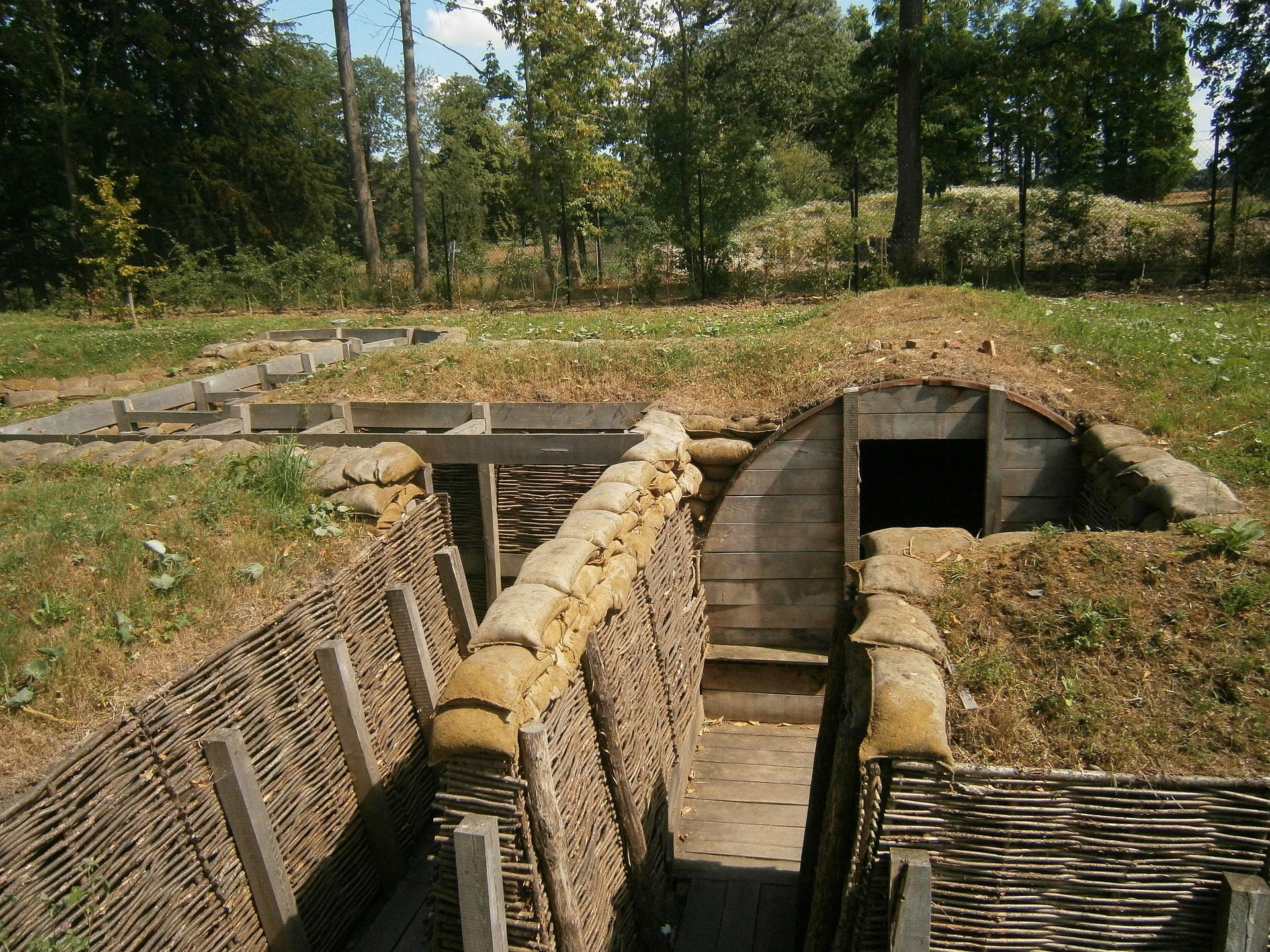
World War I
1914–1918 — the Great War that reshaped empires, borders, and the modern world.
World War I, also known as the Great War, was the first industrial-scale global conflict in human history. Fought between 1914 and 1918, it drew in the major empires of Europe along with their colonial dominions, the United States, the Ottoman Empire, and Japan. By the time the guns fell silent on November 11, 1918, four empires had collapsed, the borders of Europe and the Middle East had been redrawn, and the stage had been set for many of the political upheavals of the twentieth century.
Overview
World War I began on July 28, 1914, when Austria-Hungary declared war on Serbia, and it ended on November 11, 1918, with the signing of an armistice that silenced the guns on the Western Front. In the intervening four years and three months, more than sixty-five million men were mobilized into armies from every inhabited continent, and the war spread from its initial Balkan flashpoint to battlefields across Europe, the Middle East, Africa, the Pacific, and the world's oceans. It was a conflict unprecedented in scale, in industrial violence, and in the extent to which entire national societies were drawn into its service.
The war was fought between two great coalitions. The Central Powers were led by the German Empire and Austria-Hungary, joined later by the Ottoman Empire in November 1914 and by Bulgaria in October 1915. The Allied Powers, sometimes called the Entente, were led at the outset by France, the United Kingdom and its dominions, the Russian Empire, Serbia, Belgium, and Japan. Italy joined the Allies in May 1915, Romania in August 1916, and Greece in 1917. The United States entered the war on the Allied side in April 1917, decisively tipping the balance of manpower and industrial output toward the Entente.
Estimates of the total dead range widely but generally cluster between fifteen and twenty-two million people, roughly evenly divided between military and civilian losses. Approximately nine to eleven million soldiers were killed in action or died of wounds and disease, and between six and thirteen million civilians perished from military operations, famine, disease, and the related violence of the years during and immediately after the war. An additional twenty-one million soldiers were wounded, many permanently disabled. The Spanish influenza pandemic of 1918 to 1920, which spread rapidly along the exhausted supply lines of the combatants, is estimated to have killed tens of millions more worldwide.
World War I was the first conflict in which the full industrial capacity of modern nation-states was harnessed to mechanized warfare. Machine guns, heavy artillery, poison gas, tanks, submarines, and military aircraft were deployed at a scale never before seen. Civilian economies were converted to war production, propaganda campaigns were directed at entire populations, and a generation of young men returned to their countries changed, if they returned at all. The war ended the long nineteenth-century order of European empires and set in motion the political, technological, and cultural transformations that would define the decades to come.
Key Facts
- Dates
- July 28, 1914 – November 11, 1918
- Duration
- Approximately 4 years, 3 months, 2 weeks
- Main Allied Powers
- France, United Kingdom, Russia (until 1917), Italy (from 1915), United States (from 1917), Japan, Serbia, Belgium, Romania, Greece, and others
- Main Central Powers
- German Empire, Austria-Hungary, Ottoman Empire, Bulgaria
- Estimated total deaths
- Approximately 15–22 million (civilian and military combined)
- Military deaths
- Approximately 9–11 million
- Civilian deaths
- Approximately 6–13 million; Spanish influenza (1918–1920) killed tens of millions more worldwide
- Key weapon debuts
- Machine guns at mass scale, poison gas, tanks, military aircraft, submarine warfare
- Armistice
- November 11, 1918 (observed annually as Armistice Day or Remembrance Day)
- Ended by
- Treaty of Versailles, signed June 28, 1919, plus separate treaties with each of the other Central Powers
Origins and Causes
The origins of World War I lie in a dense web of long-term political, economic, and cultural pressures that built up across Europe in the decades before 1914. Historians traditionally summarize the underlying causes with four interlocking forces: nationalism, imperialism, militarism, and the alliance system. Rising nationalist movements, particularly in the Balkans, challenged the multinational empires of Austria-Hungary and the Ottoman Empire, while pan-German and pan-Slavic ideologies pulled larger states toward confrontation. Imperial competition for colonies, markets, and naval supremacy brought Europe's great powers into repeated diplomatic crises in Morocco, the Balkans, and elsewhere.
Militarism, meanwhile, placed the armed forces at the center of national policy and glorified the settlement of disputes by arms. Military budgets, arms races, and elaborate mobilization plans, most famously the German Schlieffen Plan, committed governments to rapid escalation once a crisis began. The alliance system locked the major powers into two rival blocs. The Triple Entente bound France, the United Kingdom, and the Russian Empire in informal but increasingly firm cooperation, while the Triple Alliance linked Germany, Austria-Hungary, and the Kingdom of Italy, although Italy eventually joined the Allies when war broke out.
The immediate trigger came on June 28, 1914, when Archduke Franz Ferdinand of Austria, heir to the Austro-Hungarian throne, and his wife Sophie were assassinated in Sarajevo, Bosnia, by Gavrilo Princip, a young Bosnian Serb nationalist connected to the Black Hand secret society. Austria-Hungary, encouraged by a German guarantee of support known as the blank cheque, issued a severe ultimatum to Serbia. When Serbia's reply was judged insufficient, Austria-Hungary declared war on July 28. Over the following week, the alliance system drew Russia, Germany, France, Belgium, and the United Kingdom into the conflict in a cascading series of ultimatums and declarations of war known as the July Crisis. By August 4, 1914, what had begun as a regional Balkan confrontation had become a general European war.
Major Fronts
World War I was fought across a series of interlocking fronts and theaters, each with its own geography, combatants, and operational character. The following five fronts frame the broad military shape of the conflict.
Western Front
The Western Front stretched from the North Sea coast through Belgium and northeastern France to the Swiss border, and became the defining image of the war. After the German advance was halted at the First Battle of the Marne in September 1914, both sides dug in, and a nearly continuous line of trenches settled into a war of attrition that lasted almost four years.
- • Battle of Verdun (1916)
- • Battle of the Somme (1916)
- • Third Battle of Ypres / Passchendaele (1917)
Eastern Front
The Eastern Front ran from the Baltic Sea to the Black Sea across the territory of modern Poland, the Baltic states, Belarus, Ukraine, and parts of Romania. Unlike the static Western Front, it was a more mobile war of great distances, with large sweeping advances and retreats, and it ultimately ended with the collapse of Imperial Russia.
- • Battle of Tannenberg (1914)
- • First Battle of the Masurian Lakes (1914)
- • Brusilov Offensive (1916)
Italian Front
Italy entered the war against Austria-Hungary in May 1915 and fought primarily in the Alpine and Isonzo river regions along its northeastern border. The Italian Front combined high-altitude mountain warfare with brutal river-valley offensives and saw one of the war's most dramatic defeats at Caporetto.
- • Twelve Battles of the Isonzo (1915–1917)
- • Battle of Caporetto (1917)
- • Battle of Vittorio Veneto (1918)
Middle Eastern Front
Allied forces and the Ottoman Empire fought across a vast arc from the Dardanelles to the Caucasus and down through Mesopotamia and Palestine. Campaigns in this theater would reshape the political map of the modern Middle East and directly influenced the mandates and borders that followed the war.
- • Gallipoli Campaign (1915–1916)
- • Mesopotamian Campaign
- • Palestine Campaign and the Arab Revolt
African and Pacific Theaters
The war reached far beyond Europe. Allied forces, including South African, Indian, Australian, New Zealand, and Japanese troops, seized German colonial possessions in Africa and the Pacific. The East Africa Campaign continued until shortly after the Armistice, making it one of the longest continuous campaigns of the war.
- • German Southwest Africa Campaign
- • East Africa Campaign
- • Seizure of German Pacific island colonies
Trench Warfare and New Technology
Once mobile operations on the Western Front ground to a halt in the autumn of 1914, both sides built elaborate systems of trenches that would define the experience of the war for millions of soldiers. A typical trench system consisted of a front line, support trenches, and reserve trenches, connected by communication trenches, and protected by deep belts of barbed wire and machine gun posts. Between the opposing lines lay no man's land, a shell-pocked strip that could range from a few dozen meters to more than a kilometer wide. Conditions in the trenches were miserable, with mud, rats, lice, cold, and a constant threat from artillery and sniping.
The industrial character of the war accelerated weapons development at a pace unimaginable only a decade earlier. Rapid-firing artillery, reliable machine guns, and the widespread use of barbed wire gave a crushing advantage to the defender, while attackers searched for tactical and technological solutions that could break the deadlock. The result was the debut or first mass deployment of many weapons that would define military affairs for the rest of the century, from the submarine and the military aircraft to the armored tank and chemical weapons.
Machine Guns and Artillery
Heavy machine guns such as the Maxim, Vickers, and Maschinengewehr 08, combined with quick-firing artillery and high-explosive shells, made frontal assault across open ground devastatingly costly.
Poison Gas
Chlorine gas was first used by German forces at the Second Battle of Ypres in April 1915. Mustard gas followed in 1917. Gas caused relatively few deaths as a share of casualties, but it terrified soldiers and required the universal adoption of gas masks.
Tanks
The British Mark I tank was first used at the Battle of the Somme in September 1916. Early tanks were slow and mechanically unreliable, but by 1918 they had become a central element of successful Allied offensives.
Military Aircraft
Aircraft, at first used only for reconnaissance, quickly evolved into dedicated fighters, ground-attack machines, and strategic bombers. Aerial combat gave rise to the cult of the fighter ace and the foundations of modern air power.
Submarines
German U-boats attacked Allied shipping across the Atlantic. Unrestricted submarine warfare, resumed in early 1917, inflicted heavy losses on merchant fleets and was a decisive factor in the United States entry into the war.
Barbed Wire and Steel Helmets
Dense belts of barbed wire protected trench lines and funneled attackers into killing zones. Steel helmets, such as the British Brodie, French Adrian, and German Stahlhelm, were introduced in 1915 and 1916 and dramatically reduced head wounds from shrapnel.
Timeline of Key Events
A chronological summary of the most pivotal moments of the war, from the Sarajevo assassination in June 1914 to the Armistice of November 1918.
-
Jun 28, 1914
Assassination of Archduke Franz Ferdinand
The heir to the Austro-Hungarian throne and his wife Sophie are shot dead in Sarajevo by Gavrilo Princip, triggering the July Crisis.
-
Jul 28 – Aug 4, 1914
July Crisis and declarations of war
Austria-Hungary declares war on Serbia, Germany invades Belgium, and within a week the major European powers are at war.
-
Sep 5–12, 1914
First Battle of the Marne
French and British forces halt the German advance east of Paris. The war on the Western Front begins to settle into trench warfare.
-
Apr 1915 – Jan 1916
Gallipoli Campaign
Allied forces, including a large contingent from the Australian and New Zealand Army Corps, fail to force the Dardanelles and withdraw from the Gallipoli peninsula.
-
Feb 21 – Dec 18, 1916
Battle of Verdun
German and French armies fight one of the longest and costliest battles in history around the fortress city of Verdun. Total casualties exceed 700,000.
-
Jul 1 – Nov 18, 1916
Battle of the Somme
British and French forces launch a massive offensive on the River Somme. Tanks are used in combat for the first time. More than one million men are killed or wounded.
-
Apr 6, 1917
United States declares war on Germany
Following the resumption of unrestricted submarine warfare and the Zimmermann Telegram, the United States Congress approves a declaration of war against Germany.
-
Nov 7, 1917
October Revolution in Russia
Bolshevik forces seize power in Petrograd. The date is October 25 in the Julian calendar still used in Russia at the time, and November 7 in the Gregorian calendar.
-
Mar 3, 1918
Treaty of Brest-Litovsk
Soviet Russia accepts a harsh peace with the Central Powers, ceding vast territory in the west and formally ending Russian participation in the war.
-
Nov 11, 1918
Armistice on the Western Front
An armistice between the Allies and Germany is signed in a railway carriage in the Forest of Compiègne. Hostilities cease at 11:00 on the eleventh hour of the eleventh day of the eleventh month.
The Home Front and Civilian Life
World War I was a total war in which the civilian economy was mobilized to the same extent as the armed forces. Governments took unprecedented control over national production, directing factories to produce shells, rifles, uniforms, and food for the armies in the field. In the United Kingdom, the Ministry of Munitions oversaw the conversion of civilian industry to war production. In Germany, the Hindenburg Programme pursued a similar transformation, while in France and the United States, comparable agencies coordinated industrial effort at national scale. Conscription was introduced or expanded in most combatant countries, reaching into rural villages and urban factories that had never before sent sons to war in such numbers.
With so many men in uniform, women entered the paid workforce in numbers that far exceeded prewar norms. They built munitions in large shell-filling factories, drove trams and buses, worked on farms with the Women's Land Army in the United Kingdom, and served as nurses close to the front lines. Many of these roles returned to men after the war, but the experience contributed to the expansion of women's suffrage in the United Kingdom in 1918, in Germany and Austria in 1918, in the United States in 1920, and in many other countries shortly afterward.
Civilians endured food rationing, coal shortages, and relentless propaganda campaigns designed to sustain morale and demonize the enemy. In Germany and Austria-Hungary, the Allied naval blockade produced severe food shortages, and the winter of 1916 to 1917 became known in Germany as the Turnip Winter. War bonds were sold to the general public to finance military spending, and millions of refugees fled across borders in Belgium, Serbia, Russia, and the Ottoman Empire. The long shadow of forced migration, civilian internment, and wartime atrocities, including the Armenian Genocide of 1915 to 1916 in the Ottoman Empire, became part of the conflict's lasting civilian toll.
Eastern Front and Russian Collapse
Imperial Russia entered the war in August 1914 with a rapid invasion of East Prussia and Austrian Galicia. Early successes against Austria-Hungary were overshadowed by catastrophic defeats at the hands of the German Eighth Army, most famously at the Battle of Tannenberg in late August 1914 and the First Battle of the Masurian Lakes in September. Russian forces stabilized through 1915 and in 1916 mounted the Brusilov Offensive, one of the most successful Allied operations of the war, which inflicted very heavy casualties on Austria-Hungary and forced Germany to divert divisions from the Western Front.
Behind the front, however, the Russian war effort was buckling. Shortages of munitions, food, and transport, combined with incompetent political leadership and staggering casualties, undermined support for the Tsarist regime. In February 1917, by the Julian calendar then used in Russia, strikes and protests in Petrograd led to the abdication of Tsar Nicholas II and the formation of a Provisional Government. That government continued to fight, but a failed summer offensive and collapsing army discipline paved the way for the Bolshevik seizure of power in October 1917, which by the Gregorian calendar fell in early November.
The new Soviet government opened peace negotiations with the Central Powers and signed the Treaty of Brest-Litovsk on March 3, 1918. The treaty stripped Russia of Poland, the Baltic provinces, Finland, Ukraine, and portions of the Caucasus, representing roughly one third of its prewar population and much of its industry. Although the territorial provisions were largely reversed by the later Allied victory, the withdrawal of Russia freed dozens of German divisions for transfer to the Western Front in early 1918 and fundamentally changed the shape of the final year of the war.
American Entry and End of the War
The United States entered the war in April 1917 after years of official neutrality. Two developments in early 1917 pushed Washington off that neutral course. The first was Germany's resumption of unrestricted submarine warfare on February 1, which threatened American shipping and lives. The second was the interception and publication of the Zimmermann Telegram, a German diplomatic message proposing a military alliance with Mexico against the United States in the event of war. On April 2, President Woodrow Wilson asked Congress to declare war, and Congress did so on April 6, 1917.
American mobilization was rapid but took time to reach the battlefield. The Selective Service Act of May 1917 eventually registered more than twenty-four million American men for the draft, and roughly four million served in the armed forces before the Armistice. American Expeditionary Forces under General John J. Pershing began arriving in France in significant numbers in 1918 and played a decisive role in halting the German Spring Offensives and in the Meuse-Argonne Offensive later that year.
The German Spring Offensive of March to July 1918, known as the Kaiserschlacht, was Germany's last major bid to win the war before American strength could fully tip the balance. Initial gains were spectacular, but the offensives exhausted the German army and created long, thinly held salients. Beginning on August 8, 1918, the Allied Hundred Days Offensive steadily rolled back German gains. By late October, Austria-Hungary had effectively disintegrated, the Ottoman Empire had signed the Armistice of Mudros, Bulgaria had surrendered, and the German high command advised the Kaiser that the war could not be won. An armistice was signed at Compiègne in the early hours of November 11, 1918, and hostilities on the Western Front ceased at 11:00 that morning.
Peace Treaties and Aftermath
The Paris Peace Conference opened in January 1919 and was dominated by the leaders of the principal victorious Allies, the so-called Big Four: President Woodrow Wilson of the United States, Prime Minister David Lloyd George of the United Kingdom, Premier Georges Clemenceau of France, and Prime Minister Vittorio Orlando of Italy. Defeated powers were excluded from the negotiations. Wilson's Fourteen Points, issued in January 1918, had outlined a liberal vision for a peace based on national self-determination and collective security, but the final settlement was shaped heavily by French and British concerns about German power and by the secret wartime agreements of the Allied governments.
The Treaty of Versailles, signed on June 28, 1919, imposed stringent terms on Germany. Article 231, widely known as the War Guilt Clause, assigned legal responsibility for the war to Germany and its allies and formed the basis for large reparations payments. Germany lost all of its overseas colonies, ceded Alsace-Lorraine to France, and gave up territory to the newly independent state of Poland, including the Polish Corridor. The German army was capped at 100,000 men, and its air force, submarines, and major warships were prohibited. The Treaty also established the League of Nations, a permanent international organization intended to prevent future wars.
Separate treaties settled the fate of the other Central Powers. The Treaty of Saint-Germain-en-Laye with Austria, the Treaty of Trianon with Hungary, and the Treaty of Neuilly-sur-Seine with Bulgaria confirmed major territorial losses and reparations obligations. The Treaty of Sèvres with the Ottoman Empire was never ratified and was replaced by the Treaty of Lausanne in 1923, which recognized the modern Republic of Turkey. In total, four major empires ended with the war. The German Empire became a republic, the Austro-Hungarian Empire fractured into successor states including Austria, Hungary, and Czechoslovakia, the Russian Empire gave way to the Soviet Union, and the Ottoman Empire was reduced to its Anatolian core.
Legacy and Ongoing Effects
The human cost of World War I, measured in killed, wounded, bereaved, and displaced, cast a shadow over Europe and the world for decades. The generation of young men who came of age in the trenches is often called the Lost Generation. Its experience shaped the novels, poetry, and memoirs of Wilfred Owen, Siegfried Sassoon, Robert Graves, Erich Maria Remarque, Henri Barbusse, Ernest Hemingway, and many others, and it drove a broad cultural turn toward disillusionment with nineteenth-century ideals of glory, empire, and progress. Annual commemorations on Armistice Day, Remembrance Day, Veterans Day, and Anzac Day, along with war memorials in almost every city, town, and village of the combatant nations, remain central elements of civic life more than a century after the war ended.
Politically, the war accelerated the end of the old European order and prepared the ground for later upheavals. The harsh terms imposed on Germany, combined with the economic turmoil of the 1920s and 1930s, contributed to the political crisis that brought the Nazi Party to power and set the stage for World War II. In the Middle East, the mandate system administered by the League of Nations placed former Ottoman territories under British and French control and drew borders whose consequences are still felt today. The war also hastened the emergence of modern national states in central and eastern Europe, including the Second Polish Republic, Czechoslovakia, the Kingdom of Yugoslavia, and an independent Finland, among others.
The Spanish influenza pandemic of 1918 to 1920, although not caused by the war, was amplified by the mass movements of troops, the crowded conditions of military camps, and the general weakening of public health systems in wartime. It is estimated to have infected roughly one third of the world's population and to have killed tens of millions of people, many of them young and previously healthy. The pandemic reinforced the broader sense that the war had inaugurated a new and unfamiliar era in world affairs, one in which industrial technology, globalization, and mass politics could produce catastrophes on a scale unknown to previous generations. The international system, cultural life, and political imagination of the twentieth century all bear the imprint of the four years between 1914 and 1918.
Countries Most Affected
World War I reshaped dozens of nations, creating some of them outright and redrawing the borders of others. The following countries were among those most profoundly shaped by the conflict. Each card links to a full country profile.
Germany
Principal Central Power; its empire ended in revolution in 1918.
France
Host of the Western Front; suffered enormous battlefield losses.
United Kingdom
Led the British Empire and naval blockade of the Central Powers.
Russia
Tsarist empire collapsed in revolution; withdrew from the war in 1918.
Austria
Successor to Austria-Hungary, which disintegrated in 1918.
Hungary
Lost two thirds of prewar territory under the Treaty of Trianon.
United States
Entered in 1917; emerged as a major world power.
Italy
Joined the Allies in 1915; fought Austria-Hungary in the Alps.
Turkey
Successor to the Ottoman Empire, which collapsed during the war.
Serbia
Initial flashpoint of the war; suffered proportionally severe losses.
Belgium
Invaded in August 1914; occupied for most of the war.
Poland
Restored as an independent state in November 1918.
Czech Republic
Czech lands formed part of newly independent Czechoslovakia in 1918.
Romania
Joined the Allies in 1916; gained substantial territory postwar.
Japan
Allied power; seized German concessions in Asia and the Pacific.
Greece
Entered the war in 1917 on the Allied side after internal political crisis.
Canada
Dominion of the British Empire; earned distinct national identity at Vimy Ridge.
Australia
Anzac forces served at Gallipoli and on the Western Front.
India
British India sent more than 1.3 million troops and laborers overseas.
Bulgaria
Central Power; signed an armistice on September 29, 1918.
Sources
Detailed citations, data references, and institutional sources for all CountryReports content are listed on the Sources page. The following government archives, national museums, and academic institutions are the primary authorities we rely on for World War I content. Each link points to the institution's homepage or relevant subsite.
Government Archives and Official Records
- National Archives and Records Administration (NARA) — United States Government records of the First World War, including Selective Service records and the American Expeditionary Forces papers.
- The National Archives (United Kingdom) — War Office, Foreign Office, and Cabinet records covering British and Commonwealth participation in the war.
- Library of Congress — World War I collections — Photograph and document collections, posters, and oral histories relating to the First World War.
- Bibliothèque nationale de France — La Grande Guerre — French national library collections on the First World War, including the Gallica digital library.
- Bundesarchiv (German Federal Archives) — German state records relating to the German Empire, the Western and Eastern Fronts, and the Weimar transition.
- Yale Law School — Avalon Project, World War I Documents — Primary source documents including treaties, declarations, and diplomatic correspondence.
National Museums and Memorial Institutions
- Imperial War Museums (United Kingdom) — Founded in 1917 to record British and Commonwealth involvement in the First World War; houses photographs, film, oral histories, and the official British war art collection.
- The National WWI Museum and Memorial (Kansas City) — Designated by Congress as the official museum and memorial of the First World War in the United States.
- Commonwealth War Graves Commission — Register of Commonwealth war dead, cemeteries, and memorials in more than 150 countries, including Thiepval, Tyne Cot, and the Menin Gate.
- International Committee of the Red Cross (ICRC) Archives — First World War prisoner of war records and civilian internee files maintained by the International Prisoners of War Agency in Geneva.
Academic Research Centers
- Harvard University — Widener Library — Extensive First World War collection, including the Archibald Cary Coolidge papers and the Harvard Memorial Room.
- Stanford University — Hoover Institution Library & Archives — Founded by Herbert Hoover to document the First World War and its consequences; holds more than six thousand collections on war, revolution, and peace.
- University of Oxford — Faculty of History — Research and teaching on the First World War, including contributions to the centenary program (2014–2018).
If you notice an error or would like to suggest a correction, please use our contact page to get in touch.