
 English
 Español
 中文
中文 हिन्दी
 Français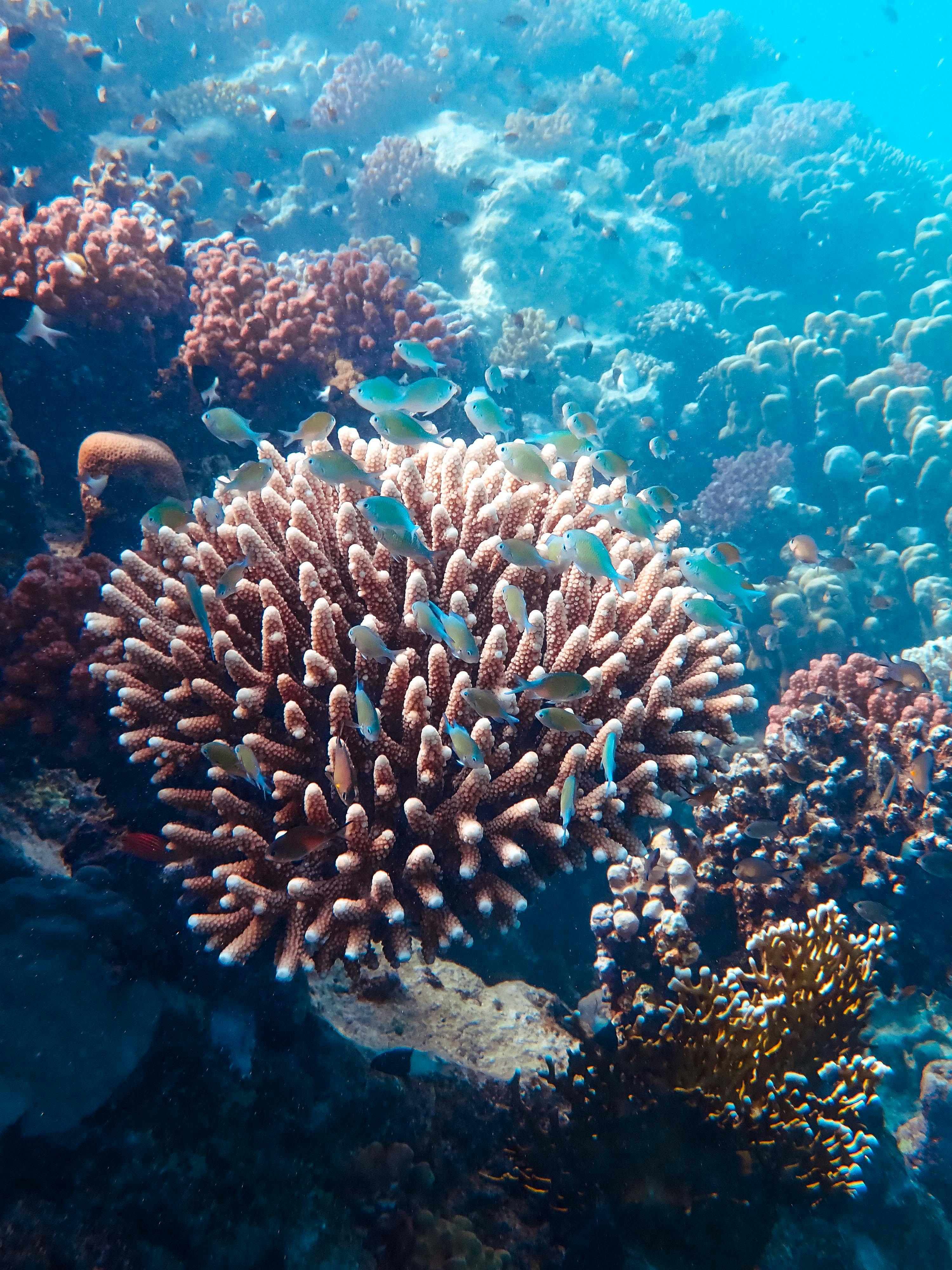
Marine Life
Ocean biodiversity from sunlit reefs to the hadal deep — the living systems of the global sea.
The ocean covers roughly 71 percent of the surface of the Earth and provides the largest habitat on the planet by volume. Within its sunlit surface waters, twilight middepths, deep abyss, and hydrothermal vent fields live an extraordinary diversity of animals, plants, protists, and microorganisms. Marine life sustains the chemistry of the atmosphere, the productivity of global fisheries, and the cultures of hundreds of coastal nations, and it remains one of the most incompletely catalogued components of the natural world.
Overview
Marine life encompasses every living organism whose habitat lies wholly or partly in a marine environment. This includes charismatic animals such as whales, sharks, and sea turtles, but also the vast majority of the tree of life on Earth, from the cyanobacteria and diatoms that built our oxygen atmosphere to the reef-building corals, jellyfish, sea stars, octopuses, fishes, seabirds, and marine mammals that most people associate with the sea. Every major phylum of animals has a marine representative, and several phyla are exclusively marine. The ocean is also home to the greatest amount of living biomass on the planet when prokaryotic microorganisms are included in the count.
The Census of Marine Life, a ten-year international program completed in 2010, catalogued more than 230,000 formally described marine species and estimated that perhaps one to two million more remain to be discovered and named, particularly in the deep sea, in microbial groups, and in small invertebrate fauna. Public data from that census and its successor programs are curated in the Ocean Biodiversity Information System, which aggregates hundreds of millions of species occurrence records contributed by research institutions worldwide. Even with this growing inventory, biologists regularly describe new species from every ocean and every depth, and the pace of description has accelerated as molecular tools reveal cryptic diversity inside what used to be considered single species.
The structure of marine ecosystems is organized vertically by depth, horizontally by latitude and continental geography, and by distance from the shore. Sunlight penetrates only the uppermost two hundred meters or so of seawater, and this sunlit zone supports the photosynthesis that drives almost all ocean productivity. Below the photic zone, life depends on food sinking from above or, in rare places, on chemical energy produced at hydrothermal vents and cold seeps. The ocean therefore forms a connected vertical system in which surface, midwater, and seafloor communities exchange nutrients, carbon, and living organisms continuously across the water column.
Marine life is neither evenly distributed nor stationary. Tropical reefs, temperate upwelling systems, polar seas, and abyssal plains each support distinctive communities, and many species migrate thousands of kilometers between feeding and breeding grounds. This overview treats the major ocean habitats, key taxonomic groups, feeding and migration patterns, and the conservation pressures that are now reshaping the global ocean. For companion treatment of the physical ocean basins, see World Oceans and Seas, and for a broader look at life on land and in fresh water, see Animal Species and Biodiversity.
Key Facts
- Described marine species
- Approximately 230,000 formally named species (Census of Marine Life, 2010); total believed to be well over one million
- Ocean share of Earth's surface
- Approximately 71 percent; the ocean holds about 97 percent of all surface water on the planet
- Largest living animal
- The blue whale (Balaenoptera musculus), which reaches up to about 30 meters (98 feet) in length and more than 150 metric tons in mass
- Deepest known fish
- Snailfishes of the genus Pseudoliparis, observed at depths beyond 8,300 meters in the Mariana and Izu-Ogasawara trenches
- Most species-rich marine phylum
- Arthropoda, dominated in the ocean by crustaceans (copepods, krill, crabs, shrimps, barnacles), which together account for a very large share of animal diversity in the sea
- Described marine fishes
- More than 20,000 species, roughly 60 percent of all known fish species worldwide
- Marine mammal species
- Approximately 130, grouped into cetaceans (whales, dolphins, porpoises), pinnipeds (seals, sea lions, walruses), sirenians (manatees, dugong), and the sea otter and marine otter
- Reef-building coral species
- About 800 species of scleractinian (stony) corals form tropical reefs; many more species exist as deep-water or cold-water corals
- Oxygen from marine photosynthesis
- Marine phytoplankton are estimated to produce roughly half of the oxygen generated annually by photosynthesis on Earth
- Marine protected area coverage
- About 8 percent of the global ocean in 2024; a United Nations goal under the Kunming-Montreal Global Biodiversity Framework targets 30 percent by 2030 (the 30x30 target)
- IUCN Red List marine assessments
- More than 25,000 marine species assessed; roughly one third of reef-building corals and more than one third of sharks and rays are classified as threatened
Ocean Habitats
Marine biologists divide the ocean into a set of standard zones based on depth and position relative to the seafloor. The pelagic realm is the open water column; the benthic realm is the seafloor and the organisms living on, in, or just above it; and the intertidal zone is the narrow band of shoreline that is alternately flooded and exposed by the tides. Each realm is divided further into vertical bands that reflect the penetration of sunlight, pressure, temperature, and productivity.
The pelagic zone is traditionally broken into five layers. The epipelagic, or sunlit surface layer, extends from the surface to about 200 meters and hosts almost all oceanic photosynthesis. The mesopelagic, or twilight zone, runs from about 200 to 1,000 meters and contains some of the largest fish populations on Earth, dominated by lanternfishes and bristlemouths. The bathypelagic, or midnight zone, lies between 1,000 and 4,000 meters in perpetual darkness. Below that, the abyssopelagic zone extends to about 6,000 meters, and the hadopelagic zone, confined to the ocean's deepest trenches, reaches down to nearly 11,000 meters at the Challenger Deep in the Mariana Trench.
The benthic realm is structured by the shape of the seafloor. Continental shelves, generally less than 200 meters deep, support the world's most productive fisheries and are the principal homes of seagrasses, kelp forests, oyster reefs, and demersal fishes. Continental slopes descend from the shelf edge into abyssal plains of deep-sea sediment, interrupted by submarine canyons, seamounts, and the global mid-ocean ridge system. Hydrothermal vent communities and cold-seep ecosystems along these features support lush assemblages of tubeworms, vent crabs, shrimps, and specialized mollusks that derive their energy not from sunlight but from chemosynthesis by sulfur- and methane-metabolizing bacteria.
Between the open sea and the land lies the intertidal zone, where life must tolerate daily cycles of inundation, wave action, and exposure to air. Rocky shores host barnacles, limpets, mussels, sea stars, and algae arranged in distinctive vertical bands. Sandy beaches and mudflats appear lifeless from above but hold large populations of burrowing clams, polychaete worms, and crustaceans, and they serve as critical feeding grounds for migratory shorebirds.
Coral Reefs
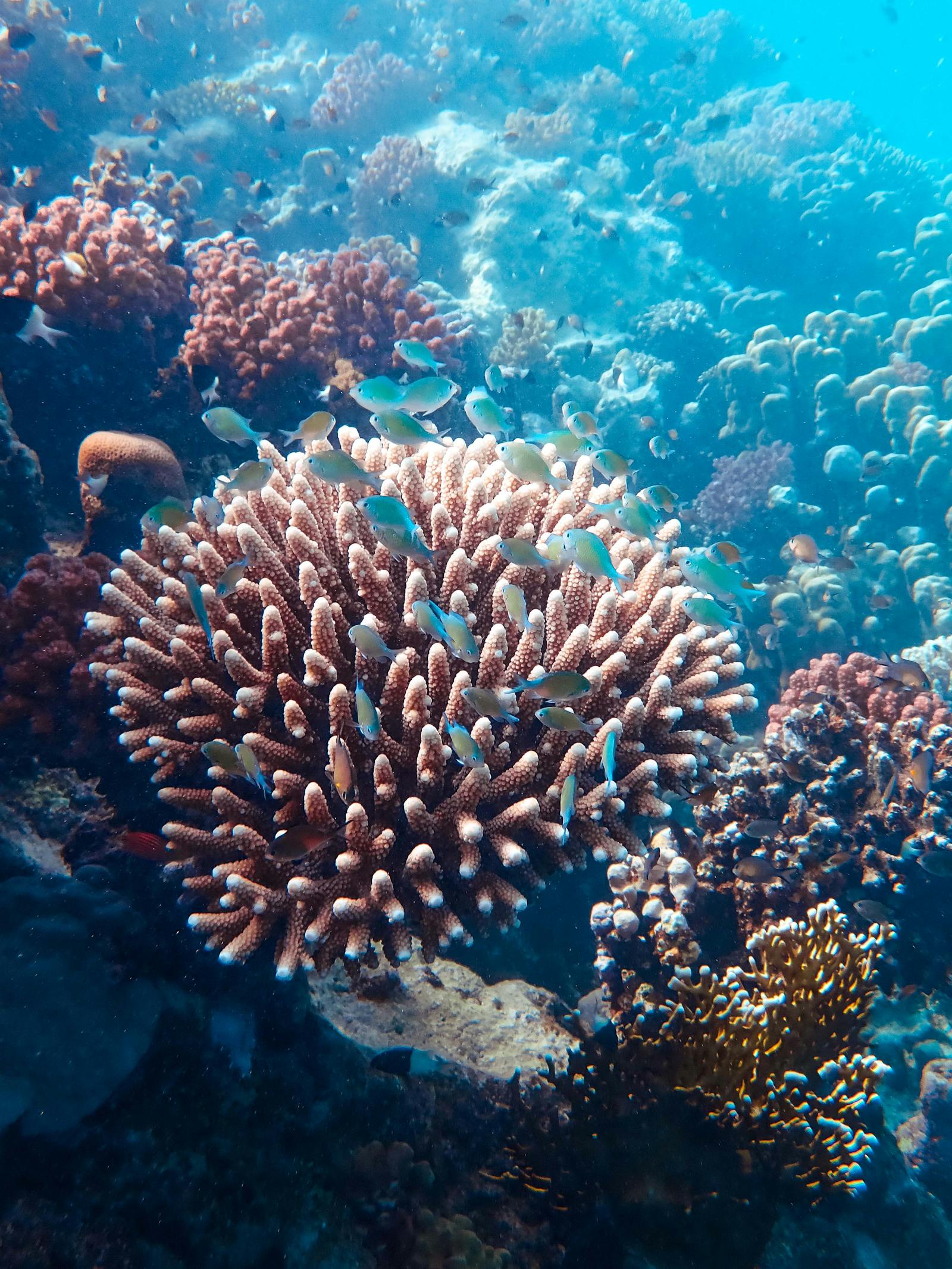
Coral reefs are built over thousands of years by colonial stony corals in the order Scleractinia. The reef framework depends on a symbiosis between the coral polyp and single-celled algae called zooxanthellae that live inside the coral tissue and supply much of its energy through photosynthesis. Reefs flourish in warm, clear, nutrient-poor tropical waters, typically between 30 degrees north and 30 degrees south of the equator, and they support an estimated one quarter of all known marine species despite occupying well under one percent of the ocean's surface.
Reefs take several characteristic forms. Fringing reefs grow directly from the shore, barrier reefs are separated from the coast by a lagoon, and atolls are ring-shaped reefs that surround a central lagoon, often capping the summit of a submerged volcano. Patch reefs and cays are smaller isolated structures. Together these forms compose the reef habitats of almost every tropical coastline and many mid-ocean islands.
Great Barrier Reef
Stretching more than 2,300 kilometers along the northeastern coast of Australia, the Great Barrier Reef is the largest coral reef system on Earth and a UNESCO World Heritage site. It comprises roughly 2,900 individual reefs and 900 islands and supports more than 1,500 fish species, 400 hard coral species, and six of the world's seven marine turtle species.
- • Largest reef structure on Earth
- • UNESCO World Heritage site (1981)
- • Managed under a federal marine park authority
Coral Triangle
The Coral Triangle spans the waters of Indonesia, the Philippines, Papua New Guinea, the Solomon Islands, Malaysia, and Timor-Leste. It holds the highest coral diversity on Earth, with more than 600 species of reef-building corals and more than 2,000 reef fishes, and it is widely considered the global center of marine biodiversity.
- • Highest coral species diversity on Earth
- • Spawning grounds for tuna and billfish
- • Home to six marine turtle species
Mesoamerican Reef
The Mesoamerican Reef extends about 1,000 kilometers along the Caribbean coasts of Mexico, Belize, Guatemala, and Honduras. It is the second-largest barrier reef in the world and hosts whale sharks, manatees, and critically endangered staghorn and elkhorn corals.
- • Second-largest barrier reef system
- • Belize Barrier Reef is a UNESCO site
- • Seasonal whale shark aggregations
Red Sea
The narrow, warm, and saline Red Sea lies between Africa and the Arabian Peninsula and supports reefs known for unusual heat tolerance. More than 300 species of stony coral and more than 1,200 reef fish species have been recorded, with about 10 percent of the fishes found nowhere else.
- • High rates of endemic fish species
- • Corals with notable thermal tolerance
- • Fringing and patch reef systems
Cold-Water Corals
Far from the tropics, stony corals such as Lophelia pertusa and Desmophyllum form dense reef mounds at depths of 200 to more than 1,000 meters in the North Atlantic, off Norway, and along seamounts worldwide. These lightless reefs depend on currents that supply plankton rather than on photosynthesis.
- • Grow in cold, deep, dark waters
- • Important habitat for deep-sea fishes
- • Highly vulnerable to bottom trawling
Kelp Forests and Temperate Reefs
Kelp forests are underwater stands of large brown algae that form dense, three-dimensional habitats along cool, nutrient-rich temperate coastlines. Giant kelp (Macrocystis pyrifera) grows in fronds anchored by holdfasts on the seafloor and can reach the surface from depths of more than 30 meters, while bull kelp, split kelp, and several Laminaria species form similarly structured forests in other temperate seas. Kelp canopies provide shelter and food for dense communities of fishes, invertebrates, and mammals and rank among the most productive ecosystems on the planet.
The North Pacific kelp forests of California, Oregon, and Washington are iconic habitats for sea otters, garibaldi, rockfishes, and the abalones and urchins that graze on kelp. Off southern Chile, Argentina, South Africa, Tasmania, and New Zealand, kelp forests are grazed by southern rock lobsters, abalones, and sea urchins, and they provide cover for benthic sharks, octopuses, and a diverse cast of temperate fishes. The Great Southern Reef, which wraps around southern Australia for more than 8,000 kilometers, is one of the largest temperate reef systems in the world and has a high rate of endemism.
Kelp forest ecosystems are strongly shaped by grazing pressure from sea urchins. When predators of urchins, such as sea otters and large rock lobsters, are removed, urchin populations can expand rapidly and mow down kelp into barren fields of encrusting pink algae known as urchin barrens. This feedback loop is a classic example of a trophic cascade and illustrates the outsized role that a few keystone species can play in structuring marine habitats. Recent decades have seen kelp decline on many temperate coastlines from a combination of marine heatwaves, urchin outbreaks, and the loss of predatory fishes.
Mangroves and Seagrasses
Mangroves are salt-tolerant trees and shrubs that form dense forests along tropical and subtropical coastlines. Their stilt roots, pneumatophores, and waxy leaves allow them to thrive in soft, waterlogged, saline soils where most terrestrial plants cannot grow. Mangrove forests stabilize shorelines, filter sediments and nutrients, buffer storm surge, and serve as vital nurseries for fishes and shellfish of enormous economic importance, including snappers, groupers, shrimps, and mud crabs. The Food and Agriculture Organization of the United Nations estimates that global mangrove cover exceeds 140,000 square kilometers across more than 100 countries.
The Sundarbans, shared between India and Bangladesh at the mouth of the Ganges-Brahmaputra-Meghna delta, is the largest continuous mangrove forest on the planet and is famous for its population of Bengal tigers that hunt among the tidal creeks. Large mangrove systems also fringe northern Australia, the Niger and Amazon deltas, the coasts of Indonesia and the Philippines, and parts of Central America. Cold temperatures and salt-water freezing limit mangroves to latitudes within approximately 30 degrees of the equator.
Seagrasses, although superficially similar to seaweeds, are flowering plants that colonized shallow coastal waters from terrestrial ancestors. Meadows of seagrasses such as eelgrass (Zostera), turtle grass (Thalassia), and posidonia cover an estimated 300,000 square kilometers globally and are among the planet's most efficient natural carbon sinks. Seagrass beds shelter juvenile fishes, nurse dugongs and green turtles, and stabilize sediment against waves and currents. Together with mangroves and salt marshes, they are often called blue carbon ecosystems for their role in sequestering carbon in coastal sediments.

Open Ocean and Deep Sea
Beyond the coasts, the open ocean forms the largest biological habitat on Earth. In the sunlit surface, microscopic phytoplankton, dominated by diatoms, dinoflagellates, coccolithophores, and cyanobacteria such as Prochlorococcus, convert carbon dioxide and dissolved nutrients into organic matter. These organisms form the foundation of almost every marine food web and together are estimated to produce about half of the oxygen released each year by global photosynthesis. Zooplankton, from copepods and krill to salps and jellyfish larvae, graze on phytoplankton and pass their energy up the food chain.
Highly migratory fishes cruise through the open ocean in search of schools of smaller prey. Tunas, billfishes such as marlin and swordfish, mahi-mahi, and open-ocean sharks follow thermal fronts and upwelling zones across entire ocean basins. Whales, dolphins, seabirds, and sea turtles track the same productive waters on their own feeding migrations. The productivity of the open ocean is not uniform: rich fishing grounds cluster around coastal upwellings, the edges of current systems, and seamounts, while vast central gyres in the middle of each ocean basin remain comparatively nutrient-poor.
Below the photic zone, the deep sea begins. In the mesopelagic twilight zone, bristlemouth fishes of the genus Cyclothone may be the most abundant vertebrates on Earth by number. Each night, an enormous mass of mesopelagic animals migrates upward to feed in surface waters and returns to depth by dawn in the largest daily animal migration on the planet, known as the diel vertical migration. In the midnight bathypelagic zone, bioluminescence is nearly universal, with predators using light for camouflage, lures, and signaling. Gulper eels, anglerfishes, giant squid (Architeuthis dux), and many other specialists prowl these waters.
The deepest parts of the ocean, below 6,000 meters, are the hadal zone of the trenches. The human-occupied submersible Alvin, in operation from 1964 onward, was critical in the 1977 discovery of hydrothermal vent communities at the Galapagos Rift, where tubeworms, vent clams, and shrimps thrive in the absence of sunlight by partnering with chemosynthetic bacteria. Later descents by the bathyscaphe Trieste in 1960 and the submersibles Deepsea Challenger in 2012 and Limiting Factor in 2019 reached the Challenger Deep, the deepest known point in any ocean at approximately 10,935 meters. Each deep-sea expedition continues to return new species that extend the known limits of where life on Earth can exist.

Marine Mammals
Marine mammals are a taxonomically diverse group that returned to the sea independently several times during mammalian evolution. All members share adaptations for life in water, including streamlined bodies, insulating blubber or fur, modified limbs, and specialized respiratory and circulatory systems for holding breath during long dives. The group is typically organized into four assemblages: cetaceans, pinnipeds, sirenians, and the marine and sea otters.
Baleen Whales
The mysticetes, or baleen whales, filter plankton and small fish through keratin plates. They include the blue, fin, humpback, gray, bowhead, and right whales. The blue whale is the largest animal ever known to have lived.
Toothed Whales, Dolphins, and Porpoises
The odontocetes hunt fish, squid, and other prey using echolocation. The group includes sperm whales, beaked whales, pilot whales, killer whales (orcas), belugas, narwhals, and some 40 species of dolphins and porpoises.
Pinnipeds
True seals, eared seals (sea lions and fur seals), and the walrus together form the pinnipeds. They breed and molt on land or ice but forage in the sea, and they dominate the marine mammal fauna of polar and temperate coasts.
Sirenians
Manatees and the dugong are the only fully aquatic herbivorous mammals. They graze on seagrasses in warm shallow waters of the Caribbean, West Africa, the Amazon, and the Indo-Pacific, and all living species are classified as vulnerable by the IUCN.
Sea Otters and Marine Otters
The sea otter of the North Pacific and the smaller marine otter of the South American Pacific coast are the two carnivoran species that spend most of their lives in salt water. Sea otters are keystone species in kelp forest ecosystems.
Polar Bears
The IUCN formally classifies the polar bear as a marine mammal because it spends most of its life on sea ice and derives virtually all of its food from the marine environment, principally ringed and bearded seals.
Polar Seas
The Arctic and Southern Oceans are each home to distinctive and highly productive marine communities adapted to extreme cold, strong seasonal cycles of light, and the presence of sea ice. Although polar ecosystems appear harsh, their cold, oxygen-rich waters support abundant life, and their margins drive some of the world's most productive fisheries and seabird colonies.
In the Southern Ocean around Antarctica, the key species is Antarctic krill (Euphausia superba). Krill form enormous swarms that may reach hundreds of millions of metric tons in total biomass, and they feed blue, fin, and humpback whales, crabeater seals, king, emperor, Adelie, and chinstrap penguins, fishes, and flying seabirds. Emperor penguins breed on the sea ice itself during the austral winter, leopard seals hunt penguins and other seals near ice edges, and the slow-growing Antarctic toothfish (marketed as Chilean sea bass) occupies the top of the Antarctic fish fauna.
In the Arctic, sea ice and the rich communities of ice algae that bloom along its underside anchor a food web supporting Arctic cod, narwhals, belugas, bowhead whales, walruses, ringed and bearded seals, and polar bears. The Bering, Barents, and Chukchi seas and the Canadian Arctic Archipelago host globally important seabird colonies, including thick-billed murres, ivory gulls, and several species of auklets and eiders. Indigenous peoples of the circumpolar Arctic have harvested marine mammals, fish, and seabirds for thousands of years and continue to maintain subsistence rights under international agreements. Rapid warming and sea-ice loss in both polar regions are now reshaping these ecosystems at an accelerating pace.
Threats and Conservation
Marine life faces a broad set of pressures from human activities. The biennial State of World Fisheries and Aquaculture report published by the Food and Agriculture Organization of the United Nations (SOFIA) estimates that more than one third of assessed marine fish stocks are harvested at biologically unsustainable levels, and that another half are fished at maximum sustainable yield with little remaining room to grow. High-profile collapses, such as the northwest Atlantic cod fishery in the early 1990s, demonstrate how quickly sustained overfishing can transform a rich ecosystem. Bycatch, the incidental capture of non-target species, kills hundreds of thousands of sea turtles, marine mammals, and seabirds annually in gillnets, longlines, and trawls.
Climate change is driving rapid warming of the ocean, the loss of polar sea ice, declining oxygen in midwater layers, and a steady decline in surface pH known as ocean acidification. Warming waters have triggered repeated mass coral bleaching events on the Great Barrier Reef and in the western Indian Ocean, the western Pacific, the Caribbean, and the Red Sea, with successive bleaching years leaving less time for reefs to recover. Acidification makes it harder for corals, pteropods, mollusks, and many plankton to build calcium carbonate skeletons. These stresses interact with overfishing, pollution, and coastal development in ways that are complex and often compounding, and they connect marine life closely to the broader patterns treated in Biomes and Ecosystems.
Pollution from land reaches the ocean in many forms, from nutrient runoff that fuels harmful algal blooms and coastal dead zones to persistent organic pollutants and heavy metals that accumulate in marine food webs. Plastic pollution has emerged as one of the most visible problems of the modern sea. Estimates of the annual input of plastic waste into the ocean range from several million to more than ten million metric tons, and plastics are now documented in surface waters, sea ice, beach sediments, the stomachs of seabirds and sea turtles, and the deepest trenches. Derelict fishing gear, or ghost nets, continues to entangle marine life long after it is lost or discarded.
Conservation responses operate at many scales. Marine protected areas and other effective area-based conservation measures restrict or manage human activity in defined zones of the ocean. Coverage of the global ocean has grown from well under one percent in 2000 to roughly 8 percent in 2024, and the Kunming-Montreal Global Biodiversity Framework commits its parties to effectively conserving at least 30 percent of the ocean by 2030 (the 30x30 target). The 2023 United Nations Agreement on Marine Biological Diversity of Areas Beyond National Jurisdiction, known as the BBNJ or High Seas Treaty, provides a legal framework for protected areas on the two thirds of the ocean that lie outside any country's exclusive economic zone.
Species-specific protections complement area-based measures. The International Whaling Commission adopted a global moratorium on commercial whaling in 1986, which has allowed populations of blue, fin, and humpback whales to recover strongly across many ocean basins, although several species, including the North Atlantic right whale and the vaquita porpoise of the Gulf of California, remain on the brink of extinction. The Convention on International Trade in Endangered Species of Wild Fauna and Flora (CITES) regulates cross-border trade in sharks, rays, corals, seahorses, sea turtles, and other marine species. The IUCN Red List provides the most comprehensive global assessment of extinction risk for marine species, guiding national and international conservation priorities. For broader context on these listings and their use, see Endangered Species.
Sources
Detailed citations, data references, and institutional sources for all CountryReports content are listed on the Sources page. The following government agencies, academic institutions, and scientific programs are the primary authorities we rely on for marine life content. Each link points to the institution's homepage or relevant subsite.
Government Science Agencies
- National Oceanic and Atmospheric Administration (NOAA) — United States federal agency for oceans and atmosphere, including the National Marine Fisheries Service, National Ocean Service, and the Office of National Marine Sanctuaries.
- NOAA National Ocean Service — Authoritative overviews of ocean habitats, coral reefs, marine mammals, and sanctuaries maintained by the United States government.
- NOAA Fisheries — Stock assessments, protected species management, and marine mammal and sea turtle research across United States waters.
- United States Fish and Wildlife Service — Manatee, sea otter, polar bear, and walrus conservation in United States waters, together with the Marine Mammal Protection Act program.
- Food and Agriculture Organization — Fisheries and Aquaculture — Publisher of the biennial State of World Fisheries and Aquaculture (SOFIA) report and custodian of the global fisheries statistical service.
National Museums and Research Institutions
- Smithsonian Ocean Portal — Public science education resource maintained by the Smithsonian National Museum of Natural History in collaboration with marine research partners worldwide.
- Woods Hole Oceanographic Institution — One of the world's largest private non-profit oceanographic research institutions; operator of the human-occupied submersible Alvin used at hydrothermal vents and in deep-sea biology.
- Scripps Institution of Oceanography, University of California San Diego — Research and teaching on physical, chemical, biological, and geological oceanography, including major contributions to fisheries science and marine ecology.
- Monterey Bay Aquarium Research Institute (MBARI) — Leading deep-sea biology program using remotely operated vehicles off the California coast and worldwide.
- Australian Institute of Marine Science — Tropical marine research on the Great Barrier Reef, the Coral Sea, and northwestern Australian shelves.
- Census of Marine Life — Ten-year international program (2000–2010) to catalogue the diversity, distribution, and abundance of marine life, whose results continue to inform global biodiversity databases.
Conservation and International Organizations
- IUCN Red List of Threatened Species — Comprehensive global assessment of extinction risk for more than 150,000 species, including extensive marine coverage of fishes, corals, sharks, rays, marine mammals, and seabirds.
- Ocean Biodiversity Information System (OBIS) — Open-access global database of marine species occurrence records hosted by the Intergovernmental Oceanographic Commission of UNESCO.
- Protected Planet / World Database on Protected Areas — Official registry of marine and terrestrial protected areas maintained by UNEP-WCMC and IUCN, used to track progress toward the 30x30 target.
- International Whaling Commission — Intergovernmental body established in 1946 that regulates whaling and supports conservation research on large whales.
- Convention on International Trade in Endangered Species of Wild Fauna and Flora (CITES) — International treaty regulating trade in sharks, rays, corals, sea turtles, seahorses, and other listed marine species.
- Commission for the Conservation of Antarctic Marine Living Resources (CCAMLR) — International body that manages Antarctic krill, toothfish, and other living resources of the Southern Ocean under the Antarctic Treaty System.
Peer-Reviewed Journals in Marine Biology
- Annual Review of Marine Science — Flagship review journal covering physical, chemical, biological, and geological oceanography.
- Frontiers in Marine Science — Open-access peer-reviewed journal covering the full range of marine science, from deep-sea biology to fisheries and ocean observation.
If you notice an error or would like to suggest a correction, please use our contact page to get in touch.