
 English
 Español
 中文
中文 हिन्दी
 Français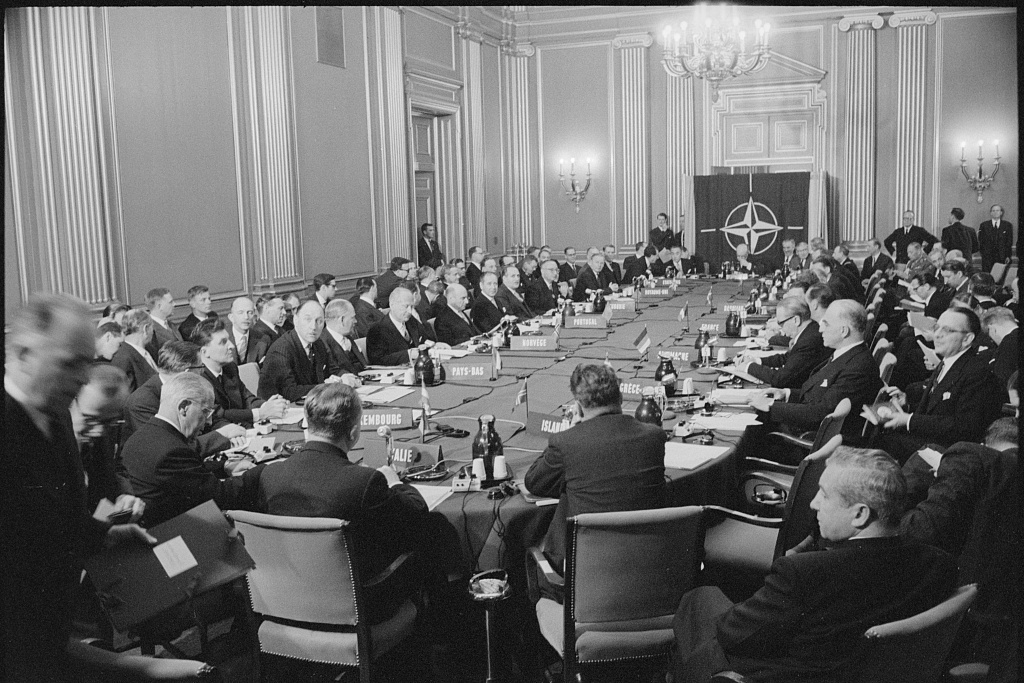
NATO (North Atlantic Treaty Organization)
A transatlantic political and military alliance founded in 1949 and built on the principle of collective defense.
The North Atlantic Treaty Organization, commonly known as NATO, is a transatlantic political and military alliance of thirty-two member states drawn from North America and Europe. Founded on April 4, 1949 by the signing of the North Atlantic Treaty in Washington, D.C., the alliance is built on the principle of collective defense codified in Article 5 of the treaty, under which an armed attack against one member is considered an attack against all. Over more than seven decades, NATO has evolved from a Cold War deterrent directed at the Soviet Union into a broader instrument of crisis management, cooperative security, and political consultation among the world's liberal democracies.
Overview
NATO was established in the immediate aftermath of the Second World War to bind the United States, Canada, and the democracies of Western Europe into a permanent security community. Its founding treaty was signed in Washington, D.C., on April 4, 1949, by twelve original member states. The organization has its political headquarters in Brussels, Belgium, and its military nerve center, the Supreme Headquarters Allied Powers Europe (SHAPE), at Mons in southern Belgium. Membership has grown in ten successive waves of enlargement to thirty-two states, most recently with the accession of Finland in 2023 and Sweden in 2024.
The alliance is governed by consensus among the member states through the North Atlantic Council, chaired by the Secretary General, a senior civilian diplomat chosen by common agreement of the allies. The Military Committee, composed of the chiefs of defense of the member states, provides military advice to the council and directs the work of NATO's two strategic commands: Allied Command Operations, led from SHAPE by the Supreme Allied Commander Europe, and Allied Command Transformation, led from Norfolk, Virginia, by the Supreme Allied Commander Transformation. National armed forces remain under national control in peacetime but are trained, exercised, and, where necessary, employed together under NATO command.
Although NATO was created as a defensive alliance and its founding treaty describes a limited geographic area of application, its activities now extend well beyond the territory of its members. The alliance has undertaken operations in Kosovo, Afghanistan, the Mediterranean Sea, off the Horn of Africa, and in Iraq, and it maintains partnerships with more than forty countries around the world, including dialogue with neighbors in the Mediterranean, Middle East, and Indo-Pacific. Since the full-scale Russian invasion of Ukraine in February 2022, the alliance has returned to its core deterrence and defense mission with renewed intensity, reinforcing its eastern flank and revising its strategic concept.
Key Facts
- Founded
- April 4, 1949 (North Atlantic Treaty signed in Washington, D.C.)
- Headquarters
- Brussels, Belgium (political); SHAPE, Mons, Belgium (military)
- Member states
- 32 (as of 2024, following the accession of Sweden)
- Original members (1949)
- United States, United Kingdom, France, Canada, Italy, Netherlands, Belgium, Luxembourg, Denmark, Norway, Portugal, Iceland
- Secretary General
- Mark Rutte (Netherlands), since October 1, 2024
- Supreme Allied Commander Europe (SACEUR)
- A four-star United States general or admiral, based at SHAPE in Mons, Belgium. SACEUR is always an American officer, while the Secretary General is always a European.
- Active military personnel
- Approximately 3.5 million across allied armed forces (2024 estimate, drawn from national contributions)
- Defense spending target
- At least 2 percent of gross domestic product, as agreed at the 2014 Wales Summit; a majority of allies had met the target by 2024
- Article 5 invoked
- Once in NATO's history, on September 12, 2001, following the terrorist attacks on the United States the previous day
- Official languages
- English and French
- Current Strategic Concept
- Adopted at the Madrid Summit in June 2022; identifies Russia as the most significant and direct threat to allied security
Founding and the Washington Treaty
NATO was born from the uncertain security environment that followed the end of the Second World War. By 1948, Soviet pressure in central and eastern Europe had produced the communist coup in Czechoslovakia in February, the Berlin Blockade from June 1948 to May 1949, and a pattern of political intimidation directed at neighboring democracies. Western European governments, economically exhausted and militarily weakened by six years of war, concluded that only a formal security commitment from the United States could provide a credible deterrent against further Soviet expansion. The Brussels Treaty of March 1948, which linked the United Kingdom, France, Belgium, the Netherlands, and Luxembourg in a mutual defense pact, was an important first step, but it lacked the American commitment that most European leaders believed was essential.
Negotiations among the prospective allies began in Washington in the summer of 1948, shortly after the United States Senate passed the Vandenberg Resolution of June 1948, which opened the way for American participation in peacetime regional defense arrangements. The text that emerged, the North Atlantic Treaty, was a short and carefully worded document of fourteen articles. Its preamble committed the signatories to the principles of the Charter of the United Nations, to the defense of freedom and the rule of law, and to the peaceful settlement of disputes. Its operative heart was Article 5, which declared that an armed attack against one or more of the parties in Europe or North America would be considered an attack against them all, and that each party would assist the attacked ally by taking, individually and in concert, such action as it deemed necessary, including the use of armed force.
The treaty was signed in Washington, D.C., on April 4, 1949, by the foreign ministers of the twelve founding members: the United States, the United Kingdom, France, Canada, Italy, the Netherlands, Belgium, Luxembourg, Denmark, Norway, Portugal, and Iceland. The United States Senate approved the treaty by a vote of 82 to 13 in July 1949, and it entered into force on August 24 of that year. The first Secretary General, the British diplomat and former general Hastings Lionel Ismay, took office in April 1952 and famously characterized NATO's unofficial purpose as keeping the Russians out, the Americans in, and the Germans down.

Cold War Era
For four decades, NATO's central purpose was the deterrence of a Soviet attack on Western Europe. The alliance's early years were shaped by the outbreak of the Korean War in June 1950, which convinced Western governments that the Soviet threat extended well beyond Europe and that paper guarantees required real military forces. In response, NATO created an integrated military command in 1950 and 1951, established the position of Supreme Allied Commander Europe, and appointed General Dwight D. Eisenhower as its first holder. Allied forces were forward-deployed in West Germany and surrounding countries, and integrated air defense, nuclear consultation, and joint planning mechanisms were developed over the course of the 1950s and 1960s.
The alliance had its own internal turbulence. France, under President Charles de Gaulle, withdrew from the integrated military command structure in 1966 while remaining a political member, leading to the relocation of NATO headquarters from Paris to Brussels in 1967. Debates over strategy ranged from the doctrine of massive retaliation adopted in the 1950s to the more calibrated strategy of flexible response approved in 1967, which integrated conventional, theater nuclear, and strategic nuclear forces into a single deterrent concept. The 1979 Dual-Track Decision, which paired the deployment of United States intermediate-range nuclear forces in Europe with an offer to negotiate their limitation, produced both large protest movements in several member states and, ultimately, the Intermediate-Range Nuclear Forces (INF) Treaty of 1987.
The Soviet response to NATO's creation and subsequent consolidation was the Warsaw Treaty Organization, commonly known as the Warsaw Pact, established in May 1955 after the accession of West Germany to NATO. Throughout the Cold War, the two alliances faced one another across the inner-German border and the broader dividing line of Europe. The Berlin Crisis of 1958 to 1961 and the Cuban Missile Crisis of October 1962 brought the world to the edge of nuclear war, and each prompted significant reviews of NATO strategy and planning. For a fuller account of this wider confrontation, see The Cold War. Although the period produced intense crises and a continuous arms race, it is also remembered as a long peace in Europe, in which major war among the great powers was avoided for more than forty years.

Structure and Command
NATO operates through a dual civilian and military structure. Civilian consultation, political decision, and long-term policy are the responsibility of the North Atlantic Council and the international staff in Brussels. Military planning, command, and the conduct of operations are the responsibility of the integrated military command structure and the international military staff. The following cards summarize the principal bodies.
North Atlantic Council (NAC)
The NAC is NATO's principal political decision-making body. Each member state is represented by a permanent representative at ambassadorial level. The council takes all decisions by consensus, meets regularly at the level of permanent representatives, and periodically at the level of foreign ministers, defense ministers, and heads of state and government.
Military Committee
The Military Committee is the senior military authority within NATO, composed of the chiefs of defense of the member states. It provides the North Atlantic Council with consensus-based military advice and directs the work of the two strategic commands through the international military staff.
Secretary General
The Secretary General is NATO's senior civilian official, chairs the North Atlantic Council and other major political bodies, and serves as the alliance's principal spokesperson. The current Secretary General is former Prime Minister of the Netherlands Mark Rutte, who took office on October 1, 2024, succeeding Jens Stoltenberg of Norway.
Allied Command Operations (ACO)
ACO is responsible for the planning and execution of all NATO operations. It is led by the Supreme Allied Commander Europe (SACEUR), a four-star United States officer, from Supreme Headquarters Allied Powers Europe (SHAPE) near Mons in southern Belgium. SACEUR also serves as the Commander of United States European Command, a dual-hatted role that dates from the early 1950s.
Allied Command Transformation (ACT)
ACT is NATO's warfare development command, responsible for driving innovation, concept development, experimentation, and training across the alliance. It was established in 2003 and is led by the Supreme Allied Commander Transformation (SACT), based in Norfolk, Virginia, the only major NATO command headquartered in North America.
NATO Headquarters, Brussels
NATO's political headquarters has been in Brussels since 1967, when it relocated from Paris following France's withdrawal from the integrated military command. A new headquarters building, designed to symbolize transatlantic unity with two interlocking wings, opened on the same site in 2018 and houses the North Atlantic Council, the international staff, and the international military staff.
Enlargement
NATO's founding treaty provides in Article 10 for the accession of additional European states by unanimous invitation from the existing members. Over the decades this provision has been used ten times, carrying the alliance from its twelve founding members to thirty-two. Each round of enlargement has responded both to changes in the security environment and to the aspirations of the acceding states, and each has required the unanimous consent of all existing members.
During the Cold War, enlargement was deliberately limited. Greece and Turkey joined in February 1952, extending allied commitments to the eastern Mediterranean. West Germany acceded in May 1955 under the Paris Agreements, a step that led directly to the creation of the Warsaw Pact on the other side of the Iron Curtain. Spain joined in May 1982, seven years after the end of the Franco dictatorship, bringing allied membership to sixteen.
Post-Cold War enlargement transformed the alliance. In March 1999 the Czech Republic, Hungary, and Poland joined, the first states of the former Warsaw Pact to do so. The largest round followed in March 2004, when Bulgaria, Estonia, Latvia, Lithuania, Romania, Slovakia, and Slovenia all joined together, bringing the former Soviet Baltic republics into the alliance. Albania and Croatia joined in April 2009, Montenegro in June 2017, and North Macedonia in March 2020.
The most recent rounds were driven by the Russian war of aggression against Ukraine. Finland, which had been formally non-aligned for decades, applied for membership in May 2022 and joined on April 4, 2023, the alliance's seventy-fourth anniversary. Sweden, which had been neutral for more than two centuries, applied at the same time but faced prolonged ratification delays in Turkey and Hungary. Its accession was completed on March 7, 2024. The two Nordic accessions roughly doubled NATO's direct border with Russia and completed a previously elusive strategic geography across the Nordic and Baltic region.
Article 5 and Collective Defense
Article 5 of the North Atlantic Treaty is the alliance's founding commitment to collective defense. The article provides that an armed attack against one or more of the parties in Europe or North America shall be considered an attack against them all. Each ally agrees that, in the event of such an attack, it will assist the attacked party by taking, individually and in concert with the other parties, such action as it deems necessary, including the use of armed force, to restore and maintain the security of the North Atlantic area. The commitment is not automatic: each ally retains the authority to decide what assistance it will provide, and all allied action is subject to Article 51 of the Charter of the United Nations on individual and collective self-defense.
In more than seven decades, Article 5 has been invoked only once. The North Atlantic Council agreed on September 12, 2001, less than twenty-four hours after the terrorist attacks on New York and Washington the previous day, that the attacks fell within the scope of Article 5. The decision was confirmed on October 2 once investigators had established the foreign origin of the attacks. Allied operations in direct response included Operation Eagle Assist, in which NATO airborne early warning aircraft patrolled United States airspace, and Operation Active Endeavour, a naval counter-terrorism patrol in the Mediterranean. The broader allied effort eventually led to the NATO-led International Security Assistance Force (ISAF) in Afghanistan, which ran from 2003 to 2014, followed by the Resolute Support Mission until 2021.
Article 4, the consultation clause, has been invoked more often, most notably by Turkey during the wars in Iraq and Syria and by Poland, Estonia, Latvia, Lithuania, Romania, Bulgaria, the Czech Republic, and Slovakia after the full-scale Russian invasion of Ukraine in February 2022. These consultations have shaped the alliance's posture on its eastern flank and its response to threats to allied territory and critical infrastructure, including suspected sabotage of undersea cables and pipelines in the Baltic Sea.
Operations and Missions
Beyond the defense of allied territory, NATO has conducted dozens of operations and missions since the end of the Cold War, spanning peace support, counter-piracy, humanitarian assistance, and crisis management. The most consequential are summarized below.
Kosovo Force (KFOR)
KFOR is a NATO-led international peacekeeping force that has operated in Kosovo since June 1999, following the seventy-eight-day Operation Allied Force air campaign that ended the humanitarian crisis in the province. Originally a 50,000-strong force, KFOR remains on the ground under a United Nations Security Council mandate and retains responsibility for a safe and secure environment and freedom of movement.
International Security Assistance Force (ISAF)
ISAF was a United Nations-mandated, NATO-led mission in Afghanistan from 2003 to 2014. At its peak it deployed approximately 130,000 personnel from fifty-one NATO and partner nations. Its successor Resolute Support Mission, a non-combat training and advisory effort, ran from 2015 until the withdrawal of allied forces in 2021.
NATO Mission Iraq
Launched in 2018 at the invitation of the government of Iraq, NATO Mission Iraq is a non-combat training and advisory mission intended to help build more sustainable, transparent, inclusive, and effective Iraqi security institutions and armed forces. It succeeds earlier NATO training activity in the country and operates in close coordination with the Global Coalition to Defeat ISIS.
Operation Unified Protector (Libya)
In 2011, acting on United Nations Security Council Resolutions 1970 and 1973, NATO led Operation Unified Protector in Libya. The operation enforced an arms embargo and a no-fly zone and conducted strikes to protect civilians from forces loyal to Muammar al-Qaddafi. It ended on October 31, 2011, following the collapse of the Qaddafi regime.
Operation Sea Guardian
Sea Guardian is a flexible maritime security operation in the Mediterranean, launched in 2016 as the successor to Operation Active Endeavour. It conducts maritime situational awareness, counter-terrorism at sea, and capacity building, and provides support to wider allied efforts, including the European Union's own Mediterranean missions.
Operation Ocean Shield
From 2009 to 2016, NATO conducted Operation Ocean Shield off the Horn of Africa to deter, defend against, and disrupt piracy in the Gulf of Aden and the western Indian Ocean. Allied warships escorted World Food Programme vessels and patrolled key shipping lanes; the combination of naval patrols, industry best practices, and capacity building in Somalia reduced pirate attacks to negligible levels by 2016.

Russia, Ukraine, and Contemporary Strategy
For most of the 1990s and 2000s, NATO and the Russian Federation pursued what both sides described as a strategic partnership. The NATO-Russia Founding Act, signed in Paris on May 27, 1997, established mutual commitments to cooperation, transparency, and the principle that no state had the right to veto the choices of other European states in matters of security. The NATO-Russia Council, created in 2002, provided a forum for dialogue on terrorism, arms control, and crisis management. After 2008, however, these arrangements steadily eroded. The Russo-Georgian War of August 2008 came only months after the Bucharest Summit declaration that Ukraine and Georgia would become members of NATO, without setting a timetable.
The Russian annexation of Crimea in March 2014 and the subsequent covert war in eastern Ukraine marked a turning point in NATO-Russia relations. At the Wales Summit of September 2014, the allies suspended all practical civilian and military cooperation with Russia, affirmed a Readiness Action Plan for enhanced presence on the eastern flank, and set the 2 percent of gross domestic product defense spending target. Enhanced Forward Presence battlegroups were subsequently established in Estonia, Latvia, Lithuania, and Poland. United States and British forces led early deployments, supplemented over time by contingents from Canada, Germany, France, and other allies.
The full-scale Russian invasion of Ukraine on February 24, 2022, produced the most profound reassessment of NATO strategy since the end of the Cold War. The alliance activated its response forces, reinforced the eastern flank with four additional multinational battlegroups in Bulgaria, Hungary, Romania, and Slovakia, and increased the readiness of hundreds of thousands of troops. Allied nations, acting individually and in coordination, provided large-scale military, financial, and humanitarian assistance to Ukraine, though NATO itself has not become a direct party to the conflict.
The Madrid Summit of June 2022 adopted a new Strategic Concept, replacing the 2010 document. It characterizes Russia as the most significant and direct threat to allied security and stability and, for the first time, identifies the challenges posed by the People's Republic of China to allied interests, security, and values. Subsequent summits at Vilnius in 2023 and Washington in 2024, the latter marking NATO's seventy-fifth anniversary, have further developed new regional defense plans, a NATO Defense Industrial Pledge, and the NATO Security Assistance and Training for Ukraine coordination mechanism. The broader strategic context is also informed by the end of the Soviet Union, a development treated at greater length in The Cold War and in the broader history of World War II, which framed the postwar international order.
Partnerships
NATO maintains structured relationships with more than forty partner countries and a range of international organizations, reflecting the conviction that its own security cannot be secured by allied territorial defense alone. These partnerships are grouped into several overlapping frameworks, each with its own origins and purposes. Partnership for Peace, launched at the 1994 Brussels Summit, was designed to build trust between NATO and countries of the former Warsaw Pact and the former Soviet Union. It provides a menu of cooperation activities, including joint exercises, education, and defense reform, and for many states it has served as a pathway to eventual membership.
The Euro-Atlantic Partnership Council (EAPC), established in 1997, is the overall political framework that brings NATO and its Euro-Atlantic partners together for consultation. The NATO-Ukraine Commission, created in 1997, has been replaced since the 2023 Vilnius Summit by the NATO-Ukraine Council, which places Ukraine alongside allied foreign and defense ministers on a more equal footing. The NATO-Georgia Commission, launched in 2008, provides a similar structure for cooperation with Georgia. The Mediterranean Dialogue, inaugurated in 1994, includes Algeria, Egypt, Israel, Jordan, Mauritania, Morocco, and Tunisia.
The Istanbul Cooperation Initiative, launched in 2004, engages the Gulf monarchies, including Bahrain, Kuwait, Qatar, and the United Arab Emirates, in cooperation on interoperability, counter-terrorism, and maritime security. NATO's partners across the globe, sometimes called the Asia-Pacific Four when discussed together, include Australia, Japan, the Republic of Korea, and New Zealand, all of which have participated in allied operations and have attended recent summits as invited guests. These relationships have taken on additional weight as the alliance adjusts to a more contested strategic environment in the Indo-Pacific.
NATO also maintains working relations with other international organizations, most notably the United Nations, the European Union, the Organization for Security and Cooperation in Europe, and the African Union. Its partnerships illustrate that, although NATO's core commitment remains the collective defense of its own members, its practical work is increasingly tied to cooperative security with non-member states and institutions. This broader approach complements the longer story of twentieth-century international cooperation traced, from a different angle, in the pages on the United Nations and on decolonization.
Sources
Detailed citations, data references, and institutional sources for all CountryReports content are listed on the Sources page. The following official publications, government archives, and academic research institutions are the primary authorities we rely on for NATO content. Each link points to the institution's homepage or relevant subsite.
NATO Official Publications and Archives
- NATO (nato.int) — Official website of the North Atlantic Treaty Organization; hosts the text of the North Atlantic Treaty, successive Strategic Concepts, summit declarations, speeches of the Secretary General, and the e-Library of official documents.
- NATO Archives — The central archives of NATO, including declassified records of the North Atlantic Council, the Military Committee, and successive Secretaries General, available through an online catalog.
- NATO Defense College (Rome) — Allied education and research institution; its Research Papers and Policy Briefs provide analysis of alliance strategy, partnerships, and operations.
- Supreme Headquarters Allied Powers Europe (SHAPE) — Headquarters of Allied Command Operations in Mons, Belgium, publishing public information on allied military structures and exercises.
Government Sources
- U.S. Department of State — North Atlantic Treaty Organization — Official United States reference pages on NATO, including the text of the treaty and current policy statements.
- U.S. Department of State — Office of the Historian: The North Atlantic Treaty Organization, 1949 — Authoritative historical background on the founding of NATO produced by the official historian of the United States government.
- United Kingdom Foreign, Commonwealth and Development Office (FCDO) — British government policy on NATO, the Atlantic alliance, and European security, including ministerial statements and white papers.
- National Archives and Records Administration (NARA) — Cold War records — United States records relating to NATO's founding, Cold War operations, and integrated command structures.
- Library of Congress — Photographic collections and legislative records documenting the United States Senate's approval of the North Atlantic Treaty and the alliance's subsequent anniversaries.
Independent Research Institutes
- Stockholm International Peace Research Institute (SIPRI) — Independent research on armaments, disarmament, and international security; annual data on military expenditure and arms transfers used to contextualize allied defense spending.
- International Institute for Strategic Studies (IISS) — Publisher of The Military Balance, Survival, and Strategic Survey, which provide authoritative assessments of allied force structures and of NATO's strategic environment.
- Atlantic Council — Washington-based research organization focused on the transatlantic relationship and NATO; publishes policy reports on deterrence, enlargement, and allied defense reform.
- RAND Corporation — Nonprofit research organization whose reports on force planning, deterrence, and alliance politics inform allied defense discussions.
- Council on Foreign Relations — American think tank publishing regular analysis on NATO, the Russia-Ukraine war, and the future of the transatlantic alliance in Foreign Affairs and in background briefings.
- Brookings Institution — Research on foreign policy, security, and the transatlantic relationship, including the work of the Center on the United States and Europe.
Peer-Reviewed Journals
- International Security — Peer-reviewed journal published by the Belfer Center for Science and International Affairs at Harvard Kennedy School; a leading venue for academic work on alliance politics and deterrence.
If you notice an error or would like to suggest a correction, please use our contact page to get in touch.