
 English
 Español
 中文
中文 हिन्दी
 Français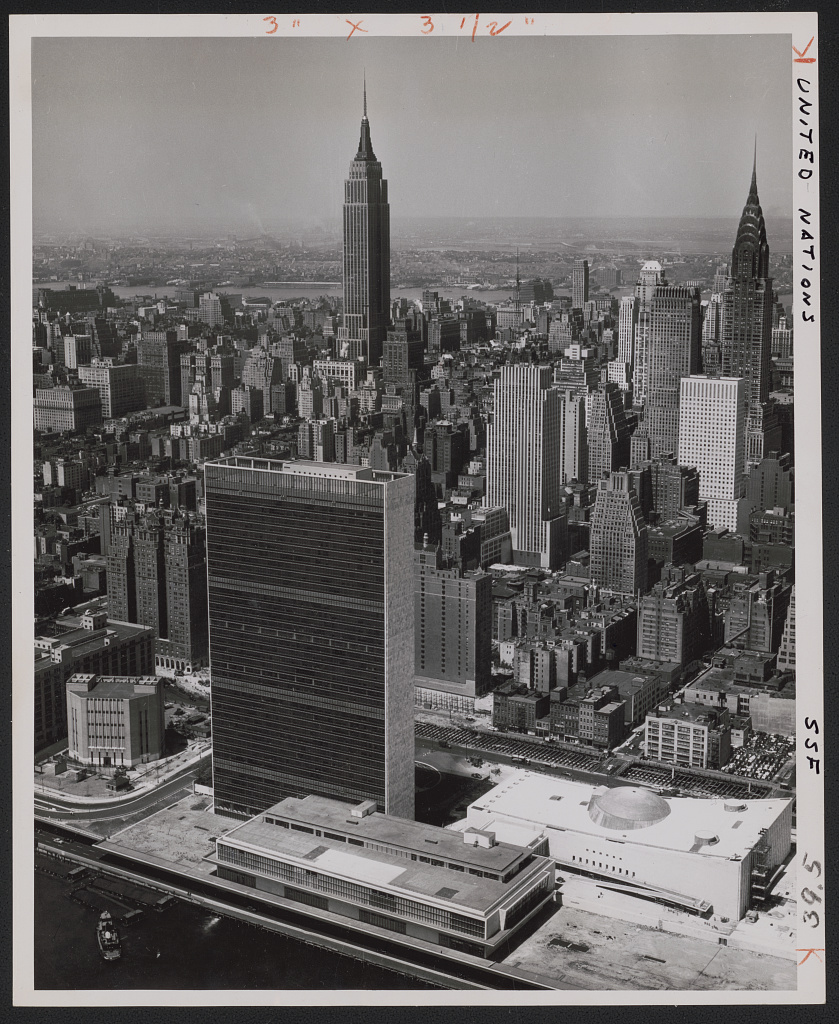
United Nations
Founded October 24, 1945 — the world's largest intergovernmental organization, with 193 member states and a universal mandate for peace, development, and human rights.
The United Nations is the principal global forum for cooperation among sovereign states. Founded in San Francisco in 1945 in the aftermath of the Second World War, it was created to maintain international peace and security, develop friendly relations among nations, promote social progress and better standards of life, and advance respect for human rights and fundamental freedoms. With 193 member states, six official languages, and a network of specialized agencies that touch almost every area of human activity, the organization has become the most durable experiment in multilateral governance in modern history.
Overview
The United Nations, commonly abbreviated UN, is an intergovernmental organization established by the Charter of the United Nations, a binding multilateral treaty that entered into force on October 24, 1945. Its founding members were the fifty states that signed the Charter at the San Francisco Conference in June 1945, together with Poland, which signed shortly afterward. The organization replaced the League of Nations, which had been established after the First World War and which had proven unable to prevent the aggressions of the 1930s or the outbreak of a second global conflict. The UN was designed to correct the weaknesses of its predecessor while preserving the underlying idea of collective action by sovereign states.
The organization's purposes, set out in Article 1 of the Charter, fall under four broad headings. The first is the maintenance of international peace and security, including the prevention and suppression of acts of aggression. The second is the development of friendly relations among nations based on respect for the principle of equal rights and self-determination of peoples. The third is the achievement of international cooperation in solving problems of an economic, social, cultural, or humanitarian character. The fourth is to serve as a center for harmonizing the actions of nations in the attainment of these common ends. The Charter's Preamble, drafted by the South African statesman Jan Smuts among others, frames the entire project as a commitment by the peoples of the United Nations to save succeeding generations from the scourge of war.
The United Nations is not a world government. It has no independent police force, no standing army, and no authority to tax individuals. Its powers derive from the consent of member states, who retain sovereign control over most areas of policy. Nonetheless, the Charter gives the organization some of the strongest legal instruments available in international law, including the binding enforcement powers of the Security Council under Chapter VII. The UN has grown from fifty-one founding members in 1945 to 193 today, making it the most nearly universal organization in world history. The last state admitted was South Sudan, which joined in 2011 after obtaining independence from Sudan.
The organization operates through a system of six principal organs and a large family of specialized agencies, funds, programmes, and related bodies. Its main headquarters stands on an eighteen-acre international territory along the East River in Manhattan, New York. A second major campus, the United Nations Office at Geneva in the historic Palais des Nations, houses the human rights, disarmament, and humanitarian affairs machinery. Additional duty stations in Vienna and Nairobi complete the network of core UN offices. The International Court of Justice, the principal judicial organ, sits at the Peace Palace in The Hague. Collectively, the UN system employs more than forty thousand international civil servants and operates in almost every country on Earth.
Key Facts
- Founded
- October 24, 1945 (Charter entry into force)
- Charter signed
- June 26, 1945, San Francisco, California
- Headquarters
- United Nations Plaza, 405 East 42nd Street, New York, NY, United States
- Other major offices
- Geneva, Vienna, Nairobi; ICJ at The Hague
- Member states
- 193 (most recent admission: South Sudan, 2011)
- Observer states
- Holy See and State of Palestine (non-member permanent observers)
- Official languages
- Six: Arabic, Chinese, English, French, Russian, and Spanish
- Current Secretary-General
- António Guterres of Portugal (ninth holder of the office; second term began January 1, 2022)
- Regular budget
- Approximately 3.6 billion United States dollars per year (regular budget biennium; peacekeeping financed separately)
- Peacekeeping missions
- Approximately 11 active operations, with tens of thousands of uniformed and civilian personnel deployed
- Foundational document
- Charter of the United Nations (1945) and Statute of the International Court of Justice, annexed to the Charter
- Nobel Peace Prize recipients
- The UN and its agencies have received twelve Nobel Peace Prizes, including the 2001 award shared by the UN and Secretary-General Kofi Annan
Founding and the UN Charter
The United Nations was conceived during the darkest years of the Second World War. Its most immediate predecessor, the League of Nations, had been founded in 1920 under the terms of the Treaty of Versailles but had failed to stop the Japanese invasion of Manchuria in 1931, the Italian invasion of Ethiopia in 1935, or the successive German aggressions of the late 1930s. By 1942, the leaders of the Allied Powers had concluded that a new organization, built on firmer legal foundations and backed by the great powers themselves, would be needed once the war ended. The name "United Nations" was coined by United States President Franklin D. Roosevelt and first used officially in the Declaration by United Nations, signed by representatives of twenty-six Allied governments in Washington on January 1, 1942.
The legal and institutional architecture of the new organization was hammered out at a series of wartime meetings. The Moscow Declaration of October 1943 committed the four major Allies to establish a general international organization as soon as practicable. The Dumbarton Oaks Conference, held at a country estate in Washington, D.C. from August to October 1944, produced the first detailed blueprint, including the outlines of the General Assembly, the Security Council, and the Secretariat. The Yalta Conference of February 1945 resolved the final sticking points on Security Council voting procedures and great-power veto rights. Roosevelt, Winston Churchill, and Joseph Stalin agreed that the permanent members of the Security Council would hold a right of veto on substantive decisions, a compromise that secured Soviet participation but that has shaped the politics of the UN ever since.
The founding treaty itself was negotiated at the United Nations Conference on International Organization, held in San Francisco from April 25 to June 26, 1945. Delegates from fifty countries met in the War Memorial Opera House and the adjacent Veterans Building, and the Charter they produced runs to 111 articles divided into nineteen chapters. It was signed on June 26 and entered into force on October 24, 1945, when the ratifications of the five permanent members of the Security Council and a majority of the other signatories had been deposited. October 24 is now marked every year as United Nations Day. The Statute of the International Court of Justice was annexed to the Charter and entered into force at the same time, establishing the continuity between the new court and its predecessor, the Permanent Court of International Justice at The Hague.
The Charter is a comparatively short document that combines binding legal obligations with broad statements of purpose. Article 2 sets out the organization's principles, including the sovereign equality of member states, the peaceful settlement of disputes, and the prohibition on the threat or use of force in international relations. Chapter VI empowers the Security Council to recommend methods of pacific settlement. Chapter VII authorizes the Council to determine the existence of a threat to the peace, breach of the peace, or act of aggression, and to impose measures ranging from economic sanctions to the collective use of force. Amendments to the Charter require adoption by two-thirds of the members of the General Assembly and ratification by two-thirds of the members, including all five permanent members of the Security Council. The Charter has been amended only five times, in relatively limited ways relating to the size of the Council and ECOSOC.

Principal Organs
Article 7 of the Charter establishes six principal organs of the United Nations. Each has a distinct mandate, membership, and procedure. Together they form the institutional backbone of the organization.
General Assembly
The General Assembly is the universal plenary organ of the United Nations. All 193 member states are represented, each with one vote regardless of size or contribution. The Assembly adopts the regular budget, elects the non-permanent members of the Security Council, admits new members on the recommendation of the Council, and issues resolutions on virtually any matter within the scope of the Charter. Its annual General Debate each September draws heads of state and government to New York.
- • 193 member states, one vote each
- • Six Main Committees cover the full agenda
- • Resolutions are recommendatory, not binding
Security Council
The Security Council holds primary responsibility under the Charter for the maintenance of international peace and security. It has fifteen members: five permanent (the P5) and ten elected (the E10) for two-year terms. The permanent members are China, France, Russia, the United Kingdom, and the United States, each of which holds the power to veto substantive decisions. Only the Council can authorize binding sanctions or the collective use of force under Chapter VII.
- • 5 permanent members with veto power
- • 10 elected members on regional rotation
- • Presidency rotates monthly by alphabetical order
Secretariat
The Secretariat is the permanent international civil service of the United Nations. It is led by the Secretary-General, who is appointed by the General Assembly on the recommendation of the Security Council. The Secretariat services the other organs, carries out their programs and policies, and employs tens of thousands of international officials drawn from virtually every member state. Its staff are bound by oaths of loyalty to the organization rather than to their home governments.
- • Led by the Secretary-General (five-year renewable term)
- • Headquartered in New York with major offices worldwide
- • Approximately 37,000 staff under the Secretary-General
Economic and Social Council
The Economic and Social Council, or ECOSOC, coordinates the economic, social, and related work of the United Nations system and the specialized agencies. It comprises fifty-four member states elected by the General Assembly for three-year terms. ECOSOC oversees functional and regional commissions on topics from statistics and population to human rights and the status of women, and it holds a High-level Political Forum on Sustainable Development each year.
- • 54 members, three-year staggered terms
- • Coordinates 15 specialized agencies
- • Oversees the High-level Political Forum on the SDGs
International Court of Justice
The International Court of Justice, often called the World Court, is the principal judicial organ of the United Nations. It sits at the Peace Palace in The Hague and consists of fifteen judges elected for nine-year terms by the General Assembly and the Security Council voting separately. The Court has jurisdiction over contentious disputes submitted by states and delivers advisory opinions at the request of authorized UN organs.
- • 15 judges, nine-year renewable terms
- • Peace Palace, The Hague, Netherlands
- • Contentious cases between states and advisory opinions
Trusteeship Council
The Trusteeship Council supervised the administration of eleven Trust Territories, former colonies and League of Nations mandates placed under international oversight after the Second World War. Its work was effectively completed when the last Trust Territory, Palau, achieved independence on October 1, 1994. The Council formally suspended operations on November 1, 1994, and has met only rarely since. Any revival would likely require Charter amendment.
- • Operations suspended November 1, 1994
- • Last Trust Territory, Palau, became independent in 1994
- • Remains a principal organ under the Charter
Secretaries-General
Under Article 97 of the Charter, the Secretary-General is the chief administrative officer of the United Nations and the most visible face of the organization. He or she is appointed by the General Assembly on the recommendation of the Security Council, customarily for a single renewable five-year term. The office holds no formal executive power over member states, yet Secretaries-General have used its prestige to exercise what Dag Hammarskjöld called the "quiet diplomacy" of the United Nations.
-
1946–1952
Trygve Lie — Norway
The first Secretary-General. Oversaw the establishment of the organization and its response to the Korean War. Resigned in 1952 amid tensions with the Soviet Union over UN involvement in Korea.
-
1953–1961
Dag Hammarskjöld — Sweden
Architect of modern UN peacekeeping and quiet diplomacy. Launched the first armed peacekeeping force, UNEF, during the 1956 Suez Crisis. Killed in a plane crash in Northern Rhodesia while seeking a ceasefire in the Congo Crisis. Posthumously awarded the Nobel Peace Prize.
-
1961–1971
U Thant — Burma
The first Secretary-General from the developing world. Mediated the Cuban Missile Crisis, presided over the admission of many newly independent African states, and negotiated an end to the Congo operation and the 1965 India-Pakistan war.
-
1972–1981
Kurt Waldheim — Austria
Served two five-year terms during the height of the Cold War. Oversaw expansion of peacekeeping and UN development work, including responses to crises in Cyprus, the Middle East, and South Africa under apartheid.
-
1982–1991
Javier Pérez de Cuéllar — Peru
Helped end the Iran-Iraq War, negotiated the independence of Namibia, and opened the way for a dramatic expansion of UN peace operations as the Cold War wound down. The first Latin American to hold the office.
-
1992–1996
Boutros Boutros-Ghali — Egypt
First African and first Arab Secretary-General. Published An Agenda for Peace, a reform vision for the post-Cold War UN. Served during the difficult operations in Somalia, Bosnia, and Rwanda. The only Secretary-General denied a second term, after a United States veto in the Security Council.
-
1997–2006
Kofi Annan — Ghana
The first Secretary-General elected from within the UN staff. Led major management reforms, launched the Millennium Development Goals, and championed the Responsibility to Protect doctrine. Shared the 2001 Nobel Peace Prize with the UN as a whole.
-
2007–2016
Ban Ki-moon — Republic of Korea
Placed climate change and sustainable development at the center of the UN agenda. Oversaw adoption of the 2030 Agenda and its seventeen Sustainable Development Goals in 2015 and the Paris Agreement on climate change in the same year.
-
2017–present
António Guterres — Portugal
Former United Nations High Commissioner for Refugees and Prime Minister of Portugal. Began a second term on January 1, 2022. Priorities include climate action, digital cooperation, conflict prevention, and an Our Common Agenda reform package.
Specialized Agencies and the Wider UN System
The United Nations system reaches far beyond the six principal organs. A family of specialized agencies, each an autonomous international organization with its own membership, budget, and governing body, works under relationship agreements with the UN. The Economic and Social Council coordinates their activities. Funds and programmes such as UNICEF, UNHCR, UNDP, and the World Food Programme are part of the UN itself and report to the General Assembly. Related bodies such as the International Atomic Energy Agency and the World Trade Organization are linked to the UN by cooperation agreements but are not strictly specialized agencies.
Several of the largest specialized agencies predate the UN itself or were created at the same moment. The International Labour Organization was founded in 1919 under the Treaty of Versailles, became the first specialized agency in 1946, and remains the only UN body to include representatives of governments, employers, and workers on equal terms. The Bretton Woods institutions, the International Monetary Fund and the World Bank, were created at a July 1944 conference in Bretton Woods, New Hampshire, and affiliated themselves with the UN in 1947. Today the specialized agencies cover areas as diverse as health, food, education, aviation, shipping, intellectual property, meteorology, and postal services.
UNESCO
The United Nations Educational, Scientific and Cultural Organization, based in Paris, was founded on November 16, 1945. It is best known for the World Heritage List of cultural and natural sites of outstanding universal value and for promoting press freedom, education, and intangible cultural heritage. See UNESCO World Heritage Sites.
WHO
The World Health Organization, founded in 1948 and headquartered in Geneva, directs and coordinates international health work. It led the eradication of smallpox, declared complete in 1980, and coordinated the international response to HIV/AIDS, SARS, Ebola, and COVID-19. See Major Pandemics in History.
FAO
The Food and Agriculture Organization, founded in 1945 and headquartered in Rome, leads international efforts to defeat hunger, improve nutrition, and promote sustainable agriculture. It maintains the Codex Alimentarius food standards jointly with the WHO.
UNICEF
The United Nations Children's Fund was established in December 1946 to provide emergency food and health care to children in countries devastated by the Second World War. It now operates in more than 190 countries, focusing on child survival, education, and protection.
UNHCR
The Office of the United Nations High Commissioner for Refugees was created in 1950 and is guided by the 1951 Refugee Convention. It protects and assists refugees, asylum-seekers, internally displaced persons, and stateless people. It received the Nobel Peace Prize in 1954 and again in 1981.
IMF and World Bank
The International Monetary Fund and the World Bank Group are the Bretton Woods institutions created in 1944. Both are specialized agencies linked to the UN. The IMF focuses on monetary stability and balance of payments support; the World Bank provides loans and grants for development. See World Bank and IMF.
ILO
The International Labour Organization, founded in 1919 as part of the Treaty of Versailles, adopts international labour standards and promotes decent work. Its tripartite structure of governments, employers, and workers is unique in the UN system. It received the Nobel Peace Prize in 1969 on its fiftieth anniversary.
WMO, IMO, ICAO, WIPO, UPU, IAEA
The World Meteorological Organization (Geneva), International Maritime Organization (London), International Civil Aviation Organization (Montreal), World Intellectual Property Organization (Geneva), and Universal Postal Union (Bern) are technical specialized agencies. The International Atomic Energy Agency, based in Vienna, is a related body that reports to both the General Assembly and the Security Council.
Peacekeeping Operations
Peacekeeping is not explicitly mentioned in the UN Charter, and Dag Hammarskjöld famously described it as lying in "Chapter six and a half," somewhere between the pacific settlement provisions of Chapter VI and the enforcement measures of Chapter VII. The first UN peacekeeping operation, the United Nations Truce Supervision Organization, or UNTSO, was established in May 1948 to monitor the ceasefire in the Arab-Israeli War. UNTSO continues to operate from Jerusalem today, making it the longest-running UN field operation. The first armed peacekeeping force was the United Nations Emergency Force, created in November 1956 to supervise the withdrawal of British, French, and Israeli forces from Egypt during the Suez Crisis.
Over more than seven decades, the United Nations has mounted more than seventy peace operations on every inhabited continent. Modern peacekeeping has evolved well beyond the original model of lightly armed observers policing a ceasefire between regular armies. Contemporary multidimensional missions often combine military, police, and civilian components with mandates that include protecting civilians, supporting political processes, disarming armed groups, reforming justice and security institutions, and helping to organize elections. More than 4,200 UN peacekeepers have died in service since 1948, and every May 29 is marked as the International Day of United Nations Peacekeepers.
Current major missions include the United Nations Organization Stabilization Mission in the Democratic Republic of the Congo (MONUSCO), the United Nations Mission in South Sudan (UNMISS), the United Nations Mission for the Referendum in Western Sahara (MINURSO), the United Nations Interim Force in Lebanon (UNIFIL), the United Nations Peacekeeping Force in Cyprus (UNFICYP), the United Nations Disengagement Observer Force on the Golan Heights (UNDOF), the United Nations Interim Administration Mission in Kosovo (UNMIK), and the United Nations Interim Security Force for Abyei (UNISFA). Peacekeeping is financed through a separate assessed budget agreed by the General Assembly, distinct from the regular budget of the organization, and the largest troop-contributing countries in recent years have included Bangladesh, Nepal, India, Rwanda, and Ethiopia.
Human Rights Framework
The promotion of human rights is one of the three pillars of the United Nations, alongside peace and security and development. The foundational text is the Universal Declaration of Human Rights, proclaimed by the General Assembly on December 10, 1948, at the Palais de Chaillot in Paris by resolution 217 A (III). Drafted by a committee chaired by Eleanor Roosevelt and including members from Canada, China, France, Lebanon, and other countries, the Declaration sets out thirty articles describing the civil, political, economic, social, and cultural rights to which all human beings are entitled. Though a non-binding resolution in legal form, the UDHR has become the single most translated document in history and the foundation of modern international human rights law.
The UDHR was followed by a series of binding treaties. The Convention on the Prevention and Punishment of the Crime of Genocide was adopted one day before the Declaration, on December 9, 1948. The International Covenant on Civil and Political Rights and the International Covenant on Economic, Social and Cultural Rights, both adopted in 1966 and entering into force in 1976, elaborated the Declaration's rights into binding treaty obligations. Together with the UDHR, these two Covenants form what is often called the International Bill of Human Rights. Subsequent treaties addressed racial discrimination, discrimination against women, torture, the rights of children, the rights of persons with disabilities, enforced disappearances, and the rights of migrant workers.
The institutional machinery for human rights has expanded alongside the treaty framework. The Human Rights Council, established by General Assembly resolution 60/251 on March 15, 2006, replaced the earlier Commission on Human Rights. The Council comprises forty-seven members elected by the General Assembly, meets regularly in Geneva, and conducts a Universal Periodic Review of every member state's human rights record. It is supported by the Office of the United Nations High Commissioner for Human Rights, created in 1993 following the Vienna World Conference on Human Rights. A network of independent Special Rapporteurs, working groups, and treaty bodies monitors specific rights or country situations and produces detailed public reports. See also Decolonization, an era in which the UN served as the primary international forum for self-determination claims.

Development Agenda and the SDGs
Economic and social development has been part of the UN agenda from the beginning. The first United Nations Development Decade, launched by the General Assembly in 1961, set broad targets for economic growth and poverty reduction in what were then called the developing countries. Successive decades and world conferences through the 1970s, 1980s, and 1990s refined the agenda, adding attention to population, women, human settlements, environment, social development, and food security. The United Nations Conference on Environment and Development in Rio de Janeiro in 1992 produced the framework conventions on climate change and biological diversity and the Rio Declaration on Environment and Development.
The Millennium Summit of September 2000 represented a turning point. World leaders meeting in New York adopted the Millennium Declaration, from which the Secretariat developed the eight Millennium Development Goals (MDGs) with a target date of 2015. The MDGs covered extreme poverty and hunger, primary education, gender equality, child mortality, maternal health, HIV/AIDS and other diseases, environmental sustainability, and a global partnership for development. By 2015, many of the targets had been met in whole or in part. Extreme poverty was cut by more than half, the HIV epidemic had begun to reverse in most regions, and primary school enrolment in developing countries approached parity, though progress was uneven across regions and within countries.
The successor framework, the 2030 Agenda for Sustainable Development, was adopted by the General Assembly on September 25, 2015. It contains seventeen Sustainable Development Goals (SDGs) and 169 targets, covering poverty, hunger, health, education, gender equality, water, energy, decent work, industry, inequality, cities, consumption, climate, oceans, land, peace and justice, and partnerships. Unlike the MDGs, the SDGs apply to every country and connect environmental, social, and economic dimensions as a single integrated agenda. The High-level Political Forum on Sustainable Development, which meets annually under ECOSOC and quadrennially at the level of heads of state and government, reviews progress against the goals.
Climate change is increasingly the defining challenge of the UN development agenda. The United Nations Framework Convention on Climate Change, opened for signature in 1992 and in force since 1994, established the Conference of the Parties (COP) as the supreme decision-making body. The Kyoto Protocol of 1997 introduced binding emissions targets for industrialized countries. The Paris Agreement of 2015, adopted at COP21, established a universal framework of nationally determined contributions with the goal of holding average global warming well below two degrees Celsius above pre-industrial levels and pursuing efforts to limit the increase to 1.5 degrees.
Criticism and Reform Debates
The United Nations has attracted sustained criticism since its earliest days. The Security Council is charged with the primary responsibility for peace and security but reflects the geopolitical distribution of power in 1945, with three of its five permanent members drawn from Western Europe and North America and none from Africa or Latin America. The veto power has been used to block action in situations including Syria, Ukraine, and Israel-Palestine, leading critics to argue that the organization has fallen short of its core mandate. Defenders counter that without the veto, the great powers would not have joined the organization at all and that the Council's mere existence has provided a consistent forum for crisis management.
Security Council reform has been formally on the General Assembly agenda since 1993. The best-known proposal comes from the so-called G4 grouping, which pairs Brazil, Germany, India, and Japan and seeks an expansion of permanent seats to include themselves along with two seats for African states, as expressed in the Ezulwini Consensus of the African Union. The Uniting for Consensus group, which includes Italy, Pakistan, and others, opposes new permanent seats and instead favors a larger number of elected non-permanent members. Separate initiatives, such as the French-Mexican initiative on veto restraint in cases of mass atrocities and the Accountability, Coherence and Transparency (ACT) group's code of conduct, would limit the use of the veto without formally amending the Charter.
Beyond the Security Council, reform debates have touched on almost every corner of the organization. Oversight reforms have followed major scandals, including the Oil-for-Food Programme inquiry led by Paul Volcker in 2005 and allegations of sexual exploitation and abuse by peacekeepers, which triggered the Zero Tolerance policy and the creation of a Victims' Rights Advocate in 2017. The 2005 World Summit produced the Peacebuilding Commission, the Human Rights Council, and the Responsibility to Protect doctrine. Secretary-General António Guterres has pursued a management, development-system, and peace-and-security reform package since 2017, supplemented in 2021 by the Our Common Agenda report, which called for a Summit of the Future, a New Agenda for Peace, and a Global Digital Compact. The enduring challenge is that meaningful structural change typically requires Charter amendment, which in turn requires the assent of the very permanent members whose relative weight such reform would diminish. See also World War II, the conflict whose conclusion shaped the 1945 settlement, and The Cold War, during which the Security Council was frequently paralyzed by the superpower rivalry. The North Atlantic Treaty Organization emerged in parallel as a regional collective defense arrangement under Article 51 of the Charter.

Sources
Detailed citations, data references, and institutional sources for all CountryReports content are listed on the Sources page. The following official UN bodies, peer-reviewed research institutes, and archival collections are the primary authorities we rely on for content about the United Nations. Each link points to the institution's homepage or the relevant subsite.
Official UN Bodies and Archives
- United Nations — UN.org — Principal portal for the organization, including the Charter, General Assembly and Security Council resolutions, press briefings, and the Secretary-General's speeches and reports.
- United Nations Digital Library — Searchable repository of UN documents, resolutions, voting data, speeches, and publications from all principal organs.
- Dag Hammarskjöld Library — The official library of the United Nations, located at UN Headquarters in New York, with research guides on every aspect of the organization's work.
- United Nations Archives and Records Management Section — Historical archives of the United Nations, including the Secretariat fonds, peacekeeping mission records, and the papers of former Secretaries-General.
- Charter of the United Nations (full text) — The authoritative English-language text of the 1945 Charter and the annexed Statute of the International Court of Justice.
- United Nations Office at Geneva (UNOG) — Portal of the second-largest UN duty station, housed in the historic Palais des Nations, and hub for human rights, disarmament, and humanitarian affairs.
- International Court of Justice — Official site of the principal judicial organ of the United Nations, with case law, advisory opinions, and the Statute of the Court.
- Office of the United Nations High Commissioner for Human Rights (OHCHR) — Lead UN human rights office, with the text of the Universal Declaration, core treaties, and Human Rights Council documentation.
UN Specialized Agencies and Programmes
- UNESCO — United Nations Educational, Scientific and Cultural Organization, based in Paris.
- World Health Organization — UN specialized agency for health, based in Geneva.
- Food and Agriculture Organization — UN specialized agency for food and agriculture, based in Rome.
- UNICEF — United Nations Children's Fund, with operations in more than 190 countries.
- UNHCR — United Nations Refugee Agency, headquartered in Geneva.
- International Labour Organization — The oldest UN specialized agency, founded in 1919.
- International Monetary Fund — Bretton Woods institution linked to the UN by specialized-agency agreement.
- World Bank Group — Umbrella of five institutions, all specialized agencies of the UN system.
- International Atomic Energy Agency — UN-related body for peaceful uses of nuclear energy and nuclear safeguards, based in Vienna.
- United Nations Peacekeeping — Official portal of the Department of Peace Operations, including current mission profiles and historical mission data.
- Sustainable Development Goals Knowledge Platform — Official UN hub for the 2030 Agenda and the seventeen SDGs.
Academic and Research Institutions
- Council on Foreign Relations — Independent think tank that publishes Foreign Affairs and maintains a Global Governance Program and backgrounders on the United Nations and Security Council reform.
- Stockholm International Peace Research Institute (SIPRI) — Peer-reviewed data and analysis on armed conflict, military expenditure, peace operations, and the SIPRI Yearbook.
- Brookings Institution — Research on multilateral institutions, global governance, and the role of the United Nations in development and security policy.
- United Nations University (UNU) — Global think tank and postgraduate teaching organization of the United Nations, headquartered in Tokyo, with institutes around the world.
- United Nations Institute for Disarmament Research (UNIDIR) — Autonomous UN body based in Geneva, producing peer-reviewed research on arms control and international security.
- American Journal of International Law — Peer-reviewed quarterly of the American Society of International Law, the premier English-language journal of public international law and UN practice.
If you notice an error or would like to suggest a correction, please use our contact page to get in touch.